Deutsche Bahn timetable change: more Sprinters
5 min read
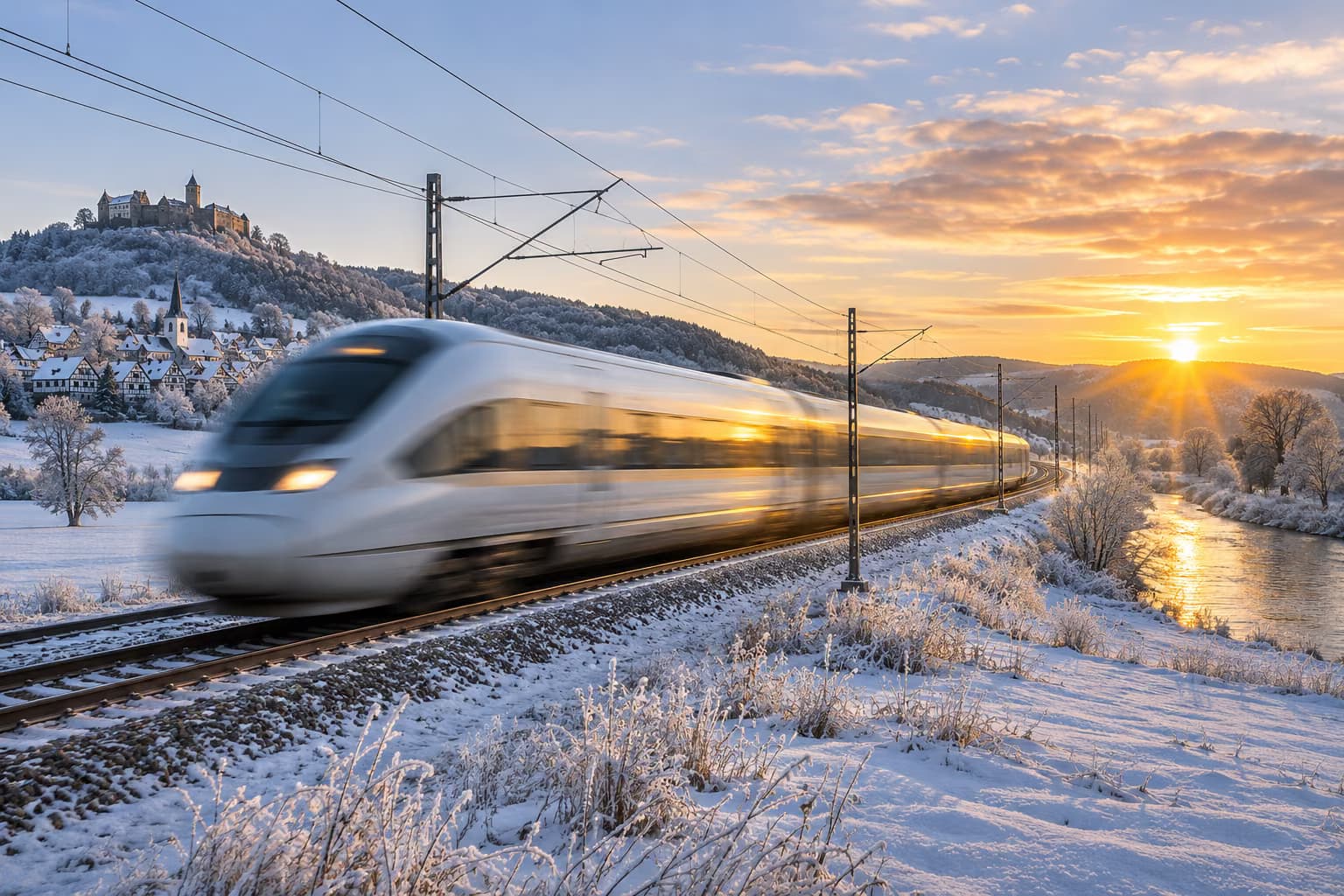
The next Deutsche Bahn timetable change takes effect on Sunday 13 December 2026, and it pulls in two directions at once. Travellers between Hamburg and Munich or Berlin and Stuttgart get faster Sprinter trains, and several cross-border routes return or run more often. At the same time, the renovation of the busy line between Hannover and Berlin forces long detours through most of 2027.
Tickets for journeys under the new timetable have been on sale since 14 October through bahn.de, the DB Navigator app, travel centres and agencies. Deutsche Bahn says long-distance fares will stay stable for now, and commuters who use long-distance trains already pay less for monthly passes. Here is an overview of what changes and who is affected.
More Sprinters after the Deutsche Bahn timetable change
The Sprinter, an ICE that skips most intermediate stops, is the centrepiece of the new timetable. According to ZDF, Deutsche Bahn will run about 70 Sprinter journeys a day on its main routes from mid-December. The most visible addition links Hamburg and Munich three times a day in each direction, stopping only in Hannover and Nuremberg. Deutsche Bahn puts the journey time at 5 hours 20 minutes, about 20 minutes faster than today. From Hamburg the trains leave at 7.23 am, 11.23 am and 3.23 pm.
Berlin and Stuttgart, so far connected by a single Sprinter a day, get three in each direction. The trains stop only in Nuremberg and need around 4 hours 45 minutes. They leave Stuttgart at 7.03 am, 11.03 am and 3.03 pm and Berlin at 8.12 am, 12.12 pm and 4.12 pm. Not every fast link survives, however. Between Berlin and Frankfurt, the Sprinters are suspended while the line between Frankfurt and Erfurt is under construction, from 6 February to 14 May and again from 14 August 2027. The regular hourly ICE then takes about four and a half hours.
Hannover to Berlin: the big detour
The biggest drawback of the Deutsche Bahn timetable change is the renovation of the Hannover to Berlin corridor, one of the busiest long-distance routes in the country. Work started on 2 October and is now expected to last until December 2027, because the electrification of the Lehrter Stammbahn, a line that was meant to serve as a diversion, has been delayed by about a year, the Berlin news site Entwicklungsstadt reported. Long-distance trains are therefore rerouted via Magdeburg and Braunschweig, with some stops in Potsdam, which adds about 80 minutes. A trip from Berlin to Cologne or Düsseldorf takes around five and a half hours.
The detour thins the service considerably. Deutsche Bahn says only three ICEs per direction will run in each two-hour window on the corridor, direct links from Berlin via Hannover to Bremen and Aachen are dropped, and the planned Sprinters between Berlin and Cologne cannot start yet. The ICE line from Bremen via Hannover to Berlin will only run between Bremen and Hannover, while direct trains from Berlin to Amsterdam are sent via Hamburg. According to dpa, Stendal will have no ICE stops at all in 2027, although Intercity connections remain.
New links to Vienna, Paris and Copenhagen
For international trips the news is better. From 19 December, two daily ICE pairs run again from Berlin to Vienna via Regensburg, Passau and Linz, also serving Leipzig and Erfurt, after works on the line between Nuremberg, Regensburg and Passau had interrupted them since February. A night ICE from Stuttgart to Vienna returns after a break of about one and a half years, leaving Stuttgart at 10.32 pm and arriving in the Austrian capital at 6.05 am. Stuttgart also gets more direct trains to Paris, and from March 2027 there will be seven daily connections between Hamburg and Copenhagen.
Deutsche Bahn adds that up to four ICEs a day will run directly between Hamburg and Amsterdam, and ZDF reports a new direct service from Munich via Milan to Rome next summer, operated with the Italian and Austrian railways. Within Germany, a morning ICE returns between Jena and Berlin, an Intercity from Dresden via Berlin to Warnemünde runs up to five times a day, and a daily ICE again links Stuttgart and Berlin with Rostock.
Tickets, monthly passes and the family ticket
Deutsche Bahn describes the 2027 fares as stable and has not announced a general price rise for the timetable change. Commuters got a discount earlier: since 21 October, long-distance Monatskarten and Schülermonatskarten (monthly passes for adults and pupils) bought without a subscription cost 25 percent less. Route season tickets, known as Streckenzeitkarten, will in future only be sold without a subscription, so anyone with an existing Abo should check how their contract continues.
The Familienticket, tested over the summer, is now permanent. According to Deutsche Bahn it costs 99.99 euros for a return trip in second class for up to five people, including seat reservations, and can be booked for travel from 1 November. DB long-distance chief Michael Peterson presented the timetable as a good and affordable alternative to car and plane at a time of expensive fuel.
What the Deutsche Bahn timetable change means for expats
If you travel regularly between Berlin and western Germany, plan for longer journeys and fewer direct trains until the end of 2027, and check every connection in the DB Navigator before booking, because construction can change routes at short notice. Passengers between Hamburg, Munich and Stuttgart, on the other hand, gain fast options, and the Sprinter departures are already bookable. Families visiting relatives abroad or travelling within Germany over the holidays may find the Deutsche Bahn family ticket worth comparing with Sparpreis fares.
Commuters who use ICE or IC trains every day should compare the cheaper monthly pass with the Deutschlandticket and with BahnCard offers, since the best choice depends on the route and on whether a subscription is still needed. The Deutsche Bahn timetable change also comes as the company struggles with punctuality, so allow extra time for important connections. For background, see our report on falling rail punctuality and network upgrades.