Driving licence reform: what changes in 2027
5 min read
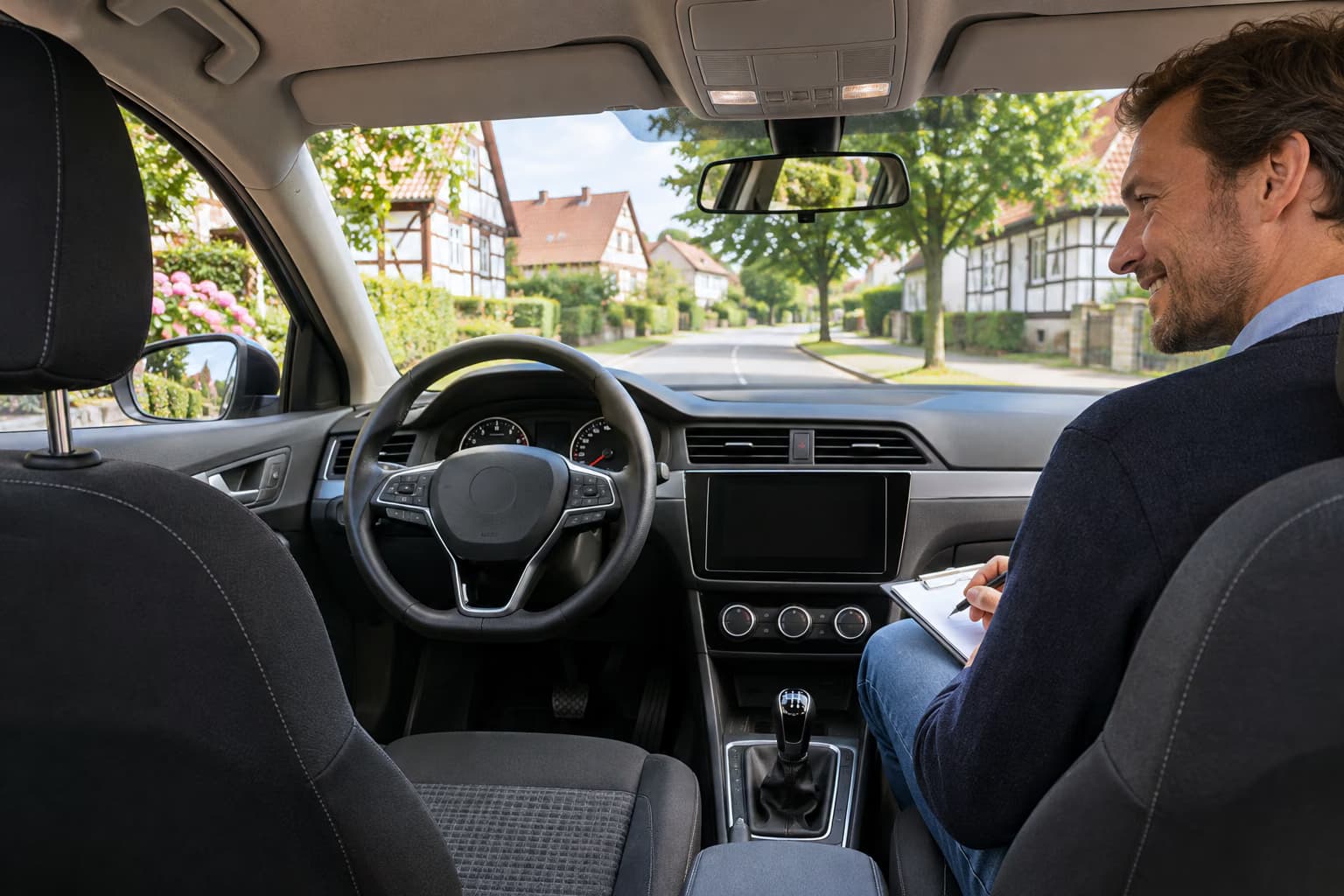
Getting a car licence in Germany is set to become faster, more digital and possibly cheaper. On Thursday, 5 November, the Bundestag passed the first part of the government's driving licence reform with the votes of the governing CDU/CSU and SPD. Learners will be able to study theory with an app instead of sitting in a classroom, the number of compulsory special drives will no longer be fixed, the practical test will be shorter and, in states that opt in, parents or other close relatives will be allowed to supervise practice drives. Most of the new rules are due to apply from 1 July 2027.
The reform is not law yet. The Bundesrat, the chamber of the 16 federal states, still has to approve it, and a second part, an ordinance from the federal transport ministry that covers the tests and the special drives, also needs the states' consent. How much money learners actually save is disputed.
What the driving licence reform changes in training
The biggest change concerns theory lessons. Until now, learner drivers have had to attend lessons in person at a driving school. Under the new rules they can choose: study at home with an app, follow a hybrid model or keep going to the classroom. Driving schools also lose many of their documentation and record-keeping duties, as well as some rules on their premises. According to ZDF, the catalogue of questions for the theory test is to shrink from 1,169 to about 840, a cut of almost 30 percent.
Practical training is also being loosened. For a car licence (class B), learners currently need twelve special drives (Sonderfahrten) of 45 minutes each on country roads, on the motorway and at night. That fixed number is to go. Instead, the driving instructor will decide how many such drives a learner needs, based on how well they drive. ZDF reports that simulators may be used for some practice, but not for the special drives.
Driving schools will have to publish their prices and pass rates in a central online database, so that learners and comparison portals can see the differences between schools. The Bundestag's own news service hib also reported that driving examiners will no longer need an engineering degree.
A shorter practical test
The practical exam for class B is to become shorter. It currently lasts 55 minutes, of which at least 30 minutes must be spent actually driving; parking and similar manoeuvres do not count. In future, the whole test will last 40 minutes, with a minimum of 25 minutes of driving time, the minimum allowed under EU rules.
The shorter format is meant to allow examiners to hold more tests per day and so cut waiting times for a test date, the news agency dpa reported.

Practice with parents: the lay training model
The most controversial part of the driving licence reform is the so-called Laienausbildung, or lay training. It allows learners to gain extra driving practice on public roads with a private companion, such as a parent, alongside their lessons at a driving school. Learners must first have passed the theory test and completed six lessons with a driving school. The companion must have held a car licence for at least seven years, may have no more than one penalty point in the central traffic offence register in Flensburg and must have a close personal relationship with the learner.
The Bundestag's transport committee tightened the original draft on 4 November. The key safety requirements are now written into the law itself, and the companion must also receive practical preparation at a driving school, not only theory. The SPD said it had pushed for a compulsory observation drive with a driving instructor and for a scientific evaluation of the effects on prices and road safety. Lay training is optional for the states: each of the 16 Länder decides by its own regulation whether to introduce it, and ZDF reports that states may trial it for five years. Supporters point out that accompanied driving of this kind is common in France, Austria and Belgium.
Will the licence really get cheaper?
According to the federal transport ministry, a class B licence currently costs about 3,400 euros on average. Transport minister Steffen Bilger (CDU), who took over the ministry from Patrick Schnieder, has said learners could save several hundred euros and, in the best case, up to 1,000 euros. He also pointed to large regional differences and to the fact that some learners simply need more lessons than others. The motoring club ADAC expects costs to fall by up to a third at best, but warned that savings must not come at the expense of training quality and safety.
Not everyone is convinced. Kurt Bartels of the federation of driving instructor associations said he could not follow the minister's calculation and rejects lay training. The road safety association Moving called savings of 1,000 euros unrealistic. Critics, including Left Party MP Jorrit Bosch, argue that the real cost drivers, such as the number of lessons, failed exams, staff wages and vehicle costs, are barely touched. Green MP Swantje Michaelsen said that instead of making the licence more affordable, the reform lowers standards. SPD transport spokesman Truels Reichardt said it was not yet foreseeable how much cheaper the licence would become, and CDU MP Henning Rehbaum said much depends on how the states shape the ordinance. According to hib, Christian Hirte (CDU), a parliamentary state secretary in the transport ministry, told the committee that insurance premiums for car owners could rise as a result of lay training.
What the driving licence reform means for expats
The next step is the Bundesrat, which, according to The Local, is expected to discuss the reform on 20 November. The rules were originally meant to start at the beginning of 2027, but even if the states approve them now, the main changes will not apply before 1 July 2027, and lay training will only be available in states that choose to introduce it. Anyone who needs a German licence before then will train and take the test under the current rules, so waiting for the reform only makes sense if you can do without a licence for at least another eight months.
For many expats, the reform matters most if their foreign licence cannot simply be exchanged for a German one and they have to go through driving school. App-based theory could make it easier to fit lessons around work, and the new price database should help when comparing schools. Our guide to driving in Germany explains when a foreign licence is valid and how an exchange works, and an earlier article shows why driving licence costs in Germany have risen so sharply in recent years.