





 Turkish
 Italian
 Spanish
 Portuguese
 Romanian
 Albanian
 Lithuanian
 Latvian
 Bulgarian
 Greek
Greek Hungarian
 French
 Croatian
 Czech
Czech

Germany’s largest legal challenge to a streaming service has failed, at least for now. On July 17, 2026, the Bayerisches Oberstes Landesgericht (BayObLG), Bavaria’s highest court, dismissed the collective lawsuit against Amazon over the introduction of Prime Video ads. Almost 330,000 subscribers had joined the case in the hope of compensation after Amazon started interrupting films and series with commercials in February 2024. The judges concluded that Amazon had never promised an advertising-free service. The consumer organization behind the claim immediately announced that it will take the dispute to Germany’s highest civil court.
What the Bavarian Court Decided
The case was a Verbandsklage, a collective redress action in which a consumer organization sues a company on behalf of registered consumers. The Verbraucherzentrale Sachsen, the consumer advice center of the state of Saxony, filed the action in 2024 under case number 102 VKl 1/24 e. Its central argument: Amazon broke its contracts with existing Prime members when it switched Prime Video to an ad-supported model and began charging an extra 2.99 euros per month for viewing without commercials.
The court saw it differently. According to the BayObLG’s press statement, the Prime terms and conditions contain no assurance that Prime Video would remain free of advertising, and the consumer center could not prove that Amazon had marketed the service as permanently ad-free. On that basis, the judges ruled that introducing commercials was covered by the existing contract and rejected the demand for damages in full.
Why Judges Say Prime Video Ads Were Allowed
The scale of the case shows how much anger the change caused. According to the tech site mobiflip, 329,903 Prime customers had registered their claims in the official register, making it one of the biggest collective actions since Germany introduced this type of lawsuit in 2023. The news portal t-online reported that many participants had hoped for a refund of part of their subscription fees or of the monthly ad-free surcharge.
For the court, however, the decisive question was narrow: did Amazon ever contractually guarantee streaming without commercials? The judges answered no. As the gaming magazine GameStar noted in its analysis of the ruling, Prime Video was sold as part of the wider Prime bundle, and the subscription documents never contained the words “ad-free” as a binding promise. Frustration alone, the ruling implies, does not create a legal claim.
The Fight Moves to Germany’s Highest Court
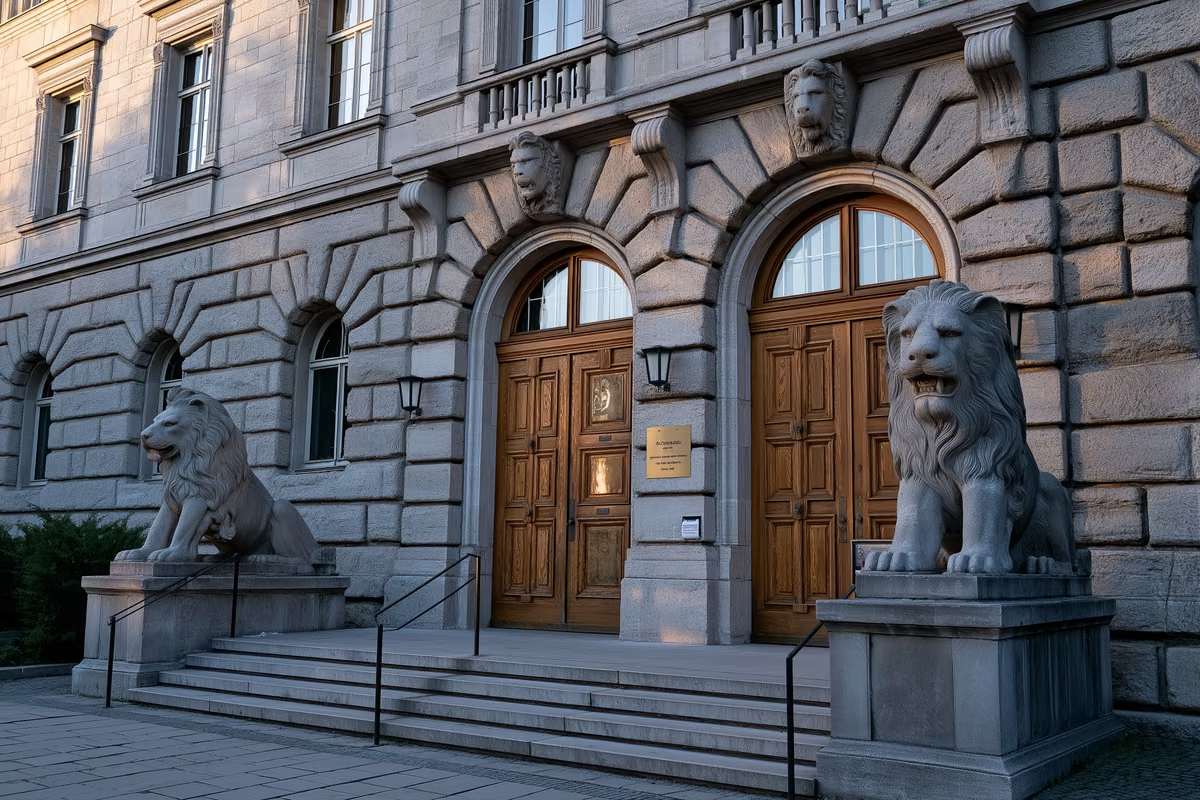
The judgment is not the end of the story. The BayObLG explicitly allowed a revision, an appeal on points of law, to the Bundesgerichtshof (BGH), Germany’s federal court of justice. The Verbraucherzentrale Sachsen confirmed within hours that it will use this option. “We are moving on to the next instance with determination,” said Michael Hummel, the head of the organization’s board, in a press release. The consumer center argues that if the ruling stands, the collective action instrument would be seriously weakened.
A decision from the BGH will take time, likely a year or more. Until then, the claims of the registered participants remain part of the ongoing proceedings. The Verbraucherzentrale Sachsen maintains a FAQ page for participants and has said it will inform them about the next steps. Consumers who joined the register do not receive any money now, but they have not lost the case definitively either.
Prime Video Ads: What Subscribers Can Expect Now
For the moment, nothing changes on the screen. Prime Video ads remain part of the standard subscription in Germany, and anyone who wants to stream without interruptions still has to pay the 2.99 euro monthly surcharge on top of the regular Prime fee. The ruling means Amazon is under no legal pressure to switch the commercials off or to refund past payments.
Subscribers who find the ads unacceptable have the usual consumer options: downgrade, cancel, or switch providers. German law gives consumers relatively strong cancellation rights for online subscriptions, including a mandatory cancellation button on websites. Our guide to consumer protection laws in Germany explains these rules and where to get help in a dispute with a company.
What This Means for Expats in Germany
If you are one of the hundreds of thousands who registered for the lawsuit, you need to do nothing for now. Registration was free, and the case continues at the BGH. Keep an eye on the Verbraucherzentrale Sachsen website for updates, and be cautious about third-party services that offer to enforce streaming claims for a share of any payout.
The bigger lesson concerns how subscription services can change over time. German courts will not automatically treat every worsening of a service as a breach of contract; what counts is what the provider actually promised in writing. Before you sign up for any long-term digital service, it is worth checking what the contract guarantees, not what the advertising suggests. The BGH will now have the final word on whether Amazon’s approach to Prime Video ads crossed a legal line.

