Guide to German Festivities and Local Traditions
15 min read
Germany runs on a calendar of festivities that most locals feel in their bones long before they think about them. For someone who has just moved here, those same days can be quietly confusing: the shops shut on a Thursday you did not expect, a colleague vanishes for a long weekend in May, or the whole city fills with costumes and no one explains why. This chapter walks you through the German festive year not as a list of events to visit, but as the rhythm of local life, so you understand what each season means and, more importantly, how to take part. Joining in with German festivities and traditions is one of the fastest and warmest routes to actually belonging here, and none of it requires you to be religious, fluent, or born in the country.
Think of this as cultural literacy rather than a tourist itinerary. When you know why Heiligabend matters more than the 25th, why a stranger might press sweets into your child’s hands in February, or why your Rhineland neighbours treat Rosenmontag like a national emergency of joy, the customs stop feeling foreign and start feeling like something you can share. If you want the practical side of attending the big public celebrations, our seasonal and holiday celebrations guide covers the events themselves; here we stay with what they mean and how you fit in.
The rhythm of the German year
The German year is shaped, first of all, by the Christian calendar, and this remains true even for the many people who never set foot in a church. The public holidays, the school breaks, the seasonal mood, even the closing of the shops on a Sunday, all still follow a Christian frame that has become simply the shared civic rhythm of the country. You do not need to be a believer to live by it. What you do need to understand is that the year has a clear shape: a long, inward-looking build-up to Christmas in the darkest weeks, an explosion of colour in the late-winter carnival, the release of Easter and spring, the open-air season of summer festivals, and then the harvest, unity and lantern season that carries you back into the dark. Germans feel these shifts strongly, and the small rituals attached to each one are how the change of season gets marked.
The second thing to grasp early is that Germany is federal, and its holidays are not uniform. Only a handful of Feiertage (public holidays) are nationwide; many are set by each Bundesland (federal state), and the split still follows the old religious map of the Reformation. Catholic states in the south and west keep feast days that Protestant regions do not. Fronleichnam (Corpus Christi) is a holiday in Bayern, Baden-Württemberg, Nordrhein-Westfalen, Rheinland-Pfalz, Hessen and Saarland but an ordinary working day elsewhere. Allerheiligen (All Saints, 1 November) is off in the Catholic states, while Reformationstag (Reformation Day, 31 October) is the day off in the mostly Protestant east and north instead. This is why a holiday your friend in Cologne enjoys may not exist where you live, and why it is worth checking your own state’s calendar rather than assuming. For the legal detail of which days are off where, and how holiday pay and Sunday rules work, see our guide to public holidays and customs; here we care about what the days mean and how people mark them.
Advent and Christmas, the heart of the year
Nothing in the German calendar carries the weight of Weihnachten (Christmas), and the season starts far earlier and more gently than newcomers expect. It opens with Advent, the four Sundays leading up to Christmas. Many homes and offices set out an Adventskranz, a wreath with four candles, and light one more each Sunday, so the room grows brighter as the date approaches. Children count down with an Adventskalender, a calendar with a small door or treat for each day of December. The whole point is anticipation: the season is a slow, warm build-up in the darkest, coldest weeks of the year, and that mood of cosy waiting is something you can join simply by lighting the candles along with everyone else.
On the night of 5 December, children polish a boot or shoe and leave it out, and on the morning of 6 December, Nikolaustag, Sankt Nikolaus has filled it with chocolate, nuts and mandarins (or, for the misbehaving, left a symbolic twig). This is separate from Christmas Day gifts and often catches new parents by surprise; if you have children in a Kita (daycare) or school, expect the day to be marked there too. Nikolaus is not the same figure as the Weihnachtsmann who comes later, even though the two have blurred over time.
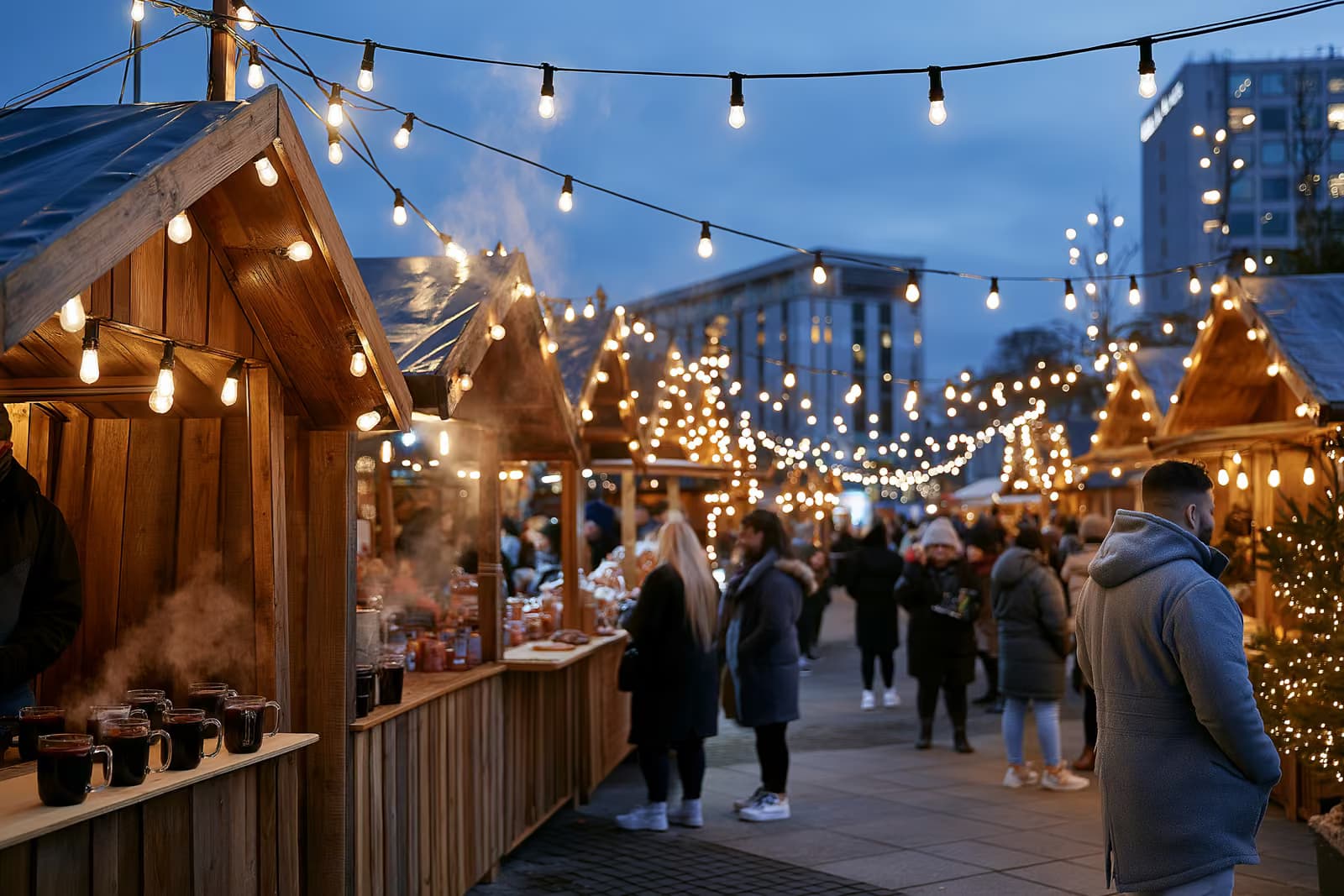
The Weihnachtsmarkt (Christmas market) is the great social ritual of the season, and it is best understood as a place to meet rather than to shop. From late November the town squares fill with wooden stalls, and after work people gather around them with a mug of Glühwein (hot spiced wine, or Kinderpunsch for those not drinking alcohol). A detail worth knowing: your mug usually carries a Pfand, a deposit of a few euros, which you either get back when you return the mug or keep as a small souvenir. Standing in the cold with a warm mug, catching up with colleagues or neighbours, is the real function of the market. You do not need to buy anything to belong there; being present and sociable is the entire point. For the food side of the market, our German dining culture guide covers the eating customs.
The single most important thing to understand about German Christmas is the date. The main celebration is Heiligabend, Christmas Eve, on 24 December, not the 25th. This is the evening families gather, share a meal, and exchange presents in a moment called the Bescherung, often after a walk, a church service, or the children being kept busy while the tree is prepared. The 25th and 26th (both public holidays, the erster and zweiter Weihnachtsfeiertag) are quieter days for extended family, food and rest. If a German colleague invites you to something on the evening of the 24th, understand that this is their most intimate family night, and being included is a real gesture. Many shops close early on the 24th and stay shut for two full days, so plan your groceries in advance.
Silvester and the New Year
The festive stretch does not end at Christmas. Silvester, New Year’s Eve on 31 December, is a loud, public, sociable night, quite unlike the family calm of Heiligabend. At midnight, cities light up with private fireworks set off from streets and balconies; the sale of consumer fireworks is restricted to only the last few days of the year, and each city sets its own rules about where you may light them, so check locally before you buy. People gather with friends, eat a late supper, often raclette or fondue that lets everyone sit and cook together for hours, and toast the new year with Sekt (sparkling wine).
Two small traditions are worth knowing so you are not the only one in the room who is lost. The first is Bleigießen, an old fortune-telling game of melting a little metal and dropping it into cold water to read the shape. The lead version was effectively banned across the EU from 2018, because lead sets breached chemical-safety limits, so it now survives as Wachsgießen (pouring wax) or with tin instead. The second is Dinner for One, a short black-and-white English comedy sketch that German television has broadcast every Silvester for decades. Almost everyone can quote its punchline, “the same procedure as every year”, and knowing the reference is a genuine piece of local insider knowledge. Neujahr, 1 January, is a public holiday and a slow recovery day for most of the country.
Karneval, Fasching and Fastnacht, the fifth season
In late winter, parts of Germany erupt into what locals only half-jokingly call die fünfte Jahreszeit, the fifth season. This is carnival, and the first thing a newcomer must understand is that it is deeply regional and goes by different names depending on where you are. In the Rhineland it is Karneval, in Bavaria and the south-east it is Fasching, and in the south-west (around Mainz and the Swabian-Alemannic areas) it is Fastnacht or Fasnet. The names carry different local styles, but the idea is shared: a wild, costumed release before the fasting season of Lent begins.
The heartland is the Rhineland, above all Köln (Cologne), Düsseldorf and Mainz, where carnival is an enormous part of local identity. The season formally opens on 11 November but the intense days come in February or early March. Weiberfastnacht (the Thursday before Lent) starts the street carnival, traditionally the day women take charge and, by custom, may snip off men’s ties. The climax is Rosenmontag (Rose Monday), when huge parades roll through the cities and revellers shout “Kamelle!” to catch the sweets thrown from the floats. People dress in costume for days, sing, dance, and greet each other with the local carnival call (“Alaaf” in Cologne, “Helau” in Düsseldorf and Mainz).
The crucial cultural literacy point is that this is a genuine regional divide, not a national event. In the Rhineland and the Catholic south, carnival is huge, joyful and inescapable; schools and many workplaces effectively pause. In much of the north and east, it barely registers, and locals there may find the whole thing slightly baffling. If you live in Cologne, joining in, wearing a costume to the office, and learning to shout the right call will earn you real goodwill. If you live in Hamburg or Leipzig, do not be surprised that the day passes almost unnoticed. Knowing which world you are in is the point.
Easter and the arrival of spring
Ostern (Easter) is the second great Christian festival of the year and, like Christmas, it structures a long weekend that shapes everyone’s plans, believer or not. It brings a cluster of public holidays: Karfreitag (Good Friday) and Ostermontag (Easter Monday) are both days off nationwide, giving a four-day weekend that many families use to travel or gather. The mood is one of relief: spring is arriving, the days are lengthening, and homes fill with cut branches hung with painted eggs and yellow decorations.
Karfreitag deserves special attention because it is a stiller Feiertag, a “silent holiday” with a solemn legal character. In most Bundesländer this means a Tanzverbot, a ban on public dancing, so clubs close and some venues cancel events; the exact hours and strictness vary by state. It is not something newcomers usually expect, and turning up to a locked-up nightlife district on Good Friday is a common surprise. The customs around Easter are gentler: children hunt for eggs and chocolate hidden by the Osterhase (Easter bunny) on Easter Sunday, and eggs are decorated and hung on branches. In many regions an Osterfeuer (Easter bonfire) is lit over the Easter weekend, a communal village or neighbourhood gathering to burn the winter away and mark the turn of the season. If a neighbour mentions the local Osterfeuer, that is an open invitation to come and stand by the fire and meet people.
From May into the open-air summer
Spring proper opens with one of the odder and more charming German transitions. On the night of 30 April comes Walpurgisnacht, an old tradition (strongest in the Harz mountains) of witches and bonfires, which for most people today simply means Tanz in den Mai, dancing into May, an excuse for parties and open-air events to greet the new month. The morning after, 1 Mai, is Tag der Arbeit (Labour Day), a nationwide public holiday. It has two faces: political demonstrations and union rallies in the cities, and, in villages, the raising of the Maibaum, a tall decorated maypole that is a point of local pride (in some regions neighbouring villages will playfully try to steal each other’s pole). It is a day of being outdoors and social.
Two more spring holidays are worth decoding. Christi Himmelfahrt (Ascension Day), a Thursday forty days after Easter, doubles in Germany as Vatertag (Father’s Day). In practice, especially in the north and east, this often means groups of men heading out into the countryside pulling a Bollerwagen, a handcart loaded with beer and food, for a long day’s drinking hike. It is a well-known custom, sometimes rowdy, and worth expecting if you are out that day. Pfingsten (Whitsun/Pentecost), fifty days after Easter, brings another long weekend with Pfingstmontag off nationwide, often used for short trips as the weather warms.
From late spring the country moves outdoors for the long season of Volksfeste (folk festivals), Schützenfeste (marksmen’s festivals) and the Kirmes or Rummel (funfair). These town and village festivals, with their beer tents, funfair rides, processions and local clubs, are the backbone of communal summer life, and almost every town has its own. Culturally, they are where a community shows itself off and where locals of every age come together. Getting to know your town’s own festival, and the Vereine (clubs and associations) that run it, is one of the surest ways to be recognised as part of the place, and the practical business of attending is covered in the Events and Festivals section.
Autumn, harvest, unity and lanterns
Autumn is the richest stretch of the German festive year, and it holds the one truly national secular celebration. Culturally, the season is bracketed by Oktoberfest and the harvest. Oktoberfest is the world’s most famous folk festival, but the point to hold onto is that it is Bavarian and Munich-specific, not a German-wide event; running from mid or late September into the first weekend of October, it began in 1810 as a royal wedding celebration and grew into a symbol of Bavarian identity, complete with Tracht (traditional dress: Dirndl and Lederhosen). Many other regions have their own autumn Volksfeste and quietly resent Oktoberfest being taken abroad as a stand-in for all of Germany. What it means culturally is regional pride and community; for the practical business of visiting a Wiesn tent, our seasonal and holiday celebrations guide is the place to look. Around the same time, Erntedankfest (harvest thanksgiving) is marked in churches and villages with decorated altars and processions giving thanks for the harvest, a quieter, older counterpoint to the beer tents.
The 3rd of October is Tag der Deutschen Einheit (German Unity Day), and it is worth knowing precisely, because it is the single nationwide statutory holiday established by the German state itself rather than the church calendar. It marks the reunification of East and West Germany in 1990. It is a calm, civic day rather than a boisterous one, with an official celebration hosted by a different city each year, and it is a good moment to understand how recent and how significant reunification still is in the national story.
As the evenings draw in, Sankt Martin (Martinstag, 11 November) brings one of the gentlest and most beloved customs, especially for families. Children make paper lanterns, often at Kita or school, and in the early dark they walk in a Laternenumzug, a lantern procession, singing Martinslieder and frequently following a rider on horseback who represents Saint Martin sharing his cloak with a beggar. A Martinsfeuer (bonfire) and shared Weckmänner (sweet bread figures) often round off the evening. If you have young children, this is very likely the first German tradition you will be pulled into, and turning up with a lantern is exactly what is expected. Around the end of October, Halloween has arrived in Germany relatively recently and is largely a commercial and party import; older Germans may be indifferent to it, while children increasingly enjoy it, so do not mistake it for a deep-rooted local custom the way Sankt Martin is.
Taking part as someone new
The good news for a newcomer is that German festivities are made for participation, and joining in is welcomed rather than treated as intrusion. The most valuable thing you can do is say yes. When a colleague invites you to a Weihnachtsmarkt after work, a neighbour mentions the Osterfeuer, or someone asks if your family is coming to the Laternenumzug, accepting is the whole game. These low-stakes, public, seasonal moments are where relationships in Germany are quietly built, and showing up repeatedly matters more than saying anything clever.
Bring the right thing and observe the small rules of conduct, because Germans notice the effort. If you are invited into a home, especially at Christmas or for a celebration, arriving with a small gift, flowers or good wine or something for the children, is expected, and there are toasting customs (meeting the eye when you say “Prost”, not drinking before the host) that are easy to get right once you know them. Our guide to German social etiquette covers gifts, greetings and party manners in detail, and it is worth a read before your first invitation.
The workplace has its own festive customs, and they are one of the easiest ways in. In December many teams hold a Weihnachtsfeier, a Christmas party, and organise Wichteln, a Secret Santa gift exchange with a small budget and sometimes playful rules. These are genuine social occasions where the usual formality relaxes a little, and taking part signals that you want to belong to the team rather than just work in it. The same openness applies to your building and street: a friendly word at the Christmas market stall your neighbours run, or a lantern in the window in November, tells people you are one of them. None of this asks you to abandon your own traditions. It simply asks you to stand in the cold with a warm mug alongside everyone else, and that, more than anything, is how a foreigner in Germany starts to feel at home.
Where to start
You do not have to master the whole calendar at once. Begin with whatever season is next: if it is autumn, make a lantern with your children for Sankt Martin or find your town’s Volksfest; if it is winter, go to the Weihnachtsmarkt after work and remember that Heiligabend on 24 December is the day that matters; if it is late winter, find out whether your region does carnival at all before deciding whether to buy a costume. Check your own Bundesland’s list of Feiertage so the days off do not surprise you, and read our public holidays and customs guide for how the legal side works.
Then simply accept the next invitation that comes your way and turn up. Bring something small, learn the one local greeting that fits the occasion, and let the season carry you. The German festive year rewards presence over performance: you do not need to understand every ritual perfectly to be welcome at it. Each celebration you join makes the next one easier, and before long the rhythm that once confused you becomes the rhythm you live by too.
About this information
This chapter is general orientation based on widely-published information about everyday life in Germany, last reviewed in July 2026. It is general guidance, not individual legal, tax, or medical advice. See the related WeLiveIn.de chapters linked in the text above for topic-specific detail and official sources.