Perseids and a Solar Eclipse Light August
3 min read
August offers one of the best free shows of the year for anyone in Germany who is willing to look up. This time the sky delivers a double bill on a single date. The Perseids, the most reliable meteor shower of the summer, reach their peak on the night of August 12 to 13, and on the evening of August 12 a partial solar eclipse dims the sun across much of the country. You do not need any equipment for the meteors, and both events can be enjoyed from almost anywhere with a clear view.
For newcomers to Germany, this is an easy and low-cost way to spend a summer evening, whether you live in a city or the countryside. A little planning helps, so here is what is happening and how to make the most of it.
The Perseids meteor shower
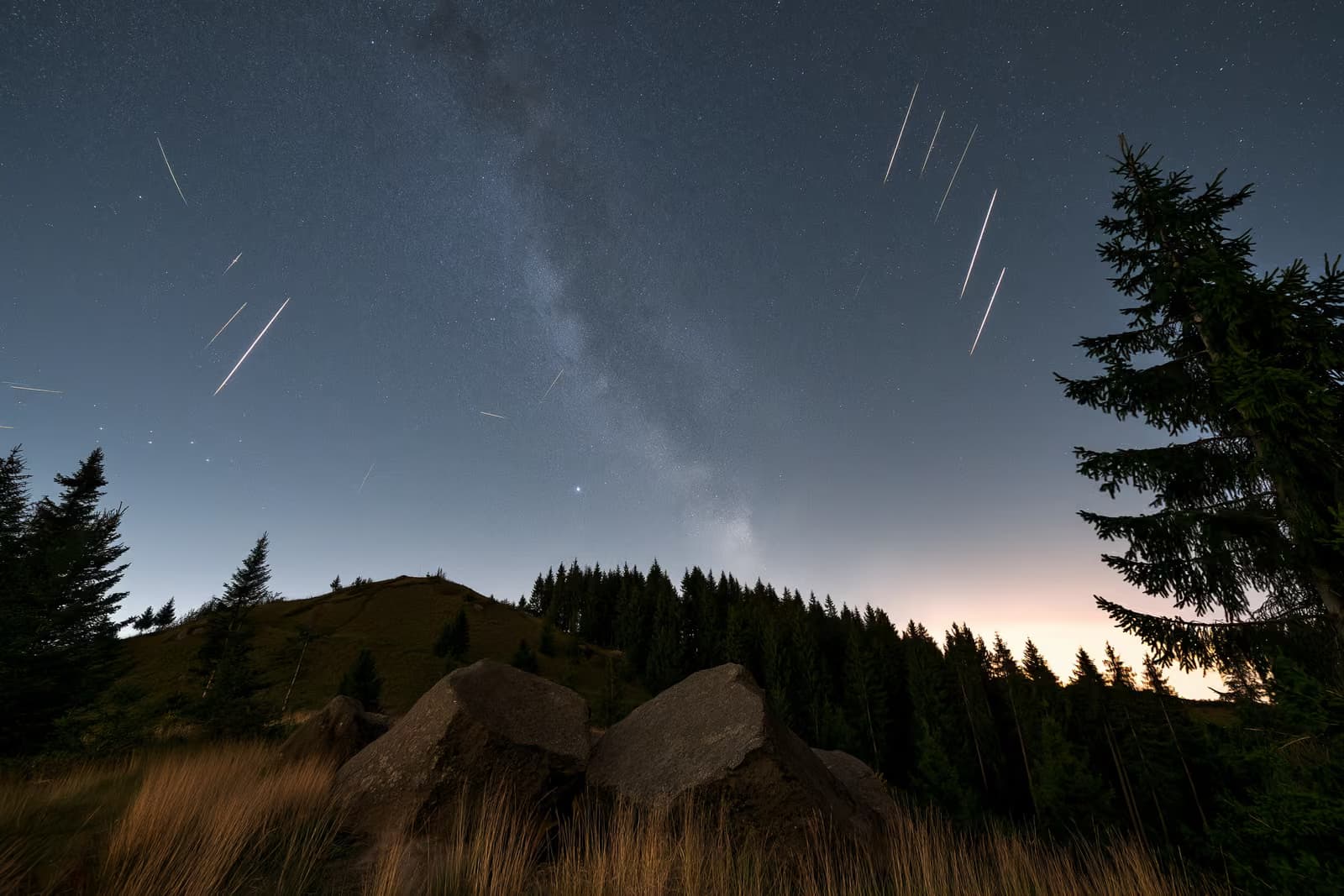
The Perseids are a meteor shower caused by Earth passing through the trail of dust left behind by a comet. As those tiny particles hit the atmosphere they burn up and appear as brief streaks of light, often called shooting stars. The shower is active from mid-July until around August 24, but it is at its most intense on the peak night of August 12 to 13.
At the peak, and under good conditions, observers can see up to around 60 meteors per hour, with the best rates coming after midnight into the early morning, roughly between 11 in the evening and 4 in the morning. This year the timing is especially favourable because the peak falls on a new moon, meaning there is no bright moonlight to wash out the fainter streaks. Dark skies like these are close to ideal for meteor watching, which does not happen every year, and it makes the 2026 shower one of the more promising in recent memory.
A partial solar eclipse the same evening
Adding to the occasion, the evening of August 12 brings a partial solar eclipse visible from Germany. During a solar eclipse the moon passes between the Earth and the sun and blocks part of the sun’s light. From Germany the eclipse is partial, meaning the sun is only partly covered, and it happens low in the sky in the hours before sunset.
How much of the sun is hidden depends on where you are, with northern parts of Germany seeing the deepest coverage of up to about 85 percent. Further south the effect is smaller. The eclipse becomes total only along a narrow track that crosses parts of Spain and Iceland, far from Germany, so people here will see a striking partial bite taken out of the sun rather than full darkness.
How to watch the Perseids and the eclipse
The two events call for completely different approaches, and the difference is important for your safety. Watching a solar eclipse means looking toward the sun, which must never be done with the naked eye or through ordinary sunglasses. You need certified eclipse glasses or a proper solar filter, because even a partly covered sun can damage your eyesight. If you do not have the right glasses, a planetarium or astronomy club may host a viewing, and some offer safe projection methods.
The Perseids are the opposite and require nothing but patience and darkness. Find a spot away from city lights, give your eyes about twenty minutes to adjust, and lie back with a wide view of the sky. No telescope is needed, since the meteors can appear anywhere overhead. Warm clothing and a blanket help even in August, as clear nights can turn cool.
An easy summer plan for expats
For anyone settling into life in Germany, these events are a simple and welcoming way to mark the season, alone or with friends and family. They cost nothing beyond a pair of eclipse glasses, and they work just as well from a balcony on the edge of a town as from a field in the countryside. Checking the local weather forecast for August 12 is the single most useful step, since a clear sky is what matters most.
If you enjoy planning your calendar around shared occasions, the late-summer sky pairs nicely with the many outdoor events happening across the country at this time of year, from open-air concerts to the celebrations listed in our guide to major German festivals. Mark the night of August 12 to 13, hope for clear weather, and enjoy the Perseids and the eclipse as a shared moment under the same sky as everyone around you.