




 Turkish
 Italian
 Spanish
 Portuguese
 Romanian
 Albanian
 Lithuanian
 Latvian
 Bulgarian
 Greek
Greek Hungarian
 French
 Croatian
 Czech
Czech
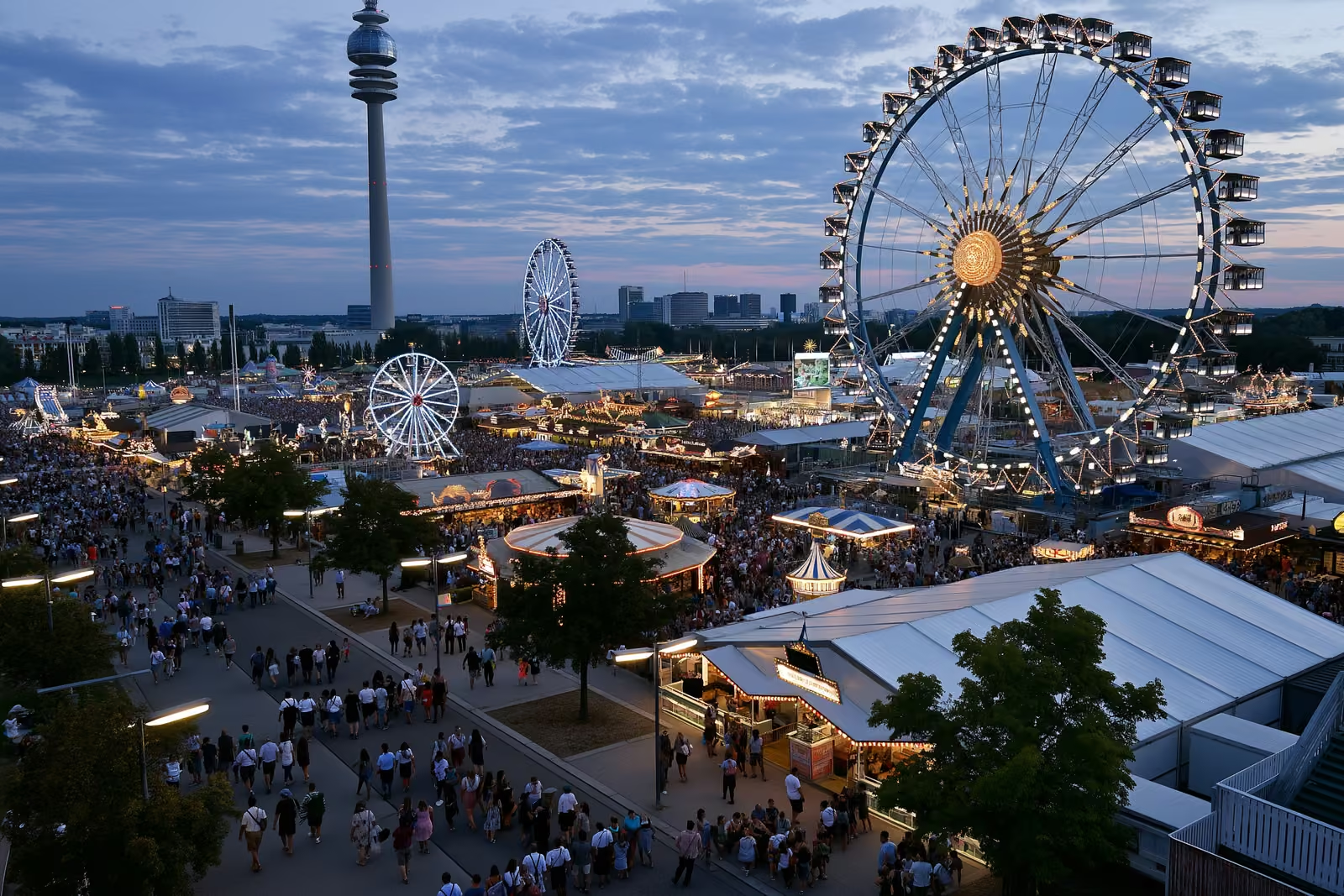
If you have just moved to Germany, one of the quickest ways to stop feeling like an outsider is to go to a Fest. This chapter is your map to the country’s major festivals: the marquee events every newcomer hears about, roughly when in the year they happen, and how to actually go and enjoy them rather than watch from the sidelines. It is an overview and a starting point. Each big festival has its own dedicated chapter in this section, and we point you to those as we go, so think of this page as the entrance hall rather than the whole building.
Germany, a Nation of Festivals
Germans hold thousands of festivals every year. A Fest (the plural is Feste) can be anything from a village Straßenfest, where one street closes to traffic and neighbours set up beer benches and a grill, to a Volksfest (a public funfair with beer tents, fairground rides and live music) that draws millions. Almost every town has at least one Stadtfest, its own annual celebration, and most regions keep a calendar of Feste that has run, in some cases, for centuries. You do not need an invitation, a ticket for most of them, or even much German. You turn up, buy something to eat and drink, and you are part of it.
What makes German festival culture distinctive is the Geselligkeit at the heart of it, a word that means sociable togetherness. At a Volksfest you sit on long shared benches at long shared tables, elbow to elbow with strangers, and by the end of the evening the strangers are usually singing along to the same songs. Festival-going is not a niche hobby here; it is a normal part of social life for families, pensioners, students and office colleagues alike. Turning up is how many Germans mark the turning of the seasons and stay connected to where they live.
The festival year has a clear rhythm, and learning it helps you plan. Spring and summer are the open-air season: town festivals, wine fairs, music festivals and street parades fill the warm months from May to September. Early autumn brings the great beer and folk festivals, Oktoberfest above all, alongside the wine harvest celebrations. Late autumn and winter turn inward and cosy, with the Weihnachtsmärkte (Christmas markets) glowing through December, followed by the long build-up of Karneval, which the Rhineland treats as a season in its own right. If you want the deeper meaning and the household customs behind all this, our guide to German festivities and local traditions covers the traditions themselves, while this chapter stays focused on the big public events you can go out and attend.
The big cities layer their own signature festivals on top of this rhythm, and these are often the easiest for a newcomer to reach. Every summer Kiel hosts the Kieler Woche, one of the largest sailing regattas in the world, which wraps a week of races on the Baltic in a huge free harbourside festival of concerts and food. Traditional funfairs run on a fixed calendar too: the Hamburger DOM, held on the Heiligengeistfeld several times a year, is one of the largest fairs in northern Germany, and the Bremer Freimarkt in Bremen, first held in the year 1035, is among the oldest funfairs in the country. You do not need to know these by name in advance. The point is that wherever you land, a major public celebration is rarely more than a short season away, and most of them cost nothing to walk into.
The Beer and Folk Festivals
The most famous festival in the world is a German one. Oktoberfest, held on the Theresienwiese meadow in Munich, is the giant of the calendar. Despite the name it begins in mid-September and runs to the first Sunday in October (extended by a day or two in years when that would otherwise cut the festival short around the 3 October holiday). Inside enormous beer tents run by Munich’s traditional breweries, visitors in Tracht, the regional folk dress of Lederhosen for men and the Dirndl dress for women, drink from one-litre glasses called a Maß and sway to brass bands. Around the tents spreads a full funfair with rides, roast-chicken stands and gingerbread hearts. Oktoberfest is so large, and so particular in its customs, that it has its own chapter: for the tent-by-tent guide, the truth about whether you need to wear Tracht, and above all how to reserve a table before the popular tents sell out, read our full guide to the Oktoberfest. As a newcomer the one thing worth knowing early is that the best tables are booked months ahead, so decide sooner than feels necessary.
Oktoberfest is the biggest, but it is not the only great Volksfest, and you do not have to go to Munich to experience one. Stuttgart’s Cannstatter Volksfest, known to locals as the Wasen after the Cannstatter Wasen fairground where it is held, runs from late September into October and is often called the second-largest beer festival in the world. It has the same brass bands, beer tents and fairground but noticeably shorter queues than Munich, and Stuttgart adds a spring version, the Frühlingsfest, in April and May. Many other cities run their own large Volksfeste too, so wherever you settle there is usually a version within easy reach.
Older and quieter than the beer festivals are the Schützenfeste, the marksmen’s festivals rooted in the historic Schützenvereine, the civic shooting clubs that once helped guard a town. Today they are community festivals with parades in uniform, funfairs and beer tents, and the Schützenfest in Hannover is generally described as the largest of its kind in the world. These are among the best places to see small-town Germany celebrating itself, and they belong to a wider world of traditional folk festivals, from harvest fairs to costume processions, which our chapter on traditional folk festivals explores in full.
Karneval, Christmas Markets and the Wine Harvest
The autumn wine harvest brings its own festivals, especially along the rivers of the southwest where Germany grows most of its wine. In the small Palatinate town of Bad Dürkheim, the Dürkheimer Wurstmarkt claims the title of the world’s largest wine festival, drawing several hundred thousand visitors each September to taste the new vintages under the chestnut trees. Wine villages up and down the Rhine, Mosel and Neckar hold their own Weinfeste through late summer and autumn, where a few euros buys a glass of local wine and a seat among the growers. Because the food and drink is really the point of these events, the culinary side, what to order and how the tastings work, lives in our chapter on food festivals and events.
As the year darkens, the Weihnachtsmärkte take over. From late November through Christmas, town squares fill with wooden stalls selling handmade decorations, roasted almonds, sausages and Glühwein, the hot spiced wine that keeps everyone warm. The most celebrated is the Christkindlesmarkt in Nürnberg, and Dresden’s Striezelmarkt is documented back to 1434, which makes it one of the oldest Christmas markets in Germany. Nearly every town has one, so you will not need to travel far. We look at the markets as part of the wider winter calendar in our chapter on seasonal and holiday celebrations, and one small practical note: the mug your Glühwein comes in usually carries a deposit, so you either return it for your coins back or keep it as a souvenir, a habit closely related to the wider Pfand deposit system you will meet in German shops.
Winter then rolls into Karneval, which goes by different names in different regions: Karneval in the Rhineland, Fasching in Bavaria and much of the south, and Fastnacht in the southwest. In the Rhineland cities of Cologne, Düsseldorf and Mainz it is treated as the “fifth season”, which officially opens on the 11th of November at 11 minutes past 11, then sleeps through winter and erupts in the week before Lent. The climax is Rosenmontag, Rose Monday, when costumed crowds line the streets for enormous processions of decorated floats, marching bands and sweets thrown into the crowd. The parades, the costumes and the etiquette of joining in are a big enough subject to have their own home, so for the full picture see our chapter on street parades and carnivals.
The Great Cultural Festivals: Film, Music and Art
Germany’s festival calendar is not all beer tents and funfairs. The country hosts some of the most important cultural events in the world, and if your interests run to film, music or art you will find a marquee event to build a trip around. In cinema, the Berlinale, the Berlin International Film Festival, is held every February and ranks alongside Cannes and Venice as one of the “big three” of world film festivals. Unusually for an event of that stature it sells a large share of tickets to the general public, so ordinary residents, not just industry insiders, can watch premieres. Alongside it, literary festivals and readings run throughout the year across the country. Film and books have their own chapter, so for the Berlinale ticketing details and the wider literary scene, see film and literary events.
In music, Germany runs open-air festivals for every taste. Rock am Ring, staged at the Nürburgring motor-racing circuit, is one of the country’s largest rock festivals, while Wacken Open Air, held each summer in a tiny village in Schleswig-Holstein, is widely recognised as the largest heavy-metal festival in the world, drawing tens of thousands of fans to a place that is otherwise farmland. Germany’s electronic and techno scene, centred on Berlin, is famous in its own right and spills into festivals through the summer. City music festivals matter too: the Reeperbahn Festival in Hamburg, spread across the clubs of the St. Pauli district each September, is one of the largest club festivals in Europe and a showcase for new bands. All of this, from the line-ups to the camping practicalities, is the territory of our chapter on music and arts festivals.
The visual and performing arts reach the same scale. In Kassel, the documenta is one of the world’s most significant exhibitions of contemporary art, staged only once every five years and running across a hundred days when it does, so catching it takes planning around its rare schedule. In classical music, the Bayreuther Festspiele, the Bayreuth Festival, is devoted entirely to the operas of Richard Wagner and performed in the Festspielhaus he had built for them; demand so far outstrips seating that tickets are famously hard to get. These are bucket-list events rather than casual afternoons out, but knowing they exist, and roughly when they fall, lets you plan ahead instead of hearing about them once they are over.
The Messen: Germany’s Trade Fairs
One kind of “festival” is easy to overlook but matters enormously here, especially if you have moved for work: the Messe, or trade fair. Germany is the world’s leading trade-fair country, and several of its Messen are the biggest of their kind anywhere. The Hannover Messe is the world’s largest industrial technology fair, the Frankfurter Buchmesse (the Frankfurt Book Fair) is the world’s largest publishing event, and the exhibition grounds in Cologne and Düsseldorf host global fairs in everything from food to fashion to gaming. When one of these is on, the host city fills up: hotel prices jump and the trains run packed, which is worth knowing whether you are attending or just trying to book a room that week.
For a newcomer, a Messe can be a surprisingly good way to get into an industry, meet people in your field, or simply spend a day surrounded by whatever you are into, since many fairs open their doors to the public on at least some days. Gamescom in Cologne, the world’s largest video-game fair, is a good example: it runs mainly as a public event and draws hundreds of thousands of visitors each August, and food, book and travel fairs across the country do the same. The professional and consumer detail, which fairs welcome the public, how to get a ticket, and what to expect on the floor, sits in our chapter on craft and trade fairs (Messen). For sports fans, meanwhile, Germany’s stadiums and arenas host their own calendar of major events, covered in sports events and competitions.
How to Experience a German Festival as a Newcomer
Finding out what is on is the first hurdle, and it is easier than it looks. Every town hall runs an events calendar, usually on the city website under Veranstaltungen (events), and this is where the smaller Stadtfeste and neighbourhood celebrations are listed, the ones no guidebook mentions but locals actually go to. Regional tourism sites, local newspapers and simple word of mouth fill in the rest. Our chapter on local cultural events goes into how to track down what is happening near you, which is often where the warmest, least touristy festival experiences are found.
A few practicalities make the day go smoothly. Carry cash: many festival stalls and beer tents still do not take cards, and a working cash machine can be hard to find in a crowd. Expect a deposit on your cup or glass, the Pfand mentioned earlier, so keep a few coins handy and return the cup to get them back. Plan to leave the car at home, because parking near a big Fest is close to impossible and the beer is the point; regional and city public transport is designed to absorb festival crowds, and a Deutschlandticket covers local trains, trams and buses across the whole country on one monthly pass. For the marquee events, book early: tables at the famous Oktoberfest tents, and tickets to Bayreuth or the Berlinale, go long before the gates open.
Timing and booking reward a little forethought. For the marquee events, accommodation is the real bottleneck, not the ticket: during Oktoberfest, a big Messe or the Berlinale, hotel rooms in the host city sell out and prices climb steeply, so if you are travelling in, book a place to stay as early as you fix the dates, or plan to stay a train ride away and commute in. Many festivals are free to enter and you simply pay for what you eat and drink, but the ticketed ones, the music festivals, Bayreuth, some Messe days, sell in advance and the popular ones sell out, so check the official festival website months ahead rather than hoping to buy at the gate. Dates shift a little from year to year, and Karneval and the Christmas markets move with the calendar, so confirm the exact days for the year you are going before you commit to anything.
The etiquette of joining in is simpler than newcomers fear, and getting it a little right goes a long way. On a shared bench, a friendly nod or a “Ist hier noch frei?” (is this seat free?) is all it takes to sit down among strangers, and once the band starts, standing on the benches to sing along is normal rather than rude, though standing on the tables is not. You do not need fluent German or a costume to belong; a willingness to raise your glass, say “Prost” and join the song is enough, and locals tend to be delighted rather than bothered when a newcomer joins in. Treating a festival as something to take part in, rather than photograph from the edge, is the whole difference between watching German culture and being inside it for an evening.
Festivals are also genuinely welcoming to families. The funfairs at a Volksfest, the Christmas markets and most Stadtfeste are built for children as much as adults, with rides, sweets and space to run around, and our guide to family-friendly activities can help you pick the right ones. Two sensible cautions: the big events draw enormous crowds, so agree a meeting point in case your group gets separated and keep an eye on valuables in the crush, and pace the drinking, since the beer served in a Maß is stronger and comes in larger measures than many newcomers expect. None of this should put you off. It is simply the difference between a good day and a stressful one.
Where to Start
You do not need to wait for the famous ones. The single best first step is to look up your own town’s events calendar and go to the next Stadtfest or market you find, however small. Turning up on a shared bench, buying a Bratwurst and a beer, and staying until the band plays teaches you more about German life than any amount of reading, and it costs almost nothing. From there you can build toward the big trips: an autumn at Oktoberfest or the Cannstatter Wasen, a February at the Berlinale, a December wandering the Christmas markets, a summer at Wacken or a wine festival on the Rhine.
Whichever direction your interests pull you, the specialist chapters in this section carry the detail: dates, tickets, tips and the customs that make each event what it is. Use this page to get your bearings, then follow the links to whatever calls to you. Going to festivals is one of the most reliable ways to feel at home in Germany and to meet people beyond work, which is exactly what our guide to building a social network in Germany is about. Pick one event, put it in your calendar, and go.
About this information
This chapter is general orientation based on widely-published information about everyday life in Germany, last reviewed in July 2026. It is general guidance, not individual legal, tax, or medical advice. See the related WeLiveIn.de chapters linked in the text above for topic-specific detail and official sources.

