Bicycle Culture and Routes
17 min read
This chapter is about using a bicycle (Fahrrad) as everyday transport in Germany, and about the law you actually live under once you are on the saddle. The rules for cyclists are not the same as the rules for car drivers, and they are often not what newcomers assume. Get them right and cycling here is cheap, fast and genuinely pleasant. Get them wrong and you can collect a fine, or in the worst case put your car licence at risk. What follows explains how Germans treat the bike, which paths you must use and which you may ignore, what makes a bike legally roadworthy, how alcohol and helmets are handled, how to buy or lease and protect a bike, and where the long-distance routes go. None of this is legal advice; when a real dispute or accident is involved, speak to a lawyer or the ADFC (Allgemeiner Deutscher Fahrrad-Club, the German cyclists’ association).
The Bicycle as Everyday Transport
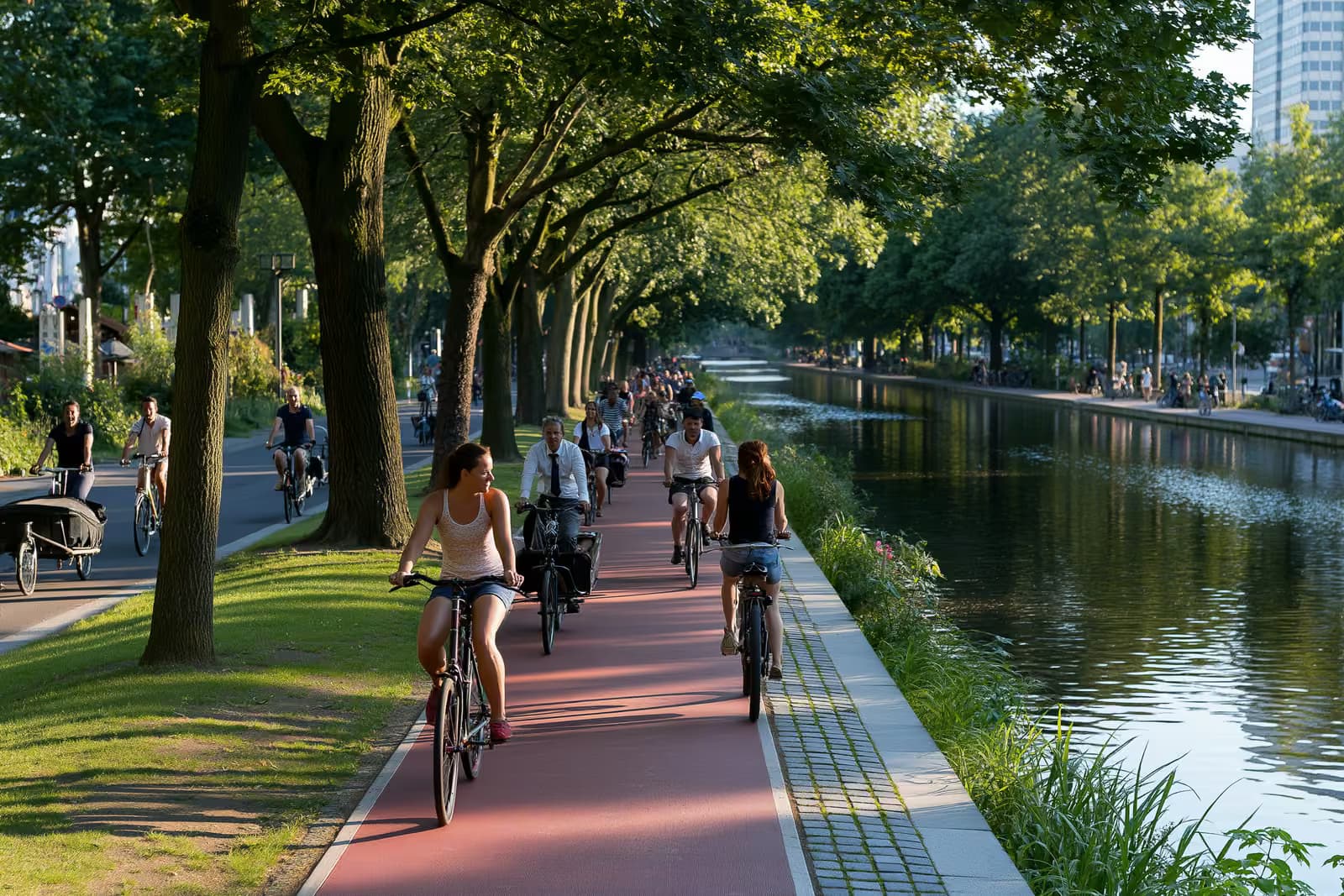
The first thing to understand is that in Germany the bicycle is normal adult transport, not a hobby or a sign that you cannot afford a car. People in suits ride to the office, parents ride children to Kita (daycare) in a seat or trailer, pensioners ride to the doctor, and students ride everywhere. Cycling is treated as an ordinary way to move through a city, the same way you would treat a bus or a car, which is why the infrastructure and the law take it so seriously. In cities built around the bike, the share of trips made by bicycle is very high: Münster is the best-known example and feels almost Dutch, with wide bike routes and huge parking stations, but Freiburg, Bremen, Karlsruhe and large parts of Berlin, Hamburg and Cologne also carry heavy everyday bike traffic. The Fahrradstadt, the “bicycle city”, is a real planning ambition that towns compete over.
What this means for you is practical. You do not need special clothing, a sports bike or any particular fitness to take part; a plain city bike (Stadtrad or Hollandrad) with a basket, a luggage rack and mudguards is the standard commuting machine, and most people ride in ordinary clothes. Distances that feel long by foot are short by bike, and in dense inner cities a bike is often the fastest door-to-door option because it skips traffic jams and parking searches. Cycling continues through the year: with lights, gloves and a bit of care on wet leaves and ice, winter riding is common, and many people simply keep going in November and December rather than putting the bike away. Treating the bicycle as transport rather than recreation is the mental shift that makes everything else in this chapter make sense.
The Rules of the Road for Cyclists
The single most common mistake newcomers make is believing that every bike path is compulsory. It is not. Under Paragraph 2 of the Straßenverkehrsordnung (StVO, the road traffic regulations), a cyclist is only obliged to use a bike path when it is marked with one of three blue round signs: Zeichen 237 (a white bicycle on blue), Zeichen 240 (a shared foot-and-cycle path, pedestrian above bicycle) or Zeichen 241 (a separated foot-and-cycle path, bicycle beside pedestrians). This is the Radwegbenutzungspflicht, the compulsory-use rule, and it exists only where one of those blue signs stands. Where a path along the road has no blue sign, you may use it if you wish, but you are equally entitled to ride on the carriageway (Fahrbahn) instead - which is often the safer and faster choice, because drivers see you better and you avoid pedestrians, driveways and badly maintained surfaces. Many older mandatory bike paths have quietly lost their blue signs after legal challenges by cyclists, precisely so that riders can choose the road.
Beyond that, cyclists follow the ordinary rules of the road in the same direction as traffic, keeping to the right. You must stop at red lights, and a bicycle has its own red-light offence with its own fine; where a separate bicycle traffic light (Fahrradampel) exists it governs you, otherwise the normal signal does. Riding the wrong way against traffic, whether on the road or on a one-way bike path, is a frequent cause of collisions and is fined. Using a mobile phone in your hand while riding is prohibited exactly as it is for drivers - the Handy-am-Steuer rule applies to cyclists too, and holding a phone to navigate or call will cost you a fine. Hand signals before turning are expected and make you predictable. Riding two abreast (nebeneinander) is now generally allowed as long as you do not obstruct traffic, a change from the old single-file default.
Pavement cycling deserves its own warning because the age limit surprises people. Cycling on the Gehweg (pavement) is not a general right for adults. Children must ride on the pavement up to their eighth birthday and may continue to do so up to their tenth; from the age of ten they use the road or the bike path like everyone else, and one accompanying adult of at least sixteen may ride on the pavement alongside a small child. For anyone over ten, riding on the pavement is an offence and carries a fine, and it is also where many bike-versus-pedestrian conflicts happen. If there is no usable bike path and the road feels unsafe, the lawful answer is to ride on the road carefully, not to move onto the pavement. Driving-specific rules - speed limits from a driver’s point of view, the motorist Bußgeldkatalog and the driver alcohol limit - are covered in our guide to driving in Germany; here we stay with the version of the StVO that applies to you on a bike.
Alcohol, Helmets and Your Driving Licence
This is the paragraph most worth reading carefully, because the alcohol rules for cyclists are different from the car rules and the consequences are bigger than most people expect. On a bicycle there is no fixed 0.5 limit as there is in a car. Instead, the threshold for absolute driving incapacity (absolute Fahruntüchtigkeit) is 1.6 per mille of blood alcohol; from 1.6 upward, riding is automatically a criminal offence (a Straftat) of drink-driving under Paragraph 316 of the Strafgesetzbuch (StGB, the criminal code), punishable by a fine or up to a year in prison, even if nothing happens. But you can be criminally liable well below that. From 0.3 per mille, if you show alcohol-related impairment or are involved in an accident, the courts treat you as relatively unfit to ride (relative Fahruntüchtigkeit) and that too is a criminal drink-driving offence. So a single serious lapse on a bike is not a minor traffic ticket.
The part that catches foreigners off guard is that a bicycle drink-driving offence can cost you your car licence. When police record a reading of 1.6 per mille or more, the case is passed to the Führerscheinstelle (the driving-licence authority), because such a high level suggests a possible alcohol problem. The authority can then order a Medizinisch-Psychologische Untersuchung (MPU), the medical-psychological assessment popularly and unaffectionately known as the “Idiotentest”. If you fail it, your car driving licence can be revoked - even though you were only on a bicycle - and in practice you may also be barred from riding a bicycle if you are judged unfit to take part in traffic at all. In other words, drinking and cycling is treated as a window into whether you should be trusted with any vehicle. The safe rule is the obvious one: if you have been drinking, push the bike or take a train, tram or taxi. Public-transport options and how the fares work are covered in our public transportation system guide.
Helmets are a gentler subject. There is no legal requirement for anyone, adult or child, to wear a bicycle helmet in Germany, though wearing one is sensible and strongly encouraged. Importantly for anyone worried about insurance, the Federal Court of Justice (Bundesgerichtshof, BGH) ruled on 17 June 2014 (case VI ZR 281/13) that a cyclist injured through someone else’s fault does not have their compensation reduced for not wearing a helmet - there is no contributory negligence (Mitverschulden) simply for riding bare-headed in ordinary road traffic, because helmet use is not general practice. That protection is framed around everyday cycling; the court left open whether sporty or racing riding might be judged differently. So you are free to choose, and choosing to wear one does not weaken your legal position if a driver hits you. None of this is legal advice, and after a real accident you should get proper legal help.
What Makes a Bike Legally Roadworthy
A bicycle used on public roads has to meet the equipment rules of the Straßenverkehrs-Zulassungs-Ordnung (StVZO, the vehicle-licensing regulations), and the police do check, especially in the dark winter months. The core requirements are two independent brakes, so that front and rear can each stop the bike on their own; a bell (Klingel) that is bright and clearly audible; and a full set of lights and reflectors. At the front you need a white headlight and a white reflector; at the rear a red rear light and a red reflector, plus a second, larger red reflector marked with a “Z”. You also need reflectors on the pedals and either spoke reflectors on the wheels (the small orange “cat’s eyes”) or reflective strips on the tyres. Since a reform of the rules, the old dynamo requirement is gone: battery and rechargeable lights are fully legal, which is why clip-on LED lights are everywhere. A racing convention of leaving lights off does not make it legal on the road.
The practical point is that missing or broken lights are the classic reason to be stopped and fined, particularly on a dark morning commute in November or December. Riding without working lights in the dark is an offence, and it is also genuinely dangerous, so it is worth carrying a spare set or keeping the batteries charged. When you buy a used bike, check that the brakes, bell and lights are all present and working before you ride it, because the legal responsibility sits with the rider, not the seller. Keeping the bike roadworthy is cheap insurance against both fines and crashes, and a quick check every few weeks of brakes, tyres and lights is enough for most everyday bikes.
Reading the Infrastructure
German cycling infrastructure comes in several distinct forms, and knowing which is which tells you your rights and your obligations. A Radweg is a bike path, usually running alongside the road, sometimes separated by a kerb or a strip of green; as explained above, you must use it only when a blue sign orders it. On the carriageway itself you will meet two kinds of painted lane that look similar but are legally opposite. A Schutzstreifen is an advisory bike lane marked with a broken (dashed) white line and often a bicycle symbol; it is a suggestion, cars may cross it when the road is otherwise too narrow and there is no cyclist there, but they may not park on it. A Radfahrstreifen is a mandatory cycle lane marked with a solid white line and the blue bike sign; it is legally part of the cycle route, cars must stay out of it, and you use it as you would a bike path. The rule of thumb is simple: dashed line means shared and advisory, solid line means yours.
Then there is the Fahrradstraße, the bicycle street, marked with its own sign (Zeichen 244.1) showing a bicycle on a white background. On a Fahrradstraße bikes have priority and set the pace: you may ride two abreast, cars are only allowed at all if an additional sign expressly permits them (for example “Anlieger frei”, residents only), and where they are allowed they are guests who must adapt to cyclists and generally keep to 30 km/h. These streets are spreading fast through residential districts as a cheap way to build safe routes. A related feature is the freigegebene Einbahnstraße, a one-way street opened to contraflow cycling: where you see a one-way sign with an added “Radverkehr frei” plate, cyclists may legally ride against the direction of car traffic, which shortens a lot of city journeys. Finally, some regions are building Radschnellwege, cycle “superhighways” that are wide, nearly free of crossings and designed for fast commuting over longer distances, such as the RS1 in the Ruhr area; they are the bicycle equivalent of a bypass and a sign of how seriously everyday cycling is now taken.
E-Bikes and Pedelecs: The Legal Categories
Electric bikes are where the law gets precise, and the German categories matter because they decide whether you need insurance, a licence or a helmet. The everyday electric bike almost everyone rides is a Pedelec: the motor (up to 250 watts) only assists while you pedal and cuts out at 25 km/h. Legally a Pedelec is a bicycle, full stop. You need no driving licence, no insurance and no helmet, you may use bike paths and Fahrradstraßen, and every rule in this chapter applies to you exactly as it would on a normal bike. This is what shops mean when they say “E-Bike” to a customer, and it is why Pedelecs have become the standard machine for commuters, older riders and anyone with a hilly route or a load to carry.
Two other categories are legally different and worth not confusing. An S-Pedelec is a fast pedal-assist bike that helps up to 45 km/h; the law treats it as a small motor vehicle (Kleinkraftrad), so it requires at least an AM driving licence, motor-vehicle insurance with a Versicherungskennzeichen (the small insurance plate), and a suitable helmet, and it is generally not allowed on ordinary bike paths. A true e-bike in the strict legal sense - one with a throttle that drives the bike without pedalling - is likewise a motor vehicle rather than a bicycle. So when someone offers to sell you an “e-bike”, check which of these three it really is, because it changes your obligations completely. The pure charging side - how and where you plug in, and how it fits with electric cars - is covered in our guide to electric vehicles and charging; the legal classification of what you are riding is the cycling matter, and that is what decides whether you need a plate and a licence.
Buying, Leasing and Protecting Your Bike
You can buy a bike new from a bike shop (Fahrradladen), where you get a fitting, a warranty and a first service, or used through classifieds and flea markets, where you save money but take on the risk yourself. For a used bike, check the frame, brakes and wheels, make sure the equipment above is complete, and be wary of a suspiciously cheap bike with no history, because stolen bikes are resold constantly. Whatever you buy, write down the frame number (Rahmennummer), usually stamped under the bottom bracket where the pedals meet the frame, together with the make, model and a photo. That number is what lets the police return a recovered bike to you, and without it a found bike is almost impossible to reunite with its owner.
Bike theft (Fahrraddiebstahl) is a real and constant problem in German cities, with hundreds of thousands of bikes reported stolen every year and many more unreported. The practical defence is a good lock and the habit of using it. A cheap cable lock is cut in seconds; a solid U-lock (Bügelschloss) or a heavy chain from a reputable brand costs real money for a reason, and the sensible guidance is to spend a meaningful fraction of the bike’s value on the lock and to secure the frame - not just a wheel - to something fixed. The ADFC and local police regularly run coding events (Fahrradcodierung) where an identification number is engraved or stuck on the frame; a coded bike is less attractive to thieves and easier to trace, and it is worth doing. Household contents insurance (Hausratversicherung) can be extended to cover bike theft, sometimes only from a locked room and sometimes on the street within set hours, so read that clause before you rely on it.
One option many newcomers miss is company-bike leasing, known by brand names such as JobRad or generically as Dienstrad-Leasing. Through your employer you lease a bike (including a Pedelec or cargo bike) and, in the common salary-sacrifice model (Gehaltsumwandlung), the monthly rate comes out of your gross pay, so you save income tax and social contributions on it. The taxable benefit of private use is calculated at just 0.25 percent of the bike’s recommended retail price per month, a favourable rate that currently applies to bikes handed over between 2020 and the end of 2030, which makes a good bike noticeably cheaper than buying it outright. If instead your employer gives you the bike genuinely on top of your salary rather than through salary sacrifice, that provision is entirely tax-free under Paragraph 3 No. 37 of the Einkommensteuergesetz (EStG, the income-tax act). Whether leasing actually beats buying depends on your tax rate, the bike’s price and your employer’s terms. A quick way to model the trade-off is the “Lohn vs. Dienstfahrrad” calculator on Werkzeu.ge, a browser tool platform for German bureaucracy and taxes built by Cryon UG, the company behind WeLiveIn.de; it sits in the platform’s Pro tier, is in beta and is not tax advice or a substitute for a Steuerberater (tax adviser), so treat its output as a first estimate and check current terms on the pricing page. Cargo bikes (Lastenräder), which carry children or shopping in a box at the front, are increasingly popular, and a number of cities offer purchase subsidies for them; these schemes vary from city to city and come and go, so check your own town’s cycling or environment pages before you buy.
Bike Sharing and Combining Bike with Transit
You do not have to own a bike to ride one. Most cities have public bike-sharing systems you unlock with an app: Call a Bike, run by Deutsche Bahn, is available in many cities and at stations; Nextbike operates a large network under local brand names; and several cities run their own municipal systems, sometimes integrated into the local transport app so one account covers train, tram and bike. You typically pay by the minute or buy a day or subscription rate, and you pick up and drop off at stations or, in free-floating systems, within a defined zone. Shared bikes are ideal for the “last mile” from a station to your destination, for a one-way trip where you do not want to ride back, or simply for trying cycling before you commit to buying.
The bike really comes into its own when you combine it with public transport for longer journeys. You can ride to the station, park in a secure bike station or a Bike-and-Ride rack, and continue by train, or take the bike on board and ride at the far end. Taking a bike onto a train or tram usually needs a separate bike ticket (Fahrradkarte) and is restricted at busy times, and the details differ by regional transport association (Verkehrsverbund); rather than repeat all of that here, see our public transportation system guide, which owns the rules for bikes on board and how the regional networks and their tickets work. Combining a bike at each end of a train trip is one of the most useful travel patterns in Germany and often beats a car for cost and door-to-door time.
Long-Distance Routes
Even as a practical cyclist you will sooner or later want to leave town, and Germany has one of the best-signposted long-distance networks in Europe. The backbone is a set of twelve numbered national cycle routes, the D-Routes (D-Netz), that cross the country and connect to routes in neighbouring states and to the wider European EuroVelo network. Alongside them run the famous river and theme routes: the Elberadweg along the Elbe from the Czech border to the North Sea, the Weser and Rhine routes, the Donauradweg along the Danube, the Ostseeküsten-Radweg along the Baltic coast, and the Romantische Straße through medieval Franconia and Bavaria. These are generally flat to gentle, well waymarked and dotted with bike-friendly guesthouses, so they suit ordinary riders and families rather than only athletes.
For everyday purposes it is enough to know these routes exist and are easy to join for a day trip or a weekend, using regional trains to reach the start and return from the end. Deeper touring, bikepacking and mountainbiking as a sport - route planning, gear, multi-day trips - belong to outdoor recreation rather than transport, and a future WeLiveIn.de chapter on outdoor adventures will cover them; here the point is simply that the same bike you commute on will happily carry you out of the city on a clearly marked path whenever you want a longer ride. Free route planners from the ADFC and open cycling maps make it easy to stitch a journey together.
What to Do Next
Start by getting a roadworthy bike and the habit of using it. If you are buying, decide between a bike shop and a used bike, note the frame number the day you get it, and budget for a genuinely good lock rather than the cheapest one on the shelf. Ask your employer whether they offer JobRad or another Dienstrad-Leasing scheme, because if they do it can make a much better bike affordable, and model the tax effect before you sign. Fit working front and rear lights before winter, since that is both the law and the single easiest way to avoid a fine and a crash.
Then learn to read the signs. Remember that a bike path is only compulsory when a blue round sign says so, that a dashed lane is advisory and a solid lane is yours, and that a Fahrradstraße puts you first. Keep the alcohol rule in mind above all others: on a bike, 1.6 per mille is a criminal offence and even 0.3 with any sign of impairment can be, and the fallout can reach your car licence through an MPU, so never ride home after drinking. If you want to go further, join or contact the ADFC for local advice, insurance and route maps, look up your city’s cycling pages for parking, coding events and any cargo-bike subsidy, and try a bike-sharing scheme or a signed day route to see how much of Germany opens up on two wheels. None of this is legal advice; for a specific dispute, fine or accident, get help from a lawyer or the ADFC.
Sources
The information in this chapter draws on the official sources and publications listed below, last reviewed in July 2026. It is general guidance for orientation, not individual legal, tax, or medical advice.
- gesetze-im-internet.de §2 StVO / bussgeldkatalog.org
- ADAC / bussgeldkatalog.org / promille-rechner.com
- BGH 17.06.2014 VI ZR 281/13 (lto.de, uni-wuerzburg.de)
- jobrad.org / finanztip.de / steuern.de