





 Turkish
 Italian
 Spanish
 Portuguese
 Romanian
 Albanian
 Lithuanian
 Latvian
 Bulgarian
 Greek
Greek Hungarian
 French
 Croatian
 Czech
Czech
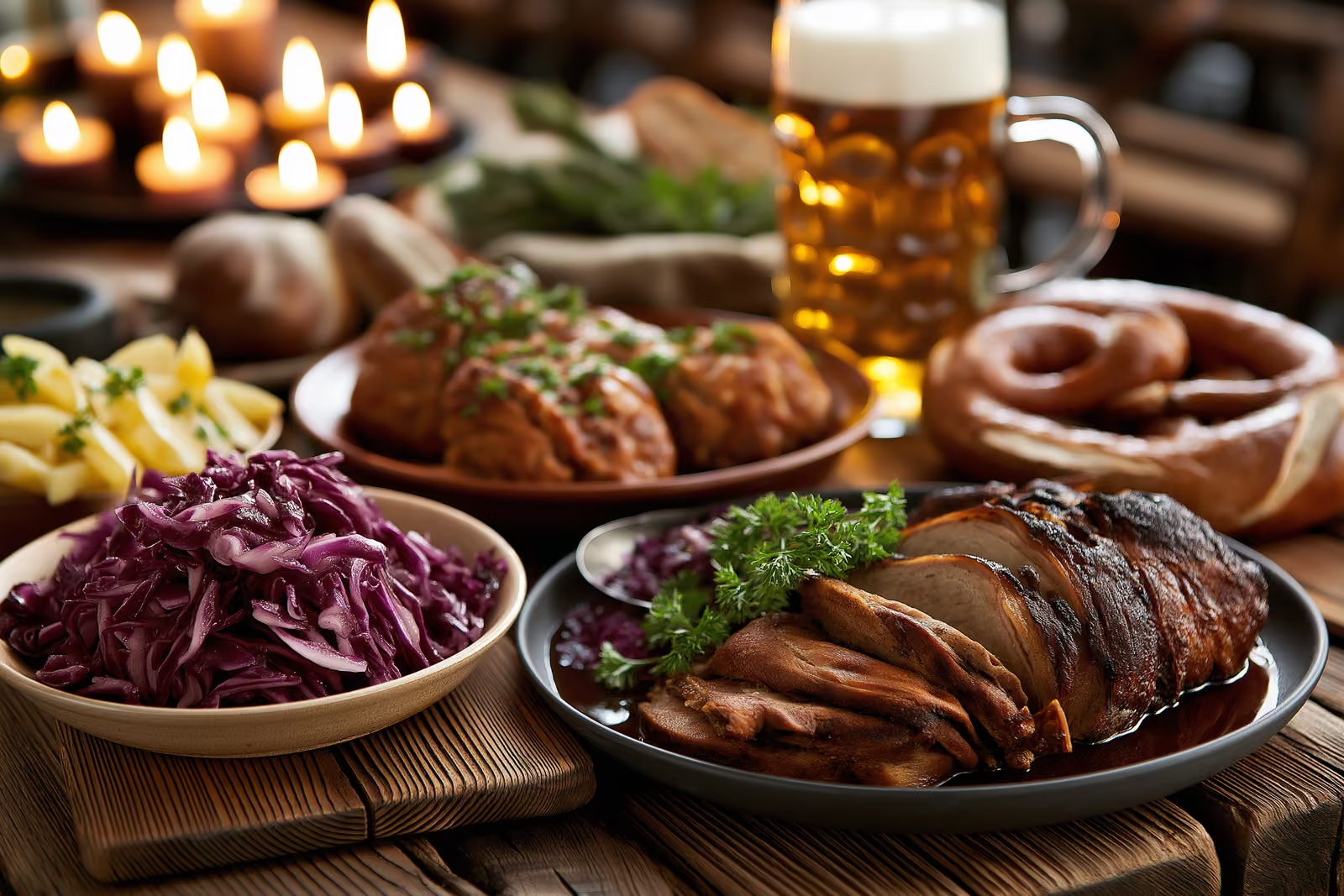
German food has a reputation abroad that does it no justice: sausages, sauerkraut, and not much else. Spend a few months here and a different picture arrives at the table. Traditional German dishes are regional, seasonal, and deeply tied to place, and they reward the newcomer who learns to read a menu and orders what the kitchen does best. This chapter is your map to the classics – what each dish actually is, what it tastes like, and where to find the good version. It is the opening chapter of our Cuisine and Dining section, so it stays on the food itself and points you to the specialist chapters for street food, regional deep dives, drinks, and the customs around the table.
What Makes German Food German
Traditional German cooking is built on a short list of honest ingredients treated with care: pork above all, then beef and poultry, potatoes in every conceivable form, cabbage fresh and fermented, bread as a food group in its own right, and the mustard, caraway, juniper, and marjoram that season it all. It is hearty rather than fiery, and it is proud of that. Portions are generous, sauces are rich, and a proper main course is meant to keep a working body going through a cold afternoon. If you arrive expecting subtle and delicate, recalibrate. If you arrive hungry, you will do very well.
The single most useful thing to understand is that there is no one German cuisine. What you eat in a Munich beer garden has little in common with what a family in Hamburg or Cologne or Leipzig puts on the table, and Germans are keenly, cheerfully partisan about their local specialties. The country only unified in 1871, and its food still carries the borders of the old kingdoms and duchies. That is a gift for the curious eater: the same three-hour train ride can take you from veal sausage and sweet mustard to kale stew and rye bread. Below we walk through the staples every region shares, then take a quick tour of the regions themselves, with the deep regional plunge handed to our regional specialties chapter.
The Wurst Universe
There is no single German sausage, there is a whole galaxy of them, and Wurst (sausage) is the natural first stop for any newcomer. The workhorse is the Bratwurst, a fried or grilled pork sausage that changes character from town to town. The fine, thumb-sized Nürnberger Rostbratwurst, seasoned with marjoram, is sold in threes or sixes in a crusty roll (“Drei im Weggla”) in Nuremberg; the longer, coarser Thüringer Rostbratwurst from Thuringia is charred over beechwood and slathered with mustard. Wherever you are, the ritual is the same: a hot sausage, a bread roll too small to contain it, and a smear of Senf (mustard), sharp or sweet depending on the region.
Bavaria’s contribution is the Weißwurst, a pale, soft veal-and-pork sausage flecked with parsley and lemon, gently simmered rather than fried and never browned. It comes with sweet Bavarian mustard (süßer Senf) and a Brezn (pretzel), and it is bound by one of Germany’s most charming food rules: a Weißwurst should not hear the church bells ring noon. The saying dates from the days before refrigeration, when the fresh morning sausage had to be eaten before it spoiled, and although the fridge has long since made this unnecessary, plenty of traditional Munich establishments still stop serving at midday. You eat it by slitting the skin and peeling the tender filling out, or by “zuzeln”, sucking it straight from the casing. The Frankfurter Würstchen, a slim smoked pork sausage scalded in hot water, and the plumper Bockwurst are the everyday boiled sausages you meet at kiosks and Christmas markets. Then there is Leberkäse, a Bavarian baked meatloaf whose name promises liver and cheese but contains neither: a warm slice in a roll, the Leberkässemmel, is one of the great cheap lunches of the south.
The most famous sausage of all, Currywurst – sliced sausage under a curry-spiced tomato sauce, a post-war Berlin invention and a national obsession – belongs more to the pavement than the dinner table, so we hand its full story to our street food and snacks chapter. Name it, crave it, and read the rest there.
Schnitzel, Braten and the Great Meat Dishes
Beyond the sausage counter lies the heart of the traditional German main course: the roast, the cutlet, and the slow-braised. Schnitzel is the gateway. A thin cutlet is pounded flat, breaded, and fried golden, and here a point of honesty helps a newcomer. The genuine Wiener Schnitzel is veal and is legally protected as such; what most German pubs actually serve is a Schweineschnitzel, the same treatment applied to cheaper pork, which is why menus that offer a plain “Schnitzel Wiener Art” (“Vienna style”) are quietly telling you it is pork. Order a Jägerschnitzel and it arrives smothered in a creamy mushroom sauce; a Zigeunerschnitzel (now often relabelled “Paprikaschnitzel”) comes with a bell-pepper sauce; a Rahmschnitzel swims in cream. Whichever you choose, it will overhang the plate and usually arrive with fries or fried potatoes.
For something more ceremonial, look to the great braises. Sauerbraten, often called Germany’s national dish, is beef (traditionally sometimes horse in the Rhineland) marinated for days in vinegar, red wine, and spices until it turns meltingly tender and tangy, then pot-roasted and served in a dark, faintly sweet gravy thickened, in the Rhenish version, with crushed gingerbread and raisins. It is the archetype of German slow cooking: patience turned into flavour. Rouladen are the dish of Sunday lunches and family celebrations, thin slices of beef spread with mustard, wrapped around bacon, onion, and a pickle, then browned and simmered for hours until you can cut them with a fork.
The pork dishes are where the region shows its muscle. Schweinshaxe, the roasted pork knuckle of Bavaria, arrives with crackling you can hear from across the beer garden and a joint of meat underneath falling off the bone; in the north and Berlin the same cut is cured and boiled as Eisbein and served with pea puree and sauerkraut, softer and paler but no less filling. Kassler, a cured and lightly smoked pork chop, turns up on a bed of sauerkraut across the country. And at the humble end, every German grandmother has a recipe for Frikadellen – the flat pan-fried meatballs known as Buletten in Berlin, Frikadellen in the north and west, and Fleischpflanzerl in Bavaria – eaten hot with potato salad or cold in a roll. They are proof that traditional German food is as much about the weekday kitchen as the festive table.
Bread, Potatoes and the Beloved Sides
Ask a German living abroad what they miss most and the answer is almost never a sausage. It is the bread. Germany takes its bread more seriously than perhaps any country on earth: the Deutsches Brotinstitut keeps a register of more than 3,000 distinct bread specialties, a diversity that earned German bread culture recognition as intangible cultural heritage. This is a world away from the soft white loaf many newcomers grew up with. Here bread is dense, dark, and built to last, from the sour, almost black Pumpernickel to nutty wholegrain Vollkornbrot studded with sunflower seeds and the everyday mixed-rye Mischbrot. The neighbourhood Bäckerei (bakery) is a daily institution, and its morning glory is the Brötchen, the crusty breakfast roll that goes by a dozen regional names – Semmel in Bavaria, Schrippe in Berlin, Wecken in the southwest. If you want to eat well and cheaply, learn to shop the bakery counter, which our grocery shopping chapter covers in practical detail.
The potato is bread’s equal partner on the plate. It arrives boiled as Salzkartoffeln, pan-fried with onion and bacon as Bratkartoffeln, and, crucially, as Kartoffelsalat (potato salad), which marks one of Germany’s great regional fault lines: in the south it is dressed warm with broth, vinegar, and mustard, while in the north it turns cold and creamy with mayonnaise. Neither side will concede. Then come the dumplings, Klöße or Knödel depending on where you stand, made either from raw and cooked potato or from stale bread, round and soft and built to soak up gravy – the essential companion to any Braten. In the Rhineland and further west, grated potato is fried into crisp Reibekuchen or Kartoffelpuffer (potato pancakes), eaten with apple sauce.
Swabia in the southwest plays a different game with its Spätzle, soft irregular egg noodles scraped fresh into boiling water, served buttered, or baked with layers of cheese and fried onions as Käsespätzle, the region’s answer to macaroni cheese. Swabia also gives us Maultaschen, large pasta pockets stuffed with meat and spinach, nicknamed “Herrgottsbscheisserle” (“little cheats on the Lord God”) for hiding the meat inside dough during Lent. And no plate of this food is complete without its sharp counterpoint: Sauerkraut, finely shredded cabbage fermented to a tangy crunch, or Rotkohl, red cabbage braised sweet-and-sour with apple and clove, the classic partner to roast goose and Sauerbraten alike. These sides are not afterthoughts. They are why the heavy mains work.
A Taste of the Regions
Here is the tour promised earlier, a fast pass over the map to show you how much the plate changes with the postcode. In the far north, where the country meets the sea, the food turns to fish and to bracing winter stews. Labskaus is the sailor’s dish, a startling pink mash of corned beef, beetroot, and potato crowned with a fried egg, pickled herring, and gherkins; the Fischbrötchen, a fresh roll packed with pickled or fried fish and onions, is the great snack of the Hamburg and Baltic harbours. Come autumn and winter the north lives for Grünkohl, kale slowly stewed with smoked sausage and pork, eaten on communal outings so beloved they have their own season.
Head south and west and each region reveals its signature. Bavaria means the Weißwurst, Leberkäse, and Obatzda already met, a spiced spread of mashed camembert, butter, and paprika built for the beer garden. Swabia is the land of Spätzle and Maultaschen. The Rhineland around Cologne and Düsseldorf offers Himmel un Ääd (“heaven and earth”), a homely plate of mashed potato and apple sauce with fried black pudding, alongside its gingerbread-sweetened Sauerbraten. And in the east, in Saxony and the states of the former GDR, you find Soljanka, a tangy, hearty soup of Eastern European origin that became a canteen classic, and the nostalgic dishes many still cook from the old days. This is only the aperitif. The full regional feast, town by town and dish by dish, is laid out in our regional specialties chapter, which is where to go when a trip or a move gives you a reason to eat your way through one corner of the country.
Sweets, Cakes and the Konditorei
Germany’s sweet tradition is grand, and it has its own retail temple: the Konditorei, the pastry shop and cake cafe that sits a cut above the everyday Bäckerei. The icon is the Schwarzwälder Kirschtorte (Black Forest gateau), layers of chocolate sponge soaked in Kirschwasser (cherry brandy), packed with sour cherries and mountains of whipped cream, and showered with chocolate shavings – a cake with the alcohol content to match its reputation. Beside it in the glass case sit Apfelstrudel, wafer-thin pastry rolled around cinnamon apples and raisins and served warm with vanilla sauce, and Käsekuchen, the German cheesecake made not with cream cheese but with Quark, a fresh curd cheese that makes it lighter and less cloying than the American version. Bienenstich (“bee sting”), a yeast cake with a caramelised almond crust and a cool custard middle, rounds out the classic trio no cafe is without.
Some sweets keep a calendar. The jam-filled fried doughnut eaten around Carnival and New Year is the subject of Germany’s most cheerful naming dispute: it is a Berliner in much of the country, a Pfannkuchen in Berlin itself, a Krapfen in the south, and a Kreppel in Hesse, and locals will happily argue the point. The deep midwinter belongs to Christmas baking – dense, fruit-and-marzipan-filled Stollen dusted white with icing sugar, and spiced Lebkuchen (gingerbread) from Nuremberg, both inseparable from the Christmas markets covered in our German festivities chapter. The eating of all this cake is itself a ritual – the mid-afternoon Kaffee und Kuchen, coffee and cake shared with family and friends, especially on Sundays. That ritual and its etiquette belong to our dining etiquette and customs chapter; here we simply invite you to the cake.
Where and How to Eat Traditional German Food
Knowing the dishes is half the battle; knowing where to order them is the other half. Traditional German food lives in the Gasthaus or Wirtshaus, the family-run inn and pub where the menu is short, the portions are large, and the Schnitzel is the size of the plate. In beer regions the equivalent is the Brauhaus, a brewery tavern serving its own beer alongside hearty classics, and in many old town halls you will find the Ratskeller, a vaulted cellar restaurant beneath the Rathaus (town hall) that trades on atmosphere and regional cooking. For a quick, cheap version – a sausage, a Leberkässemmel, a portion of fries – the Imbiss, the humble snack stand, is your friend, though the full world of pavement eating is the province of our street food and snacks chapter.
A few practical habits smooth the experience. German menus are organised by course – Vorspeisen (starters), Hauptgerichte (mains), Beilagen (sides), Nachspeisen (desserts) – and mains often already include a starch, so you rarely need to order extra. Beilage means the side that comes with the dish, and you are frequently asked to choose between Pommes (fries), Bratkartoffeln, Klöße, or Salat. Portions are honestly large, so pace yourself, and do not be surprised when tap water is not offered for free; drinks are ordered and paid for, a subject our wine and beer culture chapter takes up in full. The finer points of table manners, tipping, and how to behave as a guest are handled by our dining etiquette and customs chapter, so we leave conduct to them and stay with the food.
One old worry deserves retiring. Traditional German food is undeniably meat-heavy, and a decade ago a vegetarian could struggle outside the salad section. That has changed dramatically. Germany is now one of Europe’s leading markets for plant-based food and has among the highest shares of young vegans on the continent, and the change reaches the traditional kitchen too: Käsespätzle, Maultaschen (in their meatless form), Kartoffelpuffer, Obatzda, Semmelknödel, and a good half of the cake counter are naturally vegetarian, and most Gasthäuser now keep a marked vegetarian or vegan option or two. For the wider world of meat-free and international eating, our international cuisine chapter goes further, and if you would rather make these dishes yourself, our cooking classes and recipes chapter shows you how.
Eating with the Seasons
If there is one secret to eating well in Germany, it is this: the food is at its best when it is in season, and Germans organise real enthusiasm around a handful of ingredients as they come and go. The most cherished is Spargelzeit, white asparagus season, which runs from roughly mid-April to the 24th of June – St John’s Day, so firmly the end of the harvest that it is nicknamed Spargelsilvester, “asparagus New Year’s Eve”. For those two months, roadside stands appear, restaurants print special asparagus menus, and the plump white spears are served simply, with hollandaise, boiled potatoes, and a slice of ham. This is not a garnish; it is a national event, and the country gets through tens of thousands of tonnes of it.
The rest of the year keeps its own rhythm. High summer brings the first Pfifferlinge (chanterelle mushrooms), golden and fragrant, folded into creamy sauces over Spätzle or Schnitzel. Autumn belongs to Federweißer, the cloudy, barely fermented young wine that appears for only a few weeks, traditionally drunk with Zwiebelkuchen, a warm onion tart – a pairing you will find celebrated at vineyard festivals. Deep winter is the season of Grünkohl in the north and of the Christmas markets, with their Glühwein and gingerbread. Many of these ingredients get festivals of their own, from asparagus fairs to onion markets, which our food festivals and events chapter maps out. The lesson for a newcomer is simple and rewarding: ask what is in season, order that, and you will taste German cooking at the very top of its game.
Where to Start
You do not need to conquer this whole menu at once. If you are new here, begin with the everyday pleasures: buy a fresh Brötchen from the corner Bäckerei one morning, order a Bratwurst with mustard at the next market you pass, and sit down in a Gasthaus for a Schnitzel with Bratkartoffeln when the weather turns. Once those feel familiar, chase the seasons – a plate of Spargel in May, Pfifferlinge in July, a glass of Federweißer in September, Grünkohl in January – because that is where German cooking truly shines. Ask the waiter what the house does best, and let the region tell you what to eat.
From here the rest of our Cuisine and Dining section opens up. Follow the pavement to street food and snacks, dig into a single region with regional specialties, learn the table manners in dining etiquette and customs, or pour yourself a drink with wine and beer culture. Traditional German food is generous, seasonal, and proud of where it comes from. Come hungry, order local, and let it win you over one hearty plate at a time.
Sources
The information in this chapter draws on the official sources and publications listed below, last reviewed in July 2026. It is general guidance for orientation, not individual legal, tax, or medical advice.

