Refugee and Migrant Support
13 min read
If you have settled in Germany from somewhere else, you already know what it feels like to arrive without the language, without the paperwork sorted, and without anyone who can tell you how things work. That experience is exactly what makes you a valuable volunteer for the many refugees and migrants who are a few steps behind you on the same road. This chapter is a practical guide for the helper: how to volunteer to help refugees and migrants in Germany, where to find your local initiative, what the work actually involves day to day, and how to do it well and responsibly without burning out or overstepping.
It is deliberately the helper’s side of the story. If you want the wider rules of volunteering in Germany - how Ehrenamt (honorary, unpaid civic work) is treated, expense reimbursement, insurance, the formal Freiwilligendienste and the Führungszeugnis (police clearance certificate) for working with children - read our companion chapter on volunteering opportunities, which owns that framework so this chapter does not repeat it. And if you are a newcomer trying to understand the asylum or visa process from your own side, that belongs in our immigration and visa assistance chapter. Here, you are the person offering a hand.
Why the Help Is Still Needed, and Why You
Germany has taken in large numbers of people over the past decade, and the need for everyday support has not gone away. The arrivals of 2015 and 2016, mostly from Syria, Afghanistan and Iraq, built a whole infrastructure of volunteer welcome work almost overnight. Since Russia’s full-scale invasion of Ukraine in February 2022, Germany has become the largest host country in Europe for people fleeing that war: the Federal Ministry of the Interior reported around 1.25 million refugees from Ukraine in the country in early 2025. Alongside these two big movements, people continue to arrive from many other countries through asylum, family reunification and other routes. The result is a standing population of newcomers, in almost every town, who are learning German, decoding official letters and looking for work and housing at the same time.
The public mood around this has changed, and it is fair to be honest about that without taking a political side. The open, energetic Willkommenskultur (welcome culture) of 2015 - the crowds at train stations, the sudden surge of volunteers - has cooled. Municipalities and district associations now speak openly about being at the limit of what they can house and process, migration has become a hard-edged political argument, and some of the volunteers who signed up years ago have quietly stepped back. None of that changes the day-to-day reality on the ground: people still need someone to practise German with, someone to sit beside them at an appointment, someone who treats them as a neighbour rather than a case number. Volunteer support remains genuinely needed and, in most places, warmly welcomed by the organisations that coordinate it.
As a foreigner, you bring something to this that a lifelong German resident often cannot. You have stood in the same queues and felt the same disorientation, so your empathy is real rather than imagined. If you share a language with the people you are helping, you are worth your weight in gold, because interpreting is one of the scarcest resources in the whole system. Even if you do not, your own imperfect German is reassuring to someone just starting out, and your outsider’s understanding of what confuses a newcomer - which forms matter, which fears are unfounded, how the health-insurance card works - is precisely the knowledge that helps. You do not need to be an expert on Germany. You need to be a step or two ahead, and willing to walk back and fetch someone.
Finding Your Local Initiative
Refugee support in Germany runs through a dense network of organisations, and the easiest way in is almost always local. At the largest scale sit the Wohlfahrtsverbände, the big non-profit welfare associations that carry much of the country’s social work: Caritas (Catholic), the Diakonie (Protestant, with roughly 100,000 volunteers active in refugee work nationwide), the Deutsches Rotes Kreuz or DRK (German Red Cross), the Arbeiterwohlfahrt or AWO, and Der Paritätische, an umbrella body for independent initiatives. Each runs migration advice centres, language courses and volunteer programmes, and each has local branches you can simply contact. The Malteser Hilfsdienst and the Johanniter-Unfall-Hilfe, two large aid organisations, also run refugee shelters, visiting services and leisure activities that rely on volunteers.
Beyond the welfare giants there is a layer of dedicated refugee-rights and welcome organisations. Pro Asyl is the national refugee-rights organisation, founded in 1986; it focuses on advocacy and legal support rather than local volunteering, but it is the reference point for the wider movement and a place to send anyone with a serious legal question. Under its umbrella sit the Landesflüchtlingsräte, the refugee councils - one in each of the sixteen Bundesländer (federal states) - which network the grassroots groups in their region and can point you to the initiative nearest you. Below them are the Freundeskreise and Willkommensinitiativen, the local “circles of friends” and welcome groups: small, often volunteer-run associations attached to a town, a neighbourhood or a church congregation, and usually the warmest and most flexible place for a first-time helper to land. The Save Me campaign, which began in Munich in 2008 and now runs in around fifty municipalities, pairs local volunteers with individual refugees through a Patenschaft (sponsorship or mentoring relationship), and many towns and Länder run Integrationslotsen programmes, in which trained volunteers act as “integration guides” for newcomers. Migrant self-organisations, groups founded and run by people with their own migration history, are another route, and one where your own background may be an immediate asset.
Since 2022, a further layer of Ukraine-specific networks has grown up alongside the older structures - local aid hubs, housing-matching groups and community associations that formed to receive the sudden arrivals and have since settled into steady work. To find any of this near you, you have three reliable doors. The first is your local Freiwilligenagentur (volunteer agency), a municipal or non-profit clearing house that matches people to causes; our chapter on volunteering opportunities explains how these agencies work in detail. The second is the Rathaus (town hall) or the district’s Integrationsbeauftragte (integration officer), who almost always keeps a list of active initiatives. The third is the Landesflüchtlingsrat for your state, whose website links the groups it works with. A short email or a visit to one open meeting is usually all it takes to be welcomed in.
It helps to know roughly how these groups are organised before you walk in. A typical Willkommensinitiative divides its work into small Arbeitsgruppen (working groups) - one for language, one for accompanying people to appointments, one for the clothing store, one for children’s activities - and you join the one that fits your time and skills rather than committing to everything. Larger organisations run their volunteering more formally, with a coordinator, a short interview and a written agreement, while a neighbourhood Freundeskreis may be as informal as a monthly meeting and a messaging group. Neither is better; the formal route gives you structure and training, the informal one gives you flexibility. If the first group you contact does not fit, it is completely normal to try another until you find the people and the task you click with.
What Volunteers Actually Do
The single biggest need, in almost every initiative, is language. As a Sprachpat*in (language buddy or mentor) you meet one person or a small family regularly to practise German in the way a textbook never can - ordering in a bakery, reading a school note, rehearsing a phone call. Many groups run a Sprachcafé, an informal drop-in where newcomers and locals simply talk over coffee, and helping to host one is an easy, low-pressure way to start. This is not the same as teaching a formal course, and you do not need a teaching qualification; you need patience and regular attendance. If your own German is still growing, our chapter on language exchange meetups shows how the same conversational practice works in both directions.
The second great need is help with officialdom. Behördenbegleitung - accompanying someone to the Ausländerbehörde (immigration office), the Jobcenter, a doctor or a school appointment - is one of the most genuinely useful things a volunteer can do, because the German administrative system is daunting even for people who grew up with it. You are there to help someone find the room, understand what is being asked, take notes and follow up, not to speak for them or make decisions on their behalf. Our guide to surviving German bureaucracy is worth reading before you go, so you can explain the appointment as well as attend it. Closely related is help with the paperwork of daily life: reading and sorting official post, filling in forms, and understanding letters that arrive in dense administrative German.
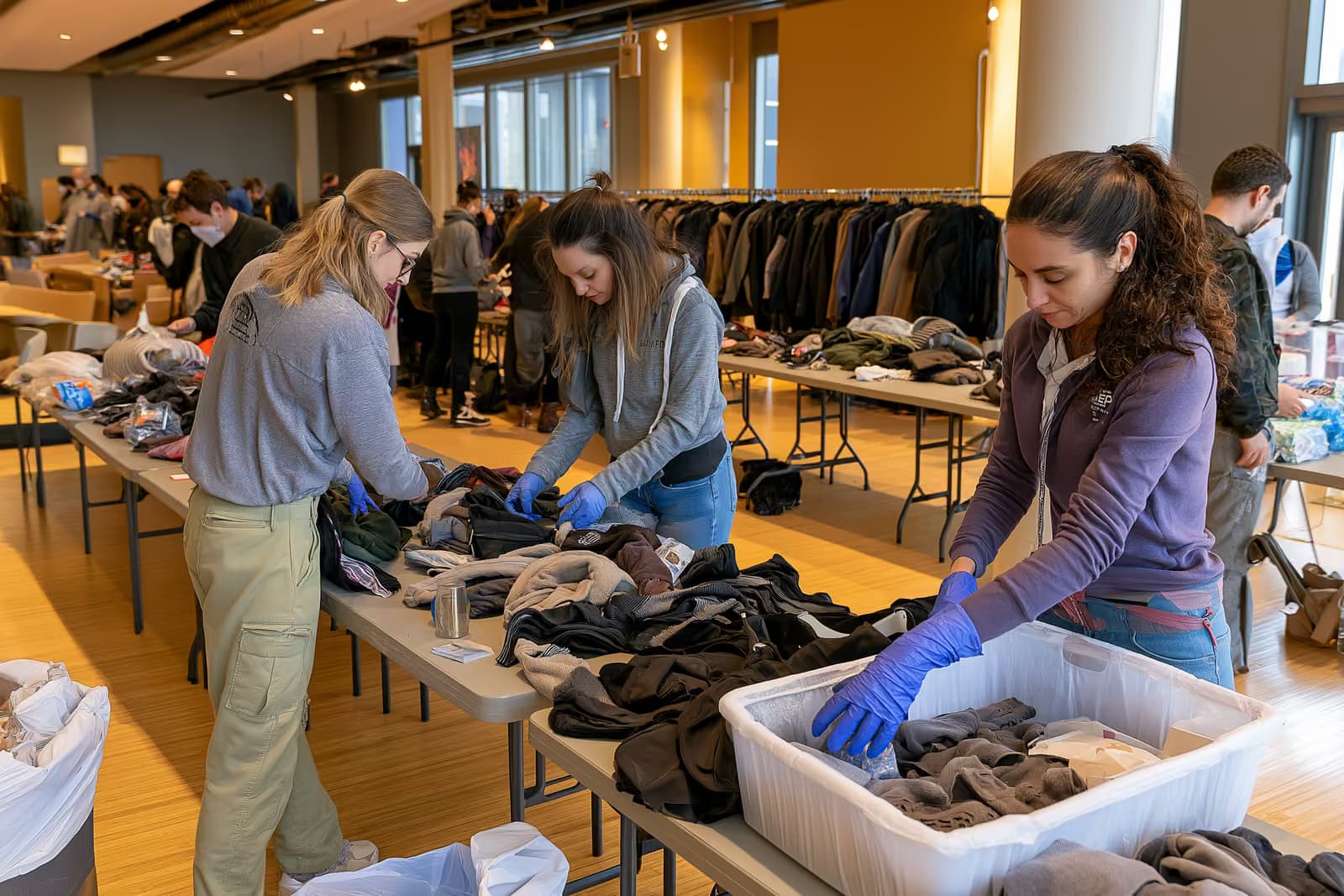
Beyond language and bureaucracy, the work is as varied as people’s lives. Volunteers give Hausaufgabenhilfe (homework help) and tutoring to children who are catching up in a new school system, and staff the Kleiderkammer (clothing store) or furniture services that many initiatives run to provide the basics of a household. There is real demand for help with the Wohnungssuche (apartment search), which is brutally hard in German cities, and for job and CV support - reviewing a Lebenslauf (German-style CV), explaining how applications work, practising for interviews. A deeper commitment is a Patenschaft, where you accompany one person or family over months or years as a kind of mentor and steady point of contact. And integration often happens fastest through ordinary shared activity: taking someone to a sports club or a hobby group, where our chapters on local clubs and societies show how the German Verein (club) works. If you speak a language many newcomers share, translating and interpreting - at appointments, in meetings, on documents - is perhaps the single most valuable skill you can offer, and one that almost every organisation is short of.
It is easy to overlook the simplest role of all: friendship. A great deal of what eases integration is unofficial and unglamorous - a shared walk, an invitation to dinner, help reading a rental contract, someone to call when a letter looks frightening. Newcomers often say that the loneliness and the sense of being a stranger weigh as heavily as any practical problem, and an ordinary, reliable acquaintance who treats them as a person rather than a case does more good than any single service. You can offer that alongside a defined role, or as your whole contribution. Whatever the task on paper, showing up consistently is the part that matters.
Doing It Well and Responsibly
Helping well is not only about goodwill; it is about knowing your limits and respecting the other person’s. The first limit is your own. This work can be emotionally heavy, and it is easy to over-commit, answer the phone at all hours and end up exhausted and resentful - the kind of burnout that helps no one. Decide early how much time you can genuinely give, keep some boundaries around your own life, and lean on the coordinating organisation rather than trying to carry everything alone. Good initiatives expect this and build in support; if yours does not, that is a sign to find one that does. If your role involves children or young people, expect to be asked for an erweitertes Führungszeugnis (enhanced police clearance certificate), which is a normal safeguarding requirement and is explained in our chapter on volunteering opportunities.
The second limit is about dignity. The people you are helping are adults with their own histories, opinions and plans, not projects to be rescued. The healthiest instinct is to help with things, not to do things for people - to hand over skills and information so they can act for themselves, rather than taking over. Many refugees have been through serious hardship or trauma, so let people share what they choose to share and do not pry into how they came to Germany. Be considerate about culture and religion, and careful with personal data: names, addresses, case details and photographs are not yours to pass on or post online. These are not bureaucratic niceties; they are what separates support that empowers from help that quietly diminishes.
The third limit is legal. You are a helper, not a lawyer and not an authority, and asylum and immigration law is a field where a well-meant but wrong answer can do real damage to someone’s case. Do not give legal or asylum advice, however confident you feel. When a genuine legal question comes up - an appeal, a deadline, a threat of deportation, a dispute with an authority - route it to the people qualified to handle it: the local Flüchtlingsrat, a specialist advice centre, Pro Asyl, or a lawyer who works in Migrationsrecht (migration law). Our chapter on legal services for expats explains how to find and work with one. Knowing when to say “I don’t know, but I know who does” is one of the most responsible things a volunteer can do.
Getting Started as a Foreigner Yourself
You do not need German citizenship, perfect German or any special qualification to begin. Most initiatives welcome volunteers whatever their own passport, and your multilingualism is an advantage rather than an obstacle. Plenty of roles work perfectly well in English or in another shared language: a Sprachcafé needs conversation partners of every level, translation obviously rewards the languages you already speak, and simply being present at a welcome event or a children’s activity asks for warmth more than vocabulary. German certainly helps and will grow as you do the work, but a lack of it is rarely a reason to wait.
The commitment is yours to shape. Some people give a one-off Saturday sorting the Kleiderkammer or driving furniture; others settle into a weekly language meeting; a few take on a long mentoring Patenschaft that lasts years. Start small, see how it fits your life, and scale up only if you want to. Many of the larger organisations offer a short introduction or training before you begin - on trauma awareness, on the basics of the asylum system, on their own safeguarding rules - and it is worth taking, both because it makes you more useful and because it connects you to other volunteers. The practical first step is simply to contact one group: email a Freundeskreis, walk into a Freiwilligenagentur, or ask at the Rathaus, using the routes described earlier in this chapter.
It is also worth saying plainly that this is among the most meaningful volunteering you can do in Germany, and that it gives back to you as much as you put in. Helping newcomers pulls you into your own town in a way that little else does; you meet people across every line of language and origin, your German improves in the most natural setting there is, and you come to understand the country’s systems far better by explaining them to someone else. For a foreigner still finding their own feet, it is one of the most integrating things imaginable - a point our chapter on learning culture through volunteering explores in depth.
Your First Step
If you take one thing from this chapter, let it be that starting is small and undramatic: one email to a local initiative, or one visit to an open meeting, and you are in. Choose a role that matches what you can honestly give - an hour of conversation, a regular appointment escort, a share of the interpreting nobody else can do - and let the coordinating organisation guide you from there. Keep your boundaries, protect your energy, treat the people you help as the capable adults they are, and hand the legal questions to the specialists.
For the wider mechanics of volunteering in Germany - insurance, expense reimbursement, the formal Freiwilligendienste and the Führungszeugnis - lean on our volunteering opportunities chapter rather than working it out alone, and route any asylum or legal matter to a Flüchtlingsrat, Pro Asyl, or a migration lawyer. Then simply begin. You once needed someone to show you how Germany worked; now you can be that someone, and few things you do here will matter more.
Sources
The information in this chapter draws on the official sources and publications listed below, last reviewed in July 2026. It is general guidance for orientation, not individual legal, tax, or medical advice.