




 Turkish
 Italian
 Spanish
 Portuguese
 Romanian
 Albanian
 Lithuanian
 Latvian
 Bulgarian
 Greek
Greek Hungarian
 French
 Croatian
 Czech
Czech
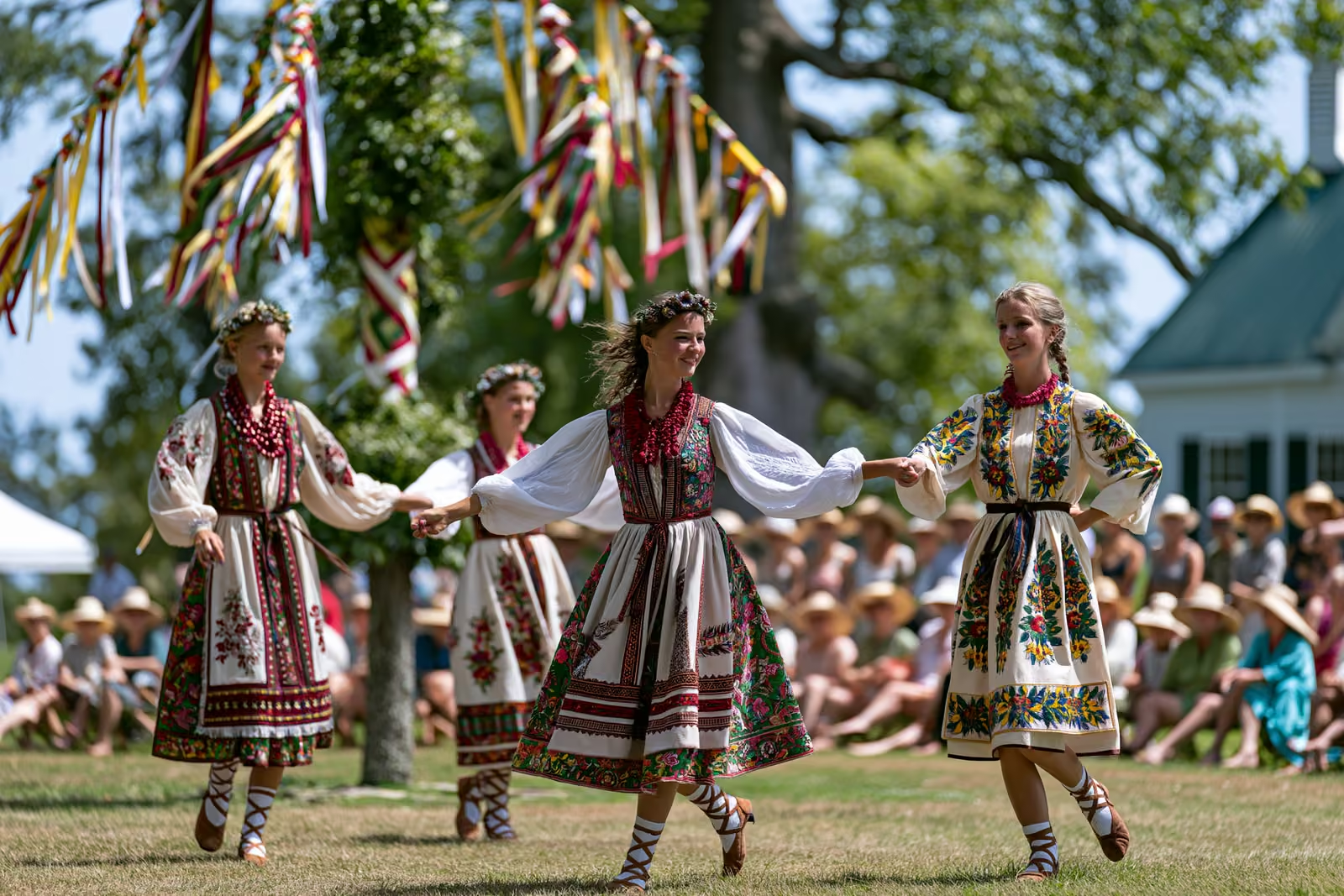
Germany celebrates far more than Oktoberfest. In every region, most weeks of the year, some town is rolling out a traditional folk festival – a mix of funfair, beer tent, parade and old local custom that turns an ordinary field or market square into the social centre of the area. This chapter is a foreigner’s guide to those festivals: what a Volksfest actually is, which of the big ones are worth travelling for, what a Schützenfest and a Kirmes involve, and the seasonal country traditions that most guidebooks miss. The goal is simple – to help you find one near you, understand what you are looking at, and feel comfortable joining in. Oktoberfest has its own chapter, and so do the wine and food festivals and the carnival parades; here you get everything else, which is most of it.
What a Volksfest actually is
A Volksfest (literally “people’s festival”) is Germany’s classic public fair, and once you understand the format you will recognise it everywhere, because the ingredients barely change from town to town. There is a funfair of rides, the Fahrgeschäfte, ranging from a gentle carousel for toddlers to a giant Ferris wheel and stomach-turning modern rides that fold you in every direction. There are the Festzelte, the big beer tents, where a band plays and hundreds of people share long wooden benches. There are the Schausteller, the travelling showpeople and ride operators whose families have often run the same stalls for generations, and the food stands selling bratwurst, Schmalzkuchen (little fried dough puffs dusted with sugar), roasted almonds, candied fruit and Lebkuchen hearts. The Bierzelt, the beer tent, is the social heart of the larger festivals, while smaller ones may have nothing more than a couple of beer stands and a bandstand. Whatever the size, the shape is familiar within minutes of arriving.
The word you will hear most often at local level is not Volksfest at all but Kirmes, Kirchweih or Jahrmarkt, and it helps to know these are essentially the same thing under different regional names. Kirmes and Kirchweih both trace back to the Kirchweihfest, the anniversary of a church’s consecration, which centuries ago gave a village its yearly excuse to hold a fair; today the religious origin is mostly forgotten and what remains is the funfair and the beer. Jahrmarkt simply means “annual market”. In the Rhineland and the Ruhr people say Kirmes, in Bavaria and Franconia Kirchweih (often shortened to “Kerwa”), and in the north you will hear Jahrmarkt or the local name of the specific fair. Practically every town of any size has its own, and the small ones matter as much to local life as the famous giants do.
There is also a rhythm to the year worth knowing. The season opens in spring, roughly April and May, with the Frühlingsfeste (spring festivals); it runs through a busy summer of town Kirmes weekends and marksmen’s festivals; and it closes with the big autumn Volksfeste in September and October, timed to the old harvest calendar. What ties all of it together is Geselligkeit, a word that means something like sociable togetherness. You sit at a shared bench with strangers, you raise your glass, and by the second round the people beside you are no longer strangers. That shared-table sociability is the whole point, and it is the thing a visitor from a more reserved public culture tends to remember most.
A little of the ritual helps you read what is happening. The larger Volksfeste open with a Fassanstich, the ceremonial tapping of the first beer keg by the mayor or a local dignitary, and close with a firework display over the grounds; in between, the beer tents run on a daily pattern of quiet, family-friendly afternoons giving way to loud, standing-on-the-benches evenings once the band shifts from folk tunes to singalong hits. The measure of beer in the southern tents is the Maß, a full litre in a heavy glass stein, and the standard toast is a shouted “Prost!” with eye contact as glasses meet. None of this is exclusive or hard to follow – you learn the shape of an evening within an hour, and the people at your table will happily show you the ropes. If a giant tent feels overwhelming, the beer garden outside, or a smaller town festival, gives you the same warmth at a gentler volume.
The great Volksfeste beyond Oktoberfest
Munich’s Oktoberfest is the biggest and most famous, and it has its own detailed guide on this site. But if you judge Germany’s folk-festival culture by Oktoberfest alone you miss most of it, because several other Volksfeste rival it in size and often beat it for a relaxed, less touristy atmosphere. The closest cousin is the Cannstatter Volksfest in Stuttgart, held on a huge open ground called the Cannstatter Wasen from late September into early October. It began in 1818 as an agricultural festival marking recovery from famine, it draws well over three million visitors, and it is widely regarded as the second-largest beer festival of the Oktoberfest type in the world. Its own agricultural roots still show in the fruit column, the Fruchtsäule, that stands at its centre. The same Wasen ground also hosts the Stuttgarter Frühlingsfest in April and early May, billed as one of the largest spring festivals anywhere, so Stuttgart effectively brackets the season with a Volksfest at each end.
The Ruhr region and the Rhineland have festivals every bit as large. The Cranger Kirmes in Herne, on the Rhine-Herne Canal, runs for eleven days in early August and is the biggest funfair in North Rhine-Westphalia, pulling in around four million people. The Rheinkirmes in Düsseldorf takes over the Oberkasseler Rheinwiesen, the meadows on the far bank of the Rhine facing the old town, for two weeks in July; it too counts roughly four million visitors and is organised, tellingly, by a marksmen’s association, the St. Sebastianus-Schützenverein, whose roots in the city go back centuries. Further west, Paderborn’s Libori is one of the oldest festivals of all, tracing to the year 836 and the arrival of the relics of Saint Liborius; over the centuries it grew into a distinctive blend of church feast, funfair and market that fills the city for nine days in late July and draws close to two million people.
The north has its own great fair in the Hamburger DOM, held on the Heiligengeistfeld near the St. Pauli district. Unusually, the DOM runs three times a year – spring, summer and winter – so Hamburg has a funfair on for a good part of the year, each edition lasting about a month and claiming the title of the largest fair in northern Germany. Bremen answers with the Bremer Freimarkt, first held in 1035, which makes it one of the oldest folk festivals in the country; it takes over the city for around seventeen days in late October and remains one of the north’s biggest crowds. Down in Franconia, the Nürnberger Volksfest runs twice a year at the Dutzendteich, as a Frühlingsfest in spring and a Herbstvolksfest in late summer, together the largest folk festival in the region with more than two million visitors. Between these, and dozens of smaller city fairs in places like Karlsruhe, Mannheim and beyond, you are rarely more than a short train ride and a few weeks away from a proper Volksfest, whatever corner of the country you live in.
Schützenfeste, the marksmen’s festivals
If there is one folk tradition foreigners routinely overlook, it is the Schützenfest, the marksmen’s festival, and in large parts of the country it is a bigger deal than anything else on the calendar. It grows out of the Schützenverein, the shooting club, one of the oldest kinds of German association; these clubs began in the Middle Ages when townspeople formed companies to defend the walls, and they survive today as social and charitable clubs that are pillars of small-town life. The Schützenverein is a classic example of the Verein culture that runs through the whole country, and if you want to understand how Germans organise their communities it is worth reading the separate chapter on Vereine and club culture. In much of the Sauerland, the Rhineland and Lower Saxony, belonging to the Schützenverein and turning out for its yearly festival is simply what you do.
The festivals themselves are large and colourful. Members parade in uniform – historic-looking jackets, caps and sashes, the Schützen equivalent of Tracht – behind brass bands, through streets lined with neighbours, and the whole thing usually ends in a big marquee with dancing that runs late. The best-known is the Neusser Bürger-Schützenfest, held on the last weekend of August in Neuss near Düsseldorf: with something like seven and a half thousand marksmen parading it is considered the largest marksmen’s festival in the world organised by a single association, and it draws up to a million spectators. The Schützenfest in Hannover, founded in 1529, is larger still by some measures, famous for a marksmen’s parade around twelve kilometres long with more than ten thousand participants from Germany and abroad. At the heart of most of these festivals is the Vogelschießen, the “bird shooting”: contestants take turns firing at a wooden bird or eagle mounted on a high pole, and whoever brings down the last piece becomes the Schützenkönig, the marksmen’s king, for the year, reigning over the festival with a queen at his side.
It is worth understanding these events on their own terms. The uniforms and the shooting can look unfamiliar to a newcomer, but a Schützenfest is a community tradition and a social occasion, not a political one – it is about belonging, local pride and a very old club looking after its town, closer in spirit to a village fete than to anything martial. Many clubs have modernised, admitting women as full members and even as Schützenkönigin. For a foreigner these festivals are one of the warmest ways into local life, precisely because they are rooted in a place and its people; if you are invited to one by a neighbour or colleague, go. You will be fed, offered a drink, and quietly folded into the crowd, and you will have seen a side of Germany that tourists almost never reach.
Regional customs and seasonal folk events
Beyond the funfairs and the marksmen, Germany keeps a calendar of older seasonal customs that are folk festivals in the truest sense, tied to the farming year and to a specific corner of the country. The most photographed is the Almabtrieb, also called the Viehscheid, in the Alpine south. Through the summer, cattle graze the high mountain pastures, the Almen; in September and October they are driven back down to the valley for winter, and if the herd has come through the summer without loss the animals are led home in a festive procession, decorated with flowers, ribbons and enormous polished cowbells, the lead cow crowned with an elaborate headdress. Villages in the Allgäu and the Bavarian Alps mark the arrival with a fair, brass bands and hearty food such as Käsespätzle and Weißwurst. It is a genuine working tradition rather than a show put on for tourists, and it is one of the most memorable autumn sights in the country.
Spring has its own customs. Across Bavaria and the south, villages raise a Maibaum, a maypole, on or before the first of May – a tall painted trunk, often striped blue and white, hung with signs and figures showing the local trades. Around it has grown one of Germany’s most entertaining traditions, the Maibaumklauen or maypole-stealing: in the days before it goes up, a rival village will try to spirit the pole away, and if they succeed the owners have to buy it back, traditionally with a generous quantity of beer and a hearty meal for the thieves. It is done in good humour and by unwritten rules, and it can end in a memorable party. Autumn brings the Erntedankfest, the harvest thanksgiving, celebrated in churches and villages with decorated harvest crowns and, in many places, a small procession or fair.
Regional pageants and spring festivals fill out the picture. In Thuringia, Eisenach stages the Sommergewinn each March, one of the oldest and largest spring festivals in the country and recognised as intangible cultural heritage; its centrepiece is a symbolic contest between Frau Sunna, standing for summer, and Herr Winter, whose straw effigy is burned to mark the victory of spring, all wrapped in a parade of floats and bands. Elsewhere, towns keep alive elaborate historical pageants in which residents re-enact a moment from local history in period costume: Dinkelsbühl’s Kinderzeche recalls how the town’s children are said to have spared it during the Thirty Years’ War, and Landshut’s Landshuter Hochzeit, staged every four years, recreates a fifteenth-century royal wedding with thousands of costumed participants. These sit alongside countless smaller Heimatfeste, port and fishing-village festivals along the coasts, and wine-village fairs whose culinary side is covered in the chapter on food and wine festivals. For the deeper meaning behind these customs and the wider ritual year, the chapter on German festivities and local traditions goes further.
How to experience folk festivals as a foreigner
Finding a festival is easier than it looks. Every town hall publishes a Veranstaltungskalender, an events calendar, on its website, and the tourist-office pages list the dates of the local Kirmes, the spring and autumn Volksfeste and any Schützenfest well in advance. Once you know the seasonal rhythm – spring festivals from April, town Kirmes weekends and marksmen’s festivals through the summer, the big Volksfeste in September and October – you can plan around it. Do not overlook the small local Kirmes on your own doorstep. The giants are spectacular, but a town fair with a handful of rides and one beer tent is often the friendlier introduction, because you are among neighbours rather than in a crowd of a million, and a shared bench is easier to join when the tent holds two hundred people instead of ten thousand.
A few practical points make the day go smoothly. Bring cash: many ride and food stalls still do not take cards, and while the bigger festivals increasingly accept them, small ones may not. The rides run on tokens or cash, a Maß of beer at a big Volksfest is not cheap, and prices climb every year, so budget a little more than you expect. The question foreigners ask most is about Tracht, the traditional dress – the Dirndl for women and Lederhosen for men. At the southern festivals, from Munich down to Stuttgart, a large share of the crowd wears it, locals included, and as a visitor you are entirely welcome to as well; nobody minds, and many enjoy it. It is far less common in the north and the Rhineland, where ordinary clothes are the norm. There is no obligation either way. If you want the full southern experience, the Oktoberfest chapter goes into the etiquette of wearing Tracht in more detail.
Folk festivals are also unusually good for families. The funfair is built for children, with gentle rides, games and mountains of sweets, and daytime hours at most Volksfeste are calm and family-friendly before the beer tents fill up in the evening; the chapter on family-friendly activities has more ideas along these lines. Getting there is usually simplest by public transport, since parking near a big festival is a nightmare and the point of the beer tent is that nobody has to drive home – the local public transport network will run extra services on festival days, and for a festival in another city the notes on domestic travel will help.
More than anything, these festivals are a way to belong. Sitting at a shared table, learning the words to a song everyone else already knows, being handed a drink by a stranger who becomes an acquaintance – this is how a lot of newcomers first feel part of the place they have moved to, and it does more for putting down roots than almost anything you can plan. The regional pride on display is real, and joining in, even a little, signals that you take the community seriously; the chapter on building a social network picks up that thread. So watch the town calendar, pick a festival, wander in with a bit of cash and an open evening, and share a bench. For the parades and carnival side of German celebration, see the chapter on street parades and carnivals, and for the full overview of the festival year, the guide to Germany’s major festivals ties it all together.
Sources
The information in this chapter draws on the official sources and publications listed below, last reviewed in July 2026. It is general guidance for orientation, not individual legal, tax, or medical advice.

