Waste Disposal and Recycling Rules
19 min read
Waste disposal and recycling is the part of German daily life that newcomers underestimate most, and it is the fastest route to a bad relationship with your neighbours. The system looks fussy from the outside, but it is learnable in an afternoon, and almost every mistake foreigners make comes from three misunderstandings: that the yellow bag is for plastic, that the rules are the same everywhere in Germany, and that nobody is watching. This chapter explains what actually goes in each bin, who writes the rules that bind you, how the deposit system gives you your money back, where batteries, electronics, furniture and paint have to go instead, and what it costs when it goes wrong.
One honest warning before the detail. There is no single national rulebook you can memorise. Germany sets the framework at federal level and hands the practical decisions to your town or district, which is why a friend in another city will tell you something that contradicts this chapter and you will both be right. The most useful thing this chapter can do is teach you the structure, so you know which local document to check and which questions to ask.
Who Actually Writes the Waste Disposal and Recycling Rules
Federal law creates the duty but does not fill in the details. Under paragraph 17 of the Kreislaufwirtschaftsgesetz (KrWG), the circular economy act, private households must hand their waste over to the öffentlich-rechtlicher Entsorgungsträger, the public body responsible for waste disposal under the law of your Bundesland. That body is normally your Landkreis (district) or your kreisfreie Stadt (independent city). This handover duty is called the Überlassungspflicht, and it is the hinge the whole system turns on: because you are legally obliged to give your waste to that specific body, the rules that body writes become binding on you.
Those rules live in a document called the Abfallsatzung, the municipal waste statute, sometimes together with a Gebührensatzung, the fee statute. The Abfallsatzung decides the bin colours, which streams get a bin at your address and which need a trip, how often each bin is emptied, what a bin costs, how Sperrmüll is booked, and what happens when a bin is contaminated. It is published on your municipality’s website, and it is the only document that actually governs your address. Everything in this chapter is the pattern; your Abfallsatzung is the law.
What federal law does fix is the list of streams the public body must collect separately. Paragraph 20(2) KrWG obliges it to separately collect organic waste, plastics, metals, paper, glass, textiles, bulky waste and hazardous waste from private households. Note that this duty falls on the municipality, not directly on you: it must offer the separation, and your Abfallsatzung then translates that into a duty you can be held to. Paragraph 9 KrWG also lets separate collection be dropped in defined cases, for example where it is technically impossible or would cost disproportionately more, which is the legal reason why some places run a combined collection that would be unthinkable one district over.
One recent change is worth knowing because it caught out long-term residents too. Since 1 January 2025, textiles have been on that separate-collection list under paragraph 20(2) number 6 KrWG. Worn-out clothing and household textiles are no longer supposed to go in the Restmüll. In practice most municipalities meet this through the Altkleidercontainer (used-clothing containers) that already stood on street corners, so for many people nothing visible changed - but the legal basis did, and some places have added collection points.
Everyday Waste Disposal and Recycling: The Bins Explained
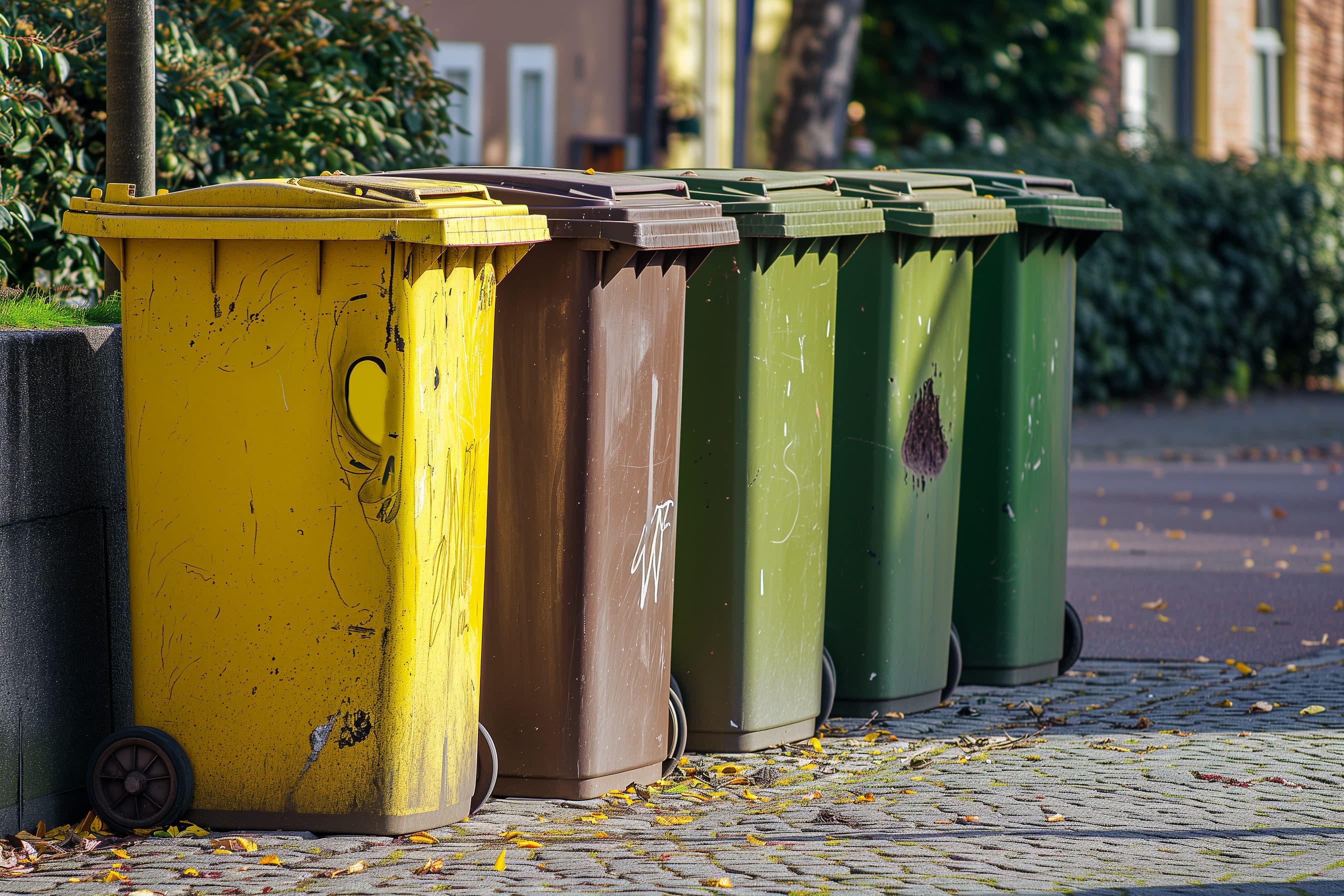
Restmüll (residual waste) is the grey or black bin, and it is defined by exclusion: it takes what genuinely belongs in no other stream. Used tissues, nappies and hygiene products, cigarette ends, vacuum cleaner bags, broken drinking glasses and ceramics, and packaging so soiled it cannot be scraped out. It is usually the most expensive bin per litre, because it is the one that gets incinerated, and municipal fee structures are deliberately built so that sorting properly makes your household bill smaller.
Altpapier (waste paper) is the blue bin. Newspapers, magazines, catalogues, writing paper, envelopes, books and flattened cardboard. Flatten the boxes, or your bin fills with air and your neighbours will notice. The exclusions are the part people get wrong: greasy pizza boxes, used kitchen roll, baking paper, receipts printed on thermal paper, and paper coated with plastic all belong in Restmüll, not in the blue bin. Contaminated paper devalues the whole load.
Biomüll (organic waste) is the brown bin, covered in its own section below because the rules changed recently. Altglas (waste glass) goes to street containers rather than a bin at most addresses, and also has its own section because the colour rule is more subtle than it looks.
Sperrmüll (bulky waste), Elektrogeräte (electrical appliances), batteries and anything hazardous have their own routes and never belong in a household bin at all. Those routes are set out further down. If you remember one principle, make it this one: when you are unsure, the answer is almost never “put it in the yellow bag”.
The Yellow Bag Is for Packaging, Not for Plastic
The Gelber Sack (yellow bag) or Gelbe Tonne (yellow bin) is the single biggest source of newcomer error, and the mistake is always the same. It is not a plastic bin. It is a packaging bin. It takes Verkaufsverpackungen (sales packaging) made of plastic, metal or composite material: yoghurt pots, margarine tubs, plastic film and wrappers, tins and cans, aluminium foil and trays, drink cartons, screw caps, and the polystyrene that came around your new appliance. The test is not “what is this made of” but “did this exist to wrap or contain a product I bought”.
Apply that test and the confusing cases resolve themselves. A broken plastic toy is plastic, but it is not packaging, so it goes in Restmüll. So does a cracked washing-up bowl, a worn toothbrush, a biro, a plastic coat hanger, a garden hose and a broken laundry basket. None of them wrapped anything. Some municipalities run a Wertstofftonne (recyclables bin) that does additionally take non-packaging plastic and metal of the same kind - and whether yours does is exactly the sort of thing only your Abfallsatzung can tell you.
Two practical details save arguments. Packaging does not need washing. It needs to be löffelrein, spoon-clean, meaning emptied well enough that nothing runs out; rinsing it with hot water wastes more resources than it saves. And separate materials that are joined: peel the aluminium lid off the yoghurt pot and put both in loose rather than nested, because sorting plants read items optically and a pot stuffed with a lid inside another pot gets read as one object and sorted wrongly. You may have heard of the Grüner Punkt (Green Dot) symbol. Ignore it as a sorting signal. It is a licensing mark showing the manufacturer paid into a recovery scheme, and its absence does not mean the packaging belongs elsewhere.
Organic Waste and the Rules That Changed in 2025
The Biotonne takes fruit and vegetable peelings, coffee grounds with the filter, tea leaves and bags, eggshells, spoiled food, cut flowers and garden waste such as leaves, grass and small prunings. Whether cooked food, meat, fish and dairy are accepted depends on your municipality and its treatment plant: many now take them because they ferment the waste in enclosed digesters, while others still exclude them. Your Abfallsatzung or your Abfallkalender (waste calendar) settles it, and this is a genuine local difference rather than a detail this chapter can decide for you.
The rule that trips up almost everyone concerns bags. Plastic bags do not belong in the Biotonne, and that includes bags marked biologisch abbaubar (biodegradable) or kompostierbar (compostable). Certified compostable bags break down more slowly than the plant’s process runs, so they come out the far end looking exactly like ordinary plastic film and have to be screened out at cost. Wrap food waste in newspaper, use the paper bags sold for the purpose, or line the caddy with nothing at all.
An amendment to the Bioabfallverordnung (BioAbfV), the organic waste ordinance, came into force on 1 May 2025 and introduced a new paragraph 2a on Fremdstoffentfrachtung, the removal of foreign matter. For solid organic waste from separate household collection, it sets a Kontrollwert (control value) of 1.0 percent for total plastics. It also requires treatment plants to carry out a Sichtkontrolle (visual inspection) of every delivery, and where that inspection suggests the foreign-matter share exceeds 3 percent of fresh mass, the plant may refuse the load and demand that whoever delivered it takes it back.
Be clear about who those numbers bind, because this was widely misreported. Paragraph 2a addresses waste processors and the collectors who deliver to them, not residents. The Federal Environment Ministry has said plainly that citizens need not fear fines under this provision; enforcement runs against the companies. What it changes for you is indirect but real. A plant that can reject an entire lorry load gives the waste company a powerful reason to police individual bins, which is why contaminated Biotonnen are now far more likely to be left unemptied with a sticker on the lid than they were a few years ago. The pressure reaches you through your waste company and your Abfallsatzung, not through a federal fine.
Glass Goes by Colour, and Green Is the Forgiving One
Altglas goes into street containers sorted into Weißglas (clear), Grünglas (green) and Braunglas (brown). The point of the separation is that colour cannot be removed once glass is melted, so a green shard in a clear load ruins the batch for clear-glass production. Only container glass belongs here: bottles and jars that held food or drink.
Now the detail that is regularly stated backwards, including by people who have lived here for years. Blue, red and any other coloured glass goes into the green container, not the brown one. Green is the tolerant stream, because green glass production can absorb colour contamination that clear and brown production cannot. The Umweltbundesamt (Federal Environment Agency) puts it simply: if you are unsure, use the green container. Brown is not a catch-all and treating it as one damages the load.
Take the caps and lids off. Metal and plastic closures go in the yellow bag, and leaving them on reduces how much of the glass can be used. Several things that feel like glass are not container glass and must stay out: drinking glasses, porcelain and ceramics, lead crystal, heat-resistant ovenware and microwave dishes, window glass and mirrors. Their melting behaviour differs and they contaminate the melt, so they belong in Restmüll or, for larger amounts, at the Wertstoffhof. Light bulbs are their own case; LED and energy-saving lamps contain electronics and go to a collection box or the recycling centre, while old filament bulbs go in Restmüll.
Finally, a timing rule that causes more neighbour conflict than any sorting error. Glass containers may generally only be used on weekdays between 07:00 and 20:00. Emptying a crate of bottles into a container on a Sunday, on a public holiday or late in the evening breaches noise rules, and in a residential street someone will say so. Our chapter on initial cultural adaptation explains the wider Ruhezeiten (quiet periods) that this sits inside.
Pfand: The Deposit System and How to Get Your Money Back
Pfand (deposit) is not recycling and not a bin. It is your money, held back at the till and returned when you bring the container back. Under paragraph 31 of the Verpackungsgesetz (VerpackG), the packaging act, single-use drink containers carry a deposit of at least 0.25 euro including VAT per container. Reusable bottles, called Mehrweg, carry their own lower deposits - commonly 0.08 or 0.15 euro - but those come from industry convention rather than from paragraph 31, so treat the figures as customary rather than statutory.
Which containers carry the deposit is where people go wrong, and the structure of the law is worth understanding rather than memorising a list. Containers under 0.1 litre or over 3.0 litres are outside the system entirely. Beyond that, the law exempts certain drink types - wine, sparkling wine, spirits, fruit and vegetable juices, still nectars, milk and drinkable milk products such as yoghurt and kefir - but then takes most of that exemption straight back with two overrides. The drink-type exemption never applies to drinks in cans: every can carries a deposit whatever is inside it. And it does not apply to drinks in single-use plastic bottles either, with milk and drinkable milk products in plastic bottles brought into the system on 1 January 2024.
Work through the consequences and it becomes intuitive. Wine in a glass bottle: no deposit. The same wine in a can: deposit. Milk in a plastic bottle: deposit, since 2024. Milk in a Getränkekarton (drinks carton): no deposit, because cartons are exempt as a packaging form regardless of contents - which matters, since most milk here is sold in cartons and reports of “milk now has a deposit” misled a lot of people. Cartons go in the yellow bag instead. If you are unsure in the shop, look for the Pfand mark printed on the container; the law requires single-use deposit packaging to be marked permanently, legibly and visibly.
Getting the money back is a right, not a favour. Retailers who sell single-use deposit containers must take them back free of charge, at or immediately beside the point of sale, during normal opening hours, and refund the deposit. The obligation covers the material types they sell - glass, metal, paper and board, plastic and composites of those - so a shop selling cans must take back cans even if it never sold that brand. There is one important exception for small shops: where the sales area is under 200 square metres, the takeback obligation shrinks to the brands that shop actually carries. That is why the kiosk on the corner can refuse your bottle while the supermarket cannot. Use the Pfandautomat (reverse vending machine) inside the entrance, keep the printed voucher, and hand it in at the till.
Deposit containers never go in any bin. If you do not want the money, set them beside the bin rather than in it, or use the bottle holders now fitted to many public bins. Collecting deposit containers is a real source of income for some people, and putting them where a hand can reach them without digging through rubbish is a small, established courtesy.
Batteries and Electronics Never Go in a Household Bin
This is the rule with the least room for local variation, and the one with the clearest safety reason behind it. Lithium batteries crushed in a collection lorry start fires, and German waste-sorting plants burn down with grim regularity because of exactly this. The law here changed recently: the old Batteriegesetz (BattG) was repealed with effect from 7 October 2025 and replaced by the Batterierecht-Durchführungsgesetz (BattDG), which implements the EU battery regulation. If you find older guidance citing the BattG, it is out of date.
Paragraph 6 of the BattDG puts the duty on you directly: end users must route waste batteries into a collection separate from unsorted municipal waste. Paragraph 14 gives you the matching right. Every dealer that sells device batteries must take back waste device batteries free of charge, in the shop or immediately beside it, regardless of their chemistry, brand, origin, size or condition - limited to the battery categories that dealer carries and to normal household quantities. In practice this is the green collection box near the entrance of any supermarket, drugstore or electronics shop. Car starter batteries have their own deposit: paragraph 19 BattDG requires dealers to charge 7.50 euro including VAT per Starterbatterie if you do not hand in an old one when you buy, refunded when you bring one back.
Electronics are governed by the Elektro- und Elektronikgerätegesetz (ElektroG). Paragraph 17 obliges two kinds of shop to take old devices back: retailers with at least 400 square metres of sales area for electrical goods, and food retailers with at least 800 square metres of total sales area that offer electrical goods repeatedly during the year or permanently. That second category is what brought the large supermarket chains into the system. Note the threshold is about the shop, not about you, and the 400 square metres refers to the electronics area rather than the whole store.
Those shops owe you two different things. If you buy a new device, they must take back one old device of the same type free of charge. Separately, and much more usefully, they must take back small devices measuring no more than 25 centimetres in any external dimension free of charge on request, without you buying anything at all, capped at three devices per device type. So you can walk into a large electronics retailer with a dead phone, an old router and a broken pair of headphones, buy nothing, and hand them over. If a large appliance is delivered to your home, the retailer must collect the old one free of charge at delivery, and must ask you at the point of sale whether you want that. Anything larger, or anything from a shop below the thresholds, goes to the Wertstoffhof. Before you hand over a phone, computer or router, delete your data and remove memory cards; nobody in the recycling chain does that for you.
Bulky Waste, the Recycling Centre and Hazardous Waste
Sperrmüll (bulky waste) covers what will not fit in a bin and is not an appliance: sofas, mattresses, wardrobes, carpets, tables. In most municipalities you book a collection rather than simply putting things out, either online or by phone, and you are given a date on which to place the items at the kerb, usually the evening before. Many places include a set number of collections per year in the fees you already pay, some charge per collection or by volume, and some run fixed neighbourhood collection days instead. Whether yours is free, cheap or chargeable is set in your Abfallsatzung. Putting furniture on the pavement without a booked date is not a shortcut - it is illegal dumping, and it is traceable.
The Wertstoffhof or Recyclinghof (recycling centre) is the municipal site that takes what the bins will not. Garden waste in quantity, scrap metal, wood, rubble in small amounts, large electrical appliances, and usually the hazardous items below. Bring proof of residence, because the centre serves its own municipality and most check; residents are typically admitted free for household quantities, with charges for larger loads or for construction debris. Opening hours are limited and Saturday mornings are busy, so check before you drive.
Sondermüll or Problemabfall (hazardous or problem waste) is the category with the strictest handling. Leftover paint, varnish, solvents, thinners, wood preservatives, adhesives, acids, drain cleaners, pesticides, motor oil, brake fluid and antifreeze must never go down a drain, into a bin or into a bottle bank. They go to the Wertstoffhof, to a Schadstoffsammelstelle (hazardous waste collection point), or to the Schadstoffmobil, a van that visits neighbourhoods on published dates and takes household quantities free of charge in most places. Fully dried-out emulsion paint in an open tin is often accepted as Restmüll, which is an exception rather than the rule - check locally before assuming it.
Medicines deserve a correction to what many guides claim. Pharmacies in Germany are not legally obliged to take back old medicines. Some do so voluntarily, and where they do it is a good option, but you cannot rely on it. In many regions unused medicines may go in the Restmüll, because residual waste here is incinerated at temperatures that destroy the active ingredients. What is never acceptable is the toilet or the sink, which puts pharmaceutical residues into water bodies and drinking water. The Umweltbundesamt recommends pharmacies and hazardous waste collection points where available, and you can check what applies at your postcode at arzneimittelentsorgung.de.
What Getting It Wrong Actually Costs You
The everyday consequence is not a fine. It is a red sticker. Where a bin is contaminated, the waste company simply does not empty it, leaves a note saying why, and comes back on the next scheduled date. In a building with shared bins that means an overflowing bin for a fortnight, visible to everyone, and it is why your neighbours care about your sorting far more than seems proportionate. Where the waste company has to do a Nachsortierung (re-sorting) of the contents, or empty a contaminated bin as a chargeable special collection, the cost goes to the property owner or the Hausverwaltung (property management), and it does not stop there.
It reaches you through the Nebenkosten (service charges). Waste collection is an apportionable operating cost, so your building’s Müllgebühren (waste fees) and any extra charges caused by contamination are divided across the tenants and appear on your annual Nebenkostenabrechnung (service charge statement). This is the mechanism that turns one flat’s sorting habits into everyone’s bill, and it is worth reading that statement rather than paying it unread - waste charges are a line where errors and unjustified extras genuinely occur. Our chapters on setting up utilities and more on renting in Germany cover how that statement is built and what a landlord may put in it.
If you want help checking that statement, Werkzeu.ge has a Nebenkostenprüfer (service charge checker), which works through an annual statement and flags items that look wrong or non-apportionable, including the waste line. It sits in the paid Plus tier - see current pricing at werkzeu.ge/en/pricing - and Werkzeu.ge is built by Cryon UG, the company behind WeLiveIn.de. It is in beta until the end of November 2026, so treat its output as a prompt to ask questions rather than a verdict, and note that it is not legal advice; a disputed statement is a matter for a Mieterverein (tenants’ association) or a lawyer. Be aware that there is no tool, on that platform or any other, that will tell you which bin an item belongs in at your address. Only your Abfallsatzung does that.
Genuine penalties exist but sit further along the scale, and they target dumping rather than sorting mistakes. Leaving waste somewhere it does not belong - a bag beside a full glass container, a mattress in a courtyard, rubbish in a forest - is an Ordnungswidrigkeit (regulatory offence). Paragraph 69 KrWG sets ceilings of up to 100,000 euro for the more serious category and up to 10,000 euro for the lesser one. Those are ceilings, not typical amounts. What you would actually pay is set by your Bundesland in its Bußgeldkatalog Umwelt (environmental fines catalogue), and the amounts differ substantially between Länder for identical conduct, which is another reason to check locally rather than trusting a figure someone quotes at you.
What To Do in Your First Week
Start with the document that governs you. Search for your town or district name together with Abfallsatzung and Abfallkalender, and download both. The Abfallkalender tells you which bin goes out on which date and is often available as an app with a reminder function, which is worth setting up on day one - most municipalities require the bin to be at the kerb early in the morning, sometimes by 06:00, which effectively means the night before. Ask your landlord or Hausverwaltung where your building’s bins are, who is responsible for moving them out, and whether the building has a schedule that rotates that duty between flats.
Then set up the small things that make sorting automatic rather than a decision. A second container next to your kitchen bin for packaging removes the daily judgement call. A paper bag or lined caddy for organic waste keeps it out of plastic. A box by the door for deposit bottles turns Pfand into money instead of clutter. A jar or tin for used batteries means they never end up in a bin by accident. Find your nearest glass containers and your nearest Wertstoffhof, and note the recycling centre’s opening hours, because they are shorter than you expect.
When you are genuinely unsure about an item, ask your municipality rather than the internet. Most run a searchable Abfall-ABC, an A-to-Z of waste items, on their website, and it answers for your address specifically rather than in general. If you want to understand why Germany builds systems this elaborate, our chapter on environmental conservation initiatives puts it in context. And if you make a mistake, the recovery is simple: take the item out of the bin and dispose of it properly. Neighbours here forgive an error corrected quickly far more readily than one repeated, and nobody expects you to have been born knowing that the Gelber Sack is for packaging and not for plastic.
Sources
The information in this chapter draws on the official sources and publications listed below, last reviewed in July 2026. It is general guidance for orientation, not individual legal, tax, or medical advice.