Freikörperkultur (FKK)
12 min read
Few things surprise newcomers to Germany as much as the local ease with nudity. You may find yourself at a lake where people undress without a second thought, in a spa where a swimsuit is not allowed, or in a mixed sauna where everyone is nude and nobody appears to notice. If your instinct is to link nudity with sex or embarrassment, this can be genuinely disorienting. This chapter explains Freikörperkultur (FKK), literally “free body culture”, the German tradition of relaxed, non-sexual social nudity, so that you understand what it is, where you will run into it, and how to behave. The goal is simple: to help you feel comfortable rather than caught out, and to save you the small but real embarrassment of getting the etiquette wrong.
What Freikörperkultur Is and Where It Came From
Freikörperkultur (FKK) is the German practice of being naked together in a matter-of-fact, non-sexual way, usually outdoors or in a spa. The single most important thing for a foreigner to understand is that in this context nudity is not a sexual act and carries no sexual charge. A family sunbathing nude at a lake, a mixed group sweating quietly in a sauna, an older couple swimming without swimsuits: none of this is understood as provocative or intimate. It is treated as ordinary, roughly the way you might treat bare feet on a beach. Once you accept that the German mind genuinely separates nudity from sexuality here, most of what follows makes sense.
The tradition is more than a century old. FKK grew out of the Lebensreform (“life reform”) movement of the late nineteenth and early twentieth century, a broad reaction against crowded, industrial city life that promoted fresh air, sunlight, natural food and physical exercise. Nudity was part of this: shedding clothes stood for shedding social rank and artificial convention, and for a healthier, more honest relationship with the body. During the Weimar Republic of the 1920s the movement flourished, with naturist clubs, magazines and dedicated grounds. Under the Nazi regime it was constrained and partly co-opted, and some of its organisers were persecuted, but the underlying habit survived the war.
Where FKK became truly mass culture was in the former East Germany, the DDR. The socialist state was cool on it at first and even banned nude bathing in 1954, but it quickly reversed course, and FKK grew into one of the most popular pastimes in the country, with hundreds of thousands of organised participants by the 1970s and countless informal nude beaches along the Baltic. For many East Germans it was a rare, uncomplicated freedom, and that is why nudity still feels especially normal in the east today. This history matters for a newcomer because it explains why FKK is not a fringe or daring thing here: it is a settled, respectable, multi-generational part of ordinary German life. Adjusting to it is one of the small cultural resets many arrivals go through, alongside the others covered in our guide to cultural adjustment challenges.
Where You Will Actually Encounter It
The place most newcomers meet FKK first, and the one that matters most in daily life, is the sauna. German saunas are almost always textilfrei, meaning “textile-free” or nude, and they are usually mixed-gender. This trips up many arrivals, because a swimsuit is often not merely optional but actively forbidden inside the sauna cabin, largely for hygiene reasons: synthetic fabric traps sweat and is considered unclean in the shared heat. You sit or lie on your own towel instead. The sauna is common enough that you are likely to encounter it through a gym, a public pool complex or a dedicated spa long before you ever visit a nude beach, which is why the etiquette below is worth learning early. The wider world of spas, thermal baths and wellness centres, the Therme, is covered in our guide to wellness and spas; here we focus on the nudity itself.
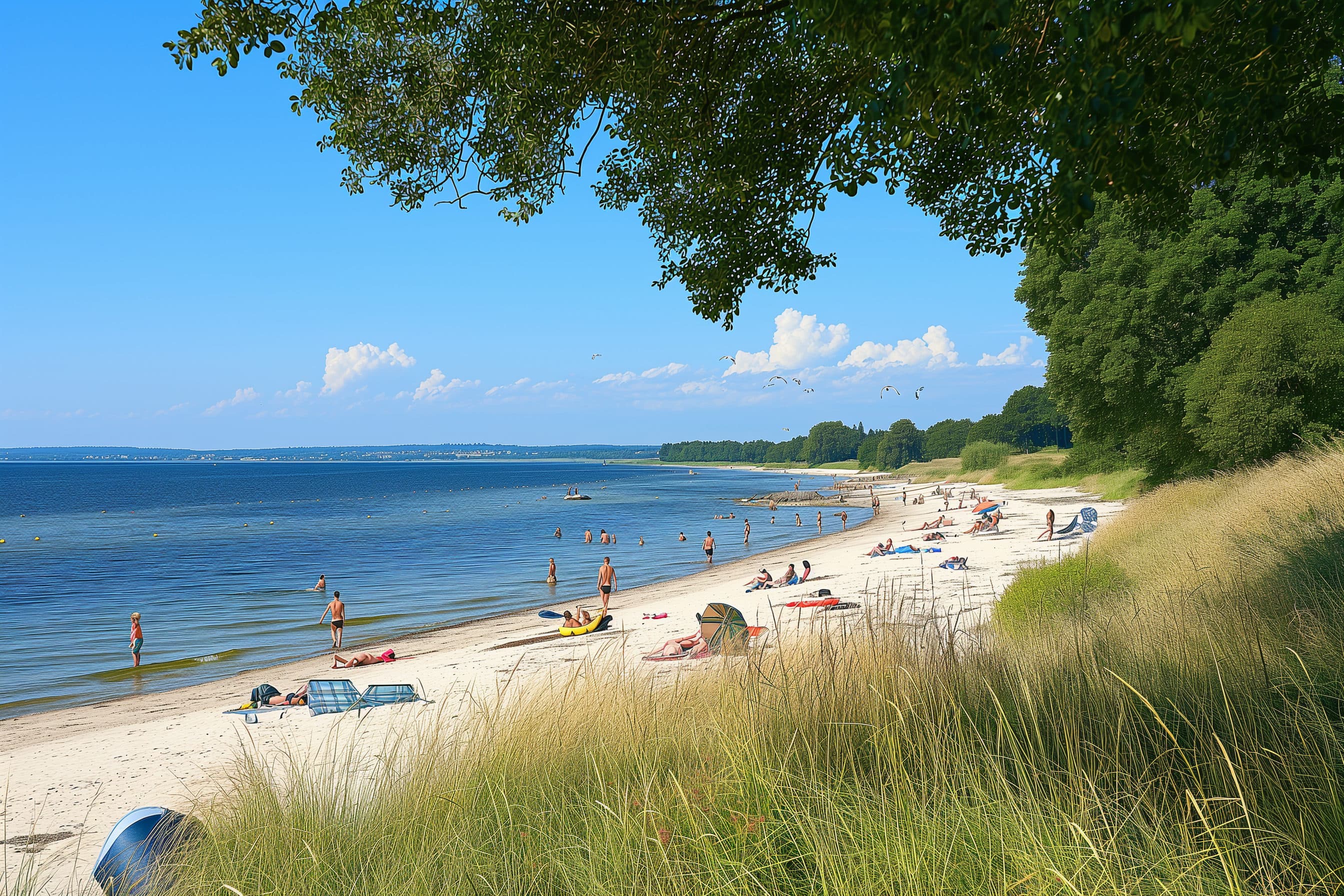
Outdoors, FKK lives at the water. Along the Baltic and North Sea coasts, and at many inland lakes, you will find stretches marked FKK or Textilfrei where nude bathing is the norm, often right next to a clothed section, with people moving between the two without fuss. The island of Rügen and the lakes around Berlin, such as the Müggelsee and parts of the Wannsee, are long-established examples. Nude sunbathing is also tolerated in some city green spaces: the Tiergarten in Berlin and the Schönfeldwiese meadow in Munich’s Englischer Garten are well-known spots where people have sunbathed without clothes for decades. These park areas are tolerated rather than officially designated, and the boundary can shift, so take your cue from what people around you are actually doing. For everything else parks offer, from playgrounds to barbecue meadows, see our guide to outdoor activities and parks.
Finally there are dedicated FKK campsites, holiday resorts and clubs, where nudity is the default across the whole site rather than in one corner of it. These range from simple naturist campgrounds to full resorts with pools, restaurants and wellness facilities, and they attract families and older regulars as much as anyone. You do not need to seek these out to live comfortably in Germany, but it helps to know they exist, so that “FKK” on a campsite listing or a beach sign reads as information rather than a surprise.
Reading the signs is straightforward once you know the words. A stretch marked FKK or Textilfrei is for nude use; one marked Textil or Badebekleidung is for people in swimwear. In practice the line between them is relaxed, and at many lakes clothed and unclothed bathers share the same shore with no tension at all, so a nude area is an invitation, never an obligation. The sensible approach at any new spot is to arrive, look at what people nearby are doing, and match it; if in doubt, a towel over your lap while you get your bearings is completely unremarkable. As with the sauna, the outdoor version is treated as ordinary rather than daring, and the same no-staring, no-photographs courtesy applies at the water as it does in the cabin.
The Sauna Etiquette a Newcomer Must Know
This is the section that saves real embarrassment, so it is worth reading closely before your first visit. Start with the basic rule: in the sauna cabin you are nude, not in a swimsuit. Take your swimwear off before you go in. The one thing you always bring is a large towel, and its job is that no bare skin touches the wood, feet included. You sit or lie fully on your towel, with the whole footprint of your body on the fabric, not on the bench. Before you enter, you shower and dry off, both for hygiene and because clean, dry skin sweats better. A bathrobe or a second towel wrapped around you is completely normal for walking between the sauna, the showers and the rest area; the nudity belongs to the cabin and the wash area, not necessarily to the whole building.
Inside, the atmosphere is quiet. People speak little and softly, if at all, and many sit with their eyes closed. The great ceremony of the German sauna is the Aufguss, an “infusion”: at set times a Saunameister (sauna master) enters, ladles water mixed with essential oils onto the hot stones, and then wafts the wave of scented heat around the room with a towel, often in a practised, almost theatrical routine. It is a genuine ritual with a schedule, the Aufgussplan, posted at the door, and the door is usually closed once it begins. The etiquette is to arrive before it starts and to stay until it ends rather than walking out in the middle, which is considered rude and disruptive. If you think you cannot take the heat for the full round, sit on a lower bench, where it is cooler, rather than leaving partway through.
It also helps to know the rhythm the whole thing is built around, because a German sauna visit is a cycle, not a single sit. You spend perhaps eight to fifteen minutes in the heat, then leave to cool down properly: a cold shower first, then often a plunge pool (Tauchbecken) or a bucket of cold water, and ideally a few minutes of fresh air outside. Cooling down fully is the point of the exercise, not an afterthought, so do not skip it. After that you rest, drink water and let your body settle before going back in, and most people repeat the round two or three times over a couple of unhurried hours. Nudity aside, the etiquette here is the same you would expect anywhere: shower off sweat before you use a shared plunge pool, and do not rush or crowd other people through the sequence.
Two rules are close to absolute. First, phones and cameras are strictly out; taking a photograph in a nude space is a serious breach and, in a spa, will get you removed. Leave your phone in the locker. Second, and most important of all, do not stare. The entire logic of FKK is that nudity is unremarkable, so the polite thing is to treat it as unremarkable: keep your eyes at face level in conversation, do not look people up and down, and do not comment on anyone’s body. Think of it as behaving exactly as you would if everyone were dressed. Most saunas are mixed-gender, but many venues also set aside a Damentag, a women-only day or session, for anyone who prefers that, so it is worth checking the schedule if mixed nudity is not for you.
What It Means and How to Handle It as a Foreigner
At its core, FKK is about naturalness and equality rather than display. Without clothes there are no labels, no expensive brands and fewer obvious markers of status, and that levelling is part of the appeal: everyone is simply a person. This connects to a wider German quality often called Gelassenheit, a relaxed, unbothered composure, applied here to the body. Germans tend not to treat the naked body as either shameful or thrilling; it is just a body, and yours is no more interesting to the people around you than theirs is to you. Understanding this reframes the whole experience. The nervousness a newcomer feels is almost always about being looked at, and the reassuring truth is that nobody is looking.
You are also free to opt out, and it is worth being honest about the trade-off. Nobody will force you to undress, and you can keep a towel or robe around you between rooms as much as you like. But wearing a swimsuit inside a nude sauna does mark you out as the tourist, and in many venues it is not permitted anyway. A comfortable middle path for a first visit is to go at a quiet time, keep a towel handy, and give yourself permission to leave whenever you want; almost everyone is self-conscious the first time, and it passes quickly once you notice how little attention anyone pays. If total nudity is genuinely not for you, choose a Damentag, a women-only spa, or simply stick to the pool, which has different rules, described in the next section.
The one boundary you must never cross is the sexual one. Because the whole culture rests on nudity being non-sexual, anything that sexualises the setting - staring, comments, flirtation, arousal made obvious, and of course photography - is a serious faux pas and can get you thrown out or worse. This is a common point of confusion for newcomers who assume a nude space must be a sexual one; it is precisely the opposite, and a German would read that assumption as crude. Keep it entirely separate in your mind from dating and romance, which run on their own, clothed set of social codes explained in our guide to the German dating scene. In the sauna or on the FKK beach, the correct attitude is friendly indifference.
Changing Attitudes and Practical Notes
FKK is not quite as universal as it once was. Among younger Germans the enthusiasm for organised naturism has cooled, and some older easterners genuinely worry that the tradition is fading, blaming a mix of smartphone-era self-consciousness and more buttoned-up newcomers. At the same time, the everyday version of it remains completely normal: the nude mixed sauna is still the default, established FKK beaches and lake sections are still busy, and older generations in particular carry on exactly as before. So the honest picture is not “dying” but “narrowing”: less of the club-and-movement side, as strong as ever in the sauna and at the water. As a newcomer you will meet the normal, unremarkable version far more often than any decline.
Two practical points round this out. First, families and children are a natural part of FKK, not an awkward exception. Kids at a nude beach or in a sauna are treated as entirely ordinary, and the culture’s non-sexual framing is exactly what makes that unremarkable to Germans; there is nothing to read into it. Second, the body positivity here is refreshingly real. FKK spaces are full of ordinary bodies of every age, size and shape, and the complete absence of posing or judgement is often what wins newcomers over once the first nerves wear off. Nobody is presenting an idealised image, so there is little to measure yourself against.
The most useful practical distinction to memorise is the difference between the pool and the sauna, because they have opposite rules and share a building. In the Schwimmbad, the swimming pool itself, a swimsuit is required and swimming nude is not allowed. In the attached sauna and steam area, the swimsuit comes off and nudity is expected. Many facilities are laid out as exactly this pair, so the moment you cross from the pool hall into the sauna zone, the dress code flips. If you remember only one rule from this chapter, make it that one: costume on in the water, costume off in the sauna.
There are a few exceptions worth checking before you assume the nude rule. Some gym chains, hotel spas and more international venues run a “textile” sauna or set aside textile hours, where swimwear is required or allowed, and a handful of larger complexes offer both a nude area and a textile one under the same roof. These are the minority, and the classic public sauna and the traditional Therme remain nude, but the venue always states its rule, whether at the entrance, on its website or on a sign at the sauna door. When in doubt, read that sign or ask at reception; a one-line question saves you from walking in either overdressed or underdressed.
What to Do Next
You do not have to become a naturist to live comfortably in Germany, but a little preparation makes the first encounter painless. If a sauna is your likely starting point, pack a large towel and a bathrobe, plan to shower first, sit fully on your towel, keep quiet, leave the phone in the locker, and treat the nudity around you as the non-event that Germans consider it to be. Check the venue’s schedule for the Aufgussplan if you want to try the ritual, and for a Damentag if you would prefer a women-only session. For the wider spa and thermal-bath experience beyond the nudity, turn to our guide to wellness and spas, and for nude sunbathing and swimming outdoors, our guide to outdoor activities and parks. Go once, notice how little anyone reacts, and the whole thing quickly stops feeling strange.
This chapter is general orientation for everyday life, not legal advice; rules on nudity in specific public places can vary by city and by site, so follow local signs and staff instructions where they apply.
Sources
The information in this chapter draws on the official sources and publications listed below, last reviewed in July 2026. It is general guidance for orientation, not individual legal, tax, or medical advice.
- iamexpat.de
- the-berliner.com
- en.wikipedia.org
- the-berliner.com / curtisatkins / fattiretours