




 Turkish
 Italian
 Spanish
 Portuguese
 Romanian
 Albanian
 Lithuanian
 Latvian
 Bulgarian
 Greek
Greek Hungarian
 French
 Croatian
 Czech
Czech
Beer and wine are two of the things Germany is most proud of, and both come wrapped in centuries of custom that can be hard to read from the outside. This chapter explains German beer and wine culture as a product and a way of life: where the famous purity law comes from and what it means today, how to tell a Pils from a Weißbier, why Germany is a serious wine country and not only a beer one, how the Biergarten and the winemaker’s tavern actually work, and the practical rules on age, buying and drinking that a newcomer should know. The aim is to help you order with confidence, understand what people are drinking around you, and take part in the rituals without feeling like a tourist.
A quick note on where this chapter stops. Beer and wine as festival events – the crowds, the dates and the tickets for Oktoberfest or the wine fairs – belong to our guide on food festivals and events. Bars, the neighbourhood Kneipe and the legality of drinking in public are covered in nightlife and entertainment. Here we stay with the drinks themselves and the culture that surrounds them.
Beer, the Purity Law and a Country of Breweries
German beer culture rests on one famous rule: the Reinheitsgebot, the beer purity law. It was issued in Bavaria in 1516 by Duke Wilhelm IV, and in its original form it said that beer could be made from only three things: water, barley and hops. Yeast is not mentioned, simply because nobody at the time understood the role it plays in fermentation; it was added to the definition much later, once brewers knew what it did. The law was partly about quality and partly about economics, keeping wheat and rye for bakers, but over five centuries it turned into a point of national pride.
It helps to understand what the Reinheitsgebot is and is not today. It is no longer the strict, all-governing statute many people imagine. Germany now regulates brewing through the Vorläufiges Biergesetz, the provisional beer law, and European free-movement rules mean the purity standard cannot be used to keep foreign beers off German shelves. In practice the Reinheitsgebot survives as a tradition and a marketing promise: many German brewers still brew to it and say so proudly on the label, while imported beers made with other ingredients are sold freely alongside them. So when you see “gebraut nach dem Reinheitsgebot” on a bottle, read it as heritage and a quality signal rather than a legal guarantee that every beer in the shop follows the same recipe.
The other thing that surprises newcomers is sheer variety. Germany has more breweries than any other country in Europe – roughly 1,400 in the mid-2020s, down a little from a peak near 1,550 – and they are spread across the country rather than concentrated in a few big names. The densest brewing landscape of all is in Franconia, the northern part of Bavaria around Bamberg, where small village breweries still sit within a short drive of one another. This is why beer in Germany is so regional. A beer that is completely normal in Cologne can be almost unheard of in Munich, and locals tend to be loyal to the style their home city brews. Learning those regional identities is a large part of learning German beer.
The Main German Beer Styles
If you learn only one word, make it Pils. Pils, short for Pilsner, is a pale, crisp, clearly hop-bitter lager, and it is the everyday beer of most of Germany, especially the north and west. When you ask simply for “ein Bier” in much of the country, a Pils is what you will usually get, poured slowly into a 0.3 or 0.5 litre glass with a firm white head. It is dry and refreshing rather than sweet, and it sets the baseline against which the regional styles stand out.
Bavaria and the south have their own family of beers. Helles is a pale lager too, but softer and more malt-forward than Pils, with only gentle bitterness; it is the relaxed, sessionable beer of Munich. Its darker cousin is Dunkel, a brown lager with bread-crust, caramel and light chocolate notes, and the malty heavyweights are the Bock and the stronger Doppelbock, together known as Starkbier, “strong beer”. These were famously brewed by monks to sustain them through Lent, and they are still a winter and early-spring speciality. The most distinctive southern beer of all is Weißbier, also called Weizen or Weizenbier, a cloudy wheat beer served in a tall, waisted glass. Its banana-and-clove aroma comes from the yeast; ordered as Hefeweizen it is served with that yeast still in it, giving the classic cloudy look, while a Kristallweizen is the same beer filtered clear.
Two western cities take regional pride to its logical extreme. In Cologne the local beer is Kölsch, a pale, delicate top-fermented beer served in a slim straight 0.2 litre glass called a Stange. Waiters known as Köbes carry them round on a ring-shaped tray and keep replacing your empty glass with a full one, marking each on your coaster, until you put the coaster on top to signal that you have had enough. Kölsch is a protected designation: to be called Kölsch, a beer essentially has to be brewed in and around Cologne. Barely forty kilometres away in Düsseldorf the local beer is Altbier, a dark copper, top-fermented brew served in a similar way, and the good-natured rivalry between the two cities and their beers is a real and much-enjoyed part of local identity.
A few more styles are worth knowing when you meet them. Berliner Weisse is a tart, low-alcohol wheat beer traditionally served with a Schuss, a shot of green woodruff or red raspberry syrup to soften the sourness. Rauchbier, the smoked beer of Bamberg, is made with malt dried over beechwood fires and tastes startlingly of smoked ham the first time; give it a second glass before deciding. And on a hot day almost anywhere you can order a Radler, beer mixed roughly half and half with clear lemonade, a light shandy that is completely respectable to drink in public and a good option if you want something less strong.
One modern development worth knowing is how seriously Germany takes alcohol-free beer. Alkoholfreies Bier is no longer an afterthought but a genuine category that most breweries make well, in Pils, Helles and Weizen versions that taste close to the real thing. Many Germans drink it by choice, not only when driving, and alcohol-free wheat beer in particular is popular as an isotonic drink after sport. If you would rather not drink much but still want to join in and hold a proper beer glass, ordering “ein alkoholfreies” is completely normal and nobody will think twice about it.
Where Germans Drink Beer
The heart of German beer culture is the Biergarten, the beer garden. In its traditional Bavarian form it is an outdoor space, classically under chestnut trees, with long shared benches where strangers sit down next to one another and fall into conversation. The word for that easy sociability is Geselligkeit, and it is the whole point: you come to sit, talk and let an afternoon go slowly. Beer is usually ordered by the Maß, a full litre in a heavy glass stein, or by the Halbe, a half litre, though many places also pour smaller measures. A genuinely traditional Munich beer garden has one feature that delights newcomers: at the self-service tables you are allowed to bring your own food, spreading out a Brotzeit of bread, radishes, cheese and sausage on the table, as long as you buy your drinks there. This right goes back a long way and is written into Bavarian rules on beer gardens, so it is not a favour but a genuine local custom. Not every beer garden with table service allows it, so watch what the regulars do.
Indoors, the equivalent is the Brauhaus, a brewery tap or beer hall serving its own beer alongside hearty food, and in many towns you will find a Stammtisch, a regulars’ table reserved for a fixed group of locals who meet on the same evening each week; look for the little reserved sign and do not sit there uninvited. Beer also anchors some of Germany’s biggest cultural moments. Munich’s Oktoberfest and the Starkbierfest, the strong-beer season around Lent, are woven deeply into Bavarian identity, with their special beers, brass bands and traditional dress. As experiences to attend, with all the practical detail, they sit in our guide on food festivals and events; what matters here is that they are expressions of a living beer culture, not tourist inventions.
One practical habit to pick up early is the deposit system. Most beer bottles and the crates they come in carry a Pfand, a refundable deposit you pay at the till and get back when you return the empties, which is why Germans hoard bottles and return them by the crate. It is explained in full in our guide to grocery shopping tips, but it is worth knowing before your first supermarket run so you are not surprised by the extra euros on your receipt.
Germany as a Serious Wine Country
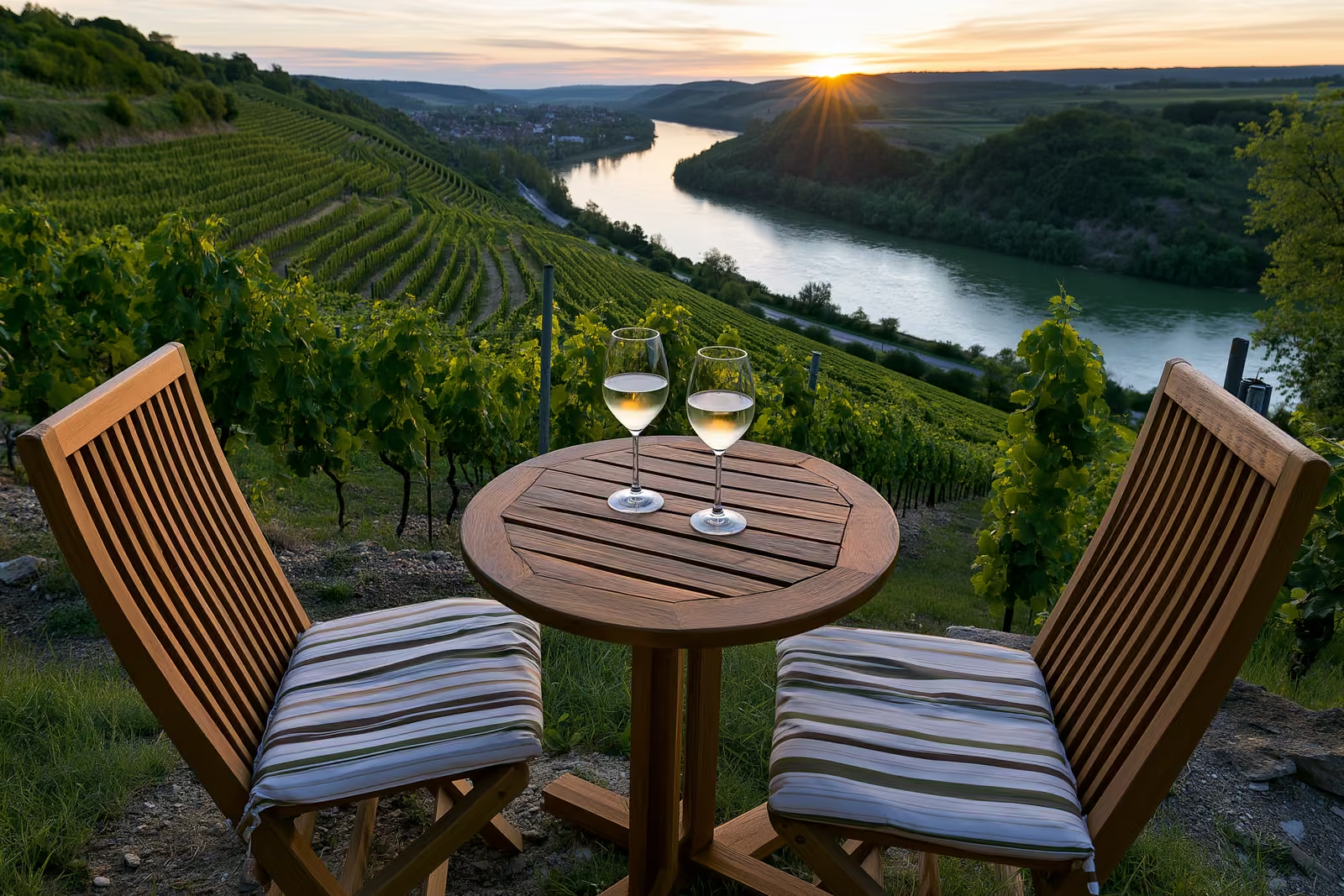
Many newcomers arrive thinking of Germany purely as a beer nation and are surprised to learn that it is also a respected producer of wine. There are 13 official wine regions, the Anbaugebiete, most of them clustered in the warmer south and west along river valleys: the Mosel, the Rheingau, Rheinhessen and the Pfalz are the best known, with Baden and Franken and the smaller Ahr, Nahe, Mittelrhein, Hessische Bergstraße, Württemberg, Saale-Unstrut and Sachsen completing the list. The cool climate is exactly what makes German wine distinctive, giving wines with lower alcohol and bright, food-friendly acidity rather than the heavy warmth of southern-European styles.
The signature grape is Riesling, and Germany is regarded as its finest home in the world. Riesling is remarkably versatile: it can be bone dry, labelled trocken, or off-dry (halbtrocken or feinherb), or lusciously sweet, always carrying aromas of orchard fruit, citrus and a mineral, sometimes petrol-like note that fans love. If you take away one thing about German white wine, let it be that trocken on the label means dry, which is what most modern German Riesling actually is. Beyond Riesling the whites include the soft, pear-scented Grauburgunder (Pinot Gris) and Weißburgunder (Pinot Blanc), the earthy Silvaner that is the pride of Franconia, and the gentle, floral Müller-Thurgau. Germany also makes serious red wine now, something that would have surprised drinkers a generation ago: the star is Spätburgunder, the German name for Pinot Noir, which from the best sites rivals good Burgundy, alongside regional reds like the light Trollinger and the spicy Lemberger of Württemberg.
German wine labels look intimidating but follow a logic worth learning. The top quality band is Prädikatswein, and within it the traditional Prädikat levels are ordered by how ripe the grapes were at harvest: Kabinett (light and fresh), then Spätlese (late harvest), Auslese (selected ripe bunches), and the rare dessert wines Beerenauslese and Trockenbeerenauslese made from individually picked, shrivelled, nobly rotten berries. Eiswein, ice wine, is a category of its own, pressed from grapes left to freeze on the vine. Importantly, these words describe ripeness, not sweetness: a Spätlese can be made dry. Running alongside the official system is the private classification of the VDP, an association of leading estates, whose top single-vineyard dry wines are labelled Großes Gewächs, often shortened to GG, and are among the best Germany produces. You do not need to memorise all of this to enjoy the wine, but recognising trocken, Riesling, Spätburgunder and GG will get you a long way in any German wine shop.
Wine Culture and the Seasonal Rituals
German wine has its own venues and its own calendar. In the wine regions the classic place to drink is the Weinstube, a small, cosy wine tavern serving local bottles by the glass with simple regional food. More seasonal, and more charming, is the winemaker’s own temporary tavern, which goes by different names in different regions: Straußwirtschaft or Besenwirtschaft in the south-west, sometimes Heckenwirtschaft in Franconia. These are pop-up bars that a Winzer, a winemaker, is allowed to run for a limited number of weeks each year in their own home, courtyard or barn, selling their own wine and a short menu of home cooking. Traditionally the family hangs out a broom or a wreath to show they are open, which is where the “broom tavern” name comes from. Sitting in one, drinking a wine made fifty metres away and served by the person who made it, is one of the loveliest and most authentic experiences the wine country offers.
Autumn brings a ritual not to be missed: Federweißer, the young, still-fermenting wine sold cloudy and only lightly alcoholic, fizzing and sweet and changing character by the day. It is drunk fresh in the weeks after harvest, traditionally paired with Zwiebelkuchen, a warm savoury onion tart, a match you will find written up in our guide to traditional German dishes. As the year turns cold, wine reappears as Glühwein, hot spiced mulled wine, which is the defining drink of the Christmas markets; those markets as an event are covered in our guide to German festivities and local traditions. Year round, Germany also makes plenty of Sekt, its sparkling wine, drunk to celebrate birthdays and New Year, and on a warm day the everyday favourite is a Schorle: a Weinschorle is wine cut with sparkling water into a long, refreshing spritzer, while the non-alcoholic Apfelschorle, apple juice with fizzy water, is one of the most ordered soft drinks in the country. Finally, after a big meal you may be offered a Schnaps, a clear fruit spirit; the fruit brandies of the south are called Obstler, while Korn is a lighter grain spirit from the north, and either is drunk in a small glass as a digestif to settle the stomach.
Drinking Well: Rules, Norms and Where to Buy
A few points of law are worth having straight, stated plainly and not as legal advice. Under the youth-protection law, the Jugendschutzgesetz, young people may buy and drink beer, wine and Sekt from the age of 16, while spirits and anything distilled are only permitted from 18. Shops and bars check identity documents, so carry ID if you look young. Drinking in public – on a park bench, at the station, on the street – is broadly legal and normal in Germany in a way it is not in many countries, and the details, along with bar and Kneipe culture, are covered in our guide to nightlife and entertainment. The one place the relaxed attitude ends firmly is behind the wheel: Germany sets a blood-alcohol limit of 0.5 for drivers, with stricter rules for new and young drivers, and you should read our guide to driving in Germany before mixing any drinking with a car. The safe habit is simply not to drive if you have been drinking.
The social norms are gentler but real. When you raise a glass to toast, the word is “Prost” for beer and often “Zum Wohl” for wine, and the important part is to make eye contact with each person as your glasses touch; looking away is considered rude, and this small ritual matters more than newcomers expect. There is more on this in our guides to German dining etiquette and wider social etiquette. Moderation is quietly valued: Germans drink often but getting visibly drunk in ordinary company is frowned upon, and one of the most cherished small rituals is the Feierabendbier, the single beer that marks the end of the working day, enjoyed slowly rather than raced.
As for buying, you have plenty of options. Ordinary supermarkets and discounters carry a solid range of beer and wine at low prices, and dedicated drinks shops called Getränkemarkt sell beer by the crate with the deposit built in, which is how most households stock up. In cities the Späti, the late-opening corner shop, is where you grab a cold bottle in the evening after the supermarkets close. For wine, the most rewarding route is to buy direct from a Weingut, a wine estate, either at the cellar door in a wine region or increasingly by mail order; you will pay fair prices and often taste before you buy. A good next step is simply to start where you live: order the local beer style by its regional name, ask for a dry Riesling or a Spätburgunder from the nearest wine region, and if you are near the vineyards, look out for a Straußwirtschaft in late summer. That is how Germans themselves enjoy these drinks – locally, seasonally and in good company.
About this information
This chapter is general orientation based on widely-published information about everyday life in Germany, last reviewed in July 2026. It is general guidance, not individual legal, tax, or medical advice. See the related WeLiveIn.de chapters linked in the text above for topic-specific detail and official sources.

