Regional Specialties
15 min read
Germany is not one cuisine but a couple of dozen, and the difference is bigger than most newcomers expect. The country only became a single nation in 1871, and its food still follows the old borders of kingdoms, duchies and bishoprics, so a three-hour train ride can carry you from veal sausage and sweet mustard to smoked eel and kale stew. This chapter is a foreigner’s tour of German regional specialties, region by region, so that when a trip, a move or a dinner invitation drops you somewhere new you know what the kitchen there does best and how to order it. Our traditional German dishes chapter maps the staples every region shares; here we go local and dig into what each corner of the country puts on the table.
Bavaria and the south-east: the beer-garden table
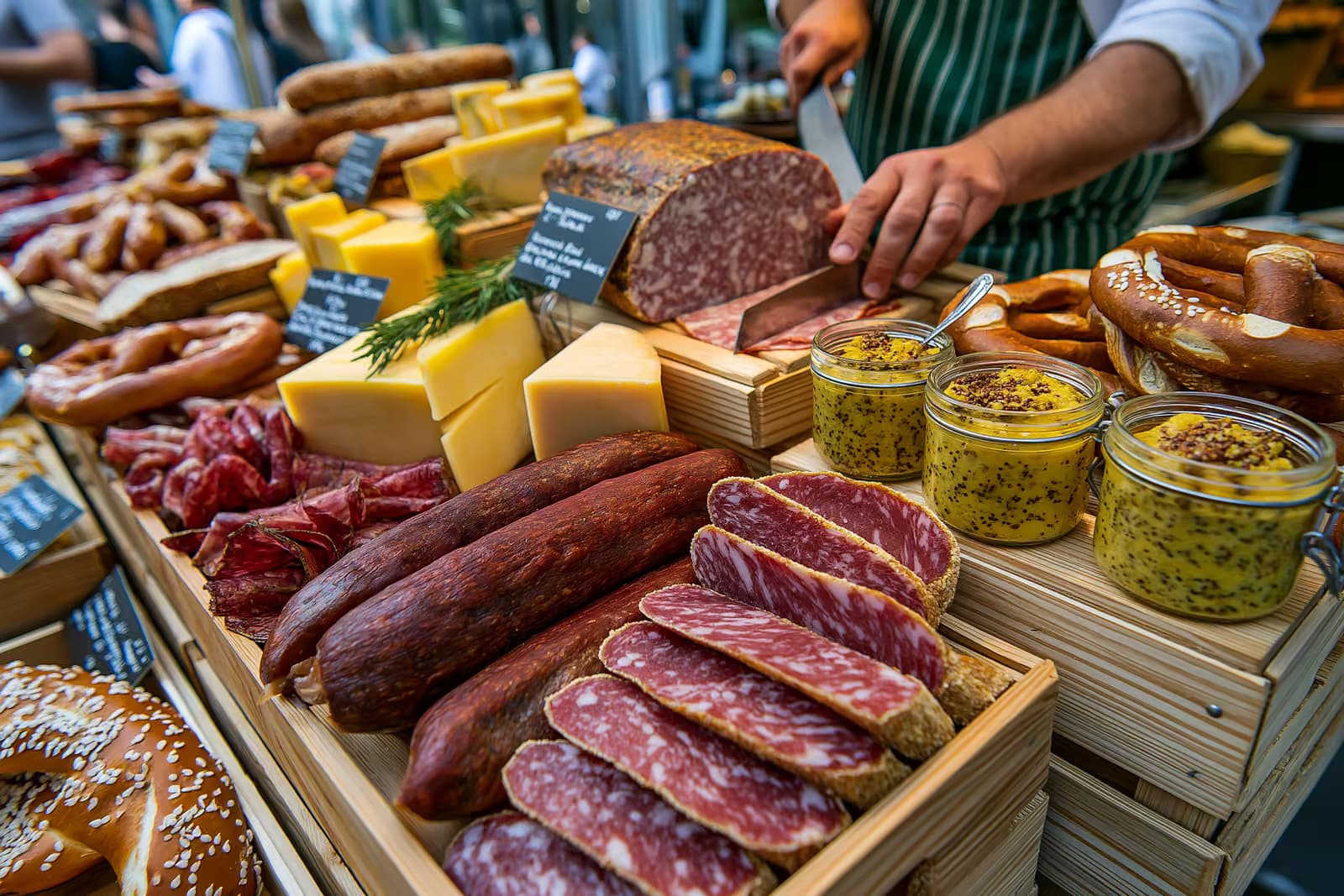
Bavaria (Bayern) is the Germany the rest of the world pictures, and for once the cliche is delicious. The day begins, in the old way, with Weißwurst, a pale sausage of finely minced veal and pork back bacon seasoned with parsley and lemon. Tradition holds that it should be eaten before the midday bells, because it was made fresh each morning in the days before refrigeration. You do not eat the skin: locals either peel it or “zuzeln” it, sucking the meat straight from the casing, always with Süßer Senf (sweet mustard), a soft Brezn (pretzel) and, if the hour allows, a wheat beer. Alongside it sits Leberkäse, a smooth baked meatloaf whose name means “liver cheese” though the Bavarian version usually contains neither. A warm slice pressed into a Semmel (bread roll) becomes a Leberkässemmel, the classic quick lunch of the south.
The heart of Bavarian eating, though, is the Biergarten, the shaded gravel courtyard under chestnut trees where whole families gather over long wooden tables. The plates here are built for sharing and for soaking up beer. Obatzda is the essential starter, a spread of ripe Camembert or Brie mashed with butter, sweet paprika and finely chopped onion, scooped up with bread or pretzel. From the kitchen comes Schweinshaxe, a roasted pork knuckle with shattering crackling and a mound of Knödel to soak up the juices, either Semmelknödel rolled from stale bread or Kartoffelknödel made from potato. For the drinks that belong beside all this, our wine and beer culture chapter is the place to go; here we stay with the food. Save room for Dampfnudeln, a steamed yeast dumpling served warm in a pool of vanilla sauce, the comforting close to a cold-weather meal.
The north of Bavaria is a country of its own in the eating. Franconia (Franken), around Nuremberg, Bamberg and Würzburg, keeps a distinct table and does not thank you for calling it Bavarian. Its Bratwurst is coarser and more herby than most, and its Sunday roast is Schäufele, a pork shoulder slow-roasted on the blade bone until the crackling gives way to meltingly tender meat, served with a dark beer gravy and a dumpling. Nuremberg’s own contribution is a study in doing small things exactly right: the Nürnberger Rostbratwürste, finger-sized, heavily scented with marjoram, grilled and eaten six or a dozen at a time. They carry an EU protected-origin mark, so a sausage may only be called a Nürnberger if it was made within the city limits to the traditional recipe, a point we come back to below. Franconia also happens to have one of the densest concentrations of small breweries anywhere on earth, which is a story for the drinks chapter rather than this one.
Swabia and Baden: thrift turned into an art
Cross into Baden-Württemberg and the sausages give way to noodles. Swabia (Schwaben), the region around Stuttgart, Tübingen and the Swabian Alb, is the home of Spätzle, soft egg noodles scraped in ragged strips from a board straight into boiling water. In their most beloved form they become Käsespätzle, layered with grated mountain cheese and crowned with a heap of deep-fried onions, a dish that outdoes any macaroni cheese and needs nothing more than a green salad beside it. The other Swabian icon is the Maultasche, a large pasta pocket stuffed with a mixture of minced meat, spinach, soaked bread and onion. Swabians eat them three ways: floating in a clear broth, sliced and fried in butter with egg, or “geschmälzt” under a shower of browned onions.
Maultaschen come with the best story in German food. Their nickname is Herrgottsbscheißerle, roughly “little God-cheaters”, from a tale that Cistercian monks invented them to smuggle meat past the Lenten fast by hiding it inside the dough where, they reasoned, God could not see it. The dish is still traditionally eaten during Holy Week. It is also a protected name: Schwäbische Maultaschen were entered on the EU register as a protected geographical indication in 2009, so the label belongs to Maultaschen actually made in the region. Both the legend and the protection are real, and both tell you something about how seriously the Swabians take a humble parcel of leftovers.
That thriftiness is the key to the whole cuisine. Swabians are teased across Germany for their carefulness, symbolised by the Kehrwoche, the strict rota that decides whose turn it is to scrub the shared stairwell, and their cooking is thrift raised to an art: lentils, flour, eggs and stale bread turned into food worth travelling for. The everyday classic is Linsen mit Spätzle und Saiten, brown lentils stewed with a splash of vinegar, served over Spätzle with a pair of slim Saitenwürste (Vienna-style sausages). A Sunday brings out the Zwiebelrostbraten, a thick slice of sirloin topped with a tangle of fried onions in a dark gravy, again with Spätzle to catch it. Even the soup is frugal and clever: Flädlesuppe is a good beef broth with ribbons of thin, rolled-up pancake floating in it.
The western edge of the state tells a softer, sunnier story. Baden runs down the Rhine along the French border, and its cooking leans toward its neighbour: richer sauces, more game and fish, and a wine-country ease that Baden folk are quietly certain makes them the better eaters of the two halves. This is one of Germany’s warmest corners, and its Sunday lunches, washed down with a local Spätburgunder or a crisp white, feel closer to Alsace than to the Alb. The drinks belong to our wine and beer culture chapter, but the unhurried, produce-led spirit of the Baden table is very much part of the regional map.
The Rhineland and the west: sweet-sour and stuffed
Follow the Rhine north into North Rhine-Westphalia and the Palatinate and the flavours turn earthy and a little sweet. Cologne’s homely classic is Himmel un Ääd, “heaven and earth” in the local dialect, apples for the heaven and potatoes for the earth: a plate of mashed potato and apple sauce with a fat slice of fried Blutwurst (black pudding) and browned onions on top. The region’s great festive roast is Rheinischer Sauerbraten, a pot roast marinated for days in vinegar and spices. It was traditionally made with horse meat, and a few old-school butchers still offer that version, but nearly everyone now uses beef. What makes it unmistakably of the Rhineland is the gravy, thickened and sweetened with Rosinen (raisins) and Rübenkraut (sugar-beet syrup) into a dark sweet-sour sauce, served with Rotkohl (red cabbage) and Klöße (dumplings).
Cologne also plays a trick on visitors. Order a Halve Hahn expecting, as the name promises, half a chicken, and you will be handed a rye roll with a thick slice of aged Gouda, mustard and onion rings, and no poultry whatsoever. The name is a century-old local joke and Kölner still enjoy the moment of confusion on an outsider’s face. More straightforward, and beloved across the whole west, are Reibekuchen, crisp pancakes of grated raw potato fried until golden and eaten with apple sauce or a smear of Rübenkraut. They turn up at every market and Christmas fair; the street-stall version is covered in our street food and snacks chapter.
South into Rhineland-Palatinate lies one of Germany’s most characterful dishes, the Pfälzer Saumagen. The name means “sow’s stomach”, which describes the method rather than the flavour: a pig’s stomach is used as a natural casing, packed with seasoned pork and potato, simmered, then sliced and pan-fried so the outside crisps. It became nationally famous as the favourite dish of Chancellor Helmut Kohl, who came from the region and made a point of serving it to visiting heads of state, from Gorbachev to Thatcher. It is not an EU-protected name, but it is a genuine local institution, best eaten in a Palatinate wine village with a glass of the region’s white. Neighbouring Saarland, hard against the French border, keeps its own potato speciality in Dibbelabbes, a shredded-potato casserole studded with leek and bacon and baked until crusty.
All along this French frontier you will meet Flammkuchen, the border’s shared treasure. A wafer-thin base of bread dough is spread with Crème fraîche, scattered with onion and Speck (bacon lardons) and blasted in a very hot oven until the edges char, then cut into squares and eaten with the fingers. It belongs as much to Alsace as to Germany, which is exactly the point: on the edges of the country, regional cuisine stops respecting the map. The wines that go with Flammkuchen and Saumagen, from the Palatinate and Baden vineyards, are the province of our wine and beer culture chapter.
The north: herring, kale and the smell of the sea
The coastal states, from Hamburg and Bremen across Schleswig-Holstein, Lower Saxony and Mecklenburg, eat with their backs to the North Sea and the Baltic, and fish runs through everything. The quick, cheap, everyday pleasure is the Fischbrötchen, a crusty roll stuffed with fish and eaten standing up by the harbour: soft, mild Matjes (young salted herring), sharp pickled Bismarckhering, hot fried Backfisch or a heap of tiny brown Nordseekrabben (North Sea shrimp), always with raw onion and often a pickle. It is the north’s answer to street food, and our street food and snacks chapter follows it to the stall. Beyond the roll, the coast prizes pan-fried Scholle (plaice), often cooked “Finkenwerder Art” with bacon, and smoked Aal (eel), a Hamburg and Baltic delicacy with a deep golden flesh.
The dish that surprises every newcomer is Labskaus, and it repays an open mind. Born as sailors’ food, made from what kept on a long voyage, it mashes salt beef or corned beef together with potato and beetroot into a startling pink hash, then tops it with a fried egg, a rolled pickled herring called a Rollmops and a gherkin. It looks like nothing else on the German table, and it tastes savoury, tangy and genuinely comforting. Do not judge it by the photograph; order it in a proper Hamburg or Kiel harbour tavern and you will understand why sailors were glad to see it.
Winter belongs to Grünkohl mit Pinkel, the great feast of the northwest around Oldenburg, Bremen and Lower Saxony. Curly kale is stewed for hours, ideally after the first frost has sweetened it, with Pinkel, a smoked sausage of oats, groats and spices, alongside Kassler (cured smoked pork) and boiled potatoes. It comes wrapped in one of Germany’s most cheerful traditions, the Kohlfahrt or Grünkohlfahrt: a group bundles up, walks out into the cold countryside pulling a handcart loaded with schnapps and hot drinks, plays silly games along the way, and ends the day at an inn eating kale until nobody can move, crowning the biggest eater the Kohlkönig, the kale king. For a foreigner it is one of the warmest ways to spend a dark January evening, and an invitation to one is worth accepting.
The north keeps a sweet side too. Hamburg’s own pastry is the Franzbrötchen, a flattened, caramelised roll of buttery, cinnamon-sugared dough, sticky in the middle and crisp at the edges, sold in every bakery in the city and almost nowhere else. Between the Fischbrötchen, the Franzbrötchen and a plate of Grünkohl, the northern table proves that hearty food is not only a southern habit; it just tastes of salt and smoke instead of beer and pork.
The east and the centre: sausages, pickles and a Berlin plate
Thuringia (Thüringen), the green heart of the country, guards two icons fiercely. The first is the Thüringer Rostbratwurst, long, thin and heavily seasoned with marjoram, caraway and garlic, grilled over charcoal until the skin snaps and eaten in a small roll with a stripe of mustard. Records of it go back to 1404, and it now carries an EU protected-origin mark, so the name belongs to sausages made in Thuringia to the traditional recipe. The second is the Thüringer Kloß, a pale, silky dumpling made from a mixture of raw grated and cooked potato, boiled whole and served as the essential partner to any Sunday roast such as a Thuringian Sauerbraten. Both are matters of regional pride, and both are protected names rather than loose descriptions.
Saxony (Sachsen) has a sweeter reputation, built on the coffee tables of Dresden and Leipzig. Its everyday treasure is Eierschecke, a Dresden cake of three layers, a thin base, a quark-and-custard middle and a rich egg-cream top baked until just set. Its famous export is the Dresdner Christstollen, the dense, marzipan-and-fruit Christmas loaf buried under icing sugar. It has been a protected geographical indication since 2010, made only by bakeries in and around Dresden, and the city celebrates it each December at the Stollenfest, where a giant Stollen is paraded through the streets and cut with a ceremonial knife. That festival, and the Christmas markets it belongs to, are covered in our guide to German festivities.
Much of the east still eats in a way shaped by the years of the GDR, the socialist East Germany that existed until 1990. The clearest survivor is Soljanka, a sour and spicy soup of pickles, smoked meat or sausage, tomato and paprika that arrived through Soviet ties and became a canteen staple; you still find it on menus from Rostock to Chemnitz. Brandenburg’s contribution surrounds Berlin in the watery maze of the Spreewald, whose Spreewälder Gurken, small crisp pickled gherkins, have been a protected geographical indication since 1999 and became a nostalgic symbol of the east after they starred in the film Good Bye Lenin.
Berlin itself keeps a plain, filling, working-city table. The dish to know is Eisbein, a cured and boiled pork knuckle, the pale northern cousin of the crackling-roasted Bavarian Schweinshaxe, served with Sauerkraut and a mound of Erbspüree (pea puree). The city’s fried meat patty is a Bulette, its own word for what other regions call something else entirely, and its jam-filled doughnut is a Pfannkuchen, which confuses every German visitor from elsewhere who expects that word to mean a flat pancake. And then there is Currywurst, the sliced sausage under curry ketchup that Berlin claims as its own invention; because it belongs to the pavement rather than the dinner table, we hand it to our street food and snacks chapter.
How regional specialties earn a protected name - and divide the country
Once you start noticing German regional specialties, you begin to see a legal mark attached to the best-known of them: geschützte Herkunft, protected origin. The European Union runs two schemes, a geschützte geographische Angabe or protected geographical indication (the g.g.A. label) and the stricter geschützte Ursprungsbezeichnung or protected designation of origin (g.U.), and a surprising number of the dishes in this chapter carry one. The Nürnberger Rostbratwürste have held protection since 2003, the Schwäbische Maultaschen since 2009, the Dresdner Christstollen since 2010, and the Spreewälder Gurken since 1999, while the Thüringer Rostbratwurst and Thüringer Kloß are protected too. In practice it works like the rules behind Champagne or Parma ham: a sausage may only be sold as a Nürnberger if it was made inside Nuremberg to the traditional recipe. For a newcomer it is a useful shortcut, a small guarantee that the name on the menu means what it says.
The other thing you learn is that Germans cannot agree on what to call the same food, and they rather enjoy the argument. The plain fried meat patty is the clearest example: it is a Frikadelle across much of the north and west, a Bulette in Berlin, a Fleischpflanzerl in Bavaria and a Fleischküchle in Swabia and Baden, all for one thing. Potato salad splits the country along a firm line, dressed cold and creamy with mayonnaise in the north and warm with broth, vinegar and oil in the south, and no cook will cross the floor. Even the humble breakfast roll changes its name from a Semmel to a Schrippe to a Wecken as you travel. These fault lines, and the shared staples of bread and potato that run beneath them, are mapped in more detail in our traditional German dishes chapter.
What all of this adds up to is a country where food is identity, and where the quickest way to place someone is to ask what they call their meatball. The regional map is not a museum piece either: it is alive on every menu and in every bakery window, and it rewards a foreigner who treats a move or a weekend trip as a chance to eat somewhere new rather than order the same Schnitzel everywhere.
Eating German regional specialties like a local
The practical trick to eating well is to find the right room. Regional cooking lives in the Gasthaus or Wirtshaus, the family-run inn where the menu is short, the portions are large and the dishes are the ones grandmothers made. Look past the laminated tourist card for a handwritten Tageskarte (daily menu) or a specials board, because that is where the kitchen puts what it is proud of and what is fresh that week. When in doubt, ask the person serving you what the local speciality is and order exactly that; you will almost never be steered wrong, and the question itself tends to open a warm conversation.
Let the seasons guide you too. Spring brings Spargelzeit, the white-asparagus weeks that much of the country treats as a national event; late summer the first golden Pfifferlinge (chanterelles); autumn the cloudy young wine and warm onion tart of the wine villages; and deep winter the Grünkohl of the north and the Christmas-market Stollen of the east. Ordering what is in season is the single easiest way to taste a region at its best, and our traditional German dishes chapter lays out that calendar in full.
Most of all, treat the local speciality as a way in. Germans warm quickly to a foreigner who takes an honest interest in their Maultaschen or their Grünkohl, and few things break the ice faster than joining a Kohlfahrt in January, a wine festival in September or a long afternoon at a Biergarten table shared with strangers. Food here is bound up with belonging, and showing up hungry and curious is a real step toward feeling at home, as our tips for building a social network chapter explains. So the next time the train sets you down somewhere new, skip the dish you already know. Ask what the region does, order it, and let Germany feed you one proud, particular plate at a time.
Sources
The information in this chapter draws on the official sources and publications listed below, last reviewed in July 2026. It is general guidance for orientation, not individual legal, tax, or medical advice.