





 Turkish
 Italian
 Spanish
 Portuguese
 Romanian
 Albanian
 Lithuanian
 Latvian
 Bulgarian
 Greek
Greek Hungarian
 French
 Croatian
 Czech
Czech
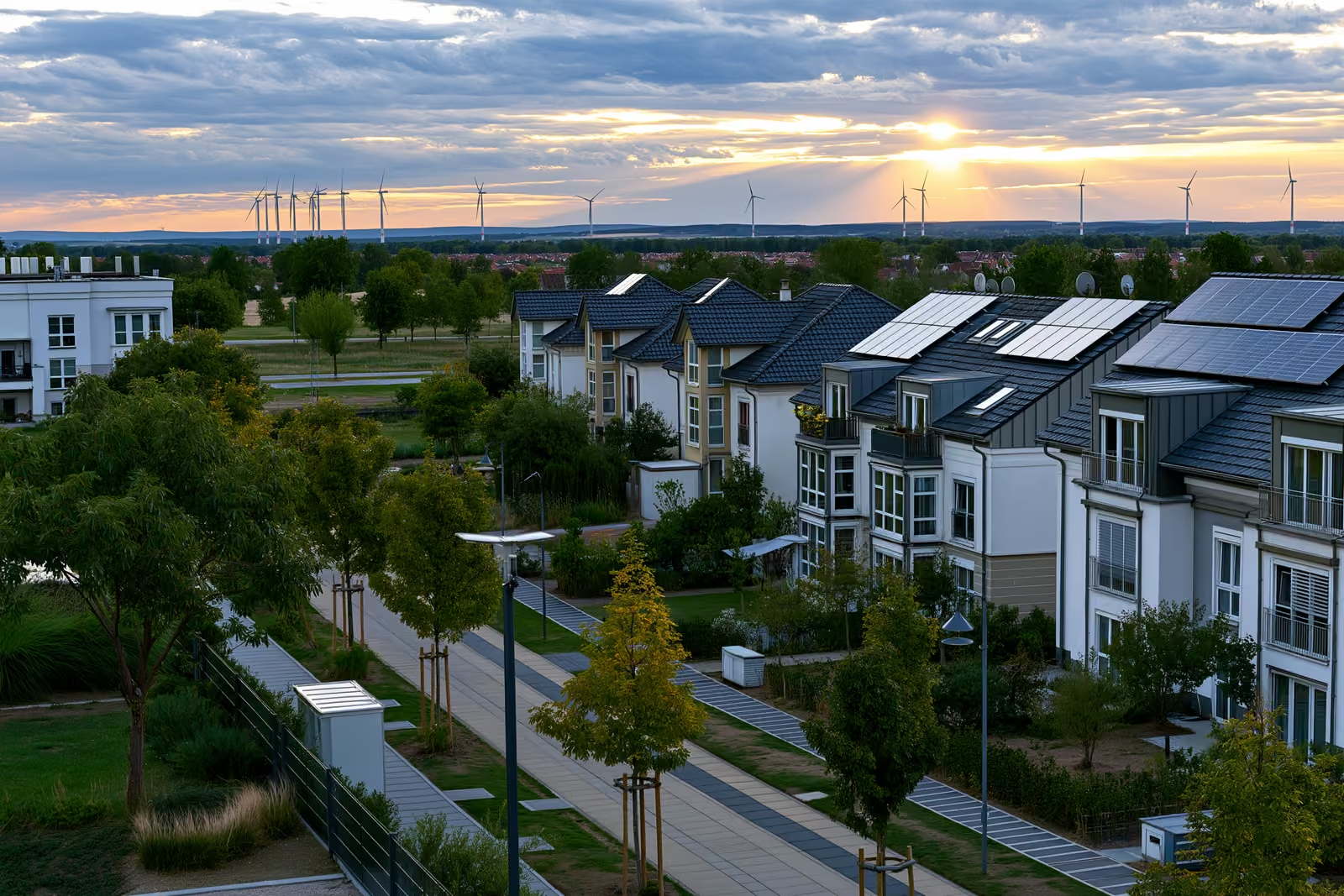
Germany lets you choose your electricity supplier, and almost every newcomer chooses badly, because nobody tells them the choice has already been made for them. On the day you move in you are supplied automatically, at the most expensive tariff in your postcode, by a company you never contacted. This chapter is about the market you have just been dropped into: how energy providers price their product, what a contract actually commits you to, what a Preisgarantie really guarantees, and how to leave. It is not about the move-in checklist. If you have just arrived and need to know how to register, read the meter and set up your Abschlag, our chapter on setting up utilities covers that ground and this one does not repeat it.
Start with the single distinction that confuses nearly every foreigner in Germany, because getting it wrong wastes months. If you rent, you almost certainly choose your own electricity supplier, and you almost certainly do not choose your heating. Electricity is your contract, in your name, and you can change it whenever you like. Heating is usually the landlord’s contract for the whole building, and it reaches you as a line in the annual Nebenkostenabrechnung, the statement of service charges. You cannot switch it, compare it or cancel it, because it is not yours. Every piece of advice below about switching applies to your electricity, and to your gas only where you have your own gas contract for a personal boiler or cooker rather than central building heat. What you can do about the heating bill is check it, and our chapter on understanding utility services explains how that statement is built and where landlords get it wrong.
Grundversorgung: The Energy Provider You Did Not Choose
Grundversorgung means basic supply, and it is the legal reason your lights work on your first evening even though you have signed nothing. Under §36 of the Energiewirtschaftsgesetz (EnWG), the energy industry act, one company in every network area must publish general terms and general prices and must supply every household customer on them. That obligation is what catches you. Draw electricity with no contract in place and, in law, you have accepted the published offer by conduct. You are now a customer of the Grundversorger, the basic supplier, on its Grundversorgungstarif.
The trap is what the Grundversorger is. §36(2) EnWG defines it with no reference to quality, price or public duty at all: it is simply the company that supplies the most household customers in that network area. That is a headcount, redetermined every three years on 1 July and published by 30 September. It is not a licence, not a public service and not an award. The company holds the position because it is the incumbent, and its incumbency is usually the legacy of the pre-liberalisation municipal utility, not a sign that it competes well. Nothing in the statute requires its price to be reasonable. In practice the Grundversorgungstarif is regularly among the most expensive tariffs available at that address, and a household that stays on it for a year without noticing typically pays a few hundred euros more than it needed to.
Now the fact that undoes the trap, and the one thing to remember from this chapter if you remember nothing else. Under §20 of the Stromgrundversorgungsverordnung (StromGVV), the ordinance governing basic electricity supply, the Grundversorgungsvertrag can be terminated with two weeks’ notice. Not at the end of a year, not on an anniversary, not with three months’ warning. Two weeks, at any time, for any reason or none. §20(2) requires only Textform, which means any durable text such as an email, with no signature needed. §20(3) forbids the Grundversorger from charging any fee for the termination or for your switch. The Gasgrundversorgungsverordnung (GasGVV) says the same for gas in identically worded terms. You are never locked into Grundversorgung. You are only ever parked in it, and you can leave any fortnight you choose.
What You Actually Pay For: The Parts of an Energy Price
Understanding energy providers means understanding that most of what they charge you is not theirs. The Bundesnetzagentur, the federal network regulator, breaks the household electricity price into four blocks. First, the competitive component: the supplier’s own energy purchasing (Beschaffung), its sales costs and its profit margin. This is the only part your supplier genuinely controls, and the only part it competes on. Second, the infrastructure component: the regulated Netzentgelte, the fees for using the wires, plus the Messentgelte for metering. Third, taxes: Stromsteuer, the electricity tax, and Umsatzsteuer, VAT. Fourth, levies and charges: the Konzessionsabgabe, a fee your municipality takes for letting cables run under its streets, plus the remaining energy levies.
Two of these are worth pinning down because they are stable. The Stromsteuer is set in §3 of the Stromsteuergesetz at 20,50 euros per megawatt-hour, which is 2,05 cents per kilowatt-hour. It has sat there for years. Umsatzsteuer is added on top of everything else, including on the other taxes and levies, which is why the headline cent-per-kilowatt-hour figure you compare is always the gross one. The regulated block as a whole, network and metering fees together, comes to roughly a quarter of a household bill, and it is identical whichever supplier you pick, because it is charged by the local network operator and merely passed through.
Here is where most guides, including some still online today, are simply wrong. They will tell you your bill contains an EEG-Umlage, the renewables levy. It does not. The EEG-Umlage was cut to zero on 1 July 2022 and then abolished outright by the Energiefinanzierungsgesetz with effect from 1 January 2023. Renewables support is now paid from the federal budget through the Klima- und Transformationsfonds instead of from a surcharge on your electricity. The levies that do remain in 2026 are the KWKG-Umlage for combined heat and power, the Aufschlag für besondere Netznutzung, and the Offshore-Netzumlage for connecting offshore wind farms. If a comparison page or a blog post still itemises an EEG-Umlage for you, it has not been updated in four years, and you should distrust the rest of it too.
The practical lesson is about where competition can even reach. If roughly three quarters of your bill is network fees, taxes and levies that every supplier passes through unchanged, then switching supplier competes over the remaining quarter. That is still real money, and it is worth having. But it also explains why the difference between the best and worst tariff at your address is meaningful rather than enormous, and why any supplier promising to halve your bill is doing something you should read the small print about. For current figures rather than a number that will rot, the Bundesnetzagentur publishes the household price breakdown at bundesnetzagentur.de, and live wholesale market data is at smard.de.
The Sondervertrag: Laufzeit, Bonus and the Second Year
Anything that is not Grundversorgung is a Sondervertrag, a special contract, freely negotiated between you and a supplier. This is where the savings are, and where the terms bite. §41 EnWG lists what such a contract must tell you, and the list is useful as a checklist in its own right: the start date, the Vertragsdauer or contract term, the conditions for extension and termination, the prices, price adjustment mechanisms, cancellation dates and notice periods, whether the price is fixed or variable, and, under §41(1) Nr.6, an express statement of whether you are being supplied inside or outside the Grundversorgung. If you cannot tell from a document which of those two you are on, the document is not compliant.
Typical terms run twelve to twenty-four months. Prefer around twelve. The reason is not flexibility for its own sake, it is the Neukundenbonus. Many suppliers front-load a Sondervertrag with a Neukundenbonus or Sofortbonus, a new-customer bonus that is credited once, usually against the first annual bill. Comparison portals then spread that one-off payment across the first year’s headline cost, which makes the tariff look permanently cheap when it is only cheap once. In year two the bonus is gone, the base price is the real price, and the tariff that ranked first is now unremarkable or worse. The Verbraucherzentrale, the state-backed consumer advice organisation, puts it bluntly: with a bonus tariff, plan on switching again after a year.
Which brings you to the automatic Verlängerung, the automatic extension. Most Sonderverträge renew themselves unless you cancel within the Kündigungsfrist, the notice period, typically one to three months before the term ends. Miss it and you are extended, usually by twelve months, at the post-bonus price. This is the single most common way a foreigner in Germany loses money on energy, and it costs nothing to prevent: the day you sign, put two dates in your calendar. One is the contract end date. The other is the last day to cancel, which is the end date minus the notice period, minus a week or two of postal safety. Treat the second date as the real one.
Two contract features deserve outright suspicion. Vorkasse means paying for a year of energy up front; Kaution means lodging a deposit. Both have been used to make a tariff top the rankings, and the Bundesnetzagentur warns against both for the same reason: if the supplier becomes insolvent, your money is gone and you are an unsecured creditor in a German insolvency you will struggle to follow in a foreign language. Several suppliers did fail in 2021 and 2022 and their prepaying customers did lose money. The normal, safe arrangement is a monthly Abschlag, a payment on account against your annual consumption, and §41b(3) EnWG requires that Abschlag to be based on your previous period’s actual use or a comparable household’s average, and to be adjusted downward if you credibly show your consumption is much lower.
Preisgarantie: What It Guarantees and What It Does Not
A Preisgarantie, or price guarantee, is the most oversold word in the German energy market. It sounds like your price cannot rise. It almost never means that. Most Preisgarantien are an eingeschränkte Preisgarantie, a restricted guarantee, and what they exclude is precisely the part of the bill that moves: Netzentgelte, taxes, levies and other statutorily regulated components. The Verbraucherzentrale’s assessment is that a restricted guarantee can leave up to seventy percent of your cost unguaranteed. What it does reliably cover is the supplier’s own procurement cost, which is real protection, but it is protection over roughly a quarter of the bill, not over the bill.
You do not have to take a consumer group’s word for it, because the statute now writes the same structure into law. §41a(4) EnWG obliges any electricity supplier with more than 200,000 customers to offer a Festpreisvertrag, a fixed-price contract, running at least twelve months and guaranteeing the Versorgeranteil, the supplier’s own share of the price, for that term. Read the next sentence carefully: Satz 2 expressly permits that contract to let the supplier adjust the price to reflect changes in components that are not part of the Versorgeranteil. In other words, Germany’s own statutory model of a guaranteed-price energy contract guarantees the supplier’s slice and passes everything else through. That is not a loophole. That is the design.
So when you compare a Preisgarantie, do not ask how long it lasts. Ask what it covers. A vollumfängliche Preisgarantie covering all components except VAT changes is genuinely valuable and genuinely rare. A twenty-four-month eingeschränkte Preisgarantie is worth much less than a twelve-month tariff with a lower base price, because the long guarantee is guaranteeing the one component least likely to be the reason your bill jumps. And note the asymmetry that follows: a guarantee protects you against rises, but it also holds you at that price if the wholesale market falls, which it did through 2025 and into 2026.
When the Price Changes: Your Sonderkündigungsrecht
Every energy provider in Germany reserves the right to change its prices, and the law answers that with a Sonderkündigungsrecht, a special right of termination. Under §41(5) EnWG a supplier that intends to use a price-change clause must inform you in good time, in plain and simple language, giving the reason, the conditions and the extent of the change, and telling you about your right to end the contract. For Haushaltskunden, household customers, the notice must arrive at least one month before the change takes effect. Two weeks is the minimum for other customers; households get the month.
What you may then do is unusually generous. §41(5) lets you terminate ohne Einhaltung einer Frist, without observing any notice period, with effect from the moment the change takes effect, and the supplier may not charge you a separate fee for doing so. Your contract term is irrelevant. A twenty-four-month Laufzeit does not survive a price increase if you do not want it to. The clock is the practical constraint: the right attaches to that specific announced change, so a letter you leave unopened for six weeks is a right you have spent. In a German household with a German letterbox, post from your energy supplier is post you open.
Two carve-outs matter, and honest advice has to name them. Under §41(6) EnWG, where a supplier does nothing but pass through a change in the statutory VAT rate unchanged, there is no notification duty and, expressly, no Sonderkündigungsrecht arises. And under §41a(4) Satz 4, where a Festpreisvertrag passes through a rise in a component outside the Versorgeranteil under the mechanism just described, §41(5) does not apply either. So a fixed-price contract can get more expensive, lawfully, without handing you an exit. This is the same fact as the Preisgarantie point, seen from the other side, and it is why reading which components a contract actually fixes is worth more than reading how many months it fixes them for.
Switching Energy Providers: The 24-Hour Rule
Almost everything written in English about switching energy suppliers in Germany describes a process that no longer exists. The old story was two to six weeks of coordination between the old supplier, the new supplier and the network operator. That is stale. §20a(2) EnWG caps the switching procedure at three weeks from the moment the new supplier’s network-use registration reaches the network operator, and then goes further: since 1 January 2026, the technical process of changing electricity supplier must be completed within twenty-four hours and must be possible on every Werktag, every working day. Be precise about the scope, because the twenty-four hours is often overstated. It binds the technical switch, not your supplier’s sales admin, and it runs on working days. But the era when switching meant a month of waiting is genuinely over.
The rest of §20a is the part that removes the excuses. §20a(1) requires the new supplier to confirm to you promptly, in Textform, whether and from when it can supply. §20a(3) states flatly that switching supplier may involve no additional cost for you, and that holds even where the energy is part of a bundled offer. §20a(4) gives you a damages claim under §§249 following of the Bürgerliches Gesetzbuch (BGB) against whichever party caused a delay past the deadline, and reverses the burden of proof: the supplier or network operator must prove it was not at fault, not you. §41(8) EnWG then obliges your old supplier to deregister you promptly and confirm your cancellation in Textform.
Mechanically, you do very little. You choose a new supplier and it handles the cancellation of the old contract and the coordination with the network operator. You supply your address, your Zählernummer or meter number, your Marktlokations-ID if you have it, and a current Zählerstand or meter reading. Your electricity does not stop, cannot stop, and is not interrupted for a second during a switch, because the physical supply never depended on which company invoices you. Nothing about the electrons changes. Only the invoice changes.
One warning about the direction of travel. If you leave Grundversorgung for a Sondervertrag, you cancel with two weeks under §20 StromGVV and you are free. If you leave one Sondervertrag for another, your old contract’s Laufzeit and Kündigungsfrist govern, and you cannot simply walk. Let the new supplier handle the cancellation, but check the date it has entered, because a switch requested for a date your old contract does not permit will either be rejected or will land you in a gap that drops you back into Grundversorgung at the expensive tariff you were trying to escape.
Dynamische Tarife: The Option Almost Nobody Uses
Since 1 January 2025 every electricity supplier in Germany has been obliged to offer a dynamic tariff, and hardly any foreign resident knows it. §41a(2) EnWG originally imposed the duty only on suppliers with more than 100,000 customers, then extended it: “Die Verpflichtung nach Satz 1 gilt ab dem 1. Januar 2025 für alle Stromlieferanten.” All electricity suppliers. Not the large ones, not the progressive ones. All of them.
A dynamischer Tarif prices your electricity against the hourly wholesale market rather than at a flat annual rate. When wind is strong and demand is low the price can fall to almost nothing and occasionally below zero; on a still winter evening at six o’clock it can be several times the flat rate. It rewards households that can move consumption: charging a car overnight, running the washing machine at two in the afternoon, heating water with a heat pump when the market is cheap. It punishes households that cannot, and it removes your budget certainty entirely. It is a genuine option, not a free lunch, and §41a(6) EnWG requires your supplier to explain the Vorteile, Nachteile und Risiken, the advantages, disadvantages and risks, before you sign, along with a summary of the key terms under §41a(7).
There is one condition, and it is the reason the right stays theoretical for most people. The duty in §41a(2) runs only toward customers who have an intelligentes Messsystem, a smart metering system as defined in the Messstellenbetriebsgesetz. No smart meter, no entitlement. Since a normal flat does not get a smart meter automatically, most households who want a dynamic tariff must first acquire the meter that unlocks it, which is the subject of the next section and is more achievable than almost anyone realises. Note also §41a(1), a quieter provision: suppliers must, where technically feasible and economically reasonable, offer a tariff that rewards saving energy or shifting load, such as a lastvariabler or tageszeitabhängiger Tarif, and must also keep offering at least one tariff for households where data collection stays limited to total consumption over a period. If you do not want your quarter-hourly life recorded, that last one is your statutory refuge.
Smart Meters: Who Gets One, Who Pays, and How to Demand One
The Messstellenbetriebsgesetz (MsbG), the metering point operation act, governs German metering, and its rollout is narrower than the publicity suggests. Under §29(1) MsbG the grundzuständiger Messstellenbetreiber, the default metering point operator, must fit an intelligentes Messsystem only where annual electricity consumption exceeds 6.000 kilowatt-hours, or where you have a §14a EnWG arrangement for a controllable load such as a heat pump or wallbox, or where you generate more than 7 kilowatts. A typical German flat uses roughly 2.000 to 3.500 kilowatt-hours a year. Most tenants are nowhere near the threshold and will never be equipped compulsorily. Under §29(2) everything below is an optionaler Einbaufall, an optional case, which the operator may equip but need not. Under §29(3) everyone else is entitled to at least a moderne Messeinrichtung, a digital meter without communication, by the end of 2032.
So if you want the smart meter that unlocks a dynamic tariff, waiting will not deliver it. Demanding it will. §34(2) Nr.1 MsbG gives every Letztverbraucher the right, since 1 January 2025, to require early installation of an intelligentes Messsystem as a Zusatzleistung, an additional service, within four months of ordering it, even at a metering point not covered by the mandatory rollout. Since 1 July 2026 the same four-month right applies to gas metering points. That gas limb is weeks old at the time of writing and virtually unreported. This is the mechanism that turns §41a(2) from a slogan into a right you can actually use: order the meter, wait up to four months, and every supplier in Germany then owes you a dynamic tariff offer.
What it costs is capped, which is the part that surprises people. §35(1) Nr.1 MsbG presumes the extra fee appropriate if it is no more than a one-off 100 euros gross, plus, in optional cases, a running supplement of no more than 30 euros a year. The running metering charge itself sits under §30(3) MsbG, which makes the optional installation economically justifiable only where no more than 60 euros gross a year is charged in total, of which at most 30 euros may be billed to you and at most 30 euros to the network operator. So the realistic worst case for a household that demands a smart meter is roughly 100 euros once and a few tens of euros a year thereafter. Both §30(6) and §35(3) let the Bundesnetzagentur replace these caps by a formal Festlegung, so check the current figures before budgeting.
One trap on the other side. §5 MsbG gives you an Auswahlrecht, a right to appoint a third-party metering operator instead of the default one, which is how several dynamic-tariff providers prefer to work. But once the grundzuständiger Messstellenbetreiber has fitted an intelligentes Messsystem, you may exercise that right only after two years have passed since installation, unless both operators agree to end it early. Decide the order deliberately: if you intend to use a supplier that brings its own metering, arrange that before the default operator equips you, not after.
Ökostrom: What the Green Label Actually Means
Most German electricity tariffs sold as Ökostrom, green electricity, are certificate-based, and saying so is not cynicism. It is the arithmetic of how the law is built. A Herkunftsnachweis (HKN), a guarantee of origin, is an electronic certificate issued for a megawatt-hour of renewable generation, recorded in a register the Umweltbundesamt operates. It records the source, the plant, the place and the period, and once redeemed it cannot be sold again. What it does not do is travel with the electricity. As the Umweltbundesamt states, HKN trading normally takes place independently of the physical transport of the power. The certificate and the electrons are two separate markets.
Now the structural part that explains everything. Because of the Doppelvermarktungsverbot, the ban on double-marketing, German generation that receives EEG subsidy gets no Herkunftsnachweis at all: everyone already pays for it through the federal budget, so it cannot be sold to you a second time as premium green power. Only unsubsidised renewable generation can issue HKN, and that is roughly 11,4 percent of German renewable output. Domestic supply of certificates is therefore tiny while demand for green tariffs is huge, so certificates are imported from across Europe, very often from long-amortised Norwegian and Austrian hydroelectric plants that were built decades ago and would run identically whether or not you switched tariff. Your money reaches a certificate trader. The dam does not notice.
You can audit this yourself, on your own bill, and almost nobody does. §42 EnWG requires the Stromkennzeichnung, the electricity labelling, on your invoice, on the supplier’s advertising and on its website, breaking down the energy mix and listing “erneuerbare Energien mit Herkunftsnachweis, nicht gefördert nach dem EEG” as its own category, separate from EEG-subsidised renewables. §42(1) Nr.3 goes further and requires the supplier to disclose in which states the electricity behind the redeemed certificates was actually generated, and in what proportion. If your German green tariff resolves to Norwegian hydro certificates, the statement that says so is on the bill you already have, in a box you have been ignoring.
If additionality matters to you, the word to look for is Zusätzlichkeit, and the labels that deliver it are Grüner Strom Label and ok-power. The core criterion of the Grüner Strom Label is that the supplier funds new renewable capacity with a fixed contribution per kilowatt-hour sold. The Umweltbundesamt sits on the criteria boards of both. These are the two labels worth paying a premium for. A generic TÜV certificate or an unexplained green leaf on a supplier’s homepage is not the same thing and often means only that certificates were bought correctly. And if none of this moves you, that is a legitimate position: choose on price, and understand that you are not thereby causing more coal to be burned, because what you buy does not determine what the grid generates.
Comparison Portals: Useful, But Not Neutral
Verivox and Check24 are how most people in Germany compare energy providers, and they are genuinely useful. They are also brokers, and you should use them knowing what they are. A comparison portal earns a Provision, a commission, from the supplier when you sign. It lists suppliers it has an agreement with, which means the market you see is not the market. And, as the Verbraucherzentrale documents, the ranking algorithm can favour offers that pay the portal more. The Bundeskartellamt, the federal competition authority, said much the same in its sector inquiry into comparison portals: rankings are shaped by commercial relationships that the user cannot see. This is not fraud. It is a business model. But the default sort order on a comparison portal is not a neutral answer to the question “what is cheapest for me”, and treating it as one costs money.
Change the settings before you read a single result. Switch off the option that nets the Neukundenbonus into the displayed annual cost, so you see what year two actually costs. Switch off the “hohe Kundenempfehlungsquote” or high-recommendation-rate preset, which is circular, because recommendations exist only for tariffs the portal is paid to place. Exclude Vorkasse and Kaution tariffs. Set the Vertragslaufzeit to around twelve months. Set the Kündigungsfrist filter to something short. Ask for one tariff per provider, so a single supplier cannot fill your first page with variants. Then read the Preisgarantie details for the handful of survivors, and ignore the ranking.
Then do two things the portal will not do for you. Check the Grundversorger’s own tariff directly on its website, because §36(1) EnWG requires those general prices to be published and easy to find, and in a soft market the incumbent is occasionally competitive. And check the supplier’s own site before signing, because a tariff booked directly is sometimes cheaper than the same tariff booked through a portal, and sometimes dearer. Portals are a search tool. They are not an adviser, they are paid by the other side, and the honest way to use them is as one input among three.
Schufa, Vorkasse and the Contract That Cannot Refuse You
Energy suppliers in Germany run credit checks. Applying for a Sondervertrag will normally trigger a Bonitätsprüfung against the Schufa or a comparable Auskunftei, a credit agency, and the Bundesnetzagentur is candid about what follows: a competitive supplier has Vertragsfreiheit, freedom of contract, may decide against you, and does not have to tell you why. A weak or empty Schufa file can mean a worse tariff, a demand for Vorkasse or a Kaution, or a flat refusal with no reason given.
This hits newcomers hardest, and unfairly, because the problem is usually not a bad record but no record. A Schufa file is built from German banking and contract history, so someone who arrived four months ago is close to invisible, and invisibility scores badly. Our chapter on credit and loans in Germany explains how the score is built and how to see your own file, and reading it before you apply for anything is time well spent. In practice a rejection in your first year is about your thin file, not about you, and it resolves as the file thickens.
Which is where §36(1) EnWG turns out to be a protection rather than a trap. The Grundversorger must supply every Haushaltskunde on its published general terms, and may not discriminate according to when the contract came about. It cannot run a credit check and decline you. It is the one energy contract in Germany that has to take you. So the correct way for a newcomer to hold both facts is this: Grundversorgung is expensive and you should leave it, but it is also your floor, and you will never be without electricity because a credit agency has not heard of you yet. If suppliers refuse you now, stay in Grundversorgung, spend six months building a record, and switch then, using the two-week notice that never expires. Sondervertrag suppliers that ask for Vorkasse or a Kaution because of your file are not the answer; the Bundesnetzagentur’s warning about losing that money in an insolvency applies with full force to exactly the customers who can least afford it.
Moving House: The Six-Week Right Most People Miss
Moving within Germany does not end your energy contract, and assuming it does is how people acquire two contracts and a debt collection letter. But you are not stuck either. §41b(5) EnWG gives Haushaltskunden an außerordentliche Kündigung, an extraordinary termination, on a change of residence, with six weeks’ notice. You may declare it effective from the date you move out or from a later date, and you must state your future address or the identification number of your future metering point.
There is a counter-move built in, and it is fair. If, within two weeks of receiving your termination, your existing supplier offers in Textform to continue supplying you at your new address on your existing terms, and supply there is actually possible, the six-week right falls away and your contract simply travels with you. That is often a good outcome, particularly if you are on a tariff that has aged well. But it is the supplier’s option, not an automatic result, so do not assume the contract moves: declare the Kündigung, and let the supplier take the counter-move if it wants it. And note that if you are leaving a tenancy, the electricity contract is only one of several things that need the date right. Our chapter on more on renting in Germany covers the tenancy side of the same move.
Tools for Choosing and Managing an Energy Contract
Some of this chapter is a paperwork problem rather than an energy problem, and it is worth being honest about which parts. Werkzeu.ge, a browser-based platform of tools for German bureaucracy built by Cryon UG, the company behind WeLiveIn.de, has no energy tool at all. There is no tariff comparison, no Strompreis calculator, no consumption tracker, and this chapter is not going to pretend otherwise. What it does have is the contract side, which is most of what actually goes wrong here.
The Kündigungsschreiben tool, at werkzeu.ge/de/tools/rechtsdokumente/kuendigungsschreiben, generates a termination letter and is free at the Gast tier, meaning no account is needed. It covers thirty contract types across eight categories, and Energie is one of them expressly. It works out whether Textform is enough or whether §126 BGB Schriftform is required, which is exactly the §20(2) StromGVV and §41b(1) EnWG question this chapter has been circling, and it handles both an ordinary Kündigung and the Sonderkündigungsrecht arising from a price increase or a move. It calculates the date from the contract type rather than guessing. It generates the letter for you to download and send yourself; it does not submit anything to anyone, and it suggests Einwurf-Einschreiben, registered post with proof of delivery, which is the right advice when a two-week or six-week deadline turns on when the letter arrived.
The Fristenwächter, at werkzeu.ge/de/tools/alltagsverwaltung/fristenwaechter-dashboard, is a deadline dashboard that names electricity contracts among the things it is built to track, and it exists for precisely the failure described above: the Kündigungsfrist you meant to remember and did not. It is a Plus tool and therefore paid. The Schufa-Selbstauskunft tool, at werkzeu.ge/de/tools/alltagsverwaltung/schufa-selbstauskunft, helps you request your own credit file, which is worth doing before you apply for a Sondervertrag rather than after a rejection; it is also Plus and paid. Current subscription terms are at werkzeu.ge/en/pricing, and the free tier carries advertising.
Two honest caveats. The platform is in beta until 30 November 2026 and its own terms say tools may be incomplete or buggy, so check what any of them produces before you rely on it. And none of it is legal advice: a generated Kündigung is a well-drafted letter, not a lawyer’s opinion, and where real money or a disputed bill is involved, the Verbraucherzentrale in your Land gives paid energy advice cheaply and the Schlichtungsstelle Energie handles disputes with suppliers for free, a body your supplier is obliged by §41(1) Nr.11 EnWG to name in your contract.
What To Do Next
Work out what you are on today, because most people do not know. Find your last annual bill or your welcome letter and look for the tariff name and the §41(1) Nr.6 statement of whether you are inside or outside Grundversorgung. If you are inside it and have been for months, you have been paying the incumbent’s premium and you can end that with a two-week Textform email whenever you like. While you have the bill open, read the Stromkennzeichnung box, and if it claims Ökostrom, look at which countries the certificates came from.
Then compare properly rather than quickly. Take your actual annual kilowatt-hours from that bill instead of the portal’s guess, turn off the bonus netting and the recommendation-rate default, exclude Vorkasse and Kaution, set the term to about twelve months, and look at the second-year price rather than the first. For the two or three tariffs that survive, read what the Preisgarantie actually covers, and remember that a guarantee over the Versorgeranteil is a guarantee over roughly a quarter of your bill. Check the Grundversorger’s published price too, and the supplier’s own website, before you sign anything through a portal.
When you do sign, diarise two dates immediately: the contract end, and the last safe day to cancel. If a price-increase letter arrives, open it the day it arrives, because the §41(5) Sonderkündigungsrecht attaches to that change and it will not wait for you. If you have a heat pump, an electric car or a flexible daily routine, order an intelligentes Messsystem under §34(2) Nr.1 MsbG, allow four months, and then hold your supplier to its §41a(2) duty to offer you a dynamic tariff. And if a supplier turns you down in your first German year, do not take it personally and do not accept a Vorkasse tariff to get around it. Sit in Grundversorgung, let your Schufa file grow, and switch in six months. The two weeks’ notice will still be there.
Sources
The information in this chapter draws on the official sources and publications listed below, last reviewed in July 2026. It is general guidance for orientation, not individual legal, tax, or medical advice.

