Street Food and Snacks
14 min read
Some of the best food in Germany never sees a table. It is handed to you through a hatch, wrapped in paper, and eaten standing up at a chest-high counter on a cold afternoon. This chapter is your guide to that world: the Döner, the Currywurst, the sausage stand, the bakery lunch and the modern food-truck scene. It explains what the classic snacks actually are, what they should cost, how to order them, and how to eat them the way people around you do. For the sit-down side of German cooking, see our guide to traditional German dishes; here we stay on the street.
Street food in Germany runs on one institution above all: the Imbiss, a small stand or hole-in-the-wall counter selling quick, cheap, hot food to go. You will find one outside almost every train station, in every market square and on most busy shopping streets. Learning to read the Imbiss - what it sells, how you pay, whether you eat there or take it away - unlocks a fast, affordable and genuinely good way to eat that most guidebooks skip straight past.
The Döner - Germany’s defining street food
If Germany has a single national fast food, it is the Döner Kebab. Sold in the tens of thousands of small shops known as a Dönerbude or Dönerladen, it is what students eat between lectures, what office workers grab at lunch, and what a whole city seems to queue for at two in the morning. The name comes from the Turkish döner, meaning “to turn”, after the tall vertical spit of stacked, marinated meat that rotates slowly in front of a grill, crisping at the edges so the cook can shave off thin slices to order.
The dish as you meet it in Germany - seasoned meat and salad packed into a wedge of flatbread with sauce - is widely credited to the Turkish community in 1970s West Berlin, where Gastarbeiter (the guest workers recruited from Turkey and elsewhere from the 1960s on) adapted a dish that had been served on a plate with rice into something you could hold in one hand and eat while walking. It is worth being honest that the exact “who invented it” is genuinely disputed: the spit-roasted meat itself is centuries old in Turkey and the wider region, and several people have claimed the Berlin sandwich version, with dates through the early 1970s. Treat the popular story as a fair account of where the German street version took off, not as a settled patent. Kadir Nurman, who ran a Berlin stand from 1972, is the name most often attached to it, but he is one claimant among several.
Anatomy matters, because a good Döner is built, not just filled. The bread is usually Fladenbrot, a flat, square-cut wheat bread that is warmed and often toasted on the grill so the outside is crisp and the inside soft. Into it goes the shaved meat - traditionally veal or beef, very commonly chicken (Hähnchendöner), and sometimes lamb - followed by shredded cabbage and lettuce, tomato, onion, and often cucumber and red cabbage. Then the sauces, which is where the shop shows its hand. You will be asked which you want, and the three standard options are Knoblauch (a creamy garlic-yoghurt sauce), Kräuter (a herb sauce) and scharf (hot, chilli-based). “Mit alles” means everything; “mit Zwiebeln” adds onions; if you dislike raw onion, say “ohne Zwiebeln”. Many shops finish the meat with a squeeze back onto the grill so it caramelises.
The main variant to know is the Dürüm (sometimes Yufka), where the same fillings are rolled up in a thin, soft wrap rather than stuffed into bread - tidier to eat, easier to carry, and a good choice if you dislike a heavy bread base. You will also see the Dönerteller (the same components served on a plate with fries or rice, for eating in), and vegetarian builds where the meat is swapped for falafel or grilled halloumi. Chicken-only shops, veggie-focused shops and self-consciously “gourmet” Döner bars have all multiplied in the big cities.
Price has become the Döner’s most talked-about feature. For years it was the reliable cheap meal, but prices have climbed sharply - so much so that Germans coined the half-joking word Dönerflation for it, and the cost of a Döner is now used in the media as a shorthand for the general cost of living. A plain meat Döner that cost well under five euros a few years ago now averages around seven euros nationally, and in expensive cities it can run past eight or nine. There is real regional spread, so a Döner in a small eastern town can still be noticeably cheaper than one in Hamburg or Munich. Finding a good one is mostly about the basics: look for a busy stand with a fast turnover (fresher meat and bread), freshly cut rather than pre-shaved meat, and a queue of locals rather than only tourists. The Döner is also the clearest overlap with Germany’s wider international food scene, which we cover in the guide to international cuisine in Germany.
Currywurst and the curry-ketchup ritual
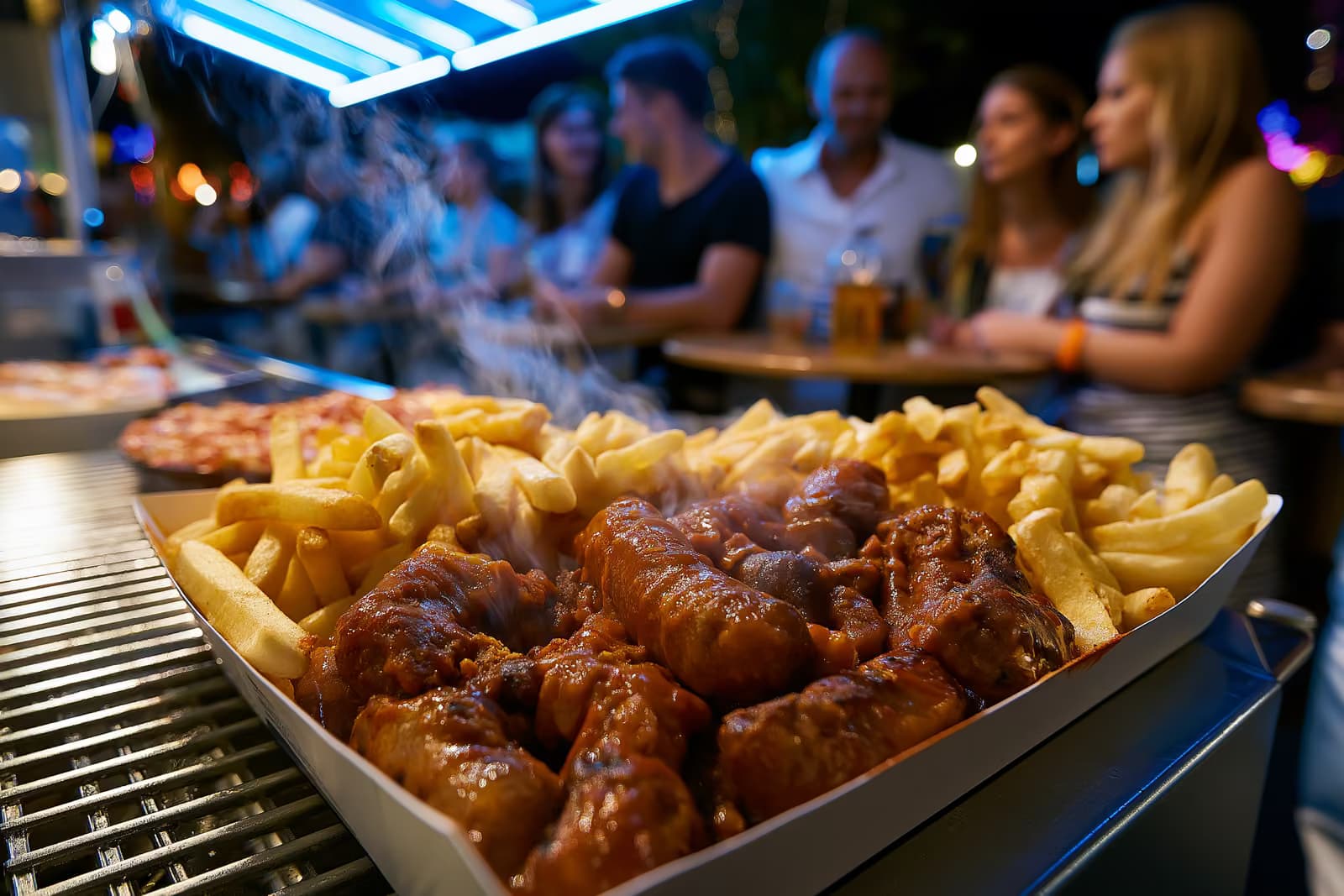
The other icon is the Currywurst: a fried or grilled Bratwurst, sliced into bite-sized rounds, doused in a warm tomato-based curry ketchup and dusted with curry powder on top. It is served in a small paper tray with a little wooden or plastic fork, usually with a Brötchen (bread roll) or a portion of fries alongside. Simple, cheap, a little messy, and beloved - the Deutsches Currywurst Museum has put yearly consumption in the hundreds of millions.
Its origin story is unusually well documented for a street food. It is attributed to Herta Heuwer, who is said to have first sold it at her stand in the Charlottenburg district of West Berlin on 4 September 1949, using ketchup and curry powder she obtained from British soldiers in the post-war city. She later trademarked her sauce and guarded the recipe for the rest of her life. Berlin still treats the Currywurst as a hometown invention, and you will find shrines to it at stands like Curry 36 with permanent queues. Our guide to traditional German dishes introduces the Currywurst among Germany’s signature plates; here it is firmly a stand-and-eat affair.
There are regional camps worth knowing. Berlin traditionally uses a skinless sausage, so the bite is soft, while the Ruhr region (Germany’s industrial west, where the Currywurst is a genuine working-class institution) favours a sausage mit Darm, with the natural casing that gives a satisfying snap. Sauces vary from mildly sweet to properly hot, and some stands guard a “secret” recipe. The classic pairing is Currywurst und Pommes, and the fries themselves come with a decision: Pommes rot-weiß means “red and white”, fries with both ketchup and mayonnaise, which is the default many people order without thinking. You can ask for just one - mit Ketchup or mit Mayo - or add both. Eating a Currywurst standing at a counter, stabbing the slices with a tiny fork while your fries go cold, is one of the small rituals of German everyday life.
The Imbiss and Germany’s sausage culture
Behind the two icons sits the broader world of the Imbiss - the catch-all word for a snack stand or quick-eat counter. An Imbissbude or Schnellimbiss (“bude” is a booth or kiosk, “schnell” means fast) is the German equivalent of the corner takeaway: often family-run, cash-friendly, and specialising in a short menu of grilled and fried things. The classic Imbiss is built around sausage, and the variety is regional and worth exploring alongside our guide to regional specialties.
The workhorse is the grilled Bratwurst in a Brötchen, where the sausage is longer than the roll so it sticks out both ends, eaten with a stripe of mustard (Senf). Regional versions define whole cities. The Thüringer Rostbratwurst is long, coarse and seasoned with marjoram and caraway. The Nürnberger is small - only finger length - and by tradition served three to a roll, “Drei im Weckla” in the local dialect, which literally means “three in a little bread roll”. At a Christmas market or a football stadium the grilled Bratwurst is the default hot snack, and the smell of it is part of the season. For the drinks that traditionally go with all this, see our guide to wine and beer culture.
On the coast and in the north, the sausage gives way to fish. The Fischbrötchen is a fresh bread roll filled with fish and eaten on the go, and it is a serious northern institution around Hamburg, Kiel and the North and Baltic Sea ports. The classics are Matjes (young, mildly salted herring), Bismarck (herring marinated in vinegar), and Backfisch (battered, fried white fish), usually with raw onion, pickle and a dab of Remoulade, a tangy mayonnaise-based sauce. Eating a Fischbrötchen at Hamburg’s harbour or at the Sunday-morning Fischmarkt is one of the north’s essential food experiences.
Bavaria and the south have their own counter classics. The Leberkässemmel is a slab of warm Leberkäse - a smooth, baked meatloaf, despite the name it usually contains no liver - served in a Semmel, the southern word for a bread roll, with sweet or medium mustard. It is the standard cheap Bavarian lunch, sold in butcher shops and bakeries as much as at stands. You will also meet the Käsekrainer, a sausage with pockets of melted cheese inside that ooze when you bite it (a favourite that crossed over from Austria), and the Bosna, a grilled sausage in bread with onions and a curry-and-mustard spice mix, associated with Salzburg but common in southern German cities. None of these needs cutlery, and none costs much.
The Bäckerei as fast food, and the sweet stuff
The most common quick lunch in Germany is not a Döner or a sausage at all - it is something from the Bäckerei, the bakery. Germany has an enormous bakery culture, and most bakeries operate a Backshop counter where they sell not just bread but ready-to-eat snacks. The staple is the belegtes Brötchen, a bread roll split and filled to order or pre-made with cheese, cold cuts, salami, egg or fish. It is fresh, portable, filling and often the cheapest hot-or-cold meal on the street, which is why bakeries and butchers quietly feed a large part of the working country at midday.
Then there is Laugengebäck, the family of lye-dipped baked goods with the dark, glossy, salted crust. The famous member is the Brezel (in Bavaria the Brezn), the pretzel, eaten plain, with butter (a Butterbrezel), or split around a slice of cheese. The Laugenstange is the same dough in a stick shape, often sold sliced and filled. These are everywhere - train stations, bakery chains, market stands - and a warm Brezel is one of the easiest, most reliable snacks to grab when you do not know what else to order.
For something sweet, look to the Teilchen or Süßgebäck - the general terms for the tray of pastries and Danish-style baked goods at the bakery counter. Regional stars are worth seeking out: in and around Hamburg the Franzbrötchen is a buttery, cinnamon-swirled pastry, a bit like a flattened cinnamon roll, and something of a local obsession you will not easily find in the south. Between the savoury Brötchen and the sweet Teilchen, the German bakery is genuinely a fast-food system in its own right, and for many residents it is the default over the sausage stand.
Ice cream deserves its own mention, because Germany’s Eisdiele (ice-cream parlour) culture is a summer institution, largely built by generations of Italian-German families. The parlours are cheap, sociable, and where the country’s most charming dessert invention comes from: Spaghettieis. This is vanilla ice cream pressed through a spätzle or potato ricer so it falls in strands that look exactly like a plate of spaghetti, topped with strawberry sauce for the “tomato” and grated white chocolate or nuts for the “parmesan”. It really is a German invention - created by Dario Fontanella at his family’s parlour in Mannheim in 1969 - and it remains a genuine treat, not a gimmick. Order one on a hot afternoon and you will understand why it never went away.
International and modern street food
German street food is not only sausages and pretzels. Decades of immigration have made the Imbiss deeply international, and in most cities the quick-eat scene is as likely to be Turkish, Arab, Vietnamese or Italian as it is German. Alongside the Döner shop you will find falafel and shawarma counters (falafel - fried chickpea balls in flatbread with salad and tahini - is the reliable vegetarian street meal), and a strong Vietnamese and pan-Asian presence: the Asia-Imbiss, a small counter serving fried noodles, rice boxes and spring rolls, is a fixture in the east of the country in particular. This street-level overlap is the tip of a much bigger story, which we tell in full in the guide to international cuisine in Germany.
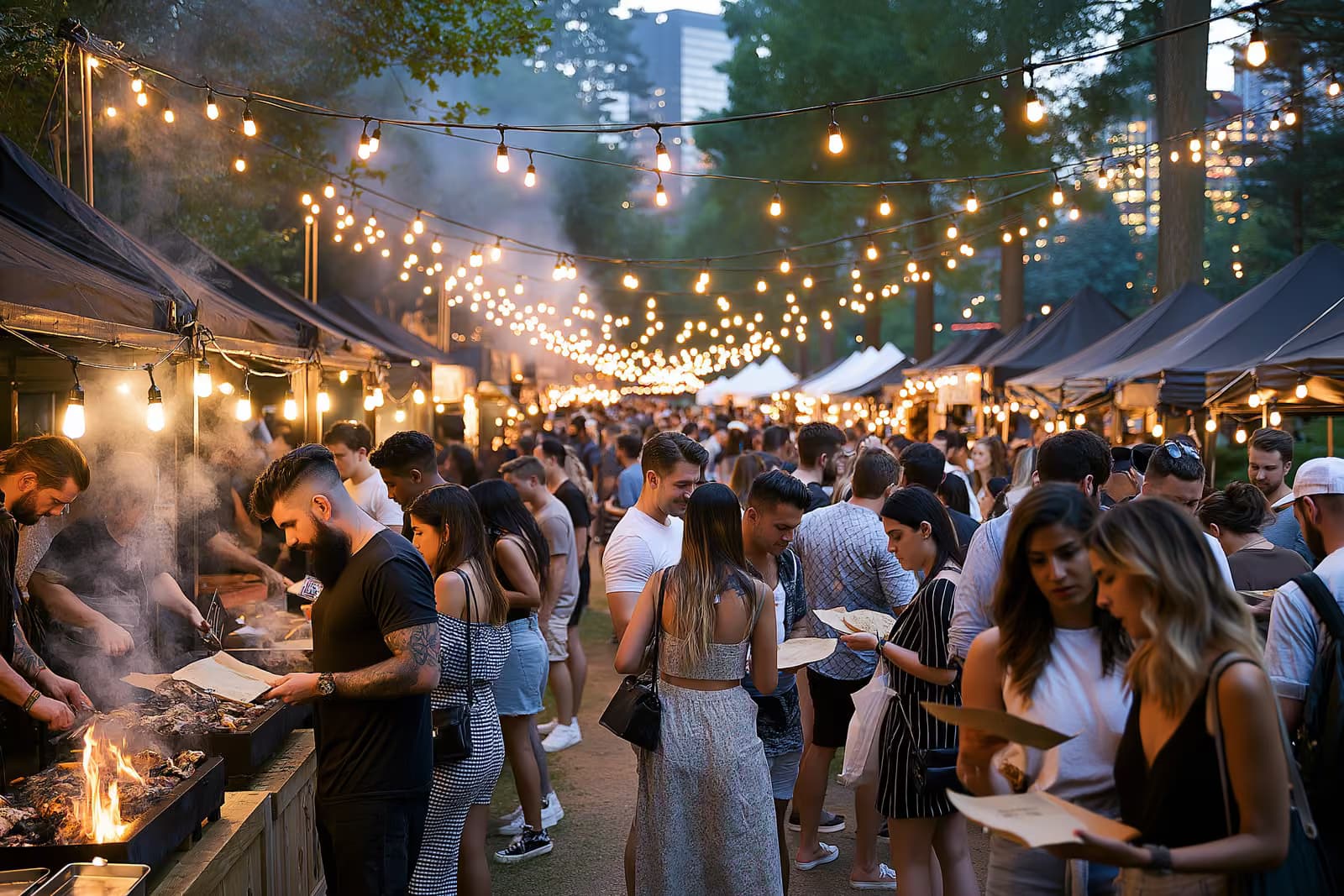
The modern scene has also grown a proper food-truck and market-hall culture. Larger cities host regular street-food markets, often in a Markthalle (a covered market hall) or a former industrial space, where trucks and pop-up stalls sell everything from Korean buns to gourmet burgers to vegan bowls. These events are where German street food gets ambitious, and they are worth timing a visit around; recurring food markets and festivals are covered in our guide to food festivals and events.
One more source of snacks belongs to the night. The Späti (short for Spätkauf, a late-opening corner shop, especially a Berlin institution) is where you buy a cold drink, a bag of crisps, a chocolate bar or an ice cream at hours when everything else is shut. It is not cooked street food, but it is a core part of how people snack on the move, particularly in the evening, and it connects to the wider going-out culture we describe in the guide to nightlife and entertainment. Between the food trucks, the Späti and the always-open Döner shop, Germany quietly does casual eating very well.
How to eat street food in Germany: what to do next
Start with where and when. The densest concentration of street food is around and inside train stations - the Hauptbahnhof of any city is effectively a food court of bakeries, Döner shops and Imbiss counters, and it is where you will eat if you arrive hungry. Market squares, especially on market days, are the other reliable place, and Christmas markets and folk festivals turn street food into an event; for the seasonal side, see our guide to food festivals and events. Opening hours vary: a bakery may open before six in the morning and close mid-afternoon, while a Döner shop can run until very late, so plan around the type of stand, not a single rule.
Now the money. Many small Imbiss stands and older kiosks are still cash only, or set a minimum for card payment, so carry some coins and small notes - do not assume you can tap a card at every hatch, even in 2026. Card and phone payment have spread fast, but the classic Bude is exactly where you are most likely to be caught out. On price, a Currywurst or Bratwurst with a roll typically lands in the low-to-mid single euros, a Döner around seven, and a bakery Brötchen often cheapest of all. One practical note on pricing: since 1 January 2026, prepared food (Speisen) carries the reduced 7 percent VAT rate whether you eat in or take away - the old split that made takeaway cheaper is gone - while drinks stay at the standard 19 percent. In practice the counter price already includes this, but it is why a bottle of cola can feel dear next to the food. The everyday-shopping side of this is covered in our guide to grocery shopping tips.
When you order, you will almost always be asked one question: “Zum hier Essen oder zum Mitnehmen?” - “to eat here or to take away?” Answer “zum Mitnehmen” for takeaway or “hier essen” to eat on the spot. Many stands have no chairs but a Stehtisch, a tall standing table with no seats, and eating standing up there is completely normal and expected - Germans do it without a second thought, and it is not considered rude the way it might be at a formal meal. If you want the rhythm and manners of German eating more broadly, our guide to dining etiquette and customs covers the sit-down side.
Vegetarians and vegans are far better served than they once were. Falafel is the dependable meat-free street meal, halloumi and grilled-vegetable Döner are widely available, the bakery counter is full of cheese and vegetable Brötchen, and a warm Brezel is vegan almost by default. Many Döner and Imbiss stands now list a vegetarisch or vegan option openly, and the food-truck scene leans strongly that way. Portions are generally generous - a full Döner is a meal, not a snack - so order accordingly and do not over-order on your first try.
The best way to learn German street food is simply to use it: pick a busy stand, watch what the person in front of you does, order the local specialty rather than the safe option, and eat it standing up like everyone else. Keep a few euro coins in your pocket, learn “mit alles” and “zum Mitnehmen”, and you have everything you need. From there, follow the thread into regional specialties and see how the snack you just ate changes from one city to the next.
Sources
The information in this chapter draws on the official sources and publications listed below, last reviewed in July 2026. It is general guidance for orientation, not individual legal, tax, or medical advice.