Nightlife and Entertainment
13 min read
German nightlife runs on its own rules, and knowing them before you go out saves you a wasted evening and a fair amount of confusion. This chapter is a foreigner’s guide to going out in Germany: the clubs, the bars, the door, the money, and how to get home. It is honest about the parts that surprise people who arrive from the UK, the US or almost anywhere else - the clubs that do not really begin until you would normally be in bed, the cash-only cash desks, the bouncer who turns you away without a word. For high culture in the evening - opera, theatre, classical concerts, cinema and museums - see our companion guide to cultural activities in Germany. This chapter stays after dark, on the dancefloor and at the bar.
Germany’s world-famous club culture
Germany, and Berlin above all, is one of the great club destinations on earth, and electronic music is the reason. Berlin became the global capital of techno after 1989, when the fall of the Wall left the city full of empty power plants, bunkers, vaults and warehouses that a young scene simply moved into. That history is now officially recognised: in March 2024 Berlin’s techno culture was added to Germany’s national inventory of intangible cultural heritage, the UNESCO framework that Germany uses to honour living traditions. Techno here is not treated as a passing trend but as a cultural practice worth protecting, on the same list as centuries-old crafts and festivals.
The name most visitors know is Berghain, housed in a former heating plant in an industrial no-man’s-land between Kreuzberg and Friedrichshain. Downstairs is punishing techno; upstairs, the Panorama Bar leans towards house. What makes it legendary is not marketing but the experience: a towering room, a serious sound system, and opening hours that run from Friday night straight through to Monday morning without stopping. Two rules define it. There is a strict no-photos policy - stickers are placed over your phone camera at the door, and this is taken seriously as a matter of protecting people’s privacy on the dancefloor. And the door is famously selective, which we come back to below. Berghain is not the only temple, though. Tresor, one of the founding clubs of Berlin techno, still runs today in a former power station on Köpenicker Strasse, its raw industrial basement intact. Sisyphos, out in the east of the city, feels more like a permanent festival than a club, with outdoor areas, food, and a playful crowd. ://about blank in Friedrichshain pairs its techno and house with an openly queer-feminist, anti-fascist politics and a big summer garden. These are all currently operating; be aware that Berlin clubs do close - the much-loved Watergate shut at the end of 2024 after twenty-two years, and Griessmühle lost its original home years ago - so always check a venue is still open and check who is playing before you make the trip.
Berlin is the headline, but it is not the whole country. Near Frankfurt, the small and revered Robert-Johnson in Offenbach has shaped German house and techno for over two decades. In Cologne, Bootshaus is a large multi-room club on the Rhine that draws big international names across techno, house and bass. In Hamburg, Uebel & Gefährlich occupies a floor of a Second World War bunker on the Heiligengeistfeld in St. Pauli, the district that is the city’s nightlife heart. Munich’s scene is smaller and more polished than Berlin’s but real, and most university cities have at least one serious club. The point for a newcomer is that you do not have to move to Berlin to find good nights out - but you should expect the Berlin template of electronic music, long hours and a certain seriousness about the dancefloor to shape the scene almost everywhere.
The door, and the rhythm of a German night
The single biggest shock for foreigners is the timing. A German club night starts far later than you expect. Turning up at a serious techno club at 11pm often means walking into a near-empty room. People tend to arrive between 1am and 3am, the floor peaks somewhere around 3am to 6am, and in Berlin many clubs simply do not stop: they run continuously from Friday night until Monday morning. There is a reason for this. Most large German cities have no Sperrstunde, the mandatory closing time that forces bars and clubs in the UK, the US and much of the world to shut at a fixed hour. Without a legal last call, a night can stretch as long as the crowd and the music hold up. The practical lesson is to pace yourself. If you drink at a British or American speed aiming for a midnight peak, you will be finished before the night has properly begun. Germans call this whole culture of committed, unhurried partying Feiern, and it rewards stamina over intensity. Eat before you go, plan to arrive late, and do not treat the first hour as a race.
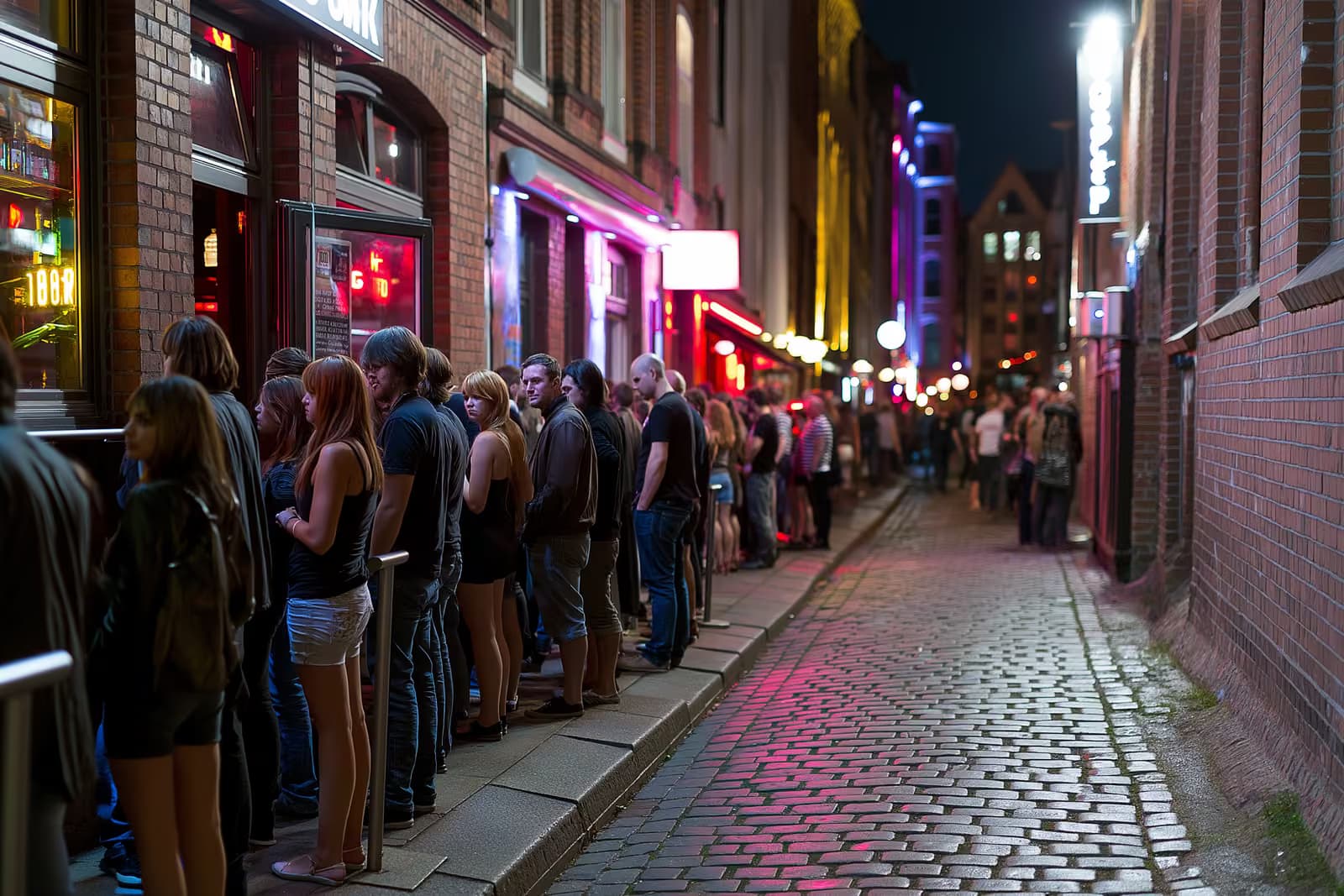
The other thing that catches people out is the door. The Türsteher, the bouncer or door selector, decides who comes in, and at the most sought-after Berlin clubs that decision can feel arbitrary and final. There is no formula and no one can promise you entry - anyone who sells a guaranteed way past the Berghain door is selling you nothing. But there are sensible habits that improve your odds and, just as importantly, show respect for the space. Dress simply and dark rather than flashy; the Berlin uniform is black and understated, though a few clubs like Sisyphos actively prefer colour and costume, so it is worth reading the specific venue. Go in a small group, ideally two or three, rather than a loud crowd of ten. Be reasonably sober and calm at the door, not visibly drunk. Do not film, do not shout, and do not treat the queue like a tourist attraction or the staff like an obstacle. Learn a little about who is playing that night. If you are turned away, accept it quietly and move on - the city has hundreds of other places, and arguing only guarantees the same answer everywhere. Being refused is not a personal verdict; on a busy night it is often just about balancing the room.
Kneipen, bars and the Späti
Most nights out in Germany never touch a club at all. The backbone of everyday going out is the Kneipe, the traditional neighbourhood pub. A Kneipe is unpretentious and often a little worn in a comfortable way: beer on tap, simple drinks, sometimes a small menu of hearty food, and a crowd of regulars. It is where you go to talk rather than to dance, and every district has its own. Around universities you will find whole Kneipenviertel, pub quarters where cheap student bars cluster along a few streets and the night drifts from one to the next. Alongside the Kneipe sits the Bar in the international sense - cocktail bars, craft-beer bars and stylish lounges are strong in every big city, with Germany’s cocktail scene especially serious in Berlin, Hamburg and Munich. The craft-beer wave has landed here too, and most cities now have a handful of bars pouring independent German and international brews well beyond the standard Pils and Helles. The line between a Kneipe and a Bar is really one of mood: the Kneipe is local, cheap and familiar; the Bar is where you go when you want something mixed with care and a little more atmosphere.
Then there is the part that genuinely surprises newcomers: drinking in public is legal in Germany. You can buy a beer and drink it in a park, on a bench, at a tram stop or while walking down the street, and nobody blinks. There is even a word for the beer you carry with you on the way somewhere - the Wegbier. Feeding this culture is the Späti, short for Spätkauf, the late-night corner shop that stays open long after supermarkets close. Especially in Berlin, where there are roughly a thousand of them, the Späti is a social institution in its own right: you buy a cold bottle, the friendly ones have a crate or a bench outside, and people end up standing around talking for an hour. It is one of the cheapest and most sociable ways to spend an evening in Germany. A word of realism: public drinking being legal nationwide does not mean it is legal everywhere at all times. Some cities designate alcohol-free zones on particular squares, and transport operators have begun testing bans at specific stations, so watch for posted signs. And, as everywhere, drinking in public is about being relaxed, not being loud or leaving broken glass behind.
In summer the whole social centre of gravity moves outdoors to the Biergarten, the beer garden. These are large, informal, tree-shaded spaces - a Munich institution but found across the country - where you share long benches with strangers and order by the Mass, the litre glass. A lovely local tradition at many traditional Biergärten, especially in Bavaria, is that you may bring your own food and only buy the drinks, so families turn up with baskets of bread, cheese and Radi. Beer and the beer garden are a culture of their own, and our guide to wine and beer culture covers the drinks themselves, the regional styles and the etiquette of the Biergarten table in more depth. Here the point is simply that on a warm evening the Biergarten, not the club, is where Germany goes out.
Live music, comedy, karaoke and LGBTQ+ nightlife
Nightlife is not only clubs and bars. Germany has a dense live-music circuit, from small Live-Musik venues and smoky jazz cellars to mid-size concert halls and big arenas, and most cities run a steady programme of touring bands and local acts through the week. Look out too for the Varieté, a German take on cabaret and variety theatre that blends music, comedy and circus-style acts over dinner - a distinctive evening out that has no exact equivalent in English-speaking countries. English-language nightlife has grown a lot as international communities have settled in. In Berlin, Cologne, Hamburg, Munich and Frankfurt you will find regular English-language stand-up comedy and open-mic nights, pub quizzes in English, and international meetups, all easy to find through listings sites and social media once you know to look. The calendar matters too. Summer is festival season, when open-air events and city festivals fill the warm months, and clubs open their gardens and outdoor floors. In the Rhineland, Karneval - the pre-Lenten carnival season peaking in February around Cologne and Düsseldorf - turns whole cities into a days-long street party, while Munich’s Oktoberfest and countless regional Volksfeste run their own huge seasonal nightlife. It is worth learning which seasons your city comes alive, because a quiet week in January and a Karneval weekend are two completely different places.
One free institution worth planning a Sunday around is the Bearpit Karaoke in Berlin’s Mauerpark. From roughly May to October, weather permitting, a Sunday-afternoon crowd of hundreds gathers in an outdoor stone amphitheatre while volunteers take turns singing to strangers, and it is warm, funny and completely unpretentious. It has become one of the city’s genuine landmarks of public good humour.
Germany also has one of Europe’s most established LGBTQ+ nightlife scenes, and it is woven into the mainstream rather than hidden away. Berlin’s Schöneberg district has been a centre of gay life for a century and remains full of bars and clubs, while the wider city’s queer scene is large, varied and famous well beyond Germany. Cologne is the other great hub, with a big, longstanding gay quarter around the old town and one of the largest Christopher Street Day (CSD) Pride celebrations in Europe each summer; most major cities hold their own CSD. Many venues are explicitly queer, plenty of others are simply open and mixed, and a number of the clubs mentioned earlier place inclusivity at the centre of what they do. For a newcomer, this is one of the parts of German nightlife that is easiest to step into and feel welcome.
The practical things a foreigner needs to know
Bring cash. This is the trap that catches almost every newcomer: a great many German clubs, and plenty of bars and Spätis too, are cash only. The door, the bar and the coat check may all refuse a card, and Germany has fewer card-friendly venues than most Western countries. Withdraw enough for the whole night before you go out, because the cash machine nearest a club is often broken, expensive or surrounded by a queue at 3am. At the door you pay an entry fee in cash, and many clubs stamp your hand or wrist so you can leave and come back - useful when you want fresh air or a break without losing your night. Inside, drink prices are moderate by international standards: a beer in a club typically runs a few euros, spirits and cocktails more, and the Späti or Kneipe is always cheaper than the club bar.
Two small customs are worth knowing. Most clubs and many bars have a Garderobe, a coat check, and in winter using it is often effectively mandatory and costs a euro or two per item - budget for it and keep the token. And tipping in Germany is done by rounding up rather than adding a percentage: at a bar you might round a 3,50 euro drink up to 4 euros, or simply say the rounded figure when you pay. It is normal but not obligatory, and it is handed to or told directly to the person serving you rather than left on the bar. Our guide to German social etiquette covers tipping and everyday manners in more detail, and the etiquette of German dining guide covers how this works in restaurants.
On the law, a few facts matter. Germany’s Jugendschutzgesetz, the youth-protection law, sets the ages: from 16 you may buy and drink fermented drinks like beer and wine, and from 18 you may buy spirits and anything containing distilled alcohol, and you must be 18 to enter most clubs. Venues can and do check identification, so carry an ID. On drugs, the position is simple to state and worth stating neutrally: most recreational drugs remain illegal in Germany, and this guide gives no advice on their use. Some cities have introduced harm-reduction measures such as supervised drug-checking services, but the existence of such a programme does not change the underlying law. Know the rules and make your own informed, lawful choices.
Finally, getting home. Because there is no fixed closing time, you may well leave a club long after normal transport has stopped and restarted. Most cities run a Nachtbus, a night-bus network, and on Friday and Saturday nights the U-Bahn and S-Bahn in the big cities frequently run all night; our guide to the public transport system explains how night services and tickets work. When transport does not reach you, a taxi or a ride-hailing app will, and our guide to taxi services and apps covers the options and roughly what to expect to pay. One last piece of neighbourly law: Germany observes Ruhezeiten, legally protected quiet hours, typically overnight and all day Sunday, when noise in residential buildings and streets is expected to drop. Coming home at 5am is fine; doing it loudly under someone’s window is how you meet your neighbours the wrong way.
What to do on your first night out
Start small and local. Before you attempt a legendary club door, spend a few evenings in the Kneipen and bars of your own neighbourhood, and go to a Biergarten on a warm evening - these are the easiest, friendliest entry points, and they teach you the rhythm of a German night without any pressure. Get a feel for arriving later than you would at home, for paying in cash, and for the round-up tip, and you will already be ahead of most visitors.
When you are ready for the club scene, pick one night, check who is playing, withdraw cash in advance, dress simply, go with one or two friends, and plan your way home before you leave. Treat a refusal at the door as part of the game, not a defeat. Keep your neighbours in mind when you get back, and remember that the daytime side of recovery - a sauna or a long slow Sunday - is a very German way to end a big night; our guide to wellness and spas covers that. German nightlife rewards people who take it a little seriously and do not rush it. Go in with patience and an open mind, and you will find one of the most distinctive, welcoming and genuinely fun nightlife cultures anywhere.
Sources
The information in this chapter draws on the official sources and publications listed below, last reviewed in July 2026. It is general guidance for orientation, not individual legal, tax, or medical advice.