The Basics of Public Transportation
18 min read
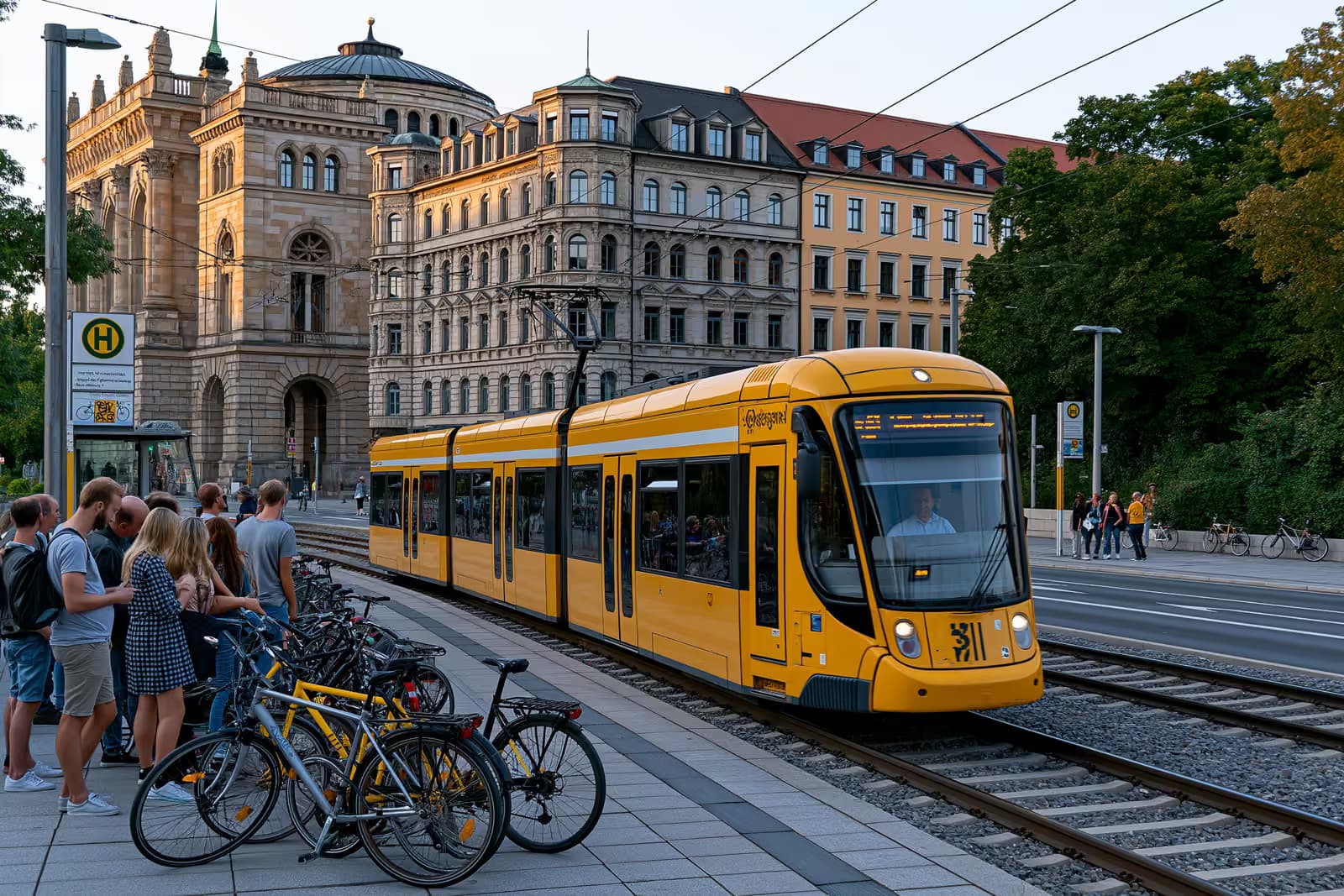
Germany runs one of the densest public transportation networks in Europe, and for most people who move here it replaces the car entirely. This chapter explains how the system actually fits together: who runs what, why a ticket bought in one city is worthless in the next, what the Deutschlandticket does and does not cover in 2026, how to buy and validate a ticket without accidentally committing a criminal offence, and what you are owed when a train is late. The goal is that you can walk to the nearest station on your first day here and travel with confidence.
Why Public Transportation Has No Single National Ticket System
The first thing to understand is that Germany has no single transport authority. Long-distance trains are run by Deutsche Bahn (DB), the mostly state-owned national railway. Everything local - the underground, the trams, the buses, the suburban trains - is organised regionally by a Verkehrsverbund, a transport association that pools all the operators in one metropolitan area under one shared tariff. Berlin and Brandenburg have the VBB, Munich has the MVV, Hamburg has the HVV, the Rhine-Ruhr area has the VRR, and Frankfurt has the RMV. There are around sixty of them.
The Verkehrsverbund is the reason a ticket you bought in Cologne does nothing for you in Stuttgart. Within its own area, though, the association is genuinely useful: one ticket covers every bus, tram, underground and suburban train inside it, no matter which company operates the vehicle. You do not buy a separate ticket when you change from the U-Bahn to a bus. You buy one ticket for the journey, and it works across all of them until it expires.
Each association then divides its area into Tarifzonen, tariff zones. This is why a Berlin ticket is sold as AB, BC or ABC: zone A is the inner city, B is the rest of the city out to the boundary, and C is the surrounding Brandenburg region, which includes Potsdam and BER airport. A ticket priced for AB will not get you to the airport. Munich, Hamburg and the Ruhr area use their own zone logic with different names, so when you arrive somewhere new, the single most useful question is which zones your daily route crosses. The Deutschlandticket, discussed below, removes this problem for most people, which is exactly why it has been so popular.
U-Bahn, S-Bahn, Tram, Bus and Regionalbahn
The vehicles have names that look confusingly similar in writing, and the difference matters when you read a departure board. The U-Bahn (short for Untergrundbahn, underground railway) is the city metro, usually run by the municipal transport company, mostly underground in the centre. The S-Bahn (Stadtschnellbahn, city rapid railway) is a suburban railway that runs further out into the surrounding region and is usually operated by Deutsche Bahn even though your local ticket covers it. In practice, in the city centre they behave the same way. The S-Bahn is the one that gets you to the airport or to the next town.
The Straßenbahn, commonly called the Tram, runs on rails in the street and is the backbone of many mid-sized cities. Buses fill in everything the rails miss and are usually the only option late at night in smaller places. Above these sit the regional trains: the RB (Regionalbahn), which stops everywhere, and the RE (Regional-Express), which is the same idea but skips the small stations. Both are regional services, which means the Deutschlandticket covers them - a fact that turns a monthly transit pass into a nationwide travel pass.
One point that catches new arrivals: your local ticket usually covers regional trains inside your association’s area, so an RE journey of forty minutes to a neighbouring town may already be included in the pass you have. Check the association’s map before buying a separate DB ticket for a short hop. This kind of overlap is normal and entirely legal to exploit.
Long-Distance Trains and What They Really Cost
For journeys between cities, Deutsche Bahn runs the ICE (Intercity-Express, the high-speed service), the IC (Intercity) and the EC (Eurocity, an IC that crosses a border). These are a separate world from local transport, with their own tickets, their own prices and no connection to your Verkehrsverbund pass. FlixTrain and FlixBus compete on some routes at lower prices and lower frequency.
DB sells long-distance seats under two logics. The Sparpreis (savings fare) is a discounted ticket tied to one specific train - this is called Zugbindung, train binding - and it is cheap if you book early and expensive or unavailable if you book on the day. The Super Sparpreis is the same idea with tighter refund rules. The Flexpreis (flexible fare) costs considerably more but binds you to nothing: you may take any train on the route that day, and you can get your money back. If your plans are firm, book a Sparpreis weeks ahead. If they are not, the Flexpreis is often worth the difference, because rebooking a Sparpreis costs a fee and the price gap between the two shrinks as the date approaches.
A seat is not included. The Sitzplatzreservierung (seat reservation) is a separate small charge, and on Friday afternoons, Sunday evenings and around public holidays it is close to essential unless you are willing to stand in the corridor for two hours. Reserve it when you book. If you regularly travel long distance, the BahnCard pays for itself quickly. The BahnCard 25 gives 25 percent off both the Flexpreis and the Sparpreis, which makes it the simplest one to reason about. The BahnCard 50 gives 50 percent off the Flexpreis but only 25 percent off the Sparpreis, so it rewards people who book late and travel often. The BahnCard 100 is a flat rate for the entire DB network for a year and now bundles local transport into it. Prices and promotions change several times a year, so check the current terms on bahn.de rather than trusting a figure you read somewhere.
The Deutschlandticket in 2026
The Deutschlandticket is the single most important thing to understand about public transportation in Germany today, and almost everything written about it online is out of date. It launched at 49 euros a month, rose to 58 euros in 2025, and since 1 January 2026 it costs 63 euros a month. Existing subscriptions were adjusted automatically, so if you signed up in 2025 you are already paying the new price. The transport ministers of the federal states agreed the increase in September 2025, and they have also agreed a cost index covering wages, energy and general costs. From 2027 the price is meant to follow that index rather than being set politically each year, so expect it to keep moving upward in smaller, more predictable steps.
What it covers is generous and precisely bounded. It is valid on all local and regional public transport across the whole country, from every participating operator: every U-Bahn, S-Bahn, tram, city bus, RB and RE in Germany, regardless of which Verkehrsverbund you are in. Zones stop mattering. What it does not cover is long-distance travel: no ICE, no IC, no EC. It also does not cover FlixTrain or FlixBus, and it does not cover first class. Around 14.5 million people hold one, according to the Bundesregierung.
It is sold only as a monthly subscription (Abo), it is personal and non-transferable, and it comes as a QR code in an app (Handyticket) or as a personalised chip card. You cannot buy a single one at a machine for one trip. It renews automatically, and most providers require you to cancel by the tenth of the month for it to end at the end of that month - miss that date and you pay for one more month. Set a calendar reminder when you sign up, particularly if you are only in Germany for a short project.
The practical arithmetic is the part worth internalising: in almost every German city, the Deutschlandticket is cheaper than the local monthly pass for that city alone, and it is valid nationwide instead of in one zone. A standard monthly pass for a large city commonly runs well above 63 euros. If you are about to buy a local Monatskarte, compare it with the Deutschlandticket first, because in most cases there is no scenario where the local pass wins. Our chapter on the Deutschlandticket goes deeper into the details and the exceptions.
Working Out Whether It Beats Driving
The other comparison people get wrong is the car. A monthly ticket looks expensive next to a tank of fuel, but the tank is not the whole cost, and the honest way to decide is to price your actual commute rather than guess. Take your daily route, multiply it by the days you really travel, and put a fuel price and a consumption figure against it. Then add insurance, tax, parking and the depreciation you are quietly paying whether the car moves or not. Many people who run this calculation find the Deutschlandticket wins on the commute alone, before parking is counted, and this became more true after the fuel tax break expired on 1 July 2026.
If you want to run the fuel side of that quickly, Werkzeu.ge has a Spritkosten-Rechner, a fuel cost calculator that is free to use with no account (the Gast tier). You enter distance, consumption and fuel price and it gives you a cost per trip and per month that you can hold against 63 euros. Werkzeu.ge is built by Cryon UG, the company behind WeLiveIn.de. It is a browser-based tool desktop, bilingual German and English, hosted in Germany, using fixed formulas rather than AI, and it is in beta until 30 November 2026, so treat its output as a sanity check rather than gospel. The free tier carries ads, and current subscription prices are on the pricing page. It is not financial advice, and it will not tell you whether you enjoy driving. If you are weighing the two seriously, read our chapter on driving in Germany alongside this one.
Jobticket, Semesterticket and Reduced Fares
Several routes make the Deutschlandticket cheaper, and the best of them runs through your employer. Under the Deutschlandticket-Jobticket rules, if your employer subsidises at least 25 percent of the ticket price, the federal scheme adds a further 5 percent discount on top, so the employer’s 25 percent buys the employee a 30 percent reduction. Many mid-sized and large German companies offer this and simply do not advertise it internally. Ask your HR department directly whether a Jobticket exists, because the answer is frequently yes and the paperwork is usually one form.
Students are covered by the Deutschlandsemesterticket, which is fixed by rule at 60 percent of the standard Deutschlandticket price. It is charged through your semester fee rather than as a monthly subscription, it runs for a whole semester and it cannot be cancelled monthly. Because it is pegged to the standard price, the 2026 increase flows through to it: it rises to 37,80 euros a month from the winter semester 2026/27. Many cities also run a Sozialticket, a reduced-price pass for people on low incomes or receiving benefits, and the rules for it are set locally, so check your own city’s transport association.
There is also a route that has nothing to do with tickets at all. People with a Schwerbehindertenausweis, the official severe disability card, can travel free on local and regional public transport if their card carries the right Merkzeichen (the codes G, aG, H, Bl or Gl) and they hold a Beiblatt (supplementary sheet) with a valid Wertmarke (token). The Wertmarke costs a self-contribution of 104 euros a year, or 53 euros for six months, and that amount was not raised for 2026. It is free for people with the Merkzeichen Bl (blind) or H (helpless) and for recipients of basic income support, now called Grundsicherung since it replaced Buergergeld on 1 July 2026. Given that the Deutschlandticket now costs 756 euros a year, a 104-euro Wertmarke that covers the same regional network is a significant difference for anyone who qualifies.
That route runs on forms from the Versorgungsamt, and forms are where new arrivals lose the most time. Werkzeu.ge’s Formularamt is a searchable index of official federal, state and municipal forms, also free without an account, with a source link, retrieval date and status on each one, and it documents the gaps where a form is not held rather than pretending to be complete. It is a reasonable place to start looking for the disability card and Wertmarke applications for your state. It prepares and generates documents; it never submits anything to an authority for you, and it is explicitly not legal advice.
Buying a Ticket and Knowing Whether to Validate It
You can buy tickets at a Fahrkartenautomat (ticket machine) at almost every station, from the driver on many buses, at a Reisezentrum (DB travel centre) for long-distance journeys, and in apps. The DB Navigator app handles long-distance and regional travel nationwide and is the one to install first. Every Verkehrsverbund also has its own app, which is usually better for local journeys and local ticket types. Google Maps works well for planning, but buy through the operator’s app rather than a reseller.
Validation is where foreigners get caught, because the rule is not uniform. Some tickets, mostly paper tickets bought from a machine or a kiosk without a printed date, must be stamped in an Entwerter (validating machine) before you board or immediately after boarding. The Entwerter is a small box on the platform or inside the vehicle, and it prints the time on your ticket. An unstamped ticket is treated as no ticket at all. Other tickets need nothing: anything with your date and time already printed on it, anything bought in an app, and the Deutschlandticket itself are valid the moment you hold them.
The safe habit is simple. When you buy a paper ticket, look at it. If it does not already show today’s date and a start time, find the Entwerter and stamp it before the train moves. If you are unsure, stamping a ticket that did not need it costs you nothing. Not stamping one that did costs you 60 euros. Note also that buying the wrong tariff zone, or holding an e-ticket that a scanner cannot read, both count as travelling without a valid ticket even though you paid.
Fare Checks, the 60-Euro Penalty and Why This Is Criminal Law
Nearly all German local transport is an open system. There are no barriers, no gates and nobody checks your ticket when you enter. This surprises people arriving from cities with turnstiles, and it leads some of them to a bad conclusion. The system is enforced instead by Kontrolleure (fare inspectors), who board in plain clothes, block the doors at the next stop and ask everyone in the carriage for a ticket. There is no talking your way past this. They can require you to identify yourself.
If you have no valid ticket you pay an erhoehtes Befoerderungsentgelt, an increased fare, of 60 euros. That figure is set nationally and applies on buses and trams under the general terms of carriage (§9 VO-ABB). On the railway it works slightly differently under §12 EVO: you pay twice the normal fare, but never less than 60 euros. There is one useful exception. If you hold a valid personal subscription card and simply left it at home, you can usually present it to the operator afterwards and pay only a small administrative fee instead of the full 60 euros - but only within the deadline printed on the payment notice you were handed. After that date, showing the card no longer helps. Do not put the notice in a drawer.
Beyond the 60 euros, there is a point that genuinely matters for anyone whose residence status depends on a clean record: fare evasion in Germany is a criminal offence, not an administrative one. Section 265a of the Strafgesetzbuch (StGB), the criminal code, covers “Erschleichen von Leistungen”, obtaining services by deception, and it names “Befoerderung durch ein Verkehrsmittel”, transport by a vehicle, explicitly. The penalty is up to one year of imprisonment or a fine, and even the attempt is punishable. In practice, first cases involving one 60-euro fare are usually settled by paying up, and operators typically report repeat offenders rather than one-off cases. But a conviction is a criminal record, and a criminal record is a question on naturalisation and residence permit forms.
This has been debated for years. In April 2026 the Bundestag voted on it directly: motions from Buendnis 90/Die Gruenen and Die Linke to decriminalise fare evasion and leave it to the existing 60-euro civil penalty were rejected on 16 April 2026, with CDU/CSU, AfD and SPD voting against. So the debate is real and ongoing, but the law has not changed. As of now, §265a StGB stands. Buy the ticket.
When the Train Is Late: Your Fahrgastrechte
German trains are late often enough that the compensation regime is worth knowing by heart. The rules are called Fahrgastrechte, passenger rights, and they are backed by EU law. On rail journeys, if you arrive at your destination 60 minutes or more late, you get 25 percent of the fare you paid for that single journey back. From 120 minutes late, you get 50 percent. Compensation under 4 euros is not paid out, which is what rules out most short local trips. You claim it with the Fahrgastrechte form, available on trains, at stations and in the DB Navigator app, and you can choose between a voucher and actual money - always choose the money.
Two further rights are less known and more valuable. If a delay of at least 20 minutes on a domestic route is expected, the Zugbindung on your Sparpreis ticket is automatically lifted: you may take a different train, including an earlier or later one, without rebooking and without a fee. On international routes the threshold is 60 minutes. This turns a discounted ticket into a flexible one the moment things go wrong, and many people do not use it because they assume the cheap ticket traps them. Second, if you cannot complete the journey the same day, the operator must arrange accommodation. If you have to organise your own alternative transport, such as a taxi, you can be reimbursed up to 120 euros - but only if the railway failed to arrange an alternative and you could not reach the operator within 100 minutes of the delay. Keep every receipt.
These rail rights do not map cleanly onto local transport. If your city bus is twenty minutes late, there is generally no compensation scheme comparable to the railway’s, though some transport associations run voluntary punctuality guarantees for their own passengers. Check your association’s terms. If DB refuses a claim you believe is valid, the Schlichtungsstelle fuer den oeffentlichen Personenverkehr, the free arbitration body for public transport, will look at it before you need a lawyer.
Night Services and Getting Home Late
Germany does not shut down at midnight, but what runs after it varies enormously by city. Berlin and Hamburg run their U-Bahn and S-Bahn through the night on Fridays, Saturdays and before public holidays, and switch to Nachtbus (night bus) lines on weekdays. Munich, Cologne and Frankfurt run night bus and night tram networks instead of a full night metro. In smaller towns and rural areas, the last bus can leave before 21:00, and there may be nothing at all on a Sunday.
Night lines usually carry an N prefix on the line number, and their routes are not the daytime routes: a night bus may follow a completely different path and stop at places the day service ignores. Your normal ticket, including the Deutschlandticket, is valid on them at no extra charge. Some rural areas also run an Anrufsammeltaxi or Rufbus, a shared taxi you must book by phone an hour or so ahead, which runs on the transit tariff rather than a taxi meter. The habit worth forming in your first week is to check the last departure of your line before you go out, not after.
Bikes, Sharing and Combining Modes
Bicycles are part of the transport system rather than a separate hobby, and most S-Bahn, U-Bahn and regional trains let you take one aboard - but usually not free. You typically need a Fahrradkarte, a bicycle ticket, and it is not included in the Deutschlandticket. There are also time restrictions: many cities bar bikes from trains during the morning rush hour. On long-distance ICE services, bicycle spaces exist on some trains only and must be reserved well in advance. Look for the bicycle pictogram on the carriage door and use the designated area.
Alongside your own bike, most cities have bike-sharing (Nextbike, Call a Bike and local schemes), e-scooters, and station-based or free-floating car-sharing. Deutsche Bahn’s Call a Bike is integrated into the DB Navigator app, which makes the last kilometre from the station simple. The realistic pattern for most people here is combining modes rather than committing to one: Deutschlandticket for the commute, a bike for short hops, a car-share for the monthly furniture run, and a Sparpreis ICE ticket booked early for the trip home at Christmas. Our chapter on bicycle culture and routes covers that side of it properly, and car sharing has its own chapter in the transport section.
Your First Week Using Public Transportation in Germany
Start with three things on your first day. Install the DB Navigator and your local transport association’s app. Find out which zones your home and your workplace are in. Then work out whether you are about to become a daily traveller, because that single answer decides everything else. If you will travel most days, subscribe to the Deutschlandticket - at 63 euros a month it is very likely cheaper than your city’s own monthly pass and it works in every other German city as well. If you will travel rarely, buy single tickets and skip the subscription entirely.
Then ask two questions that cost nothing and often pay off. Ask your employer whether they offer a Deutschlandticket-Jobticket, because a 25 percent employer contribution triggers a further 5 percent discount and many firms never mention it. And if a disability card applies to you or someone in your household, look into the Beiblatt and Wertmarke, which at 104 euros a year covers the same regional network the Deutschlandticket covers for 756. If you are a student, your Deutschlandsemesterticket is already in your semester fee - check before you buy anything.
After that, the habits are small. Stamp any paper ticket that does not already show a start time. Keep your ticket reachable, not buried in a bag, because inspectors board without warning and “I have one at home” costs 60 euros unless you follow up within the deadline on the notice. Screenshot delays and claim your Fahrgastrechte compensation when a train arrives an hour late, because 25 percent of the fare is real money and most people never file. And check the last night connection before you go out. None of this is difficult, and after a month it is automatic. For everything else that comes with settling in here, our chapter on an expat’s first steps in Germany is the place to go next.
Sources
The information in this chapter draws on the official sources and publications listed below, last reviewed in July 2026. It is general guidance for orientation, not individual legal, tax, or medical advice.