Car Sharing and Rentals
15 min read
This chapter is about getting a car when you do not own one. In most German cities you do not need to buy a car to have one available when you need it. Two systems make that possible: Carsharing, where you use a provider’s vehicle by the minute, hour or day, and the classic Mietwagen (rental car) you book for a longer stretch. Both are well developed here, both are cheaper and simpler than owning a car for the average city resident, and both hide a few traps that catch foreigners in particular. The goal here is to help you pick the right option for a given trip, register without surprises, and avoid the two mistakes that cost newcomers the most money: driving on a licence that is no longer valid, and buying the wrong rental insurance.
First Check Whether You Are Even Allowed to Drive
Everything in this chapter depends on one thing that has nothing to do with cars: whether your driving licence (Führerschein) is legally valid in Germany. No provider will rent to you, and you cannot legally car-share, without a licence they accept. If you hold a licence from an EU or EEA country, it stays valid here and you are fine. If you hold a licence from outside the EU, it is only valid for driving in Germany for a limited window, usually six months from the date you registered your residence, after which you must have converted it or you are no longer allowed to drive at all. That six-month rule and the conversion process (which country’s licence can be swapped directly, and which requires a test) are explained in full in our chapter on driving in Germany. Read it first. If your licence has fallen out of validity, renting or car-sharing is not just expensive, it is illegal, and your insurance will not cover an accident.
Assuming your licence is valid, rental companies and car-sharing providers layer their own requirements on top. The common ones: a minimum age, usually 21, though some vehicle classes (vans, larger or premium cars) require 25 or more; a minimum period for which you must have held the licence, typically at least one year; and, for many non-EU licences, an International Driving Permit (internationaler Führerschein) carried alongside the original. The International Driving Permit is only a certified translation of your national licence, never a licence on its own, so you must carry both. It is compulsory in practice whenever your licence is not written in the Latin alphabet. Get the International Driving Permit in your home country before you move, because you generally cannot obtain one in Germany for a foreign licence. Car-sharing providers usually verify your licence once, at registration, either in person at a partner shop or by a video identity check (a POS or IDnow verification done through your phone camera), so allow a day or two before your first trip rather than expecting to drive within the hour.
Do You Actually Need to Own a Car
Before you compare providers, it is worth asking the honest question most newcomers skip: do you need a car of your own at all? For the majority of people living in a German city, the answer is no. Owning a car here means paying Kfz-Steuer (the annual motor-vehicle tax), a compulsory insurance premium, the cost of the regular HU (Hauptuntersuchung, the mandatory technical inspection commonly called the TÜV), and, in most inner-city districts, the hassle and cost of Anwohnerparken (resident parking permits) with no guarantee of a space. Those fixed costs run every month whether you drive or not. The economics of ownership, and what the tax and inspection actually involve, are covered in driving in Germany, so we will not repeat them here.
For most city residents the cheaper and calmer setup is a Deutschlandticket for everyday public transport, plus car-sharing or a rental for the times you genuinely need a car, such as a furniture run, a trip to somewhere the train does not reach, or a weekend away. Our chapter on the public transportation system covers the Deutschlandticket and how the network fits together; car-sharing is best understood as the last-mile or no-car-household complement to it, not a replacement for it. If you want to see the ownership cost you would be avoiding, the free Kfz-Steuer-Rechner (motor-vehicle tax calculator) on Werkzeu.ge estimates the annual tax for a given car from its engine type and emissions, which is a useful number to put next to a year of occasional car-sharing. Werkzeu.ge is a browser-based toolkit built by Cryon UG, the company behind WeLiveIn.de. If you regularly need a car for whole days, or your trips are long-distance, the sums can tip the other way, and our chapter on domestic travel tips deals with longer trip rentals and intercity travel.
How Car Sharing Works: The Three Models
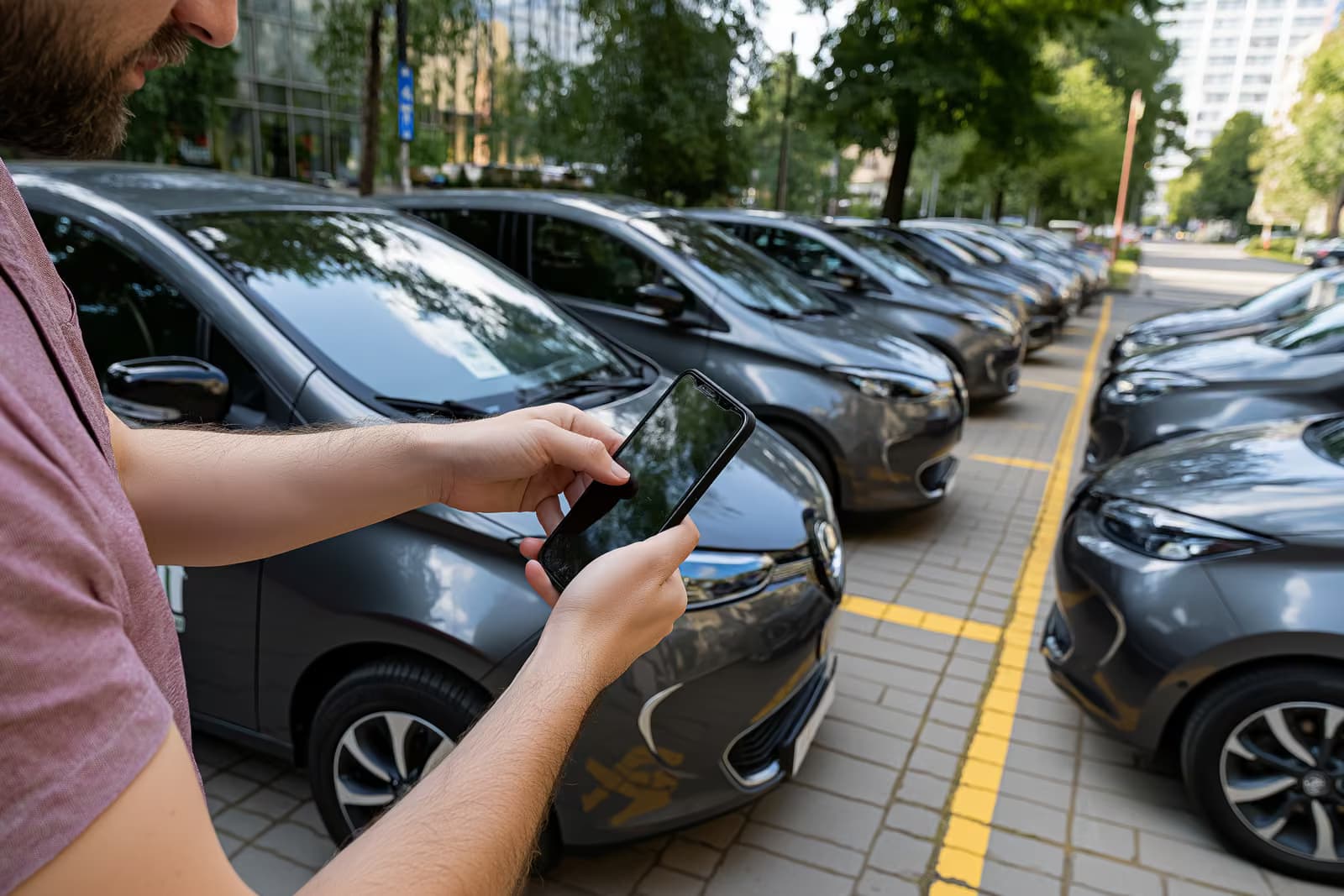
Carsharing in Germany comes in three shapes, and choosing the right one is mostly about the shape, not the brand. The first is free-floating. You pick up any available car parked within a defined city zone and drop it off anywhere inside that same zone when you are done, with no fixed station and no return time to plan around. The best-known free-floating provider is Free2move (the merged former Car2Go and DriveNow, which operated as Share Now until it was folded into Free2move in 2024, so you may still see the old name). Its main competitor is Miles, and Sixt runs its own free-floating service, Sixt share. Free-floating is built for spontaneous one-way trips inside the city: a ride across town, getting home late when the trains thin out, a quick errand. The important billing difference is that Free2move and Sixt share charge mostly per minute, while Miles bills mainly per kilometre driven rather than per minute. That single distinction decides the math: if you are stuck in traffic or parking while the meter runs, per-minute billing punishes you, so Miles is often cheaper for a longer or slower trip, whereas per-minute providers can be cheaper for a short quick hop. Always check both apps for the specific trip.
The second shape is station-based (stationär). Here you collect the car from a fixed station, usually a reserved parking bay, and you must return it to that same station by the end of your booking. Providers in this segment include Cambio, Stadtmobil, book-n-drive and Flinkster (run by Deutsche Bahn). Many of them are cooperatives or regional operators rather than large corporations. Station-based sharing is less spontaneous, because you book a specific car for a specific window in advance and bring it back where you started, but it is markedly cheaper for planned and longer use: a half-day of errands, a day trip, moving boxes across the city. If you know in advance when and for how long you need a car, station-based is usually the better value. The third shape is peer-to-peer, where private owners rent out their own cars through a platform. This segment is smaller and has consolidated recently: SnappCar still operates in Germany, and Getaround’s European business was sold to the Danish company GoMore, while Turo does not operate in Germany. Peer-to-peer can be cheaper and offers more unusual vehicles, but availability is patchy and the handover depends on a private person rather than a company, so treat it as a niche option rather than your main plan.
Whichever model you use, you register once. Registration means creating an account, proving your identity and having your driving licence checked, as described above, and it sometimes carries a small one-time fee, though many providers waive it during promotions. After that first check you simply open the app, find a car, unlock it with your phone, and drive. Keep in mind that free-floating zones have hard edges: you can drive outside the zone, but you cannot end the rental there, so you would keep paying until you bring the car back inside, or pay a surcharge for an approved satellite drop-off such as an airport.
What Car Sharing Actually Costs
The appeal of car-sharing pricing is that almost everything is bundled into the one rate. Fuel or charging, insurance, tax, and parking within the operating zone are all included in the per-minute or per-kilometre price, so you are not handed separate bills the way you are with a rental. If a free-floating car needs fuel, there is a fuel card in the vehicle, and you pay at the pump with that card, not your own money; charging a shared electric car works the same way, with a charging card provided. Some providers even give you a small credit of free minutes for plugging a low car in. Because parking inside the zone is part of the deal, you can leave a free-floating car in most public on-street parking without feeding a machine, since the provider holds a city-wide parking arrangement that covers it. This is one of the genuine advantages over owning: you never hunt for a resident permit or pay a meter for a shared car.
The cost you must not overlook is the Selbstbeteiligung (the excess, sometimes called Selbstbehalt), the amount you pay yourself if you damage the car before the provider’s insurance covers the rest. On a standard car-sharing account this excess is commonly somewhere in the region of a four-figure sum per incident, and it applies even to damage that was not your fault to prove. Most providers let you reduce this excess to a lower amount, or close to zero, either by paying a small daily or per-trip fee or by holding a paid membership tier. If you car-share regularly, reducing the excess is usually worth it, and you should also make a habit of photographing any existing scratches or dents and reporting them in the app before you drive away, because whatever you do not report can be charged to you when you return the car. To sanity-check whether a given trip is even worth taking by shared car rather than public transport, the free Spritkosten-Rechner (fuel-cost calculator) on Werkzeu.ge estimates what the same distance costs in fuel, which is a quick way to compare a per-kilometre Miles trip against a train ticket. As with all such tools, it is an estimate, not financial advice, and the free tier carries ads.
Renting a Car (Mietwagen)
When you need a car for a full day or longer, or you want a specific type of vehicle, a classic Mietwagen (rental car) is the right tool. You have two ways to book. The first is to go directly to one of the big rental firms: Sixt, Europcar, Hertz, Enterprise, Avis and their competitors, all of which have desks at airports, main train stations and city-centre branches. The second is to use a broker (a price-comparison portal) such as billiger-mietwagen or check24, which compares the same firms’ offers side by side and often finds a cheaper rate for an identical car, because brokers negotiate bulk pricing. Booking through a broker is usually cheaper, but read carefully what is and is not included in the rate you see, because the headline price on a comparison site is where the insurance question below hides.
The requirements are the same ones from the licence section, applied strictly at the counter. Expect to show your valid licence, a second form of photo identification, and a credit card in the main driver’s name. The minimum age is generally 21, with certain vehicle classes reserved for drivers 25 and older, and you normally need to have held your licence for at least a year. If yours is a non-EU licence, bring the International Driving Permit as well, and remember the six-month validity window from your registration date still applies. Choose the pickup point deliberately: airport branches are convenient but often add an airport surcharge to the rate, so a city-centre branch a short train ride away can be noticeably cheaper for the same car. Add a second driver at the counter if anyone else will drive, because an accident caused by an unregistered driver voids the insurance entirely.
The Insurance Trap and Other Rental Costs
This is the single most expensive misunderstanding for foreigners renting in Germany, so read it slowly. Almost every German rental includes Haftpflicht (third-party liability, which is legally required) and a Vollkasko (comprehensive damage cover) that comes mit Selbstbeteiligung, meaning with an excess. That excess is the amount you personally pay for any damage before the insurance covers the rest, and on a standard rental it is often somewhere between 800 and 1,500 EUR. So “fully insured” does not mean you pay nothing if the car is damaged: it means you are on the hook for that excess, per incident, even for a scratch in a car park you did not cause. You can buy the excess down to zero, either when booking (this is usually the cheapest way and worth doing) or at the counter (where the upsell is expensive). For any rental longer than a day or two, a zero-excess rate, or a separate standalone excess-reimbursement policy bought in advance, is almost always the sensible choice.
Two more things trip up foreigners specifically. First, do not assume the collision cover (CDW) bundled with your home credit card protects you here. In Germany the rental firm holds you liable under the German contract and settles against your excess directly; a card’s insurance, especially a non-European card’s, typically only reimburses you afterwards, if at all, and the firm will still charge your excess first and leave you to claim it back. It rarely helps at the moment it matters, so do not rely on it. Second, the firm places a Kaution (a deposit) as a hold on your credit card at pickup, frequently the value of the excess plus the fuel tank, which reduces your available credit for the rental period and is released after you return the car undamaged; a debit card or a card with a low limit often will not be accepted for this reason. Watch the fuel policy too: “full-to-full” (you collect a full tank and return it full) is the fairest and usually cheapest, while “full-to-empty” pre-purchase policies charge you for a whole tank at an inflated price and refund nothing for what you do not use. Expect a one-way fee if you drop the car at a different location than you collected it, and a young-driver surcharge, charged per day, if the main driver is under 25. To estimate the fuel you will actually buy on a trip, the free Spritkosten-Rechner mentioned above gives a quick figure from distance and consumption.
Driving a Shared Electric Car
A large share of free-floating fleets, and a growing share of rentals, are now electric, so there is a good chance the shared car you unlock is an EV even if you did not choose one. In practice this changes very little about the trip. The car drives itself the same way; you unlock it, drive, and end the rental as usual. The one difference is what you do if the battery runs low. With car-sharing you do not pay for charging out of your own pocket: there is a charging card in the car, exactly like the fuel card in a petrol car, and you use it at a public charging point. Many providers reward you for plugging a low car in at the end of your trip with a credit of free minutes, so it can be worth doing. The provider’s app shows you the current range and, usually, nearby charging stations within the operating zone.
What you do not need to master is the mechanics of charging itself, the connector types, the charging networks, the apps and cards, and how fast different points charge. Those belong to a car you own or charge regularly, and we cover them in full in our chapter on electric vehicles and charging. For a shared EV, the short version is enough: use the card in the car, plug in at a public point when the range gets low, and let the provider handle the billing. If you are renting an electric car for a longer trip rather than car-sharing one across town, that chapter is worth reading first, because on a rental you may be handling the charging card and networks yourself.
Parking, Fines and Airport Pickups
Parking a shared or rented car follows the normal city rules, with one helpful exception and one thing to remember. The exception is that free-floating providers hold a city-wide parking arrangement, so you can leave their cars in most public on-street parking within the zone without a permit or a meter. What does not transfer is the Anwohnerparkausweis (the resident parking permit): that belongs to a registered vehicle and a registered address, so it never applies to a shared or rented car, and in a strict resident-only bay you must still park a rental legally like any visitor. Read the signs, use a Parkscheibe (the cardboard parking disc showing your arrival time) where one is required, and pay the machine where parking is metered, keeping the receipt if you are driving a rental.
If you collect a Knöllchen (a parking or traffic fine) in a rental, the notice goes to the registered keeper, which is the rental firm, not to you. The firm pays or forwards the fine and then charges it back to your card, almost always adding an administrative handling fee on top for the paperwork, so a small parking ticket becomes a larger bill. The rules on the fines themselves, and the Bußgeldkatalog (the official schedule of penalties), are covered in driving in Germany. Damage works the same way in reverse: report any new damage immediately, in the car-sharing app or to the rental counter, and photograph the car at pickup and return, because undocumented damage is charged against your excess. For airport pickups, book the branch at the terminal if you value convenience, but compare it against a city branch, since airport locations commonly add a surcharge; and when you drop a free-floating car near an airport, check whether ending the rental there is allowed or triggers an out-of-zone fee.
What to Do Next
Start with the licence question, because nothing else works without it. Confirm your Führerschein is valid for driving in Germany, and if you hold a non-EU licence, check the six-month window and arrange an International Driving Permit before you need it, using our chapter on driving in Germany. Then match the tool to the trip: a free-floating car for a spontaneous ride across town, comparing Miles’ per-kilometre price against a per-minute provider for anything slow or long; a station-based provider for a planned day of errands; and a Mietwagen for a full day, a specific vehicle or a longer journey.
When you rent, book the excess down to zero in advance rather than at the counter, use a real credit card for the deposit, choose a full-to-full fuel policy, and photograph the car before you drive off. Register with one car-sharing provider now, while you have time, so the identity and licence check is already done before the day you actually need a car. For most people in a German city, a Deutschlandticket for daily travel plus occasional car-sharing or a rental is cheaper and simpler than owning, and it leaves the tax, insurance, inspection and parking-permit headaches to someone else. This chapter is general guidance for living in Germany, not legal or insurance advice; check the specific terms of your provider or rental firm before you sign.
About this information
This chapter is general orientation based on widely-published information about everyday life in Germany, last reviewed in July 2026. It is general guidance, not individual legal, tax, or medical advice. See the related WeLiveIn.de chapters linked in the text above for topic-specific detail and official sources.