





 Turkish
 Italian
 Spanish
 Portuguese
 Romanian
 Albanian
 Lithuanian
 Latvian
 Bulgarian
 Greek
Greek Hungarian
 French
 Croatian
 Czech
Czech
The Deutschlandticket is the single ticket that lets you ride almost all of Germany’s local and regional public transport, anywhere in the country, for one flat monthly price. That price is now 63 euros a month, and has been since 1 January 2026. You will still see it called the 49-Euro-Ticket almost everywhere, including in the web address of this very page, because 49 euros is what it cost when it launched in May 2023. The nickname stuck; the price did not. This chapter is written to be the page that is finally straight with you about what the Deutschlandticket costs today, exactly what it does and does not cover, whether it is actually a good deal for the way you travel, and how a newcomer buys and uses one without falling into the two traps that catch people most: boarding the wrong train, and forgetting that it is a subscription that renews itself every month until you stop it.
If you want the wider picture of how German public transport is organised – the roughly sixty regional tariff associations, the fare zones, the difference between local and long-distance services and your rights when a train is late – our chapter on the public transportation system is the place to start, and this chapter assumes it as background rather than repeating it. Here we stay tightly on the Deutschlandticket itself.
What the Deutschlandticket Costs Now
The current price is 63 euros per month. It reached that figure in three steps, and knowing the trajectory helps you read the many older articles that still quote the wrong number. The ticket launched on 1 May 2023 at 49 euros a month, which is where the 49-Euro-Ticket nickname comes from. It held that price through 2024, rose to 58 euros a month from 1 January 2025, and rose again to 63 euros a month from 1 January 2026. The 2026 increase was agreed by the Verkehrsministerkonferenz, the standing conference of the sixteen federal states’ transport ministers, on 18 September 2025. So if a blog, a forum post or an old sign tells you the ticket is 49 or 58 euros, it is simply out of date: as of 2026 it is 63 euros.
The price is the same everywhere in Germany and does not depend on where you live, how far you travel or which region you are in – that flat, nationwide price is the entire point of the ticket. It buys a calendar month, from the first to the last day of that month, no matter which day you start using it, so buying one on the 20th still only covers you to the end of that month. What happens to the price after 2026 is a genuinely open question that we come back to in the section on the ticket’s future, because it is tied up in a long-running argument about who pays for it. For now, the number to carry in your head is 63 euros a month.
It Is a Subscription, Not a Paper Ticket
The most important thing to understand before you buy is that the Deutschlandticket is only sold as an Abo, a subscription, and never as a one-off paper ticket you buy at a machine for a single month. There is no day-pass version and no anonymous single-use version. You sign up, you are charged automatically each month, and the ticket keeps coming until you actively cancel it. It is a digital product: in almost every case it lives either in an app on your phone as a Handyticket, a mobile ticket showing a rotating code, or on a plastic Chipkarte, a chip card, that some regional operators issue instead. Whichever form you get, treat it as a personal, non-transferable ticket tied to your name.
Because it renews itself, the subscription carries a trap that costs newcomers real money: the cancellation deadline. The Abo runs for an indefinite term and extends automatically from one month to the next. To stop it, you generally have to cancel by the 10th of a month for the cancellation to take effect at the end of that same month. Miss the 10th and you are usually charged for one more full month. So if you know you are leaving Germany at the end of March, or you only need the ticket for the summer, cancel in good time rather than on the last day. Most providers let you cancel directly in the app or in the online Abo portal – for tickets bought through Deutsche Bahn, for example, the cancellation button sits under your ticket in the DB Navigator app or in the DB Aboportal – and the cancellation is confirmed in writing. The direct-debit mandate you gave when signing up ends automatically with the contract, so there is nothing extra to unwind at your bank.
A few providers, or a few older contract types, still want a cancellation in writing rather than a click. If yours does, a cancellation-letter generator can produce a clean, correctly worded Kündigung, the German word for a notice of cancellation, for a consumer subscription like this one. One such free tool is the Kündigungsschreiben generator on Werkzeu.ge (werkzeu.ge/de/tools/rechtsdokumente/kuendigungsschreiben), which is usable without an account and fills in the letter in your browser; Werkzeu.ge is a browser-based tool platform built by Cryon UG, the company behind WeLiveIn.de. It is in open beta and its free tier carries ads, so treat it as a drafting aid rather than a guarantee, and it is not legal advice. In practice, though, for the Deutschlandticket a click in the app is almost always all that is needed, so you will rarely reach for a letter at all. Because the ticket is legally an ordinary consumer contract, the wider rules on subscriptions, deadlines and fairness that our chapter on consumer protection laws sets out apply to it just as they apply to a gym or a phone contract.
Exactly What It Covers, and What It Does Not
The Deutschlandticket covers all of Germany’s Nahverkehr – the local and regional transport you use for everyday journeys – second class, across every regional tariff association in the country. In concrete terms that means the U-Bahn (the city underground), the S-Bahn (the suburban rail network), the Straßenbahn or Tram, the great majority of city and regional buses, and, on the railway, the regional train categories: the RB (Regionalbahn, which stops everywhere), the RE (Regional-Express, which skips the smaller stations) and the IRE (Interregio-Express). One ticket, all of these, everywhere in Germany, with no zones, rings or cells to worry about. This is exactly the boundary problem it was invented to abolish: a normal regional pass dies the moment you leave the association that sold it, whereas the Deutschlandticket ignores those boundaries entirely.
What it does not cover is just as important, and getting this wrong is the single most expensive mistake you can make with it. The Deutschlandticket is not valid on long-distance trains: not the ICE (Intercity-Express, the high-speed service), not the IC (Intercity), and not the EC (Eurocity). It is not valid on the private long-distance operators either, meaning FlixTrain and the FlixBus coaches, and it does not cover first class anywhere. The trap is that a regional RE and a long-distance IC can run between the same two cities, on the same tracks, from neighbouring platforms, minutes apart – and only the regional one is included. Board an ICE for two stops because it happened to come first and you are travelling without a valid ticket, which in Germany is treated as fare evasion with real consequences, not a harmless slip. The habit that protects you is to read the letters in front of the train number on the departure board before boarding: RB, RE and IRE mean your ticket works; IC, EC and ICE mean it does not. Long-distance travel, and the separate tickets, savings fares and BahnCard discounts that go with it, are the subject of our chapter on domestic travel tips, which owns that side of the network.
Two edge cases are worth knowing. First, a small number of individual IC lines have historically been bought into the regional tariff by the Land they run through, so that a regional ticket is accepted on that specific stretch; these exceptions are few, they change, and they are the exception that proves the rule, so never assume an IC is covered – check that particular line before you rely on it. Second, the ticket reaches a little way across some borders on cross-border regional services. According to the official Deutschlandticket information service, you can, for example, reach Salzburg from the Bavarian side on regional trains without a separate ticket, and in the Basel area the ticket is honoured on regional trains as far as Basel Bad Bf and even Basel SBB, the Swiss main station. These are narrow, route-specific exceptions on regional trains only: any onward journey inside Austria or Switzerland needs a ticket from that country, and the position can change, so verify the specific line before counting on it.
Is It a Good Deal for You?
For anyone who uses public transport regularly, the honest answer is almost always yes. In most German cities a normal monthly Verkehrsverbund pass – covering only your local zones – already costs somewhere in the region of 60 to 100 euros, and often more once you add a second zone or an airport zone. The Deutschlandticket at 63 euros a month typically undercuts that local pass while also, unlike the local pass, working in every other city in the country and on every regional train between them. If you commute even a few days a week, or you make the odd regional trip at the weekend, it usually pays for itself well before the month is out, and it removes the whole question of which zone or ring you are travelling into.
Where it does not automatically pay off is the occasional user. If you walk or cycle to work and only take a tram a handful of times a month, 63 euros is a lot to spend for a few short rides that would cost you far less bought singly, or with a Kurzstrecke short-hop ticket, or through one of the pay-as-you-go check-in systems that several cities now run and that cap your daily and monthly spend automatically. The rough test is simple: work out what you would otherwise pay in a normal month on single tickets and short-trip fares, and if that number is comfortably below 63 euros, you probably do not need the subscription. Because it is monthly and cancellable, you can also treat it as seasonal, subscribing for a month with a lot of travel in it and cancelling again, as long as you respect the cancellation deadline. The one thing not to do is buy it on the vague feeling that everyone has one; run the small sum for how you actually travel.
The Cheaper Versions: Jobticket, Student, Social and School
The 63-euro price is the standard, full-price version, and there are several discounted variants that many people qualify for without realising it. The most widely available is the Deutschlandticket Jobticket, the employer-subsidised version. The mechanism is worth spelling out because it stacks two discounts. If your employer pays at least 25 percent of the ticket – at least 15.75 euros of the 63 – then the federal government and the states add a further 5 percent discount on top. With the minimum employer share, that brings the ticket’s price down to 59.85 euros, of which the employer covers 15.75 euros and you pay the remaining 44.10 euros through your salary. Many employers choose to pay more than the 25 percent minimum, and some cover the whole thing, so the amount that actually lands on your payslip varies; ask your Personalabteilung, the HR department, whether a Deutschlandticket Jobticket is on offer. As long as the employer’s contribution is paid on top of your normal wages, it is generally free of income tax and social-security contributions, though it can reduce the commuting allowance you claim on your tax return, and this is a point to check rather than take as advice.
Students are the other large group with a cheaper route. Many universities now include a Deutschlandsemesterticket in the compulsory semester fee under a solidarity model, meaning every enrolled student pays a set amount and everyone is covered. For the 2025/26 winter semester that worked out at 208.80 euros per semester, roughly 34.80 euros a month, and because the whole Deutschlandticket family follows the standard price, it is set to rise to about 37.80 euros a month from the 2026/27 winter semester. Where a university still issues an older regional semester ticket instead, there is often an Upgrade: you pay the difference between your existing semester ticket and the full Deutschlandticket price to lift your coverage to nationwide, although at many institutions the upgrade route has now been replaced by the Deutschlandsemesterticket itself. If you are studying here, check your Studierendenwerk or student union for exactly which model your university runs; the wider paperwork of studying in Germany is covered in our chapter on student visas and permits.
Beyond work and study, some federal states and cities offer a subsidised Deutschlandticket Sozial for people on low incomes or receiving benefits, typically at a reduced monthly price, and many run a discounted or free version for schoolchildren. These social and school variants are decided regionally rather than nationally, so both the price and the eligibility rules differ from one Land to the next and change over time. If your household budget is tight, it is worth asking your local Verkehrsverbund or your city’s Sozialamt, the social services office, whether a reduced Deutschlandticket exists where you live, rather than assuming the full 63-euro price is your only option.
Will the Ticket Survive, and Will the Price Rise Again?
The Deutschlandticket has lived under a cloud of funding uncertainty since it launched, and it is worth being precise about where that stands in 2026 rather than repeating the older, gloomier headlines. The ticket costs far more to run than it earns in fares, and the gap is filled jointly by the federal government (the Bund) and the sixteen states (the Länder). For years this was renegotiated annually, which meant a recurring public argument each autumn about whether the money would be there and whether the price would jump – which is why so much coverage from 2023 and 2024 questioned whether the ticket would survive at all.
That picture has become more settled. In late 2025 the Bundestag amended the Regionalisierungsgesetz, the law that channels federal transport money to the states, to secure the funding framework: the Bund and the Länder are each committed to contributing around 1.5 billion euros a year toward the ticket through 2030. In other words, as of 2026 the ticket’s continued existence for the rest of the decade is on a much firmer legal footing than it was at launch. What is not fixed is the price beyond 2026. To take the annual fight out of price-setting, the transport ministers agreed at their March 2026 conference to move to a Preisindex, a price index, from 2027, under which the monthly fare is adjusted by a formula tracking energy, personnel and general operating costs rather than by a yearly political vote. According to the ministers, the exact 2027 price is due to be fixed bindingly by the end of September 2026. The safe way to read all of this is that the ticket is here to stay through 2030, but the monthly figure is expected to keep drifting upward with costs, and the precise 2027 number was not yet settled at the time of writing. Treat any specific 2027 figure you see quoted before that autumn decision as a forecast, not a fact.
Buying and Using It as a Newcomer
You can buy the Deutschlandticket from Deutsche Bahn through the DB Navigator or DB Abo app, from your own regional Verkehrsverbund through its app or website, or from many individual municipal transport operators – and because the ticket is identical everywhere, you can simply pick whichever provider you find easiest to sign up with. There is one practical hurdle that catches new arrivals: because it is a subscription billed month after month, almost every provider wants a German payment method, most commonly a SEPA-Lastschrift, a direct-debit mandate drawn on a German or European bank account. Some providers also accept a debit or credit card or PayPal, but a local IBAN is the smoothest path, which is one more reason to open a German account early. Our chapter on opening a bank account in Germany walks through that step, and a modern app-based account is usually enough.
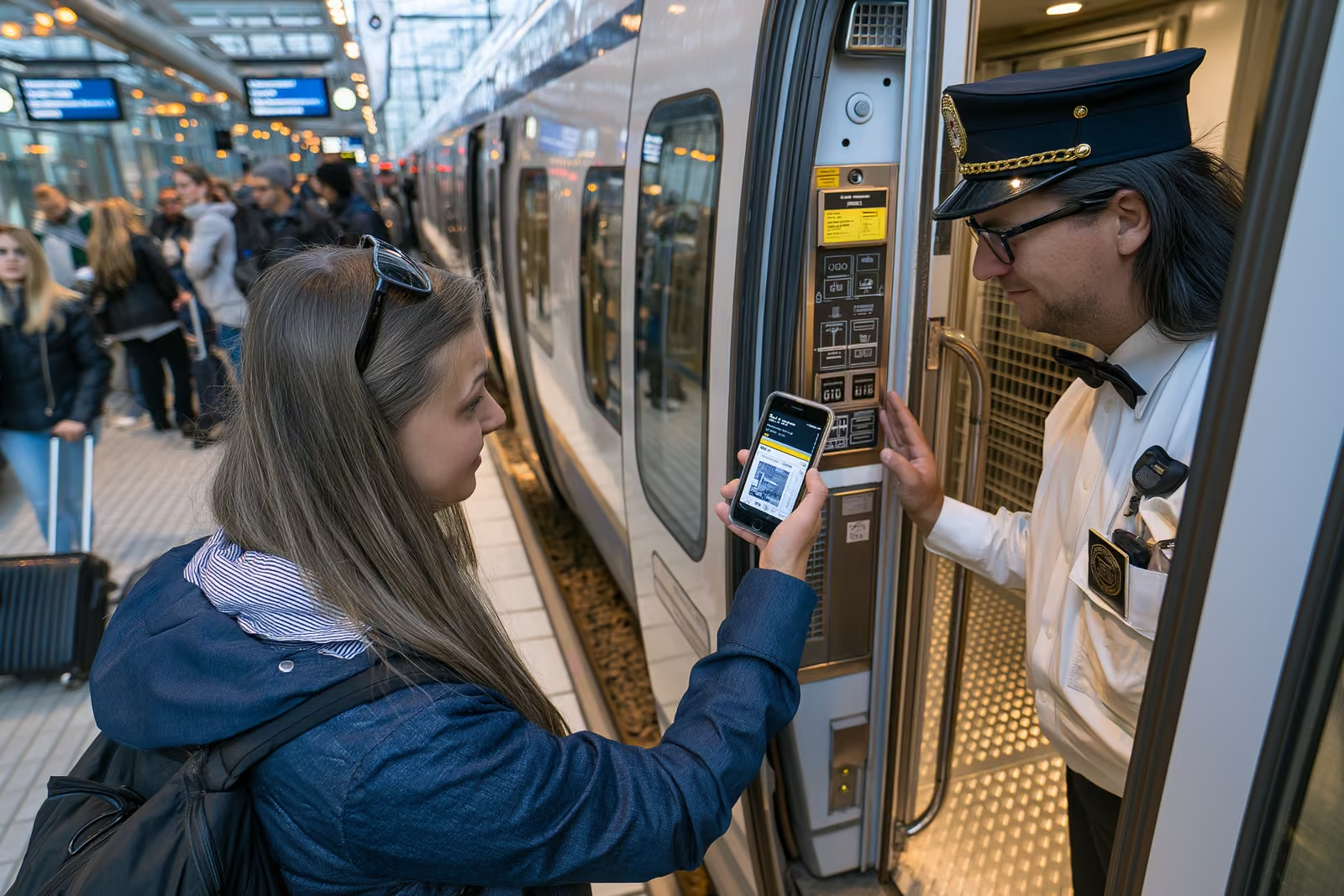
Once you have it, using it is undramatic. If your ticket is on your phone, keep the app installed, logged in and the ticket downloaded, because a fare inspector will ask to see the live ticket in the app rather than a screenshot, and a screenshot is not accepted. If you were issued a Chipkarte instead, simply carry the card. In a control, the inspector may also ask for photo identification, since the Deutschlandticket is personal and non-transferable and your name is on it, so carry an ID document as well. There is nothing to stamp or validate at the platform: unlike an old-style paper single ticket, the Deutschlandticket is valid the moment you hold it, and the Entwerter validation boxes on the platform are not for it. Do make sure the ticket has actually loaded and is readable before you travel, especially near a month boundary when the new month’s ticket needs to have refreshed.
Two everyday extras are not included and regularly surprise people. A bicycle is not covered: to take a bike on the U-Bahn, S-Bahn or a regional train you generally need a separate Fahrradkarte, a bicycle ticket, and many cities bar bikes during the morning rush hour, so the Deutschlandticket carries you but not your bike. Dogs follow the local rules too – a small pet in a closed carrier usually rides free, while a larger dog normally needs its own ticket and a lead. The cycling side of this, including the Fahrradkarte and the rush-hour restrictions, is covered properly in the public transportation and cycling chapters, so plan for a bike or a dog as a separate ticket rather than assuming your 63 euros stretches to cover them.
What to Do Next
Start by deciding honestly whether you are a regular traveller. If you commute or make regional trips most weeks, the arithmetic almost always points to buying the Deutschlandticket, and your first move should be to ask your employer whether a Deutschlandticket Jobticket is available, because the employer share plus the 5 percent discount can bring your own cost down to around 44 euros or lower. If you are a student, check with your Studierendenwerk whether a Deutschlandsemesterticket is already bundled into your semester fee, or whether you can upgrade an existing semester ticket, before you pay full price. If money is tight, ask your city or Verkehrsverbund about a subsidised Deutschlandticket Sozial. And if you only travel occasionally, do the small sum first: below roughly 63 euros of normal monthly travel, single tickets or a pay-as-you-go check-in system will usually serve you better.
When you do buy, buy from your regional Verbund app or DB, set up the SEPA direct debit, and put one date in your calendar straight away: the 10th of the month, the deadline to cancel if you ever want to stop the subscription cleanly. Keep the ticket loaded and your ID to hand, and above all read the letters in front of every train number before you board, so that an ICE or an IC never ends up charged as fare evasion on a ticket that only ever covered the RE beside it. Do that, and the Deutschlandticket turns Germany’s famously fragmented fare landscape into a single flat monthly cost – which, at 63 euros in 2026, remains one of the best-value things a newcomer can buy.
Sources
The information in this chapter draws on the official sources and publications listed below, last reviewed in July 2026. It is general guidance for orientation, not individual legal, tax, or medical advice.

