The Oktoberfest
13 min read
Oktoberfest is the event most foreigners in Germany hear about first and understand least. This chapter is the practical guide to actually attending it: what it is, when it runs, how the beer tents and reservations really work, what to wear, how to get there, and how to enjoy a very strong beer festival safely and respectfully. If you want the food and drink in depth, or the wider world of German festivals, we link those chapters as we go. Here the focus is the Wiesn itself, as an event you can plan and attend with confidence.
What Oktoberfest is, and when it happens
Oktoberfest is the world’s largest Volksfest, a German word meaning “people’s festival”: a public fair combining beer halls, fairground rides, food stalls and traditional dress. It takes place in Munich (München) on a large open ground called the Theresienwiese, which locals shorten to “die Wiesn” - and Wiesn is the name Bavarians use for the festival itself. It draws around six million or more visitors each year, and it has grown from a purely local celebration into a fixture that people travel from every continent to attend. Despite the name, most of it happens in September.
The festival goes back to 12 October 1810, when Crown Prince Ludwig of Bavaria married Princess Therese. The citizens of Munich were invited to celebrate on the fields outside the city gates, and those fields were named the Theresienwiese in the new princess’s honour. Horse races closed that first celebration, it was repeated the next year, and over two centuries it grew into the beer-and-fairground festival known today. The festival has only rarely been called off, and when it has, the reason has been serious: it was cancelled during the two World Wars, in cholera years in the nineteenth century, and most recently in 2020 and 2021 during the coronavirus pandemic. Those gaps are why the count of festivals runs lower than the number of years since 1810. If you want the deeper meaning and customs behind German celebrations like this one, our guide to German festivities and local traditions covers that ground.
The dates follow a fixed rule rather than a fixed calendar. Oktoberfest runs for about 16 to 18 days and always ends on the first Sunday in October; when that Sunday falls very early, the festival is extended so it includes 3 October, the Tag der Deutschen Einheit (German Unity Day, a national holiday). In practice it opens in mid or late September. For 2026 the festival runs from 19 September to 4 October, the 191st Oktoberfest, with the official opening at noon on the first Saturday. Always check the current year’s exact dates before you book travel, because they shift each year with that first-Sunday rule.
How the festival actually works
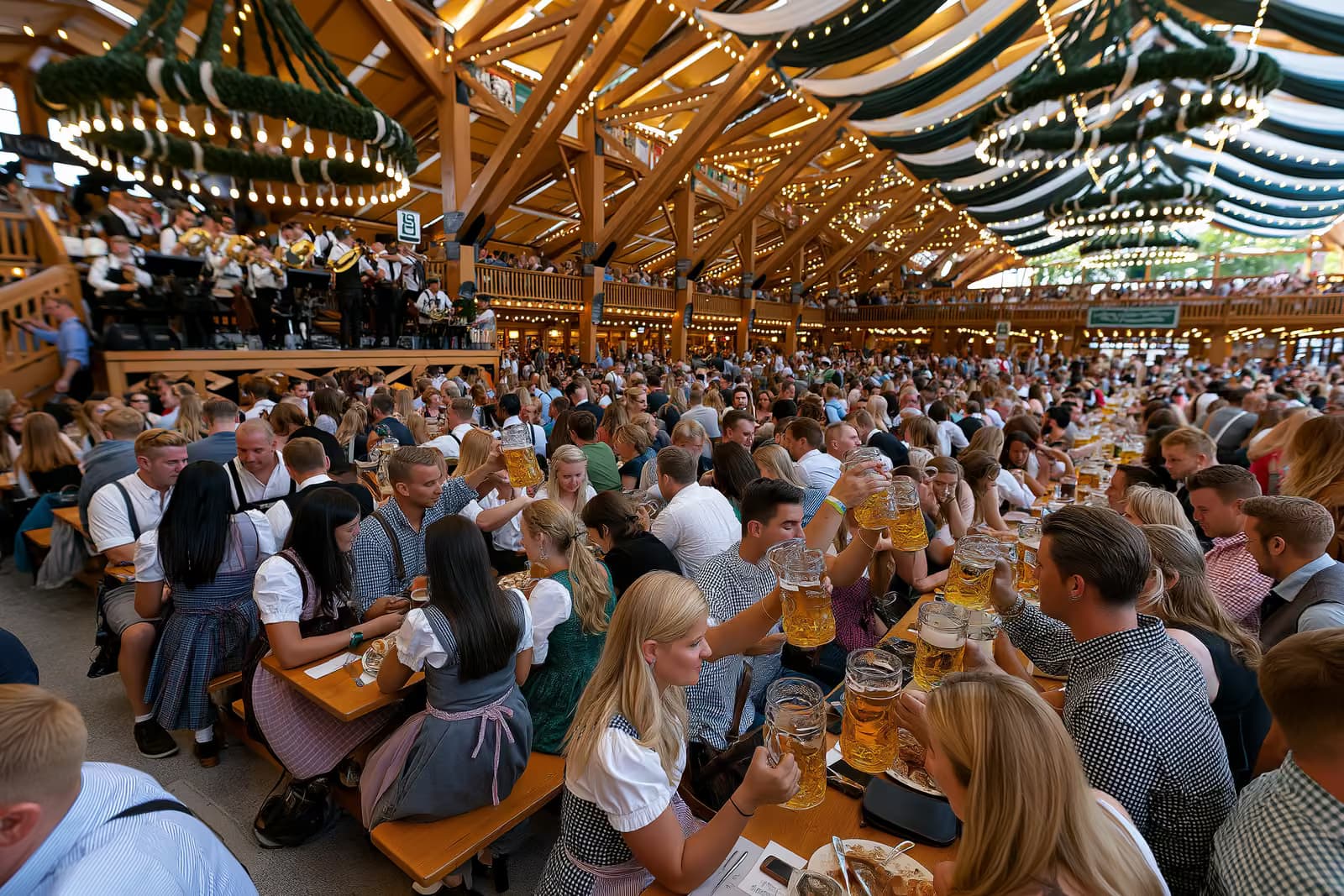
The heart of Oktoberfest is the beer tents, called Festzelte. There are fourteen large tents plus a number of smaller ones, and each has its own character rather than being interchangeable. The Schottenhamel is where the festival officially begins: at noon on the opening Saturday the Mayor of Munich taps the first keg, calls out “O’zapft is!” (Bavarian dialect for “It’s tapped!”), and only then may beer be served across the grounds. The Hofbräu-Festzelt is the loudest and most international, popular with visitors from abroad. The Käfer Wiesn-Schänke is the small, late-closing tent known for celebrities and a restaurant feel. It is worth reading up on a few tents in advance and picking one that matches the atmosphere you want, because they genuinely differ.
Not every tent is built around lager, and not every part of the grounds is loud. There is a dedicated wine tent, the Weinzelt, for those who prefer wine or sparkling wine to beer, alongside tents known for their roast ox or roast chicken. In most years the festival also runs a separate, quieter section called the Oide Wiesn (“Old Wiesn”), a nostalgic area with historical rides, brass and folk music, more space and a calmer, family-friendly feel. It charges a small entrance fee where the main grounds are free, and it is the part of Oktoberfest many locals like best. If the scale of the main tents feels overwhelming, the Oide Wiesn is the gentler way in.
Entry to the grounds and to the tents is free. There is no ticket and no entrance fee; you pay only for what you eat, drink and ride. The catch is seating. Inside a tent you are served only when you have a seat at a table, and on evenings and at weekends the good tables are reserved (a Reservierung) weeks or months ahead, usually in packages that include beer and food vouchers. If you do not have a reservation, your reliable route to a seat is to arrive early: on a weekday morning when the tents open you can almost always find a place, but by a Friday or Saturday evening a full tent will close its doors and turn people away. Plan around this single fact and most of your Oktoberfest problems disappear.
If you do want a reservation, you arrange it directly with the individual tent, not through a single central office, and each tent opens its bookings on its own schedule earlier in the year through its website. Reservations themselves are usually free, but they are sold as packages: you commit to a minimum number of Maß and often a set meal per person, paid for with vouchers you redeem on the day. Reservations normally cover a whole table of eight or ten, so they suit groups rather than solo visitors. Beware of resellers charging steep markups for tables that the tents themselves hand out at cost; book with the tent directly wherever you can.
The opening weekend has its own rituals beyond the tapping. On the first day a parade brings the brewery families, their horse-drawn beer wagons and the tent landlords onto the Theresienwiese, and on the first Sunday a large costume and marksmen’s procession, the Trachten- und Schützenzug, moves through central Munich in historical dress. Away from the tents the grounds are a full funfair, with carousels, roller coasters, game stalls and food stands, which is why families with children come for the daytime as much as anyone comes for the beer. For where Oktoberfest sits among Germany’s other big celebrations, see our overview of major German festivals.
The beer, and why you should pace yourself
Beer at Oktoberfest is served in a Maß, a one-litre glass stein, and the price of the Maß is annual news in Munich. In 2025 it ran from roughly 14.50 to nearly 16 euros depending on the tent, and it has climbed steadily year on year, so budget around 15 euros or a little more per litre and check the current figure before you go. Only six Munich breweries are allowed to pour their beer at the festival: Augustiner, Hacker-Pschorr, Hofbräu, Löwenbräu, Paulaner and Spaten. Each tent serves one of them, and the beer itself is a special festival brew called Oktoberfestbier.
One consumer point is worth knowing at those prices: a Maß is legally meant to hold a full litre of beer, not a litre of beer and foam. Short measures are a perennial complaint, and consumer groups check the tents each year. You are within your rights to ask the Bedienung to top up a glass that arrives half foam, and a well-run tent will do it without fuss.
The important thing for a newcomer is the strength. Oktoberfestbier is brewed stronger than everyday German lager, around six percent alcohol, and you are drinking it a full litre at a time. Two or three Maß add up faster than most visitors expect, especially in a warm, loud tent where the band keeps the mood going. Pace yourself, alternate with water, and eat properly while you drink. If you do not want the full-strength beer, tents also pour Weißbier (a cloudy wheat beer), and there are non-alcoholic beers, soft drinks and water available too, so you are never forced to keep up.
The food is a genuine part of the experience and deserves its own attention. The classics are Hendl (roast chicken), Brezn (large soft pretzels), Schweinshaxe (roast pork knuckle) and grilled Würstl (sausages), all built to go with a Maß. We hand the full culinary detail to our chapter on food festivals and events, and if you want to understand Oktoberfestbier and German beer as a drinking culture in its own right, see wine and beer culture. Here the point is simpler: eat before and while you drink, because a full stomach is your best defence against a very strong litre of beer.
Trachten: what people wear
Traditional Bavarian dress, known collectively as Tracht (the plural is Trachten), is now close to universal at the Wiesn. Women wear the Dirndl, a fitted dress made up of a bodice, blouse, full skirt and apron; men wear Lederhosen, leather breeches worn with a checked shirt and sturdy shoes. This is not a costume put on to mock the locals - it is what Bavarians themselves wear to the festival, across every generation. Foreigners are genuinely welcome to wear it, and doing so is read as respect rather than parody, provided you buy proper Tracht rather than the cheap novelty versions sold as fancy dress, which locals do notice.
The Dirndl carries one small code worth knowing. The apron is tied in a bow, and the side of the bow traditionally signals relationship status: tied on the wearer’s left means single, tied on the right means taken or married, tied at the front centre is generally worn by children or read as undecided, and tied at the back is worn by widows and, for practical reasons, by the serving staff. Many younger visitors treat this loosely today, but it is a real tradition and people at the festival do read it, so tie yours deliberately.
You do not need to spend a fortune. Munich has shops selling Tracht at every price level in the weeks before and during the festival, from budget outfits to handmade pieces that last for years, and several shops and online services rent a full Dirndl or Lederhosen outfit for the duration of a visit, which makes sense if you are only in Germany briefly. A decent middle-range outfit will serve you well and can be worn again at other Volksfeste around the country. Buy or rent a little ahead of the opening, because stock and sizes thin out quickly once the festival starts.
Getting there and staying safe
Do not drive to Oktoberfest. There is effectively no parking, the area around the Theresienwiese is closed and congested, and you will be drinking. Take public transport instead: the U-Bahn (underground) stops at Theresienwiese station bring you straight to the grounds, and Hauptbahnhof (the main station) is a short walk away. If you are travelling from elsewhere in Germany, our chapters on the public transportation system and the Deutschlandticket explain the tickets and connections that will get you into Munich and across the city.
Plan where you sleep well in advance. Munich hotels and guesthouses book out months ahead for the festival and charge their highest rates of the year, so if you decide late you may find nothing affordable in the city at all. A common and sensible workaround is to stay in a town outside Munich with a good rail connection and commute in, since the regional trains and S-Bahn run late during the festival. It also helps to know the hours: the tents generally open at 10:00 on weekdays and 09:00 at weekends and on 3 October, the last beer is served around 22:30, and the tents close by 23:30, while the open fairground and food stalls stay lively somewhat later. Arriving near opening time is the surest way to a seat.
Time your visit to match the crowd you want. Weekday mornings and early afternoons are the calmest, with space at the tables and a family-friendly mood; Friday and Saturday evenings, and the two weekends generally, are packed to the point where tents close their doors. The festival keeps designated quieter family days and afternoons with reduced ride prices, and children are welcome on the grounds during the daytime, though tents have limits on how late young children may stay. If you want a relaxed first visit, go on a weekday before the evening rush.
Bring cash. Many tents and stalls still take cards only reluctantly or not at all, and the servers work fastest with cash, so carry enough in small notes for your beer, food and tips. The people serving you are the Bedienung, and they work extremely hard during the festival; the custom is to round up generously, often to the next few euros on top of the already high prices, and it is expected rather than optional. Our guide to German social etiquette covers tipping norms in more detail.
Two safety points matter. First, security: since 2016 large bags and rucksacks have been banned from the grounds for safety reasons, and you may bring only a small bag up to three litres in volume (roughly 20 by 15 by 10 centimetres). Leave larger bags at your accommodation or the station lockers, because bag checks at the entrances are strict. Second, the beer. The German term Bierleichen, literally “beer corpses”, describes people who have collapsed from drinking too much too fast; it is common enough to have a nickname. Drink water, eat, and know that trained Sanitäter (paramedics) and a medical station are on the grounds if anyone needs help. Keep valuables secure and zipped away, because large festive crowds attract pickpockets.
Finally, tent etiquette. You will see people standing on the benches to sing and toast, and that is allowed during the music - but standing on the tables is forbidden and will get you removed by security. Sing along, raise your Maß, say “Prost” and look people in the eye as you clink glasses, and stay on the bench rather than the table. Every so often the band strikes up “Ein Prosit der Gemütlichkeit”, the short toasting song that is the festival’s unofficial anthem; that is the cue when the whole tent raises its Maß together, and the moment when standing up on the bench to toast is exactly the right thing to do. That one distinction keeps you on the right side of the rules and of the people around you.
You do not have to go to Munich
Munich’s Oktoberfest is the original and the largest, but it is far from the only festival of its kind, and the alternatives are often easier to reach, cheaper and less crowded. Stuttgart’s Cannstatter Volksfest, held on a ground called the Wasen, is the second-largest beer and fairground festival in Germany and runs at almost the same time of year with the same tents, Maß and Tracht. The Cranger Kirmes in Herne, in the Ruhr area, is one of the biggest funfairs in the country, and most German cities and towns hold their own Volksfest at some point in the year. If you cannot get to Munich, or want the atmosphere without the international crush, one of these is a genuine substitute; our chapters on major German festivals and traditional folk festivals point you to more of them.
To plan your own visit, start with the dates: confirm the current year’s exact run, since it changes annually with the first-Sunday rule, and book a reservation early if you want a guaranteed evening seat, or plan to arrive on a weekday morning if you do not. Sort your outfit a little ahead, whether you buy or rent, and decide which tent suits the mood you want. On the day, come in by U-Bahn, carry cash, pack only a small bag, eat as you drink, and treat the strength of the beer with respect. Do that and Oktoberfest is exactly what it looks like from the outside: one of the most welcoming and memorable things you can do in Germany. You do not need to speak German, and you do not need to drink to take part; the tents, the music and the fairground are open to everyone, and the goodwill toward visitors who join in respectfully is real. Prost, and pace yourself.
Sources
The information in this chapter draws on the official sources and publications listed below, last reviewed in July 2026. It is general guidance for orientation, not individual legal, tax, or medical advice.
- oktoberfest.de
- muenchen.de / munichtourism.org
- boredinmunich.com
- dirndl.com / raredirndl.com