Local Community Engagement
16 min read
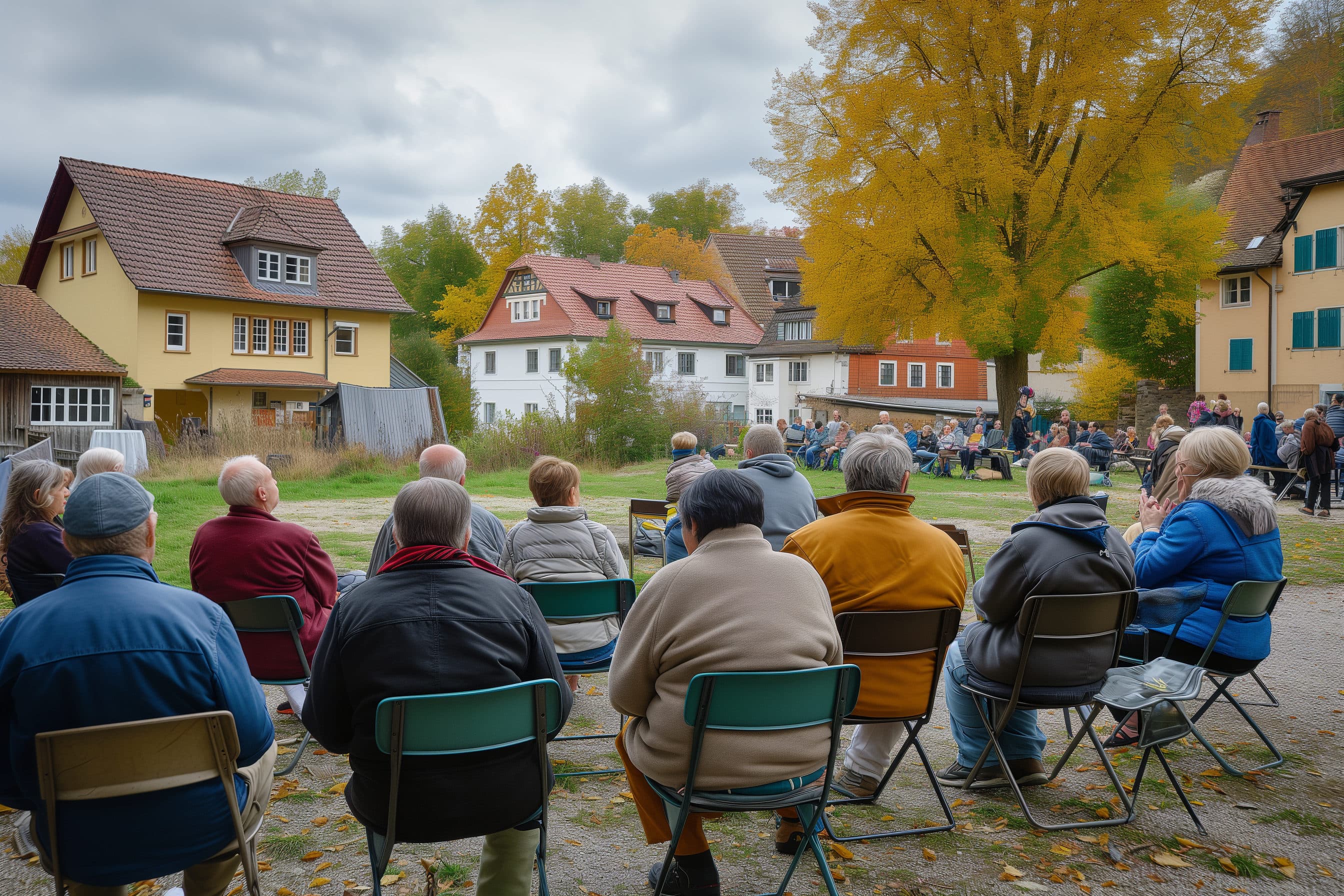
This chapter is about one specific and often overlooked path to feeling at home in Germany: engaging with the place you actually live. Not the expat scene, not an online group, not your professional network, but your street, your building, your neighbourhood and the small town or city district around it. In German this local layer has its own vocabulary and its own habits, and once you learn to read them, a city that felt anonymous starts to feel like somewhere you belong. This guide walks you through the structures a resident can plug into, the ways you can have a real civic voice even as a foreigner, the neighbourly customs that quietly decide whether you are seen as part of the community, and a practical way to start small.
Local community engagement in Germany is a slower, quieter thing than the word “community” suggests in some other countries. People do not usually knock on your door with a welcome basket, and neighbours can seem reserved for months. But underneath that reserve is a dense web of local associations, civic bodies and shared routines that is genuinely open to newcomers, including those who are not German citizens. Belonging here is earned by showing up, and this chapter is about where to show up.
What “Local” Community Engagement Actually Means Here
It helps to draw a boundary first, because Germany offers many kinds of community and they are not the same thing. There are expat organisations and international clubs, which are covered in our chapter on expat groups and clubs. There are professional and online networks with their own logic. This chapter is deliberately about none of those. It is about the local, civic layer: the community of people who happen to share your postcode, your tram stop and your recycling schedule, and the town or district institutions that serve them. It is the layer that turns “the place I moved to” into “my Kiez”.
Kiez is a Berlin word, but the idea travels. It means your immediate neighbourhood, the few streets around your home where you know the baker, the Späti (the late-opening corner shop), and which corner the neighbours gather on when the weather is good. In other cities the same feeling lives under different names: the Viertel (quarter), the Stadtteil or Ortsteil (district), the Veedel in Cologne. Germans are strongly attached to these micro-identities. Someone from Munich will tell you they are from Haidhausen, not just Munich, and that attachment is the doorway you walk through. Learning your district’s name, its history, its Wochenmarkt and its local festival is the first act of local engagement, and it signals that you intend to stay.
The reason this local layer matters so much for a foreigner is that it is where integration stops being an abstraction. You can live in Germany for years inside an English-speaking bubble and never really arrive. The neighbourhood is where you arrive: in the small, repeated encounters with the same people, in being recognised at the Bäckerei, in eventually being the person a neighbour asks to water the plants. None of it happens fast, and none of it happens if you stay invisible. The rest of this chapter is a map of the places where you can become visible.
The Local Structures You Can Plug Into
The good news is that you do not have to invent your way into community life. Germany has built physical and organisational structures for exactly this, and most of them cost little or nothing to use. The trick is knowing they exist and treating them as the entry points they are.
Start with Nachbarschaft, which simply means the neighbourly relationship between people who live close together. German neighbourliness is real but it runs on different rules than you may be used to. It is built on reliability rather than warmth at first: greeting people on the stairs with a clear “Guten Tag”, keeping noise down during Ruhezeiten (the legally recognised quiet hours, typically nights and all of Sunday), and being the kind of resident others can count on. Warmth comes later, and it comes to people who have proven they respect the shared space. If you want a low-pressure digital doorway into your own street, the neighbourhood platform nebenan.de is where a lot of this now begins, from borrowing a drill to hearing about a courtyard party. We cover it, along with the other online neighbourhood tools, in the chapter on social media and online forums, so we will not re-tread that ground here beyond saying it is often the easiest first step for a newcomer who finds knocking on doors intimidating.
The single most powerful local structure in Germany is the Verein, the registered association. There is a Verein for almost everything: sport, music, gardening, history, carnival, dog breeds, model railways. Joining one is the classic route into German social life, because a Verein gives you a reason to see the same people every week and a defined role among them, which is exactly how German friendships tend to form. Because the Verein is such a central institution, we give it its own full treatment in exploring Vereine, Germany’s club culture. For the purposes of local engagement, the point is simply this: your town’s Vereine are listed on the municipal website, they almost always welcome new members regardless of nationality, and the local sports club or Gartenverein is frequently the warmest and least bureaucratic way to meet your actual neighbours.
Then there are the community buildings, which many newcomers walk past without realising what they are. The Stadtteilzentrum or Bürgerhaus is a neighbourhood community centre, usually run by the city or a welfare organisation, hosting everything from language cafes and parent groups to cheap lunches and craft afternoons. The Mehrgenerationenhaus is a federally supported version of the same idea built around bringing generations together, so you might find toddlers, teenagers and pensioners under one roof. These places are designed as open doors, and staff are used to helping people who are new in town and still working on their German. Walking in, picking up the programme (das Programm) and simply attending something is one of the most reliable ways to plug in.
Do not overlook the Bücherei or Stadtbibliothek, the public library, which in Germany is far more than a place for books. A local library membership costs very little, and the building functions as a genuine community hub: free workshops, reading groups for children, language-learning materials, coworking-style tables, and often events aimed specifically at new residents. It is warm in winter, it is free to sit in, and the staff are a quiet mine of information about what else is happening locally.
Finally, treat the Wochenmarkt, the weekly open-air market, as a social institution and not just a place to buy vegetables. Most neighbourhoods have one on a fixed day, and going regularly, buying from the same stalls, and slowly graduating from a nod to a short conversation is neighbourhood belonging in its most concrete form. The Wochenmarkt is where you learn the rhythm of your area and where, over months, the stallholders and the other regulars start to recognise you. That recognition is the raw material of local community, and it accumulates one Saturday at a time.
Having a Say: Civic Participation at the Local Level
Here is something many foreigners in Germany do not realise: local civic life is far more open to you than national politics, and a great deal of it does not depend on citizenship at all. You do not need a German passport to attend a public meeting, join a citizens’ initiative, comment on a building project or sit on a neighbourhood advisory body. Local engagement is one of the areas where a foreign resident can have a genuine, practical voice, and using that voice is a deep form of belonging.
The most accessible entry points are the Bürgerverein and the Bürgerinitiative. A Bürgerverein is a citizens’ association, usually tied to a specific district, that looks after local interests: it might campaign for a safer school route, organise the neighbourhood festival, or act as the district’s collective voice to the town hall. A Bürgerinitiative is a citizens’ initiative, typically formed around a single concrete issue such as a proposed development, a road, or a green space that residents want to protect. Both are open to anyone who lives in the area, membership or participation does not require German nationality, and both are genuinely welcoming to residents who want to help. Getting involved in one is a fast way to meet civically active neighbours and to learn how decisions in your town are really made.
Above that sits the formal local council layer. Depending on the city, your district may have an Ortsbeirat, Bezirksvertretung or Bezirksbeirat, a local council body that advises on matters specific to your part of town. Their meetings are generally public, and you are allowed to attend and listen even if you cannot vote. Many municipalities also hold an Einwohnerversammlung or Bürgerversammlung, a residents’ or citizens’ assembly where the administration presents plans and takes questions and comments from the floor. The right to attend and often to speak at these usually belongs to all residents (Einwohner), not only to citizens, which is exactly why they matter for a foreigner who wants to be heard. A growing number of cities also run some form of Bürgerbeteiligung, structured citizen participation, and some operate a Bürgerhaushalt, a participatory budget in which residents propose and prioritise how a slice of local money is spent. Where these exist, they are usually open to all residents. Because the details vary from town to town and change over time, the reliable move is to search your city’s name together with “Bürgerbeteiligung” or “Bürgerhaushalt” on the municipal website rather than to assume your town runs one.
Now the part that is genuinely important and widely misunderstood, so it is worth stating carefully. Voting in official elections in Germany depends on nationality, and the rules differ sharply between EU and non-EU citizens. If you are a citizen of another EU member state, you have the right to vote and to stand in local elections, the Kommunalwahlen, in the municipality where you live, under Article 28 of the Grundgesetz (the German constitution). You generally need to be 18 and registered as resident for a short qualifying period. EU citizens can also vote in European Parliament elections from Germany. If you are a non-EU citizen, a so-called Drittstaatsangehöriger (third-country national), you currently cannot vote in any German public election, including at the local level. The Federal Constitutional Court ruled in 1990 that extending municipal voting rights to non-EU residents would require a change to the constitution, and that has not happened. There is an active political debate about changing this, but as of 2026 it remains the legal position, so do not assume a local vote you may have had in your home country carries over. This is not legal advice, and the qualifying details are set by each Land, so check your local Wahlamt (elections office) if your own case is close to the line.
The voting rule sounds like a closed door for non-EU residents, but there is an important body that reopens it. Many German cities and districts have an Integrationsbeirat, also called an Ausländerbeirat, Integrationsrat or Migrationsbeirat depending on the region, a migrant advisory council whose whole purpose is to give foreign residents a formal civic voice. These are elected bodies, and here is the key point: it is precisely the residents without a German passport who vote for them and who can stand for election to them. Hundreds of these councils exist across Germany, and they advise the city administration on matters affecting migrants and are consulted on local decisions. For a non-EU newcomer who cannot yet vote in the Kommunalwahl, the Integrationsbeirat is the most direct route to actually shaping local policy, and standing for or voting in one is a serious act of civic participation. Your city’s website will say whether it has one and when the next election is; several are being elected during 2026.
Neighbourly Customs and How to Belong
Civic structures give you places to go, but day-to-day belonging is decided by a set of small customs around your own building and street. Getting these right matters more than any grand gesture, because in Germany trust is built through consistent, correct behaviour in shared space. The reassuring part is that the customs are learnable and that neighbours notice and reward the effort.
Begin with introducing yourself. When you move in, it is a genuinely good idea to knock on the doors of your immediate neighbours, say hello, give your name and mention that you have just moved in. This short Vorstellen (introduction) costs nothing and heads off years of awkward silence in the stairwell. Many newcomers also host an Einweihungsparty, a housewarming, and inviting the neighbours, or at least warning them that there will be one, is both friendly and strategically wise. A note in the stairwell before a party, apologising in advance for any noise and giving your flat number, is a very German courtesy that buys you a lot of goodwill.
Your building has its own small society, the Hausgemeinschaft, the community of everyone living in the house, and it runs on written and unwritten rules. The Hausordnung (house rules) is usually posted or attached to your lease and covers quiet hours, rubbish separation, use of the courtyard and laundry room, and similar matters. Read it, because breaching it is the fastest way to start on the wrong foot. Rubbish separation in particular is taken seriously and getting the bins right marks you as a considerate resident. Because these building-level norms overlap heavily with wider German manners, our chapter on understanding German social etiquette is a useful companion here.
In the south and south-west, especially in Baden-Württemberg and among the Swabians, you will meet the Kehrwoche, and it is worth understanding because outsiders trip over it constantly. The Kehrwoche is a rota for cleaning the shared parts of a building and the pavement in front of it, sweeping the stairwell, the entrance and the path, on a weekly rotating basis between the households, traditionally done on a Saturday. It is often written into the tenancy agreement or the house rules, so it can be an actual obligation rather than a mere custom, and the schedule may be marked by a small sign that moves from door to door. If you rent in the region, ask your landlord or a neighbour how the Kehrwoche works in your building rather than guessing. Doing your Kehrwoche properly, and visibly, is a real signal that you take your place in the Hausgemeinschaft seriously, and neighbours will register that you did.
Beyond the building, the warm face of German neighbourliness shows up at the Straßenfest and the Hoffest, the street party and the courtyard party. Many neighbourhoods close a street once a year for a Straßenfest with food, music and stalls, and residents of a block will organise a Hoffest in their shared courtyard. These are the moments when the usual reserve drops and you can actually talk to the people you normally only nod to. Say yes to them, and if you can, offer to help set up or bring something, because helping is how you move from guest to member. Underpinning all of this is Nachbarschaftshilfe, the give-and-take of neighbourly help: taking in a parcel, watering plants during a holiday, lending a ladder, keeping an eye on an older neighbour. It works on reciprocity and on the long memory of a settled street. Offer help before you need it, accept it graciously when it is offered, and you will find you have quietly become part of the fabric.
Local Volunteering and Mutual Aid as Engagement
Volunteering deserves a mention here, though we treat it lightly because it has chapters of its own. Seen through the lens of local engagement, giving some time in your own town is one of the surest ways to stop being a stranger in it, and you end up shoulder to shoulder with exactly the settled, civically minded residents who form the backbone of a neighbourhood.
A few local institutions stand out as points of contact. The Tafel is a network of food banks that collects surplus food and distributes it to people in need, and it relies on local volunteers to sort and hand out food; it exists in most towns and is glad of help. In smaller towns and villages, the Freiwillige Feuerwehr, the volunteer fire brigade, is often the literal backbone of community life, doing far more than fighting fires: it runs the summer festival, trains young people and is where much of the village knows each other. Joining is a serious commitment and usually needs solid German, but even attending its events plugs you into the town. On a lighter footing, many neighbourhoods now run a Repair-Cafe, where volunteers help people mend broken appliances rather than throw them away, and community gardens (Gemeinschaftsgärten) where residents grow things together on shared plots. These are friendly, hands-on and easy to join, and they sit close to the environmental theme covered in our chapter on environmental conservation initiatives. Finally, many towns have refugee and newcomer welcome initiatives (often under names like Willkommensinitiative), and as someone who has been new yourself, you may find you have a lot to offer them.
If any of this appeals, do not stop at this overview. Our dedicated chapter on volunteering opportunities goes into how to find roles, what commitment looks like and how the German Ehrenamt (honorary, unpaid civic work) system fits together. Here the point is narrower: pick something local, in your own town, and volunteering becomes not just a good deed but the fastest route to being a recognised participant where you live.
Starting Small: A Practical Path for Newcomers
All of this can sound like a lot, so it helps to reduce it to a plan you can actually start this month. The guiding principle is to start small and start local. You do not need to join a citizens’ initiative and stand for the Integrationsbeirat in your first week. You need to become a familiar face on your own street first, and let everything else grow from there.
Begin with your building and your block: introduce yourself to your immediate neighbours, learn and follow the Hausordnung, and say yes to the next Hoffest or Straßenfest. Then widen the circle slightly. Go to your Wochenmarkt on the same day each week. Get a library card. Walk into the Bürgerhaus or Stadtteilzentrum and pick up the programme. Look up the Vereine in your district and go once to whichever one matches something you already enjoy, because a shared activity carries a conversation when your German is still finding its feet. Each of these is a small, low-risk step, and the effect is cumulative.
Be honest with yourself about the language reality, because it is the single biggest factor. Local community life happens in German. Your neighbours, the Verein, the Bürgerhaus, the market and the civic meetings all run in German, and often in the regional accent on top of it. This is not a barrier so much as the best possible reason to keep learning, and it is superb practice: the vocabulary of the stairwell and the market stall sticks precisely because you use it with real people who matter to you. If you are still building your German, our chapter on exploring German language learning methods will help, and the neighbourhood itself will become your classroom. Nobody expects perfection; they notice effort, and effort in German is read as respect for the community you are joining.
Above all, understand that local belonging is built through consistency rather than intensity. It is not one grand gesture but the same small acts repeated: the greeting on the stairs, the Saturday market, the weekly club evening, the parcel taken in for a neighbour. Do them steadily for a year and something quiet but profound happens. People start to know your name. A neighbour asks you to water the plants. Being known in your own neighbourhood, being a recognised part of the place where you actually live, is one of the deepest and most durable forms of belonging Germany has to offer, and it is open to you from your very first week, in your very own street.
Sources
The information in this chapter draws on the official sources and publications listed below, last reviewed in July 2026. It is general guidance for orientation, not individual legal, tax, or medical advice.