Insights into German Family Dynamics and Parenting
13 min read
Moving to Germany with a family, or starting one here, means meeting a parenting culture that often works differently from the one you grew up in. German family life rests on a few clear values: independence from an early age, routine and structure, and a quiet respect for children as people with their own rights. This chapter helps you read those norms as an expat parent, so that the things that first look surprising - a six-year-old walking to school alone, toddlers playing outside in the rain, a daycare that eases your child in over three weeks - make sense rather than unsettle you. It focuses on culture and daily life. For the money and the legal entitlements behind parental leave and child benefits, and for the school system as an institution, you will find dedicated chapters linked along the way.
Selbständigkeit: the free-range instinct that surprises many expats
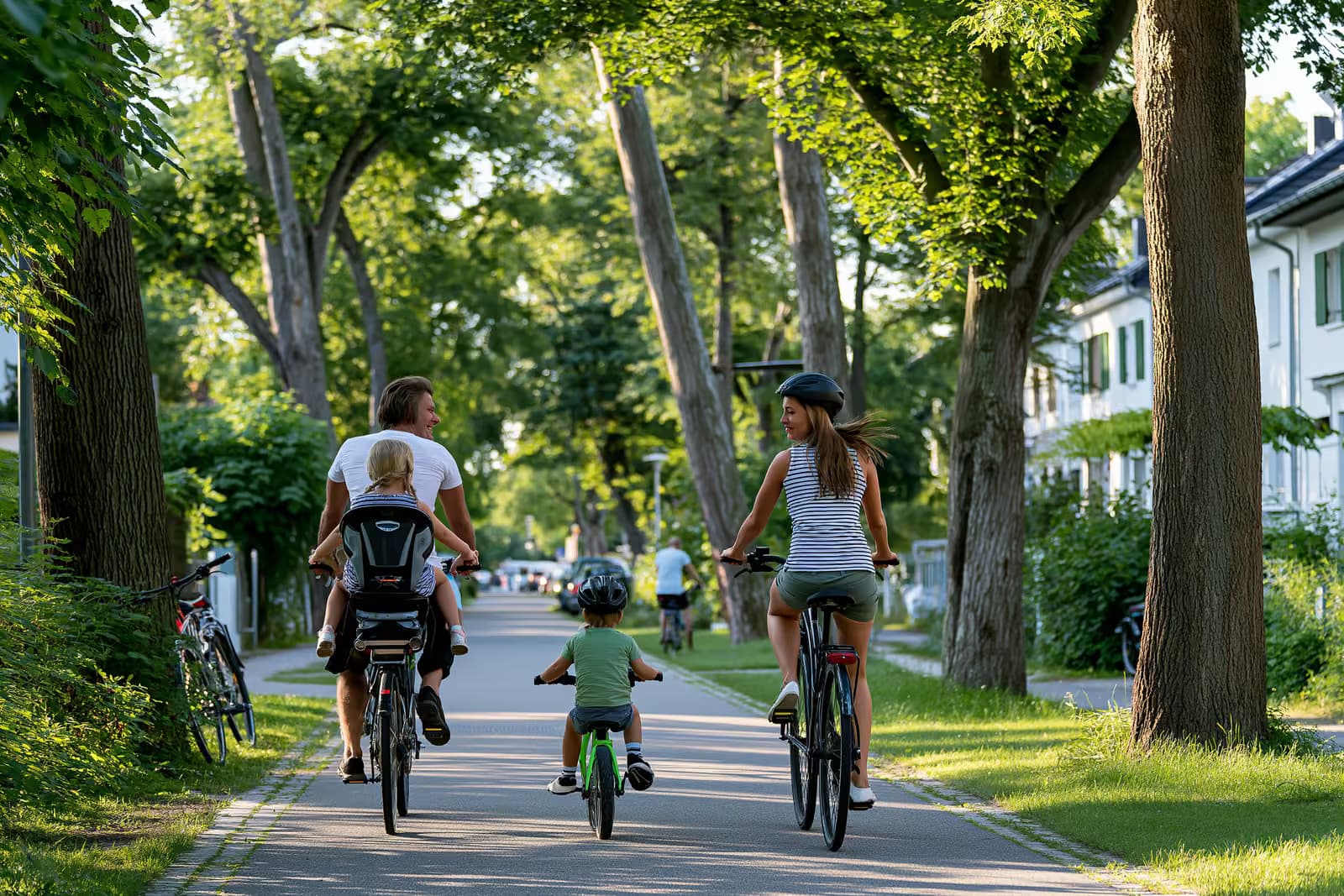
If there is one idea at the centre of German parenting, it is Selbständigkeit, which means independence or self-reliance. German parents tend to see their job as raising a child who can cope on their own, and they start earlier than parents from more protective cultures usually expect. The clearest sign of this is the school run, or rather the absence of one. From the first years of primary school, many German children walk or cycle to school by themselves or in small groups of friends, without an adult. The Schulweg, the walk to school, is treated as a rite of passage rather than a risk to be managed, and schools often actively discourage parents from driving children to the gate. For a parent used to supervising every journey, watching a class of seven-year-olds cross the neighbourhood alone can be genuinely startling.
The same instinct shows up on the playground. German Spielplätze are often built with real height, wobbling ropes, and equipment that would be quietly removed in more cautious countries. The thinking is that a child who learns to judge a climb, and occasionally to scrape a knee, becomes a child who can assess risk. Parents typically hang back and talk to other adults rather than shadowing their child up the frame. Unsupervised or lightly supervised play, children knocking on each other’s doors, and older siblings looking after younger ones are all normal. None of this means German parents care less. It means they read a child’s competence generously and treat a bit of independence as something to be trusted rather than earned inch by inch.
Outdoor life runs through all of it, in every season. There is a proverb you will hear from teachers and grandparents alike: “Es gibt kein schlechtes Wetter, nur schlechte Kleidung” - there is no bad weather, only bad clothing. In practice this means children are sent outside to play in rain, wind, and cold, dressed in a Matschhose (mud trousers) and proper boots, and that a drizzle almost never cancels an outing. The idea reaches its purest form in the Waldkindergarten, the forest kindergarten, where children spend the day outdoors in woodland in almost any weather, with few walls and even fewer plastic toys. You do not have to adopt any of this wholesale. But understanding that outdoor, weatherproof, relatively free-range childhood is the local default will save you a lot of confusion, and it explains why the German parents around you may seem remarkably relaxed about things that would set off alarms back home.
Kita, Krippe and the rhythm of the family day
Childcare institutions shape the German family calendar more than almost anything else, so it helps to know the words and the culture around them even before you deal with the paperwork. The Krippe takes the youngest children, roughly from one to three; the Kindergarten takes children from about three until school; and Kita, short for Kindertagesstätte, is the everyday umbrella term for both. On paper, families are well protected: since 1 August 2013, every child has a legal right to a daycare or childminder place from the age of one, under §24 of the Achtes Buch Sozialgesetzbuch (SGB VIII). The reality is more complicated, because in many cities there are simply not enough places. The Rechtsanspruch, the legal entitlement, is real and can in principle be enforced, but parents still queue, apply to many Kitas at once, and sometimes wait, especially in big cities. Treat the legal right as your backstop, and start looking early, ideally during pregnancy or as soon as you arrive.
The moment that surprises foreign parents most is not getting the place but starting it. German Kitas run a settling-in period called the Eingewöhnung, and it is slow by design. Rather than dropping your child off on day one, you stay with them, then gradually, over one to three weeks, extend the time they spend without you, following the child’s cues. It can feel inconvenient if you are trying to return to work on a fixed date, but it reflects a genuine belief that a secure attachment is worth the effort, and it is close to universal, so plan for it. Once your child is settled, expect regular contact with the group through an Elternabend, a parents’ evening, and to be asked to contribute to festivals, outings, and the life of the Kita. Parental involvement is expected, not optional, and it is one of the fastest ways for a newcomer parent to be drawn into a local network.
The other structural shock is the school day. Traditionally, German primary schools were half-day: lessons could end around lunchtime, which assumed a parent at home in the afternoon and clashes hard with two full-time careers. This is changing. A nationwide legal right to all-day care for primary-school children, created by the Ganztagsförderungsgesetz (GaFöG), is being phased in from the 2026/2027 school year starting with first grade, and expanding year by year until it covers grades one to four by 2029/2030. The provision covers eight hours across five weekdays and even the school holidays, though the pace of building the actual places varies a lot by region. Until your area’s Ganztag offer is fully built out, you may still be piecing together afternoons with a Hort (after-school care) or private arrangements. This chapter deals with the family culture around these institutions; for how the education system itself is structured, from Kita through the school tracks, see our overview of German education.
Work, family and the weight of the mother role
Germany has generous parental leave and a strong ideal of family time, but it also carries cultural expectations about mothers that can catch newcomers off guard. The clue is in a loaded old word: Rabenmutter, literally “raven mother”, used to shame a mother seen as neglecting her children, historically aimed at women who returned to full-time work soon after birth. The term is fading, and younger parents often use it ironically, but the pressure behind it has not fully disappeared. In many families and workplaces there is still a quiet assumption that a mother of a young child will step back from work, at least for a while, and a father who does the same may be admired rather than judged. If you come from a culture where mothers routinely return to full-time work within months, this undercurrent is worth naming so it does not blindside you.
Two patterns follow from this. The first is the long parental leave norm. It is completely ordinary here for a parent, still most often the mother, to take a full year or more at home, and the system is built to make that possible. The second is Teilzeit, part-time work, which a large share of German mothers move into for years after having children, often long after the leave itself ends. What is genuinely shifting is fathers’ behaviour: a steadily growing number of fathers now take at least a couple of months of leave, and shared leave between parents is increasingly normal and socially encouraged. As an expat, the practical point is that your own choices, whether both parents work full-time, or one goes part-time, will be read against these local defaults, and you may need to be explicit with employers and Kitas about what your family actually needs.
This chapter is about the culture, not the cash or the statute. The amounts, the eligibility rules, and how you actually claim these benefits belong to their own chapters, and it is worth reading them before you plan your leave. For the maternity protection period (Mutterschutz), parental leave (Elternzeit), and the income-replacement payment Elterngeld, see our chapter on maternity and paternity leave. For the monthly child benefit Kindergeld and related family support, see child and family benefits. Read those for the numbers; treat this section as the cultural weather those rules operate in.
Authority, structure and children’s rights inside the family
The way German parents exercise authority can look contradictory at first: firm about rules, but surprisingly soft about hierarchy. Structure matters a great deal. Children grow up with Ordnung, a sense of order, and with dependable routines around bedtimes, mealtimes, and tidying up, and parents value consistency because it makes a child feel secure. The shared quiet hours known as Ruhezeiten, typically nights and Sunday, apply to families too: children are taught early that loud play has its time and place, partly out of consideration for the neighbours. Yet within that structure, the tone is rarely commanding. German parents tend to explain rather than order, to negotiate rather than dictate, and to treat even a small child’s objection as something to be answered. Do not be surprised to hear a parent reasoning at length with a three-year-old, or a child addressing adults with a confidence that reads as cheeky in more hierarchical cultures. It is not a lack of discipline; it is discipline delivered through dialogue. That informality is even built into how families speak: within the family, and often with close family friends, the familiar du is simply assumed, and children commonly use first names for adults in their circle rather than a formal title.
Money is part of this education in independence. Many families give a small, regular Taschengeld, pocket money, from primary-school age, deliberately modest and often loosely guided by published age recommendations, precisely so that children learn to save, spend, and occasionally regret a purchase while the stakes are low. The underlying idea is the same one that puts a seven-year-old on the pavement to school alone: competence grows through practice and small, survivable mistakes.
Alongside all this independence sits a strong culture of committed, structured leisure through the Verein, the club. German childhood is often organised around Vereine, whether a sports club, a music school, or a swimming or gymnastics group, and joining one is a normal part of growing up. The value being taught is Verbindlichkeit, reliability or commitment: once your child has joined the football club or the choir, they are expected to turn up regularly, honour the schedule, and see the season through rather than drift in and out. For expat parents, Vereine are doubly useful. They give your child a stable social anchor outside school, and they draw you, on the touchline or at the pickup, into one more circle of local parents.
Underpinning all of this is a strong children’s-rights culture, and here the law is unusually clear. Since 8 November 2000, §1631 Abs. 2 of the Bürgerliches Gesetzbuch (BGB), the Civil Code, has given every child a right to a violence-free upbringing (gewaltfreie Erziehung) and declared physical punishment, emotional harm, and other humiliating measures unlawful. Germany was one of the first countries in the world to ban smacking outright, and the norm is widely internalised, not just written down. For expat parents this matters in two ways. Practically, forms of discipline that are legal or normal elsewhere are neither here, and can draw the attention of a Jugendamt (youth welfare office). Culturally, it reinforces the whole picture: the child is treated as a person with rights, to be reasoned with and respected, rather than simply managed. This is not legal advice, and if you have a specific worry you should seek qualified help, but the principle is worth taking seriously from day one.
Raising your own children here: language, integration and the Spielplatz
One cultural difference shapes daily logistics more than any other: extended family is often far away. German grandparents frequently live in another city or region, and the assumption that Oma und Opa are around the corner for regular childcare does not hold for many families, let alone for expats whose relatives are in another country. This puts more weight on institutions, friends, and neighbours, which is exactly why the Kita and the school become so central to family life, and why building your own local support network is not a luxury but a necessity. Our chapter on building a social network in Germany goes into this in depth, and much of it applies double when you have children.
Language is usually the biggest worry and, in practice, the easiest win. Young children absorb German remarkably fast once they are in a Kita or school, often overtaking their parents within a year and sometimes becoming the family’s unofficial interpreter. To hold on to your home language while this happens, many bilingual families use the OPOL approach, “one parent, one language”, where each parent consistently speaks their own language to the child. It is not the only method, but it is a clear, well-known one that gives children a stable rule. Your own German matters too, both to follow what your child is learning and to handle the school’s paperwork, letters, and parents’ evenings, which are almost all in German. If you are building your own German alongside your child’s, our chapter on German language learning methods can help you choose an approach that fits family life.
German childhood also comes with its own warm rituals, and joining in tells your child and the families around you that you are part of things. The biggest is the Einschulung, the celebration of a child’s very first day of school, when children receive a Schultüte, a large decorated cardboard cone filled with sweets and small gifts, and the day is marked with photographs and a family gathering. Through the darker months you will meet the Laternenumzug, the lantern procession held around St. Martin’s Day in November, when children parade with homemade lanterns and sing, and the Nikolaus and Advent customs that fill December. None of these are tests you can fail, but taking part, helping make the lantern or fill the Schultüte, is one of the gentlest and most rewarding ways into German family life.
Here is the reassuring part. Having children is one of the most reliable ways to integrate in Germany. The Kita gate, the school pickup, the birthday parties, and the sidelines of a Sunday football match throw you together with local parents week after week, which is precisely the kind of repeated, low-pressure contact that German friendships tend to grow from. Expect the occasional culture clash at the Spielplatz, where a difference in parenting styles becomes suddenly visible: how quickly to intervene in a squabble, whether to let a child climb higher, how much snack-sharing is polite. Read these moments as differences in norm rather than judgements of you, watch what local parents do, and ask when unsure. That same calm, observant approach serves you across German social life more broadly, as our chapter on German social etiquette describes. Over time, your children will not only adapt; they will pull you into the community with them.
What to do next
Start with the practical building blocks and let the culture follow. If you have young children, begin the Kita search early, apply to several at once, and budget mentally for the Eingewöhnung settling-in weeks so a work return date does not catch you out. If you have school-age children, find out whether your area’s all-day Ganztag places are actually available yet, and line up a Hort or afternoon arrangement as a backup. Read the two benefit chapters, maternity and paternity leave and child and family benefits, before you plan your leave, because the timing rules reward getting the applications in on schedule.
On the cultural side, give the local defaults a fair try before deciding they are not for you. Let your child walk part of the way to school, dress them for the weather rather than against it, and hang back a little at the playground. Keep your home language going with a consistent approach while German arrives on its own through the Kita. Say yes to the parents’ evening and the class outing, because those are your network forming. If you are earlier in your own story here and family life is still a plan rather than a routine, our chapter on the German dating scene covers how relationships tend to form before this stage begins. Above all, treat the differences as information, not criticism. German family culture asks you to trust your children a little sooner and to lean on community a little more, and for most expat families, both turn out to be gifts.
Sources
The information in this chapter draws on the official sources and publications listed below, last reviewed in July 2026. It is general guidance for orientation, not individual legal, tax, or medical advice.