Electric Vehicles and Charging
16 min read
This chapter helps you live with an electric car in Germany: what it costs to buy and run, how the confusing world of public charging actually works, what you can claim if you charge at home, and where the real money is - both the grants you can get and the ones that have quietly disappeared. Electric vehicles in Germany, called Elektrofahrzeuge or simply E-Autos, are now an ordinary sight rather than a novelty, but the rules and the money around them changed sharply between 2023 and 2026. Much of what you will read on older pages is out of date. The aim here is to give you the current picture, plainly, so you can decide whether an electric car makes sense for you and avoid leaving money on the table if you already own one.
A quick note on scope. This is the electric-specific layer only. The everyday mechanics of owning any car in Germany - registering it (Zulassung), the road-worthiness inspection (Hauptuntersuchung, the TÜV check), compulsory third-party liability insurance (Kfz-Haftpflichtversicherung) and the road tax (Kfz-Steuer) in general - are covered in our guide to driving in Germany. We will point you there rather than repeat it, and focus on what is genuinely different when the car runs on electricity. None of this is legal, tax or financial advice; where money and law are involved, treat it as a starting point and confirm the detail for your own situation.
What an electric car changes, and what it does not
A battery-electric car (BEV, or reines Elektrofahrzeug) is registered, insured and inspected in exactly the same way as a petrol or diesel car. You still go to the registration office (Zulassungsstelle), you still need Kfz-Haftpflichtversicherung before the car can be registered, and you still take the car for its Hauptuntersuchung every two years. If any of that is new to you, read the driving in Germany guide first, because everything in it applies to an electric car too. The differences are narrower than the marketing suggests: they sit in the tax you pay, the way you refuel, and a handful of rights and grants that only apply to electric drive.
The genuine electric-specific points, each covered below, are these. Battery-electric cars are exempt from the annual road tax for a fixed period. As the owner of an electric car you can sell your certified carbon savings once a year for cash, through a scheme called the THG-Quote. Refuelling means charging, which comes in two families - slower alternating current and rapid direct current - and a tangle of cards, apps and tariffs that can make the same electricity cost wildly different amounts. And if you want to charge at home, the law now gives both tenants and flat owners a real claim to install a charging point, even against a reluctant landlord or co-owners. Everything else about the car is just a car.
One more boundary. If you are weighing an electric car against not owning a car at all, electric car-sharing and short-term electric rentals are a separate topic, handled in our guide to car sharing and rentals. Electric bikes and Pedelecs, which are legally quite different from cars, belong to our guide on bicycle culture and routes. This chapter is about owning and running an electric car.
The subsidy reality in 2026
Start with the correction, because almost every older page gets it wrong. The federal purchase grant that everyone remembers, the Umweltbonus paid out by the Bundesamt für Wirtschaft und Ausfuhrkontrolle (BAFA, the federal office for economic affairs and export control), ended abruptly on 17 December 2023 when the money ran out. For roughly two years after that there was no federal grant for buying an electric car at all, and a great deal of advice online still describes the old Umweltbonus as if you could claim it. You cannot. It is gone.
What is new for 2026 is that a federal purchase grant has returned, in a different shape. A new scheme opened for applications during 2026 (from spring 2026, for cars first registered from 1 January 2026 onwards) and is aimed more squarely at lower and middle incomes than the old flat bonus was. In broad terms it pays a base amount for a battery-electric car, less for a plug-in hybrid, with the amount rising for households on lower taxable incomes and for families with children. Because the exact brackets, income ceilings, administering office and budget have been reported differently as the scheme rolled out, and because a fixed pot of money can be exhausted just as the Umweltbonus was, this guide deliberately does not quote you a precise figure that could already be stale. Before you count on anything, check the current terms and whether funds are still available on the authoritative pages: the ADAC overview of electric-car funding and the responsible federal ministry. Treat any dealer who promises you a specific grant with healthy caution and verify it yourself.
Two things have not changed and are worth knowing. First, if you drive an electric car as a company car (Dienstwagen), the taxable benefit-in-kind is calculated far more generously than for a combustion car: the monthly private-use benefit is based on a fraction of the list price rather than the usual one percent, which can make an electric company car markedly cheaper in your payslip. Ask your employer or your Steuerberater how your specific car is treated. Second, manufacturers and leasing companies have partly filled the gap left by the Umweltbonus with their own discounts and “environment bonus” style rebates, but those are commercial offers, not state grants - read the small print and do not assume they are guaranteed.
THG-Quote: getting paid for your emissions savings
This is the one many newcomers never hear about, and it is free money you are entitled to simply for owning an electric car. Every year, fuel companies in Germany must reduce the greenhouse-gas intensity of the fuel they sell, a duty called the Treibhausgasminderungsquote, or THG-Quote for short. Because your electric car saves carbon that would otherwise have been emitted, the state lets you certify those savings and sell them to a company that needs them to meet its quota. You do not have to understand the mechanism. You just have to claim it.
The practice is simple. Once a year you register with one of the many middleman providers - the ADAC, energy companies such as EnBW, and a crowd of specialist services all offer this - and upload a photo or scan of your vehicle registration certificate (the Zulassungsbescheinigung Teil I, the paper you keep, often still called the Fahrzeugschein). The provider bundles your savings with thousands of others, sells the certificate, and pays you. It costs you nothing and takes a few minutes. You can do it once per calendar year for the same car, and the submission has to reach the Umweltbundesamt (the Federal Environment Agency) by a mid-November deadline each year, so do not leave it to the last week of December.
Be realistic about the amount, because it has fallen a long way. In the first years the payout was genuinely eye-catching, in the region of 250 to 400 euros a year, but the price of these certificates dropped sharply as more electric cars joined the pool. For 2026 the payouts are back into the low hundreds of euros - offers have clustered around the 300-euro mark at the better providers, though quoted premiums swing a great deal between providers and over the year, and some pay considerably less. It is worth comparing a few offers rather than taking the first, and worth being slightly wary of the very highest “guaranteed” headline figures. Even at the lower end it is money you would otherwise never see, so register your car and collect it. Note that this applies to battery-electric cars; plug-in hybrids do not qualify.
The Kfz-Steuer exemption for electric cars
Battery-electric cars are exempt from the annual motor-vehicle tax (Kfz-Steuer) for a fixed window, and this is one of the clearer running-cost advantages of going electric. The rule lives in the Kraftfahrzeugsteuergesetz (KraftStG, the motor-vehicle tax act), and it was extended in late 2025, so any page describing the old end date is now wrong. As it stands, a pure electric car first registered up to 31 December 2030 is free of Kfz-Steuer for ten years from the day of its first registration - but in no case beyond 31 December 2035. In other words the ten-year clock is capped: a car registered in, say, 2029 gets the full ten years only up to the 2035 backstop, while an early registration gets the full decade.
A few practical points. The exemption attaches to the car, not to you, and it carries over if the car changes hands while the period is still running, which is worth knowing when buying a used electric car - check the first-registration date to see how much exemption is left. The exemption is only for fully electric cars; plug-in hybrids still pay Kfz-Steuer, calculated partly on their carbon emissions and partly on engine size, and after the exemption window an electric car itself falls back to being taxed on its weight. If you want to see roughly what a car would cost once the exemption ends, or what a hybrid costs now, Werkzeu.ge - the browser-based tool platform built by Cryon UG, the company behind WeLiveIn.de - has a free KFZ-Steuer-Rechner (motor-vehicle tax calculator) at werkzeu.ge/de/tools/steuern/kfz-steuer-rechner, usable without an account, though the free tier carries ads and, being in beta, it is a preparation aid rather than an official assessment. It uses the official calculation formula but does not replace advice from a Steuerberater. The general mechanics of Kfz-Steuer, and how you actually register and pay it, are in the driving in Germany guide.
Charging in public: plugs, cards and the pricing maze
Charging comes in two families, and understanding the difference removes most of the confusion. Alternating current (AC, Wechselstrom) is the slower kind you find at home, in car parks, at supermarkets and on residential streets; a full charge takes hours, which is fine overnight or while you shop. Direct current (DC, Gleichstrom) is rapid charging, found at motorway services and dedicated hubs, where you can add a large chunk of range in twenty to forty minutes. Germany has a dense and growing network: by early 2026 the Bundesnetzagentur (the federal network regulator) counted well over 149,000 normal charging points and more than 51,200 fast-charging points, so range anxiety is much less of a real problem than it once was.
The plugs matter less than they used to, because the market has standardised. For AC charging the European standard is the Typ-2 connector (Type 2), and essentially every modern car and public AC point uses it. For DC fast charging the standard is CCS (Combined Charging System), which extends the Typ-2 plug with two extra high-power pins; this is what you will use at almost every fast charger. The older Japanese CHAdeMO standard, once common on the Nissan Leaf, is fading fast - new cars rarely support it and operators are quietly retiring those connectors, so do not buy a car that only speaks CHAdeMO. Tesla’s Supercharger network in Germany uses CCS too and is increasingly open to non-Tesla cars.
Paying is where it gets genuinely messy, and this is worth patience. There are two broad ways to pay. Ad-hoc charging means paying on the spot without any contract; under the Ladesäulenverordnung (LSV, the charging-station ordinance) and EU rules, every public charging point put into service since mid-2023 must let you pay ad-hoc by contactless debit or credit card, without an app or an account. The alternative is a charging subscription: you sign up with a mobility provider - EnBW mobility+, ADAC e-Charge, Ionity, Elli (Volkswagen’s service), Aral pulse and others - and use their card or app, which usually gets you a much lower per-kilowatt-hour price across a roaming network of many operators. The catch is that ad-hoc is convenient but expensive: the ADAC has found ad-hoc charging can cost well over half as much again as a contract tariff, so for regular charging a subscription or two pays for itself quickly.
Prices are best thought of as ranges, because they move and differ by tariff. In 2026, public AC charging typically runs somewhere around 0,38 to 0,55 euros per kilowatt-hour, and DC fast charging is dearer, commonly around 0,60 euros and rising to somewhere between 0,65 and roughly 0,99 euros per kilowatt-hour at the fastest ultra-rapid chargers - and ad-hoc rates at the top end can be higher still. The honest and often-missed consequence is that public DC fast charging can cost you more per 100 kilometres than petrol would, especially in a heavier car. Home charging is a completely different story: household electricity is commonly around 0,33 to 0,35 euros per kilowatt-hour, so the running-cost case for an electric car largely stands or falls on whether you can charge at home or at work. For a current comparison of networks and tariffs, the ADAC charging-tariff overview is the most reliable, English-friendly source.
Two more things you will meet at public chargers. The first is the Blockiergebühr, an idle fee: once your car is full (or after a set time, often after an hour or two), many networks start charging a per-minute penalty, frequently in the region of 10 to 15 cents a minute, to stop people using a charger as a parking space. Watch the app, and move the car when it is done. The second is simple etiquette, which the German charging community takes seriously: use fast chargers for fast charging and leave AC points for longer stops, never unplug someone else’s car, return the cable to its holder, and do not park in a marked charging bay unless you are actually charging - in many places that is not just rude but a towable offence.
Charging at home: the Wallbox and your rights as tenant or owner
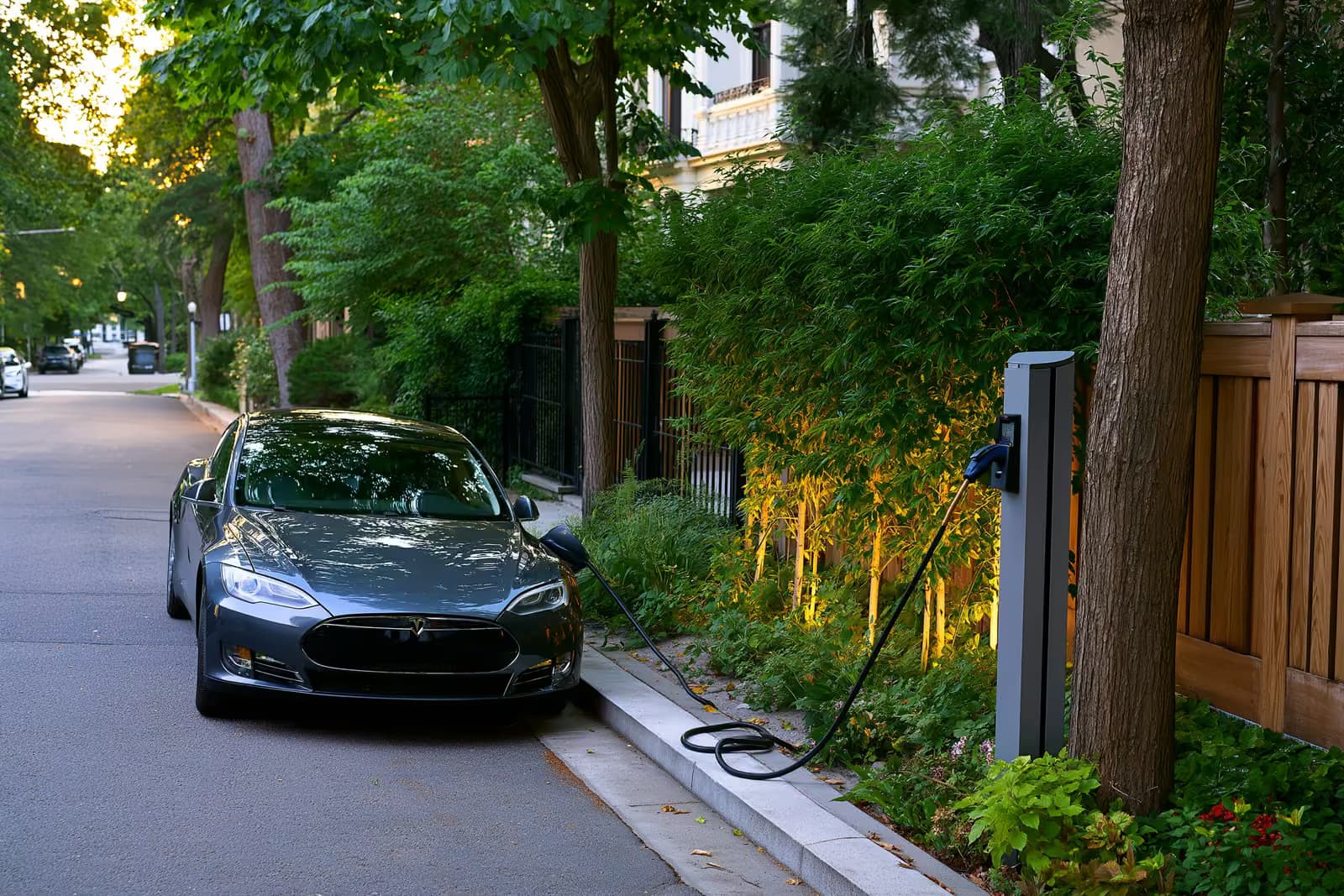
The cheapest and most convenient way to charge is at home, from a wall-mounted charging unit called a Wallbox. A Wallbox charges far faster and more safely than a normal household socket and is the setup most owners end up wanting. The obvious obstacle for the many people who rent, or who own a flat in a shared building, is permission - and here German law is unusually helpful, which is exactly why this is worth knowing.
If you rent, section 554 of the Bürgerliches Gesetzbuch (§554 BGB, the civil code) gives you a genuine claim: since 2020 a tenant can require the landlord to permit structural changes that serve the charging of an electric vehicle, including installing a Wallbox. The landlord can only refuse in narrow circumstances where the work cannot reasonably be expected of them even weighing your interest, which is a high bar. You normally bear the cost of the installation and of restoring things later, and you must ask and agree the details first rather than simply drilling into the wall. If you own a flat in a Wohnungseigentümergemeinschaft (WEG, a community of flat owners), section 20 of the Wohnungseigentumsgesetz (§20 WEG, the condominium act) gives you a parallel right: each owner can demand that the community consent to a reasonable structural change for electric-vehicle charging, and the owner who asks for it bears the cost. The others cannot simply vote you down. These two rights are powerful and widely under-used by newcomers, so if a landlord or a co-owners’ meeting waves you away, know that the law is on your side.
Permission is not the only step. You will usually need a certified electrician (Elektrofachbetrieb) to install the Wallbox, and any Wallbox with 11 kilowatts of power or more must be notified to your grid operator (Netzbetreiber) before it goes into service, with units above that threshold needing the operator’s approval. On the money side, be aware that the well-known federal home-charging grants are no longer available: the KfW’s earlier 900-euro Wallbox grant (programme 440) closed years ago, and the later KfW 442 scheme, which funded a combined solar panel, battery and Wallbox package, has exhausted its budget and can no longer be applied for. There is currently no live federal subsidy for a home charger. Some federal states and municipalities still run their own small programmes, so it is worth a quick search for your Bundesland and city before you buy. The electricity your Wallbox draws is billed on your normal home tariff, so it is also worth reading our guide to understanding utility services for how home electricity contracts and providers work, and whether a dedicated electric-car tariff makes sense for you.
Is an electric car worth it? An honest look
An electric car is not automatically the right choice, and it helps to be clear-eyed rather than swept along. The single biggest factor is where you charge. If you can charge at home or reliably at work on cheap electricity, the running costs are genuinely low and, with the Kfz-Steuer exemption and the yearly THG-Quote payment on top, an electric car can be noticeably cheaper to run than a combustion equivalent. If you would depend on public DC fast charging for most of your kilometres, much of that saving evaporates, and in some cases you would pay more per 100 kilometres than for petrol. Be honest with yourself about your charging situation before you commit; for many people without a home charger, the numbers do not work as well as the brochures imply.
Two other realities deserve a mention. Depreciation on electric cars has been steep and unpredictable over the last few years - the sudden end of the Umweltbonus in December 2023 knocked used values, and fast-moving battery and software improvements can date a car quickly - so a nearly-new used electric car can be a bargain for a buyer and a painful loss for the original owner. That cuts both ways: the growing used-EV market is one of the better ways into electric driving, provided you check the first-registration date (for the remaining tax exemption) and, ideally, the battery’s state of health. And plan for winter: in cold weather real-world range can drop noticeably, often by a fifth or more, because the battery and the cabin heater both draw power, so the range on the spec sheet is a summer best case, not a January promise.
None of this is a reason not to buy electric. It is a reason to buy for your own circumstances rather than the marketing. If you have off-street parking and can fit a Wallbox, do mostly local and regional driving, and will hold the car for several years, the case is strong. If you live in a flat with no realistic charging option and drive long distances at short notice, a different choice - including not owning a car and using car sharing and rentals when you need one - may serve you better.
What to do next
If you already own an electric car, do two things this month: register it for the THG-Quote to collect your annual payment before the mid-November deadline, and confirm that your Kfz-Steuer exemption is on record so you are not billed in error. If you are thinking of buying, work out your charging situation first - home, work or public - because that decides more than the car itself, then check the current federal purchase grant terms and whether funds remain, on the ADAC funding overview, rather than trusting a dealer’s promise or an old web page.
If you rent or own a flat and want to charge at home, start the permission conversation early, armed with the fact that §554 BGB and §20 WEG give you a real claim, and line up a certified electrician who can handle the grid-operator notification. And for the ordinary side of car ownership that an electric car shares with every other - registration, insurance, the TÜV inspection and paying Kfz-Steuer once the exemption ends - keep our driving in Germany guide to hand. Buy for how you actually drive and charge, claim what you are entitled to, and an electric car in Germany can be a calm, low-cost way to get around.
Sources
The information in this chapter draws on the official sources and publications listed below, last reviewed in July 2026. It is general guidance for orientation, not individual legal, tax, or medical advice.
- adac.de
- §3d KraftStG
- §554 BGB
- §20 WEG
- KfW
- ADAC charging-tariff overview