Cultural Activities in Germany
13 min read
This chapter helps you find your way into Germany’s cultural life and, just as importantly, enjoy it without spending a fortune or waiting until your German is fluent. It is your starting point for the everyday arts: museums and galleries, classical music, opera and theatre, cinema, and the quiet pleasures of libraries and readings. Along the way it points you toward the other guides that cover the parts of German cultural life that sit just outside this one, so you always know where to look next.
One thing surprises almost every newcomer. Culture here is not a luxury reserved for special occasions. It is woven into ordinary life, publicly funded on a scale that is hard to imagine if you are used to the United States or the United Kingdom, and priced so that students, pensioners and people on modest incomes can all take part. Once you understand how the system works, an evening at the opera or an afternoon in a world-class museum stops feeling like an extravagance and becomes something you can do on a Tuesday. This guide shows you how.
Why Culture Here Feels So Affordable
The single most useful thing to understand about cultural activities in Germany is that most of them are heavily subsidised by the public purse. Theatres, opera houses, orchestras and many museums are financed by cities, states (Bundesländer) and the federal government, on the principle that access to culture is part of public life rather than a private treat. The German Music Information Centre counts around 130 publicly financed orchestras, and there are roughly 140 publicly funded theatres, from the great houses in Berlin and Munich down to the Stadttheater (city theatre) of towns you may never have heard of. The Deutscher Bühnenverein, the association that represents these stages, lists several hundred member companies in total.
What this means in practice is remarkable. Because the state covers the bulk of the running costs, ticket prices reflect only a fraction of what a performance actually costs to produce. A seat at a municipal opera or a symphony concert can cost less than a cinema ticket does in many countries, and the cheapest tickets in a serious opera house often start in the low double digits or even under ten euros. You do not need to live in a metropolis to benefit. A mid-sized German city will typically have its own theatre with a resident ensemble, an opera or music-theatre programme, and an orchestra, all performing a full season from autumn to summer. This density is unusual anywhere in the world, and it is the reason culture feels so accessible here.
For a newcomer, the practical lesson is simple. Do not assume the good seats and the famous institutions are out of reach. The system is built so that a student, a family or someone still finding their financial feet can attend regularly. The rest of this guide walks through each art form in turn, and closes with the concrete tricks - discounts, last-minute tickets, standing room and city culture cards - that keep the cost low.
Museums and Galleries
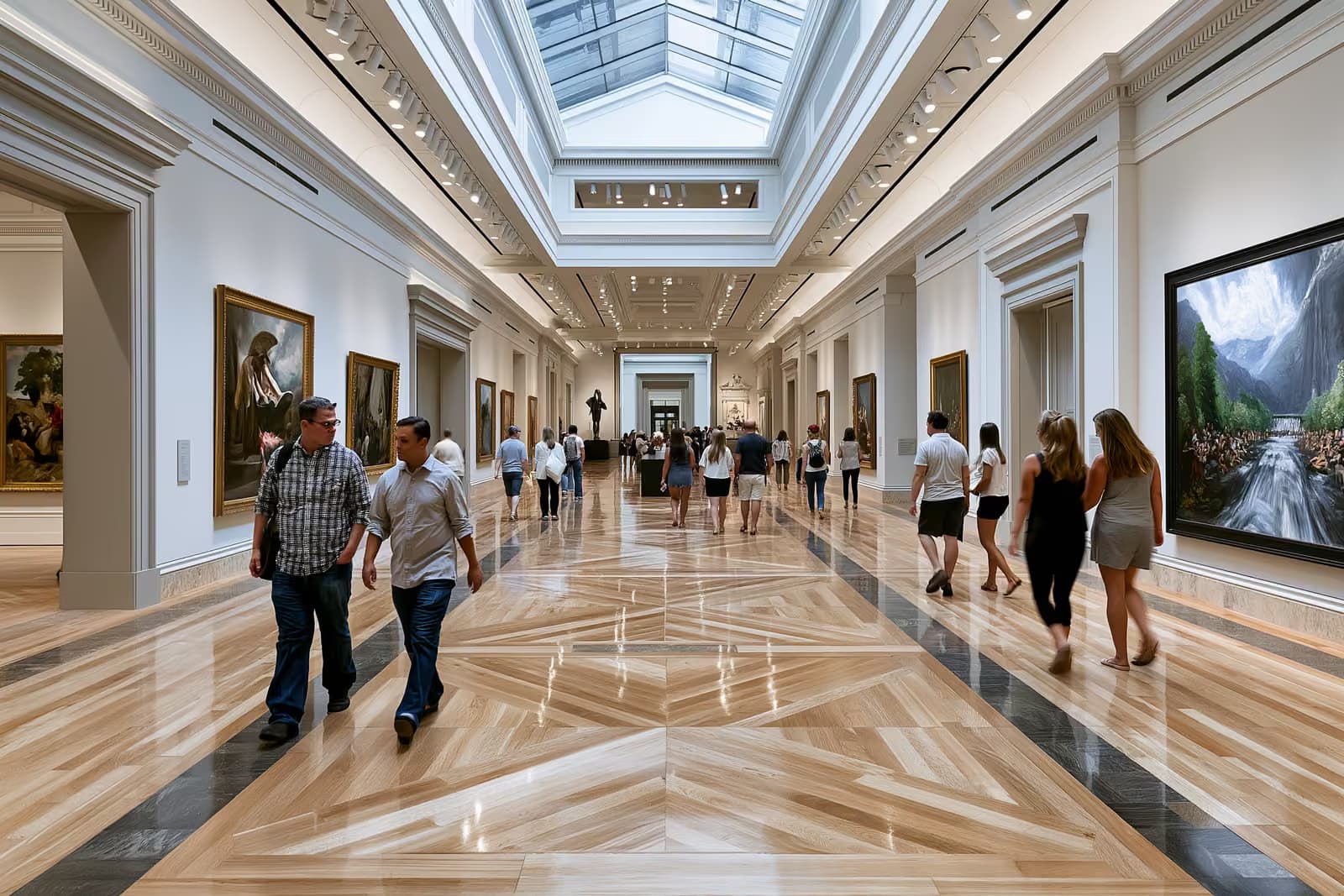
Germany’s museums are one of the easiest cultural pleasures for a newcomer, because looking does not require any German at all. The country is unusually rich in them. In Berlin, the Museumsinsel (Museum Island) is a UNESCO World Heritage site clustering five great collections on a single island in the Spree, from the antiquities of the Pergamonmuseum to the Egyptian holdings of the Neues Museum. Munich has the three Pinakotheken - the Alte, Neue and Moderne Pinakothek - covering painting from the old masters to the present, along with the Deutsches Museum, one of the largest science and technology museums in the world. Cologne has the Museum Ludwig, a major collection of modern and contemporary art. Dresden’s Staatliche Kunstsammlungen, spread across the Zwinger and the Residenzschloss, hold treasures such as the Grünes Gewölbe (Green Vault). Frankfurt’s Städel Museum spans seven centuries of European art.
A visit is easy to plan once you know two words. The Dauerausstellung is the permanent collection, usually the cheaper or free part; the Sonderausstellung is a temporary special exhibition, often the reason a museum is busy and sometimes carrying a higher price or requiring a timed ticket booked online in advance. Larger museums lend audio guides, and in the big houses these are commonly available in English, which turns a wander through unfamiliar galleries into a proper tour. Most museums close one day a week, traditionally Monday, and many stay open late one evening, so a quiet weekday visit after work is often the most pleasant. There is no need to rush a whole collection in one go; with a cheap ticket or a city card you can drop in for an hour and come back another day.
The country’s industrial past has also been turned into some of its most striking museums. In the Ruhr region, the former Zeche Zollverein coal mine in Essen is now a UNESCO-listed cultural site with the Ruhr Museum inside it, a good example of how Germany treats its industrial heritage as culture rather than as something to be hidden away. Alongside the famous names, almost every city has its own art museum, city history museum and often a specialist collection, so wherever you settle there will be something within reach.
Cost need not be a barrier. Under-18s enter most public museums free, and many houses offer reduced entry for students, trainees, jobseekers and people with disabilities, so it is always worth asking for the Ermäßigung (reduced rate) and carrying proof. A number of cities sell a museum card or pass that gives a year of unlimited entry to a group of museums for the price of a couple of visits, and tourist boards often sell a short-term city card that bundles museums with public transport. Be aware that free-entry schemes change with local budgets: Berlin’s popular free Museumssonntag, the free first Sunday of the month, ran for the last time at the end of 2024 when the city cut its funding, so check each museum’s current offer rather than relying on an old tip.
The one museum event worth building a plan around is the Lange Nacht der Museen (Long Night of Museums), a recurring evening when dozens of museums in a city stay open late, often until well past midnight, on a single combined ticket with shuttle buses running between them. Berlin runs its version twice a year, and many other cities hold their own, so look for the next date where you live. It is one of the most enjoyable and affordable ways to sample a lot of collections in one go, and a genuinely sociable night out.
Classical Music, Opera and Theatre
This is where the public subsidy pays off most spectacularly, and where newcomers are most likely to underestimate what they can afford. Germany’s classical music tradition needs little introduction - Bach, Beethoven, Brahms and Wagner are part of the national furniture - but the point for you is that it is a living, everyday tradition, not a museum piece. Berlin alone has three opera houses and the Berliner Philharmonie, home to the Berliner Philharmoniker, one of the world’s leading orchestras. Dresden has the Semperoper, Munich the Bayerische Staatsoper (Bavarian State Opera). Yet the same richness exists at the municipal level: your local Stadttheater or Staatstheater will stage opera, plays, concerts and often ballet across a single season.
Getting in cheaply is a skill worth learning early. Most houses offer heavy discounts for students and, increasingly, for anyone under a certain age, often under 30, which can bring a ticket down to single figures. Ask about Restkarten, the leftover tickets released shortly before a performance, sometimes at a steep discount for students at the box office on the day. Many theatres also sell standing-room tickets (Stehplätze) for a few euros. If you know you want to go regularly, look into an Abo (Abonnement), a subscription for a series of performances that lowers the per-ticket price and guarantees you seats for a whole season - a very German way of committing to culture.
Concert life reaches well beyond the opera houses. Hamburg’s Elbphilharmonie, the wave-topped hall on the harbour that opened in 2017, has quickly become one of Europe’s most sought-after venues, while Leipzig’s Gewandhaus is home to the Gewandhausorchester, one of the oldest civic orchestras in the world. Nearly every city has a concert hall of some kind, and the season, laid out in advance in the theatre’s or orchestra’s Spielplan (the published programme), typically runs from September to June or July with a summer break. Booking is straightforward: each house sells tickets on its own website, and it is worth signing up for a newsletter, because that is often how you hear about cheap seats, extra dates and student offers first. Ballet and dance are usually part of the same houses’ programmes, so a single local theatre can give you drama, opera, orchestral concerts and dance across one season.
The language question worries a lot of newcomers, and it is easily answered. Spoken theatre (Schauspiel) is performed in German, so it is more rewarding once your language has progressed, though some big cities have dedicated English-language theatres - Berlin has an English-speaking stage, and several cities host international or English-language productions, so it is worth searching locally. Opera is different and much friendlier to a beginner: most opera houses show Übertitel (surtitles) projected above the stage, and even when those are only in German, the plot summary in the programme and the universal language of the music carry you through. A great deal of the repertoire is Italian or French in any case. In short, you do not need fluent German to enjoy a concert or an opera, and going to them is one of the pleasanter ways to spend the months while your German catches up.
Cinema and the OmU Code
Going to the cinema in Germany comes with one piece of vocabulary that every foreigner needs to learn, because it decides whether you will understand the film. German cinemas usually dub foreign films into German, so a Hollywood blockbuster on general release will most likely be in German. To find a film in its original language, look for the abbreviations in the listings. OmU means Original mit Untertiteln - the original soundtrack with German subtitles, so you hear the English (or French, or Korean) and read German. OV or OF means Originalversion or Originalfassung, the original with no subtitles. OmeU means Original mit englischen Untertiteln, the original with English subtitles, which is the ideal combination if your German is still limited. Learn these four codes and you can always find a screening you will follow.
Bigger cities have cinemas that specialise in original-version films, and most have a lively Programmkino or arthouse scene - independent cinemas showing world cinema, classics, documentaries and restored prints, often with a bar and a loyal local crowd. These are where you are most likely to find OmU and OmeU screenings. Prices are already modest by international standards, and most cinemas run a Kinotag, a fixed cheap day (often a Tuesday or Wednesday) when every ticket costs less, so check your local cinema’s website for its discount day before you go.
In summer, cinema moves outdoors. The Freiluftkino, or open-air cinema, is a much-loved German institution: films projected onto a big screen in a park, a courtyard, a swimming-pool complex or a former industrial site, watched from deckchairs or the grass on a warm evening. Many outdoor screenings include original-version nights, so keep an eye on the programme. It is one of the most relaxed and characteristic ways to enjoy a film here, and a lovely low-cost evening out with friends. For film festivals as events - the Berlinale and the many genre and city festivals - see our guide to film and literary events, which covers them in full.
Literature, Libraries and Everyday Culture
Some of the richest cultural resources in Germany are also the cheapest, and the public library is the best example. Almost every town has a Stadtbibliothek (city library), and joining is inexpensive - typically a small annual fee, often free for children and young people - in exchange for borrowing rights to books, and usually audiobooks, films, music, magazines and increasingly e-books and digital media through apps the library subscribes to. For a newcomer, a library card is one of the best-value cultural investments you can make, and it is also a calm, warm public space to read, study or use the internet. Many libraries hold graded readers and language-learning material, which makes them quietly useful while you are working on your German.
Bookshops (Buchhandlungen) remain a genuine part of the culture, and one legal detail explains why they have survived so well. Germany has the Buchpreisbindung, a law fixing the retail price of new books so that the same title costs the same everywhere, whether you buy it from a giant online retailer or the small independent shop on your corner. Because they cannot be undercut on price, independent bookshops thrive, and they are often the hub for a neighbourhood’s literary life. That life centres on the Lesung, the author reading - an event, held in bookshops, libraries, cafés and cultural centres, where a writer reads from their work and talks about it, sometimes followed by a discussion or a signing. Lesungen are usually cheap or free, and they are a warm, low-key way to encounter German literary culture in person. Your library card usually unlocks a digital service too - the Onleihe, a shared platform many public libraries use to lend e-books and audiobooks to your phone or e-reader for a borrowing period, at no extra cost.
One more everyday institution deserves a mention, because it sits exactly where culture and learning meet: the Volkshochschule, or VHS, the adult-education centre found in virtually every town and district. For very modest fees it runs evening and weekend courses in painting, photography, music, creative writing, film, art history and much else, alongside the language courses it is best known for. For a newcomer it is one of the friendliest ways to try a creative pursuit, meet people locally and practise German in a relaxed setting, all at prices kept low by public funding. Between the library, the bookshop, the reading and the VHS, a genuinely rich cultural week can cost you almost nothing.
Beyond readings, literature festivals and the big book fairs bring the whole book world together, but as events those belong to the Events and Festivals guides rather than to this one. What matters here is the everyday layer: the library card, the local bookshop, the reading around the corner. These are the parts of cultural life you can fold into a normal week without planning or expense, and they reward you steadily as your language grows.
Enjoying It Affordably, and Where to Go Next
The thread running through this whole guide is that culture in Germany is meant to be within your reach, and a few habits keep it that way. Always ask for the Ermäßigung, the reduced rate, and carry proof of student status, an apprenticeship, disability or unemployment, because discounts are widespread but you usually have to claim them. Learn your city’s culture card or museum pass, which turns frequent visits into a flat annual cost. Chase the leftovers - Restkarten and standing-room tickets at theatres and opera houses, the cinema’s Kinotag, the library’s near-free membership. Germany has also run a national KulturPass giving 18-year-olds a budget to spend on cultural tickets, though its funding has been uncertain, so if you or someone in your household is that age, check kulturpass.de to see whether it is currently running rather than assuming it is.
Above all, remember that you do not need fluent German to begin. Museums, galleries, concerts, ballet and opera with surtitles ask little or nothing of your language, and original-version cinema and library reading rooms meet you where you are. Culture is one of the easiest and most rewarding things to enjoy while your German grows, and every evening out doubles as gentle practice. If you are still getting your bearings in the country, our guide to an expat’s first steps in Germany covers the practical basics, and if you want the language itself to catch up faster, see our overview of German language learning methods.
This chapter is the doorway to the wider world of German leisure, so let it point you onward. When you are ready for evenings that run later, our guide to nightlife and entertainment covers bars, clubs and live music. The big set-piece celebrations belong elsewhere too: major German festivals and dedicated music and arts festivals are handled as events, while the seasonal customs and rituals behind them are explained in our guide to German festivities and local traditions. For culture in the fresh air, see outdoor activities and parks, and to turn a hobby into a community, our guide to local clubs and societies (Vereine) shows how choirs, amateur theatres, art circles and countless other groups welcome newcomers. Pick one thing this week - a museum on a quiet afternoon, an OmU film, a cheap seat at the local theatre - and you will find that cultural life here is not something you watch from the outside, but something you are already part of.
Sources
The information in this chapter draws on the official sources and publications listed below, last reviewed in July 2026. It is general guidance for orientation, not individual legal, tax, or medical advice.
- berlin.de
- langenachtdermuseen.berlin
- kulturpass.de
- miz.org
- Buchpreisbindung