Fitness Centers and Gyms
15 min read
Joining a gym in Germany is easy. Leaving one can be surprisingly hard, and that gap is where foreigners lose money. Germany has one of the largest fitness markets in Europe, with a commercial Fitnessstudio (fitness studio, the standard German word for a gym) on almost every high street and budget chains that cost less than a monthly transport ticket. What trips people up is not the training but the contract: German gym memberships have historically locked members into long minimum terms with automatic renewals and notice periods that are easy to miss. This chapter is a practical, honest guide to commercial fitness in Germany - the chains, the price tiers, the day-to-day gym experience, and above all the contract rules you need to understand before you sign anything.
If your goal is a low-cost, community-run alternative to a commercial gym, that is a different animal - the Sportverein (sports club), which we cover in our guide to joining sports clubs. Here we deal with the commercial world: the chains you pay by direct debit, the studios that market themselves on lifestyle, and the paperwork that comes with both. We also point you to the wider picture in our overview of popular sports in Germany. Nothing below is legal advice, but the contract facts are drawn from current German consumer law and the Verbraucherzentrale (the consumer advice organisation), and they are accurate as of 2026.
The German gym landscape
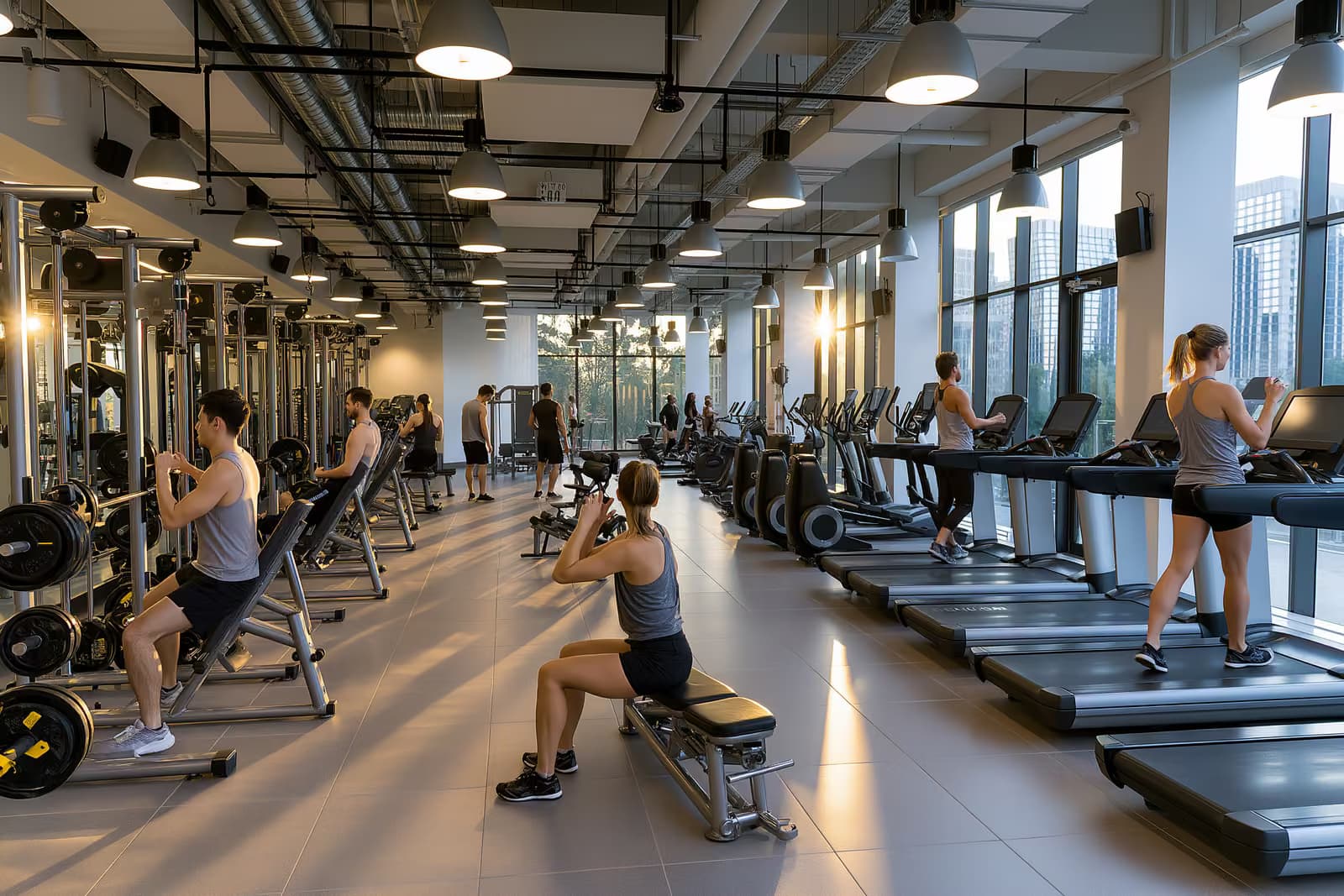
The commercial market splits fairly cleanly into price tiers, and knowing which tier you are in tells you most of what you need to know about cost and atmosphere. At the budget end sit the discount chains. McFit is the pioneer that created the German discount-gym model and remains one of the largest operators, with memberships around 30 euros a month and the same price across its studios nationwide. FitX is the aggressive budget challenger, often the cheapest of the big names at roughly 24 euros a month plus a one-off sign-up fee. Clever Fit runs a large franchise network where prices are set locally and vary by studio, frequently in the high 30s. EasyFitness and a handful of regional players fill out the same segment. These gyms give you a lot of equipment for the money: rows of cardio and strength machines, free weights, and often a basic sauna, but limited staffing and few frills.
In the mid and premium range you pay for space, service and design. Fitness First is the long-established mid-to-premium chain, typically around 60 euros a month, with more classes, pools in some locations and a calmer feel. John Reed, operated by the RSG Group (the same company behind McFit), is the design-led lifestyle brand, with music, art-heavy interiors and pricing that climbs from roughly 40 to 60 euros depending on the location cluster. Genuine luxury clubs such as Aspria and Holmes Place occupy the top of the market, bundling spa areas, pools, courts and generous opening hours into memberships that can run well over 100 euros a month. Alongside these are the boutique studios, smaller specialist places built around one discipline - CrossFit boxes, indoor cycling studios, Pilates and reformer studios - where you pay a premium for small classes and coaching. A distinct niche is EMS training (Elektromyostimulation, electrical muscle stimulation), offered by studios like Bodystreet in short personally-supervised sessions; it sits firmly in the premium bracket at roughly 70 euros a month and up.
Two structural features cut across the tiers. First, most larger chains offer nationwide access or a premium tariff that lets you train at any of their studios, which is genuinely useful if you travel or move within Germany. Second, the 24-hour or extended-hours model has spread well beyond the budget chains, so early risers and shift workers can usually find a gym open at any time, sometimes with reduced or no staffing overnight. There is also a quieter option many newcomers miss: municipal and Verein-run gyms attached to public sports centres or clubs, which are often cheaper and less commercial than the chains but come with fixed hours and less equipment. If yoga or dedicated wellness is what you are really after, those are covered separately in our guides to yoga and wellness retreats and wellness and spas.
The contract trap: what you are really signing
This is the single most important section for a foreigner, because German gym contracts work differently from the month-to-month memberships common in many countries. A typical Fitnessstudio contract has three moving parts. The first is the Mindestvertragslaufzeit (minimum contract term), the fixed period you are committed to no matter how often you actually train - most commonly 12 months, sometimes 24. The second is the Kündigungsfrist (notice period), the deadline by which you must formally cancel before the term ends, often one to three months in advance. The third, and the one that used to catch everyone, is the Verlängerung (automatic renewal): if you miss the notice deadline, the contract extends itself. The trap was simple. You sign for a year, forget to cancel a few months before it ends, and you are bound for another full year against your will.
German law changed this, and understanding the change can save you real money. The Gesetz für faire Verbraucherverträge (the Act on Fair Consumer Contracts) took effect on 1 March 2022 and rewrote the rules for contracts signed from that date. Two things matter for gyms. A new contract may still have an initial minimum term of up to 24 months. But once that initial term has run, the contract can no longer roll over into another fixed year. It may only continue on an open-ended basis that you can cancel at any time with a notice period of no more than one month. In plain terms: after your first term ends, you can never again be locked in for another full year by simply forgetting a deadline - the worst case is that you keep paying for one extra month while you cancel. This applies to memberships signed on or after 1 March 2022, which by 2026 means essentially every contract you are likely to sign.
The same reform brought a second protection, the Kündigungsbutton (cancellation button). Since 1 July 2022, any business that lets consumers sign up for an ongoing contract through a website must also provide a clearly labelled cancellation button on that website, so you can terminate online just as easily as you joined. If you signed your gym membership online, the studio is legally required to give you this button, and a cancellation submitted through it is valid. This ended the old situation where you could join with two clicks but were told you had to cancel by registered letter. Do note the boundary: the button requirement attaches to contracts that can be concluded online. A membership you signed on paper at the reception desk may still ask for a written cancellation, so keep reading.
The practical takeaways are worth stating plainly. Before you sign, find and read the Mindestvertragslaufzeit and the Kündigungsfrist - they are always in the contract, usually in the small print near the signature line. Prefer the shortest minimum term you can get; many budget chains offer a flexible monthly tariff for a few euros more, and for a newcomer whose plans may change, that flexibility is often worth the premium over a locked-in annual deal. Put the cancellation deadline in your calendar the day you join, counting back the full notice period from the end of the minimum term. That one habit avoids the most common and most expensive mistake foreigners make with German gyms.
The fees hidden around the monthly price
The headline monthly figure is rarely the whole cost, and the extra charges are where budget gyms in particular make their margins. The first you meet is the Anmeldegebühr (sign-up or registration fee), a one-off charge for setting up your membership, commonly somewhere between 20 and 50 euros. It is often waived during promotions, so it is always worth asking whether a current offer drops it. The second, and the one that surprises people most, is a recurring service fee that studios label in various ways: Servicepauschale or Verwaltungsgebühr (service or administration fee) or, very commonly, a Trainingspauschale (training flat fee) billed once or twice a year on top of your monthly dues. A typical Trainingspauschale might be 20 to 30 euros charged every six months, nominally for equipment maintenance or servicing. It is legal when it is disclosed in the contract, so read for it: a 20-euro-a-month gym that adds two 25-euro service charges a year really costs closer to 24 euros a month.
Two other contract features are worth knowing before you need them. Most studios offer a Ruhezeit or Vertragsruhe (a freeze or pause of the membership), which lets you suspend the contract for a defined period - for a long trip, an injury, a pregnancy - rather than cancelling it outright. During the freeze you usually pay a small holding fee or nothing at all, and the pause typically extends your minimum term by the frozen months. Freezing is often the sensible move when you will be away for a while but intend to return, because it keeps your existing conditions instead of forcing you to re-join later at whatever the price is then. Ask how long a freeze can last and what proof, such as a doctor’s note or a travel booking, the studio requires.
Finally, watch how payment is set up. German gyms almost always collect dues by SEPA-Lastschrift (SEPA direct debit) from a German bank account, and some are reluctant to accept members without one. If a debit is taken in error or after you have validly cancelled, you have a straightforward right to reverse a SEPA direct debit through your bank for eight weeks after it is taken, which is a useful backstop but not a substitute for cancelling properly. Keep every document the studio gives you, keep proof of anything you send them, and check your account statements so a service charge or a renewal does not slip through unnoticed.
Getting out: cancelling and cancelling for cause
There are two ways to leave a German gym. The ordinary way is the ordentliche Kündigung (regular cancellation): you give notice within the Kündigungsfrist so the membership ends when the current term does. Do it in writing, state clearly that you are cancelling and from what date, and if the studio offers a Kündigungsbutton for online-signed contracts, use it and save the confirmation. For contracts signed on paper, a written cancellation is safest; historically many studios demanded a registered letter (Einschreiben), and while the law no longer allows them to insist on more than text form for the cancellation itself, sending something you can prove was received still protects you if a dispute arises. Always ask for a written confirmation of your cancellation and the exact end date, and chase it if it does not come.
The second way is the außerordentliche Kündigung or Sonderkündigungsrecht (extraordinary cancellation, or special right of termination) - leaving mid-term for a serious reason. This is more limited than newcomers expect, so be realistic about it. Illness or injury can justify it, but the bar is high: German courts require that the condition genuinely prevents you from using the studio for at least the rest of the contract term, and you must prove it with a doctor’s certificate (an ärztliches Attest). A sore knee for a few weeks does not qualify; a lasting condition documented by a doctor can. Moving away is the case foreigners most often get wrong. A relocation, even to another city or abroad, does not by itself give you a right to cancel a German gym contract - the Bundesgerichtshof (the Federal Court of Justice) ruled in 2016 that the risk of moving generally sits with the member, unless the contract specifically grants a relocation exit. Some studios do offer such a clause, and some will release you as a goodwill gesture if you ask politely and show a new registration, but it is a favour, not a right. Plan your membership as if you cannot walk away early, because usually you cannot.
If you do need to put a cancellation in writing and want a clean, correctly worded letter, one free tool can help. Werkzeu.ge, a browser-based toolbox built by Cryon UG (the company behind WeLiveIn.de), has a Kündigungsschreiben (cancellation letter) generator for consumer contracts such as gyms, mobile plans and insurance. It is free to use without an account, produces a properly formatted German cancellation letter you can print and send, and keeps what you type on your own device. It is worth knowing two things about it: the platform is in beta until late 2026, so treat it as a helpful draft rather than legal advice, and the free tier carries ads. It prepares the letter; it does not send it to the gym for you. You can see what the platform costs beyond the free tools on its pricing page. For a straightforward regular cancellation it is a genuine time-saver; for a contested Sonderkündigungsrecht, a short consultation with a Verbraucherzentrale is money well spent.
What training in a German gym is actually like
Before you commit, use the Probetraining (trial workout). Almost every studio offers a free or cheap trial session, sometimes a Probewoche (trial week), and there is no reason not to take it. Turn up at different times to see how crowded the place gets, test whether the machines you want are available, and get a feel for the crowd. A trial also lets you ask about the contract terms in person, which is exactly when to raise the minimum term, the notice period and any Trainingspauschale. A studio that is evasive about its fees on the trial day will not be more transparent once you have signed.
Once you join, many gyms expect an Einweisung (equipment induction), a supervised introduction where a trainer shows you how to use the machines safely and sometimes sets up a starter plan. At Verein and municipal gyms this induction is often mandatory before you are allowed to train alone, and even at commercial chains it is commonly included in your fee and worth taking, both for safety and because it is usually the one piece of personal coaching you get for free. Booking it early also gets you talking to staff, which helps when you later have a question about your contract.
German gym etiquette is real and taken seriously, and getting it right marks you as a considerate member. Bring a towel: many studios operate a Handtuchpflicht (towel requirement) and expect you to lay your towel on any bench or machine you use, both for hygiene and out of courtesy to the next person. Wipe down equipment after use with the paper towels and spray provided. Change into clean indoor shoes rather than tracking street dirt across the floor; some studios enforce this. Re-rack your weights and return dumbbells to their proper place - leaving plates on a bar is genuinely frowned upon. None of this is unique to Germany, but the expectations are firm and unspoken, so err on the tidy side.
Two extras are worth understanding. Kurse (group classes) such as spinning, yoga, body pump or functional training may be included in your membership or charged separately, and the difference can be significant if classes are your main reason for joining, so check which tariff covers what. And the sauna: a great many German gyms, even budget ones, include a sauna in the wellness area, and German sauna culture is nude and usually mixed. You sit on a towel, without swimwear, which surprises many newcomers. If that is unfamiliar territory, our guide to Freikörperkultur (FKK) explains the etiquette, and our guide to wellness and spas covers the dedicated sauna and spa world beyond the gym.
Alternatives to a locked-in gym
A commercial membership is not the only way to stay fit in Germany, and for many people it is not the best value. The obvious alternative is the Sportverein, the non-profit sports club that is a cornerstone of German life. For a modest annual or monthly Mitgliedsbeitrag (membership fee), often far less than a commercial gym, a Verein gives you access to organised training, courts, halls and a built-in social circle - and clubs are one of the easiest ways to actually meet people. Many also run their own equipped gyms and fitness courses. If you value community over rows of machines, this is frequently the smarter choice; our guide to joining sports clubs explains how to find and join one.
If you prefer flexibility, consider the multi-studio aggregators. Services like Urban Sports Club and EGym Wellpass sell a single monthly pass that gets you into a network of gyms, pools, studios and classes across many providers, which suits people who want variety or who move between cities. Wellpass in particular is often subsidised by employers as a benefit, so it is worth asking your workplace whether they offer it. These passes usually run month to month, which sidesteps the lock-in problem entirely, though the per-visit economics only make sense if you actually go regularly.
Then there is training that costs nothing. German cities are well supplied with public outdoor fitness and Calisthenics parks - fixed pull-up bars, dip stations and climbing frames in parks and along rivers - which are free, open around the clock and increasingly popular. Running and cycling are woven into daily life here, with extensive paths and a strong cycling culture; our guide to bicycle culture and routes is a good starting point if two wheels appeal. Home workouts, whether bodyweight or with a few pieces of kit, remain the most flexible and cheapest option of all, with no contract to read.
The honest comparison comes down to this. A commercial gym is worth its money if you will genuinely use its equipment, its opening hours and its location several times a week - and if you go in with your eyes open about the contract. But for a large share of newcomers, especially those whose plans in Germany are still uncertain, a Verein, a flexible monthly aggregator pass, or simply the parks and paths outside will deliver more freedom for less money than a locked-in premium membership. Match the commitment to how settled you actually are.
What to do next
Start with a trial before you commit to anything. Take a Probetraining at two or three studios near your home or workplace, go at the times you would realistically train, and use the visit to ask directly about the minimum term, the notice period and any service or training flat fees. Compare that against a Sportverein and, if you want flexibility, a monthly aggregator pass, so you are choosing with the real costs in front of you rather than the headline price on a poster.
When you do sign, treat the contract as the important document it is. Read the Mindestvertragslaufzeit and the Kündigungsfrist before you put your name down, prefer the shortest term or a flexible monthly tariff if your future in Germany is not yet settled, and the day you join, write the cancellation deadline into your calendar counting back the full notice period. Keep every piece of paper the studio gives you. When the time comes to leave, cancel in writing well inside the notice period, use the Kündigungsbutton if you signed online, and get written confirmation of the end date. Remember that moving away will not usually free you early and that only a documented, lasting illness supports a mid-term exit, so do not sign a long term on the assumption you can escape it. Get those few things right and a German gym is exactly what it should be: a place to train, not a bill you cannot stop.
Sources
The information in this chapter draws on the official sources and publications listed below, last reviewed in July 2026. It is general guidance for orientation, not individual legal, tax, or medical advice.