Health and Well-being Campaigns
16 min read
Some of the most meaningful ways to help in Germany have nothing to do with a clipboard or a committee. They involve your own body and your own time - giving blood so a stranger survives surgery, letting a laboratory record your tissue type in case someone somewhere needs a stem-cell transplant, or sitting quietly beside a person in their last weeks of life. This chapter is about health and well-being volunteering: the concrete, accessible ways a foreigner living in Germany can contribute to other people’s health, from a five-minute cheek swab to a trained role on a crisis helpline. It explains what each option asks of you, how much German you need, and where to sign up, so you can pick something that fits your time, your language level and your emotional bandwidth.
A note before we start: this is a guide to contributing, not a source of medical advice. Nothing here tells you whether you personally may donate or how to treat an illness - the donation services and your own doctor decide that. If you want to understand how the German medical system works as a patient, read our chapters on accessing medical care in Germany and the German healthcare system instead. This chapter looks at the other side of the counter: how you give.
Where health volunteering fits
Health-related volunteering in Germany splits neatly into two kinds of giving, and it helps to know which one you are looking at. The first is donating something your body renews or can spare - blood, plasma, stem cells, or, after death, your organs. These contributions need almost no German, no long-term commitment and no application process worth the name. You turn up, you are checked for eligibility, and you either help that day or you go onto a register. For a newcomer who wants to do something real without first mastering the language or the paperwork, this is the most direct door there is.
The second kind is giving your time to a health cause: sitting with hospital patients, accompanying the dying through a hospice service, answering a crisis line, running a self-help group, or supporting one of the large German health charities. These roles ask more of you - often solid German, sometimes months of training, and in the intense roles a real emotional steadiness. They are also where a volunteer becomes part of someone’s story rather than an anonymous donor. Most of the practical scaffolding for this kind of work - how the German concept of Ehrenamt (honorary, unpaid civic work) functions, when you need a Führungszeugnis (a certificate of good conduct from the police), how volunteer accident insurance and the small tax-free Ehrenamtspauschale work - is covered in our anchor chapter on volunteering opportunities. This chapter assumes that framework and focuses on what is specific to health. If you are chasing personal fitness or a wellness routine rather than a way to help others, that is a different subject, covered in yoga and wellness retreats.
Giving blood and plasma
Blood donation, Blutspende in German, is the most familiar health contribution and one of the easiest for a newcomer to make. Germany relies heavily on voluntary donors because donated blood cannot be manufactured and most components last only days or weeks. The largest organiser is the Blutspendedienst of the Deutsches Rotes Kreuz (the German Red Cross, or DRK), which runs a dense network of fixed centres and travelling drives in town halls, schools and community centres across the country. Hospital and university blood banks (the Uni-Blutspendedienste and staatlich-kommunale services) collect a large share too, and there are private and commercial services as well. You do not need to be a German citizen to donate. What you generally need is to be an adult, usually between 18 and 68 for a first donation, to weigh at least 50 kilograms, to feel healthy on the day, and to bring photo identification. The service checks your haemoglobin, blood pressure and a short health questionnaire before anything else happens, and travel to certain countries, some medications and recent tattoos can lead to a temporary deferral.
One point often confuses newcomers: whether you get paid. With the DRK, the answer is essentially no - it runs on the principle of unpaid, altruistic donation, and you receive a snack, a drink and sometimes a small token rather than money. Some other services, particularly university and municipal blood banks and commercial providers, do pay a modest Aufwandsentschädigung (an expense allowance) of roughly twenty to twenty-five euros to cover your time and travel. This is legal and normal; it simply reflects who is running the drive. If being paid matters to you, ask the specific service, but the great majority of German donors give for free and think of it as exactly that - a gift.
Plasma donation, Plasmaspende, is a close relative worth knowing about. Instead of whole blood, a machine separates out the plasma - the liquid that carries clotting factors and antibodies used to make medicines - and returns the rest of your blood to you. It takes longer than a blood donation, usually around 45 to 60 minutes, but because your body replaces plasma quickly you can donate far more often, up to several dozen times a year at dedicated plasma centres. Commercial plasma centres typically pay an expense allowance for each visit, which is why you see them advertised in cities. Both blood and plasma donation share the same great advantage for a foreigner: they need almost no German beyond filling in a translated questionnaire, they ask nothing of you afterwards, and they help immediately. If you can only do one health-related thing in your first months here, this is the one that costs you least and helps most reliably.
The stem-cell register: a five-minute swab that can save a life
If you want the highest possible impact for the smallest possible effort, register as a potential stem-cell and bone-marrow donor. In Germany this is dominated by the DKMS, a donor registry founded near Tübingen in 1991 after a man named Peter Harf lost his wife Mechtild to leukaemia and set out to find donors for others. It has since grown into the largest stem-cell donor centre in the world, with more than twelve million registered donors across several countries and over seven and a half million in Germany alone. The organisation exists because for a patient with blood cancer such as leukaemia, a transplant from a genetically matching stranger is often the only chance of survival, and finding a match can require searching millions of people.
Registering is genuinely a five-minute job, and this is the part newcomers underestimate. You order a registration set online, it arrives by post, and you run three cotton swabs along the inside of your cheeks to collect a little saliva and tissue. You send the swabs back in the prepaid envelope with a signed consent form, and a laboratory determines your tissue type and adds it to the international search pool. There is no needle and no appointment. You can register from the age of 17 (you can be called as a donor once you turn 18), and donors stay in the file up to around 61. Being new to Germany is no barrier at all; in fact a diverse donor pool improves matching, so international residents are especially valuable.
It is worth being honest about what happens if you are ever matched, because that is the real commitment you are making. In roughly four out of five cases the actual donation is done through peripheral blood stem-cell collection: for a few days beforehand you take a medication that pushes stem cells from your marrow into your bloodstream, then the cells are filtered from your blood in a process similar to plasma donation, with no operation involved. In the minority of cases where bone marrow itself is needed, it is taken from the pelvic bone under general anaesthetic in a short hospital stay. Either way your costs are covered and matches are rare, so most registered donors are never called. Registering is one of those quietly remarkable German success stories, and joining it is one of the most generous things you can do without changing your week.
Organ donation and the new register
Organ donation, Organspende, is the contribution you make for after your death, and Germany’s system rests on your explicit consent. Unlike some neighbouring countries that presume you are willing unless you opt out, Germany uses an opt-in model: your organs may only be used for transplant if you have said yes, or, failing a record of your wishes, if your relatives decide on your behalf at a very hard moment. Parliament debated switching to an opt-out model in 2020 and rejected it, keeping consent firmly in your hands. That makes recording your decision the single most useful thing you can do, because it spares your family a wrenching guess and shortens the wait for the thousands of people on transplant lists.
For decades the standard way to record your choice was the Organspendeausweis, a small paper donor card you fill in yourself and carry in your wallet - no registration, no witness, no cost. You can still use one, and you can note your wishes in a Patientenverfügung (an advance healthcare directive) as well. Since 18 March 2024 there is also a national Organ- und Gewebespenderegister, an official online register run by the federal government, where you can log your decision digitally. At launch you needed an identity document with the eID online-identification function, such as the German Personalausweis, to enter your declaration, and the system has since been extended so that people can also register through their health-insurance app using the GesundheitsID. You can say yes, say no, or limit your consent to certain organs, and you can change your entry at any time. Carrying a paper card and making a register entry are not mutually exclusive; either records your wish, and hospitals can now check the register directly. Because the rules and the technology here keep evolving, it is worth confirming the current process on the official site, and our chapter on accessing medical care in Germany puts organ donation in the wider context of how the system treats you as a patient.
Self-help groups and patient support
Away from donation, one of the most distinctive features of German health culture is the Selbsthilfegruppe, the self-help group. These are small, usually volunteer-run circles of people who share a condition or situation - a chronic illness such as diabetes or multiple sclerosis, a cancer diagnosis, an addiction, a mental-health condition, bereavement, or caring for a sick relative - and who meet regularly to exchange experience and support. Germany treats self-help as a serious pillar of the health system rather than a fringe activity: statutory health insurers are legally required to fund it, and there are thousands of groups nationwide. For a patient, a group offers something no doctor can, which is the company of people who have been exactly where you are.
The way in, if you cannot find a group by word of mouth, is a Selbsthilfe-Kontaktstelle, a local self-help clearing house that keeps a directory of groups in your area and helps you find or even start one. At national level the coordinating body is NAKOS, the Nationale Kontakt- und Informationsstelle zur Anregung und Unterstützung von Selbsthilfegruppen, which maintains overviews of contact points and topic-specific networks across the country. For a foreigner this is a two-sided opportunity. If you are living with a condition yourself, a self-help group can be a lifeline and a way to build friendships in a new country. If you are well and want to help, groups often welcome volunteers to handle organisation, translation or simply reliable presence, and starting a group around an unmet need - say, support for other internationals facing a particular diagnosis - is a genuinely valued contribution. Good German helps here, since the work is entirely conversational, but the human skills matter more than perfect grammar.
Being present: hospital, hospice and the crisis line
Some of the most valued health volunteering in Germany is simply about being present for people who are ill, dying or in crisis. In hospitals and care homes you will meet the Grüne Damen und Herren, the “Green Ladies and Gentlemen”, recognisable by their green coats. This is a real and long-standing institution: the movement was started in 1969 in Düsseldorf by Brigitte Schröder, and today around 4,400 volunteers work in hundreds of groups nationwide, carried by the Evangelische Kranken- und Alten-Hilfe (eKH), an ecumenical charity. Their job is the human side of a hospital stay that overstretched staff cannot manage - listening, reading aloud, fetching a newspaper, accompanying a nervous patient to an examination, or just sitting so someone is not alone. It is undramatic, deeply appreciated work, and it is a natural fit if you have some free daytime hours and warm, patient German.
More profound, and more demanding, is hospice and palliative volunteering. Germany has a strong Hospizbewegung (hospice movement), and much of it runs through the ambulanter Hospizdienst, an outpatient hospice service whose volunteers accompany dying people and their families at home or in care homes. This is Sterbebegleitung, literally accompanying someone in dying: sitting with them, holding a hand, giving an exhausted family a few hours’ rest, being unafraid of silence. It is among the most meaningful roles a volunteer can take, and services take it seriously. You will go through a preparatory course, typically spread over several months, that helps you face your own feelings about death before you sit with someone else’s, and you will have ongoing supervision. Strong German is essential, because the whole role is presence and conversation, often with frail or distressed people.
The same seriousness applies to the TelefonSeelsorge, Germany’s crisis and emotional-support helpline. It is free, anonymous and available around the clock on 0800 111 0 111, 0800 111 0 222 and the Europe-wide number 116 123, and it is run jointly by the Protestant and Catholic churches, though callers of any or no faith are welcome. Behind those numbers are roughly 7,700 trained volunteers who take calls, and increasingly chats and emails, from people who are lonely, frightened, grieving or suicidal. Becoming one of them is a substantial commitment: the training is demanding and runs for around nine months, covering listening technique and hard subjects such as shame, grief and suicidality, and services typically ask for a commitment of several years afterwards. Near-native German and genuine emotional resilience are non-negotiable for this role. If that is beyond you now, the number is still worth saving - both for people you may want to help and for yourself, because volunteering in these fields can be heavy, and knowing where to turn is part of doing it well.
All three of these roles involve close, sustained contact with vulnerable people, so expect to be asked for an erweitertes Führungszeugnis, the enhanced certificate of good conduct, and to complete role-specific training before you start. Our anchor chapter on volunteering opportunities explains how to obtain that certificate and what the onboarding process generally looks like. If your interest is specifically in keeping older people company rather than in end-of-life care, the visiting services described in our chapter on care services for the elderly - the Besuchsdienste that pair volunteers with isolated seniors - are a gentler entry point that still makes a real difference.
Health charities and awareness campaigns
Behind the individual roles sits a layer of large, well-established health charities that run research funding, patient support and public awareness, and that always need volunteers and supporters. In cancer, the dominant name is the Deutsche Krebshilfe, founded in 1974 by Mildred Scheel, which funds research and helps patients and their families. In HIV and AIDS, the Deutsche Aidshilfe has for decades combined support, prevention and advocacy, and its work is a good example of destigmatising campaigning done well. Heart disease has the Deutsche Herzstiftung, which explains conditions in plain language and runs public information drives, and in mental health the Stiftung Deutsche Depressionshilfe works to educate the public and reduce the stigma around depression, alongside patient organisations across the whole spectrum of illnesses. These are the “campaigns” in this chapter’s title in their most concrete form: real organisations you can donate to, fundraise for, or volunteer with, rather than vague slogans.
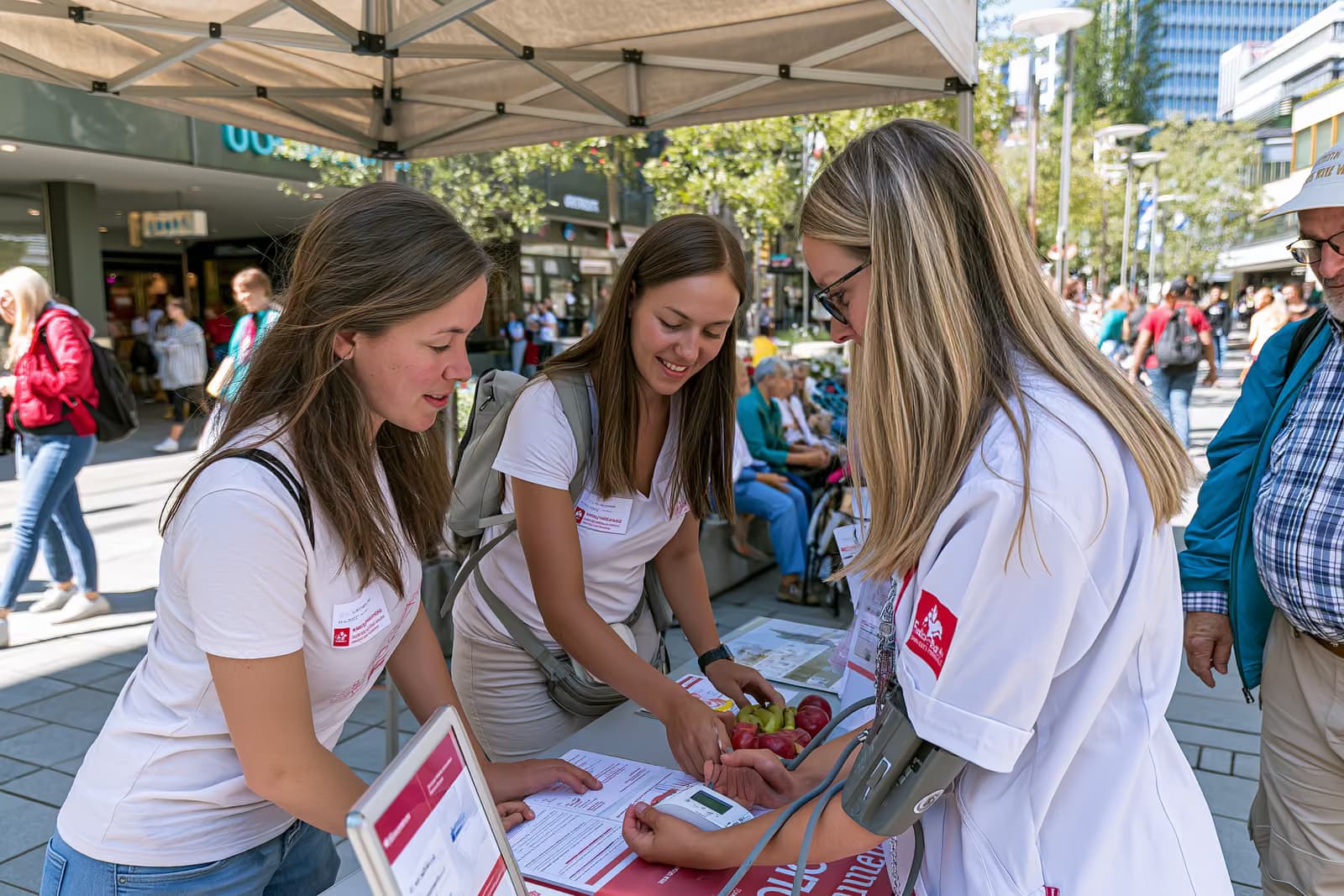
Much of their public work clusters around awareness days and months that you will start to notice once you look. Weltnichtrauchertag, World No Tobacco Day, falls on 31 May each year and drives anti-smoking messaging. October is widely marked as breast-cancer awareness month, symbolised by the pink ribbon, with information stands and fundraising events. The Movember idea - men growing moustaches in November to raise awareness of men’s health, including prostate cancer and male mental health - has taken hold in German cities too. Around any of these, an Aktionstag (a themed action day) may bring information booths, free screenings and talks to a town square or shopping street, and these are easy, low-commitment places to help out for an afternoon. A word of caution that this chapter has learned the hard way: campaign names come and go and vary by city and year, so check what is actually running near you rather than trusting a slogan you read somewhere, and be wary of “campaigns” that turn out to be marketing.
A great deal of health-charity money is raised through events, and this is where health volunteering overlaps with fundraising. Charity runs and walks - many timed to a specific cause, from cancer to heart health to mental well-being - are a friendly way to contribute even if you have no medical skills and limited German, because running, marshalling a water station or collecting sponsorship needs enthusiasm more than language. Our chapter on charity events and fundraisers covers how these events work and how to get involved, whether you want to take part or help organise. Pairing a charity run with a cause you care about is one of the most sociable forms of health volunteering there is.
Getting started, and looking after yourself
The best way to begin is to match a contribution to where you are right now. If your German is still basic and your time is short, start with the body-based donations: order a DKMS swab kit today, book a Blutspende appointment with the DRK or a local blood bank, and fill in an Organspendeausweis or make an entry in the online register. None of these need fluent German or an interview, and together they represent a real, life-touching contribution you can make in your first weeks in the country. If you have more German and want ongoing involvement, contact a self-help clearing house, a hospital’s Grüne Damen coordinator, an ambulanter Hospizdienst or a local branch of one of the health charities, and ask what they need. Many roles will ask you for an erweitertes Führungszeugnis and put you through training first; that is a sign of a serious organisation, not a hurdle to resent. For the mechanics of registering as a volunteer, the insurance and tax framework and the certificate of good conduct, lean on our anchor chapter on volunteering opportunities rather than working it out from scratch.
Be realistic about language and about weight. Donation asks almost nothing of your German; visiting and organising ask for comfortable conversational German; hospice work and the crisis line ask for near-native fluency and steady nerves, because you will be present at the hardest moments in a stranger’s life. That intensity is exactly why these roles matter, and it is also why self-care is not optional. The good services build in supervision and support precisely because sitting with dying or despairing people takes something out of you, so use it, keep your own limits, and step back when you need to. Helping is not a competition, and a volunteer who burns out helps no one.
Health volunteering rewards you with something unusually direct. The person who receives your blood, your stem cells or your organ, the patient who is a little less alone because you sat with them, the caller who made it through the night - these are not abstractions. You do not need to be German, wealthy or medically trained to take part; you need a little time, a little courage and, for some roles, a willingness to learn. Pick one thing from this chapter, do it this month, and you will have made yourself useful in the most human way a new country can offer.
Sources
The information in this chapter draws on the official sources and publications listed below, last reviewed in July 2026. It is general guidance for orientation, not individual legal, tax, or medical advice.