Street Parades and Carnivals
13 min read
Few things tell you more about a German region than the way it throws a street party. Germany has a deep tradition of parades and carnivals, and for a newcomer they are one of the easiest and most joyful ways to feel part of the place you now live. This chapter is a practical guide to German carnivals and street parades as events you can attend and take part in: what happens, when and where it happens, and how to join in without feeling like an outsider. We focus on the experience. If you want the deeper cultural background - what these customs mean and how they fit the German year - our chapter on German festivities and local traditions covers the meaning, while the overview of major German festivals maps the wider calendar this chapter sits inside.
Karneval, Fasching and Fastnacht: Germany’s fifth season
The biggest parade tradition in the country goes by different names depending on where you are. In the Rhineland - Cologne (Köln), Düsseldorf, Bonn, Mainz - it is Karneval. In Bavaria and much of the southeast, and across the border in Austria, the same season is called Fasching. In the Swabian-Alemannic southwest it is Fastnacht, often shortened to Fasnet, and it is a genuinely different tradition that we come back to below. Whatever the local name, this is a period, not a single day. Germans half-jokingly call it the “fifth season” (die fünfte Jahreszeit), and it officially opens on 11 November at 11 minutes past 11 (11.11 Uhr) with a first burst of costumes and speeches, then goes quiet over winter before exploding into life in the final week before Lent.
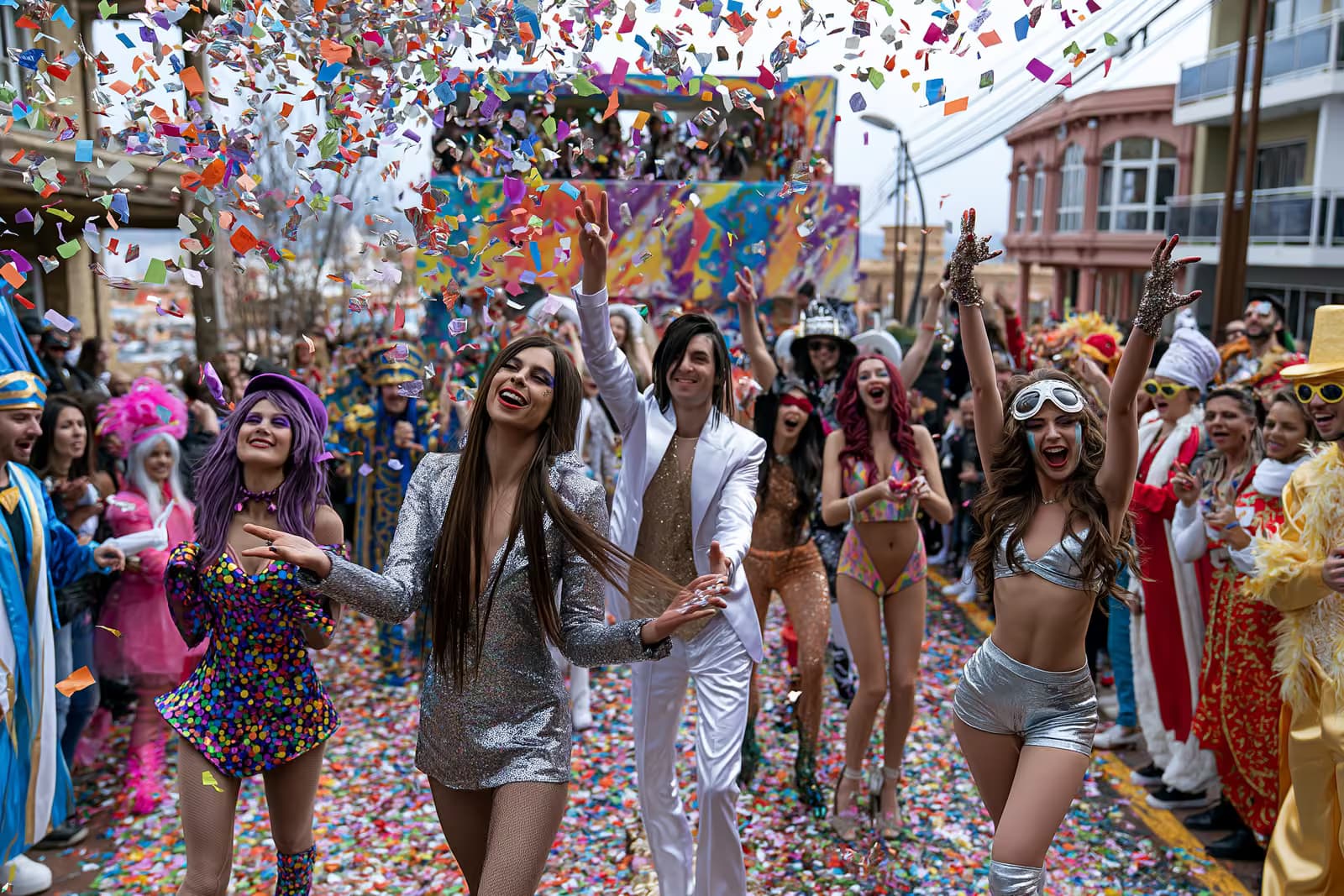
That final week is what most visitors picture. It builds from Weiberfastnacht, the “women’s carnival” Thursday, when tradition has women snipping off men’s ties with scissors - so if you wear a tie to the office that day in a Karneval city, expect to lose it, and wear one you do not mind sacrificing. The celebrations swell through the weekend and peak on Rosenmontag (Rose Monday), the day of the enormous main parades, before winding down on Faschingsdienstag (Shrove Tuesday) and stopping abruptly on Aschermittwoch (Ash Wednesday), when Lent begins and the party is officially over. The whole thing is loud, warm, boozy and welcoming, and foreigners are not just tolerated but actively drawn in.
The Rhineland has three great strongholds, each with its own personality and its own battle cry. Cologne is the largest and most famous; its Rosenmontagszug (the Rose Monday procession) runs for kilometres and draws around a million people to the streets, and the crowd greeting shouted back and forth all week is “Kölle Alaaf” (roughly, “Cologne above all”). Cologne carnival is also where you meet the Funkenmariechen, the uniformed dance-guard performers who are a fixture of the traditional carnival societies. Düsseldorf, Cologne’s friendly rival just up the Rhine, shouts “Helau” instead and is famous for its Mottowagen - satirical floats that turn politicians and current events into giant papier-mâché caricatures, often sharper and more provocative than anything you will see elsewhere. Mainz, the third of the trio and the carnival capital of the southwest Rhineland, also calls “Helau” and is especially known for its tradition of political satire delivered from the stage.
Several things happen at once during a Rhineland parade, and knowing the vocabulary helps you enjoy it. From the floats, costumed participants throw Kamelle - sweets, chocolates and small gifts - into the crowd, and children (and plenty of adults) scramble to catch them, so a shout of “Kamelle!” is an invitation to hold your hands up. Away from the parade route, in packed halls and tents, the season’s other great ritual is the Büttenrede, a comic or satirical speech delivered from a mock lectern called the Bütt, poking fun at local politics and everyday life. Costumes are everywhere and expected: this is a participatory event, not a spectator sport, and turning up in ordinary clothes marks you out more than any costume could. For what all of this actually means - why the Rhineland lets loose like this and why the north and east barely mark the season at all - see our chapter on German festivities and traditions.
It also helps to know that the parades are the public tip of a much larger, older organisation. Rhineland carnival is run by carnival societies (Karnevalsgesellschaften), some of them well over a century old, and in Cologne the season is symbolically led by the Dreigestirn (“triumvirate”): the Prinz (Prince), the Bauer (Peasant) and the Jungfrau (Maiden, traditionally played by a man). Long before Rosenmontag, from January onward, the societies host indoor galas known as Sitzungen or Prunksitzungen - ticketed evenings of Büttenreden, dance guards, brass bands and carnival songs held in halls across the region. If the outdoor crush is not for you, a Sitzung is a warmer, more structured way to experience the culture, though tickets for the well-known ones sell out early and are worth booking weeks ahead.
The Swabian-Alemannic Fasnet: older, stranger, wonderful
If your only image of German carnival is the cheerful, sweet-throwing Rhineland version, the southwest will surprise you. In the Swabian-Alemannic region - the area around the Black Forest, the upper Rhine and Lake Constance, taking in towns such as Rottweil, Villingen and Elzach - carnival is Fastnacht or Fasnet, and it is a much older and more folkloric affair. Instead of satirical floats and pop music, the streets fill with figures wearing hand-carved wooden masks (Larven or Holzmasken) and elaborate costumes called Häs, often representing witches, fools, animals and wild spirits. The overall mood is not political comedy but something closer to a living folk ritual: rooted, a little eerie, and centuries deep.
The high days run through the same pre-Lent week as the Rhineland, with the southwest’s own “fat Thursday”, Schmotziger Donnerstag, opening the street celebrations. The tradition is organised through Narrenzünfte, the “fools’ guilds” that own the masks and the choreography and pass roles down over generations. Membership and costume are taken seriously, and the processions - like Rottweil’s famous Narrensprung, where masked figures leap and jog through the old town in the early morning - follow set forms rather than a free-for-all. For a foreigner it is a spectacular thing to watch, and it makes the point that “German carnival” is not one event but at least two quite different ones. If you live in Baden-Württemberg or Bavaria, this is the version on your doorstep, and it rewards an early start and a respectful distance: you are welcome to watch and to dress up, but the masked guild members are performing a role, not posing for selfies. As with the Rhineland, the meaning behind these figures is explored in our festivities and traditions chapter.
Christopher Street Day and Pride parades
Germany’s summer brings the other great parade tradition: Christopher Street Day, universally abbreviated to CSD. The name refers to Christopher Street in New York, home of the 1969 Stonewall uprising that launched the modern LGBTQ+ rights movement, and CSD is Germany’s version of Pride. Parades take place in cities all over the country through the summer months, but the two largest - Cologne and Berlin - are among the biggest Pride events anywhere in Europe, each drawing hundreds of thousands of participants and spectators. Cologne’s CSD typically falls in early July and Berlin’s in late July, with dozens of smaller city parades filling out the calendar on either side.
What makes CSD distinctive is that it is two things at once. It is unmistakably a party - rainbow flags, decorated trucks with sound systems, music, dancing and enormous good humour - but it is also, at its core, a political demonstration for equal rights and against discrimination, and the German events keep that campaigning spirit visible in their speeches and demands. For a newcomer, whatever your own background, CSD is one of the most open and welcoming events in the German calendar. Everyone is invited to join or to watch, families included, and it is a warm, positive introduction to a confident and diverse side of German city life.
Other street parades: multicultural, techno and historical
Beyond carnival and Pride, Germany’s parade calendar has several other threads worth knowing. In Berlin, the Karneval der Kulturen (“Carnival of Cultures”) is a large multicultural street parade held over the Pfingsten (Whitsun/Pentecost) weekend in late spring, with thousands of costumed participants from dozens of communities and a multi-day street festival alongside it. Founded in 1996 as a response to racism, it celebrates the city’s diversity; after a pause during the pandemic years it has returned to the streets and continues today, marking its 30th edition in 2026. It has nothing to do with Rhineland Karneval despite sharing the word - it is its own thing, and a genuinely Berlin one.
Germany’s other famous street tradition, techno, needs a careful note because its history is often misremembered. The legendary Love Parade, the mass electronic-music street party that began in Berlin in 1989, is over: it moved to the Ruhr area in later years and ended for good after the 2010 disaster in Duisburg, where a deadly crowd crush in a tunnel killed 21 people. It does not run any more and you should not plan a trip around it. Its spirit does continue, however, through Rave the Planet, a techno street parade founded by Dr. Motte, one of the original creators of the Love Parade. Rave the Planet has run in Berlin since 2022, typically on a summer Saturday along the Straße des 17. Juni, and presents itself as both a celebration of electronic-music culture and a peaceful demonstration.
Finally, many towns hold historical and religious processions rather than modern parades. In Catholic regions you will see the solemn Fronleichnam (Corpus Christi) processions in early summer, and countless towns stage medieval pageants, guild parades and city-anniversary processions in period costume. The big Trachten (traditional-dress) parades tied to Volksfeste and Schützenfeste - the shooting-club and folk festivals with their brass bands and Lederhosen - are a whole world of their own; we cover those in the chapter on traditional folk festivals. And if it is music line-ups rather than street processions you are after, the festival season is mapped in our music and arts festivals guide.
How to experience a parade as a foreigner
The single most important thing to know about the big Karneval parades is to arrive early. For Rosenmontag in Cologne, Düsseldorf or Mainz, the good spots along the route fill up hours before the first float appears, so plan to be in position well ahead of the advertised start and pick a stretch of the route rather than the crowded start or end. Families with small children often do best at a daytime spot near the beginning of the route, where the mood is cheerful and the crush is smaller, and many cities run separate, gentler children’s parades (Veedelszöch or Kinderzüge) that are ideal for a first taste. Dressing up genuinely matters: in the strongholds this is a participatory street party, and a costume - however simple - is your ticket to belonging rather than watching from the edge.
Joining in is mostly a matter of relaxing and following the crowd. Learn the local greeting - “Alaaf” in Cologne, “Helau” in Düsseldorf and Mainz - and shout it back when you hear it, because it works like a friendly password all week. Expect a lot of Schunkeln, the habit of linking arms with the people beside you, strangers included, and swaying side to side to the carnival songs that everyone but you seems to know by heart. You will not know the words at first, and nobody minds; humming along and joining the sway is more than enough. Germans who are otherwise reserved become remarkably open during these days, so accept the offered Kölsch, return the toast, chat to your neighbours on the barrier, and let yourself be swept up. That willingness to take part, more than any costume, is what turns you from an onlooker into a participant.
Be realistic about the drinking. Karneval is one of the largest public drinking events in the country, and in Cologne that means Kölsch, the local beer, served in small glasses and consumed in remarkable quantities from early in the day. You do not have to drink to enjoy it, but if you do, pace yourself, eat properly, keep water going and look after the people you came with, because the combination of alcohol, cold weather and enormous crowds catches people out every year. Our chapter on nightlife and entertainment has more on drinking culture and staying in control of a big night out.
A few practicalities make the day far smoother. Carry cash: street vendors, small bars and Bratwurst stands often do not take cards, and card networks strain under the crowds anyway. Use public transport rather than driving, because city centres are closed to traffic, parking is impossible and trams and trains are the way everyone moves - but expect them to be extremely full, and build in extra time; our guide to the public transport system explains how tickets and networks work. Note too that Rosenmontag, although it is not a nationwide public holiday, is treated like one in the Karneval strongholds: many shops, offices and schools in cities such as Cologne close for the day, so do not count on running errands, and check opening hours in advance if you are not joining the party.
Above all, mind the crowds. These are some of the densest gatherings you will attend in Germany, so agree a meeting point with your group in case phones fail or you get separated, keep valuables secure and zipped away, dress warmly and in layers for a long day outdoors, and know where the quieter side streets are if you need to step out of the crush. Public toilets are scarce and queues are long, so use facilities in cafés or department stores when you can, and if you are attending with children agree in advance what they should do if they lose sight of you. Handled with a little common sense, a German parade is safe, generous and genuinely fun - and joining one is one of the quickest ways to stop feeling like a visitor and start feeling at home.
One more thing to weigh if you do not already live in a carnival region: the tradition is strongly concentrated. Karneval and Fasnet are enormous in the west and south but quiet to almost invisible across much of the north and east, so if you settle in Hamburg, Berlin or Leipzig you will notice the season far less, and the biggest parades will be a trip rather than something on your doorstep. That trip is well worth making at least once. If you plan to travel to Cologne, Düsseldorf, Mainz or a Fasnet town for the peak week, book accommodation early, because hotels in the strongholds fill months in advance and prices climb sharply around Rosenmontag. Going for a single day by train is entirely doable, but check the return timetable before you set out, as late services fill up fast and schedules can change for the day.
Getting ready for your first parade
If you want to start somewhere, pick the tradition closest to you. In the Rhineland, aim for Weiberfastnacht or Rosenmontag and commit to a costume; in the southwest, seek out a Fasnet Narrensprung and watch the masked guilds; anywhere in the country in summer, a CSD parade is an easy, welcoming first outing. Check the exact dates each year, since carnival moves with the church calendar and the summer parades are set city by city, and confirm the route and start time on the organiser’s own website before you go.
Then keep it simple on the day: arrive early, bring cash, take the tram, wear something warm and something festive, and go with friends. Read up on the meaning behind the customs beforehand if you like, so the calls of “Alaaf” and “Helau” and the sight of the masks make sense, and browse the wider festival calendar to plan your year around the events that appeal to you most. Germany’s parades are an open invitation. Say yes to one, and you will understand your new home a little better for it.
About this information
This chapter is general orientation based on widely-published information about everyday life in Germany, last reviewed in July 2026. It is general guidance, not individual legal, tax, or medical advice. See the related WeLiveIn.de chapters linked in the text above for topic-specific detail and official sources.