




 Turkish
 Italian
 Spanish
 Portuguese
 Romanian
 Albanian
 Lithuanian
 Latvian
 Bulgarian
 Greek
Greek Hungarian
 French
 Croatian
 Czech
Czech
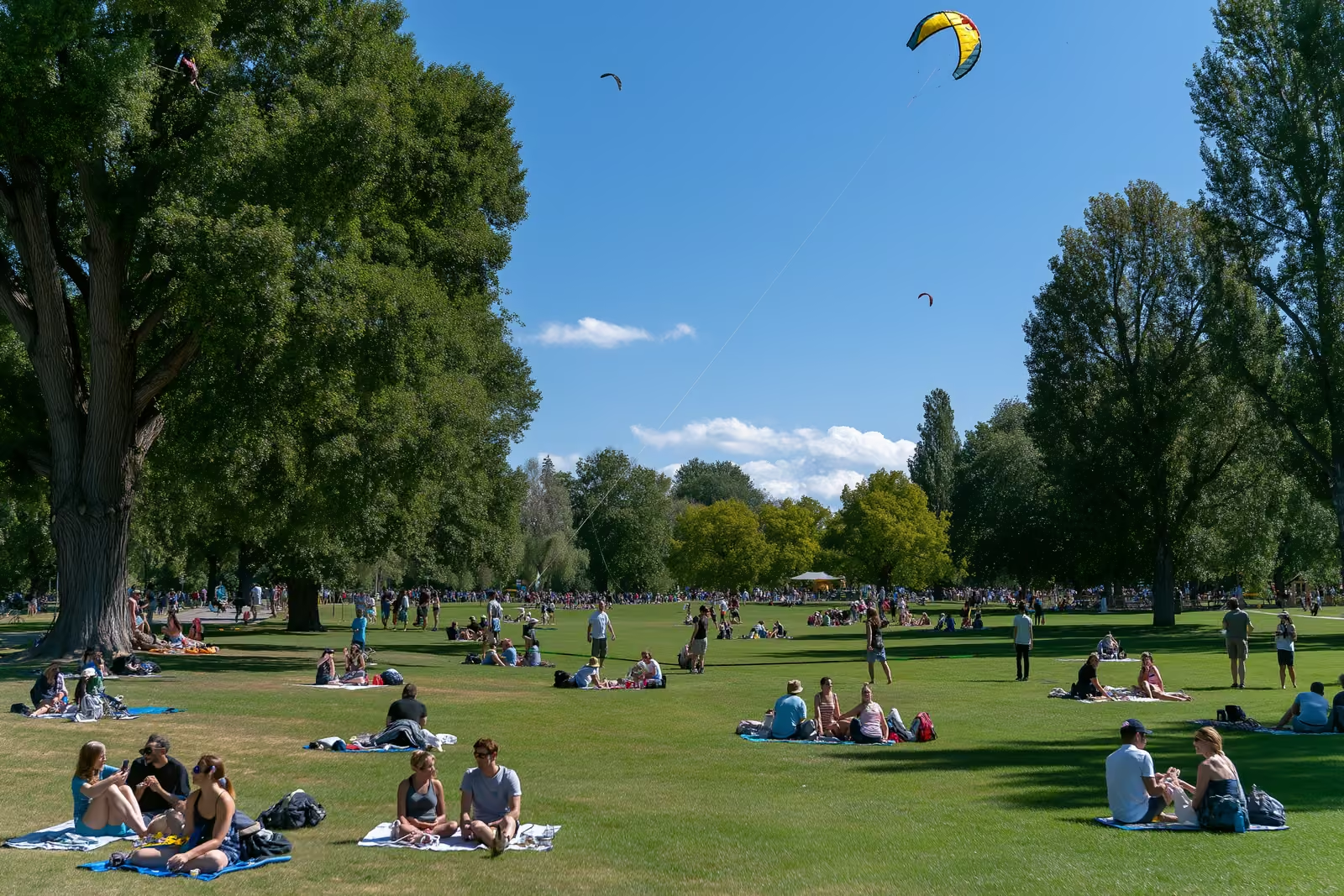
Few things tell you more about everyday life in Germany than the way people go outside. On the first warm Sunday of spring, a city park fills within hours: blankets on the grass, portable grills, families with coffee flasks, students with a football, older couples walking arm in arm for no reason other than the fresh air. This chapter is a newcomer’s guide to that outdoor life and parks culture – not the mountains and long trails, which are their own subject, but the ordinary, weekly business of getting outside where you live. Once you understand it, a lot of German habits start to make sense.
The good news for anyone settling in is that outdoor life here is genuinely democratic. You do not need equipment, a car or money to take part. A patch of public lawn, a lake on the edge of town and a forest you are legally allowed to walk into are, for most people, a short trip away. Below we cover the fresh-air mindset, the great city parks and how they are used, the peculiar and lovable world of the allotment garden, the simple activities that fill a German weekend, and how to reach nature and behave once you are there.
The German love of fresh air
There is a cultural value in Germany worth understanding early, because it shapes everything else in this chapter: the belief that frische Luft (fresh air) is actively good for you and that being outdoors is a real activity in its own right. A Spaziergang, an unhurried walk with no destination, is not killing time here. It is a legitimate way to spend an afternoon, recommended for a bad mood, a full stomach, a work problem or a restless child. Suggesting “Lass uns eine Runde gehen” (let us go for a lap) is a normal social offer, and the traditional Sunday-afternoon walk, often followed by Kaffee und Kuchen (coffee and cake), is still very much alive across generations.
Paired with this is an attitude you will hear stated almost as a proverb: “Es gibt kein schlechtes Wetter, nur schlechte Kleidung” – there is no bad weather, only bad clothing. It is not just a saying. It is how children are raised, sent out to play in rain suits and puddle boots, and it explains why parks are busy in drizzle and why nobody thinks a grey November walk is strange. If you come from a place where people stay in when it is cold or wet, this can be the hardest habit to adopt and the most rewarding once you do. You can read more about how this mindset runs through German childhood in our chapter on German family dynamics and parenting.
The practical takeaway is simple. Outdoor life is central to wellbeing here, so it is worth building into your own week rather than treating it as something you do only on holiday. Buy the waterproof jacket and the sturdy shoes, and you have bought your way into a large part of how Germans relax, socialise and stay healthy.
The city park as everyone’s back garden
Most people in Germany live in flats without private gardens, so the public park does the work a back garden does elsewhere. It is where you sunbathe, picnic, read, meet friends, exercise, walk the dog and let children run around. German cities take these spaces seriously, and several of them are famous for good reason. In Berlin, the Tiergarten is a vast wooded park in the very centre of the city, criss-crossed by paths and lawns and busy every summer with barbecues and sunbathers. Also in Berlin is the Tempelhofer Feld, the runways and open grassland of a former airport, now one of the most striking public spaces in Europe – a completely flat expanse where people cycle, skate, fly kites and grow community gardens where planes once landed.
Munich’s Englischer Garten is one of the largest city parks in the world, larger than many famous parks abroad, stretching from the centre out toward the north of the city. It is where you will find the celebrated surfers riding a standing wave on the Eisbach, a fast artificial channel near the southern entrance, and where several of the city’s beer gardens sit under old chestnut trees. In Hamburg, the Stadtpark is the classic broad city park for lawns and open-air events, while Planten un Blomen, near the centre, is a beautifully laid-out garden park known for its water-light shows on summer evenings. Many other cities keep a Volkspark or a Stadtwald, a “people’s park” or a city forest, in the same tradition. The point is not to tour them as sights but to understand that wherever you land, a green space of this kind is part of the deal, and locals treat it as an extension of their living room.
How the park is used follows some quiet rules. Picnics and sunbathing are completely normal, and on hot days lawns fill with people in swimwear; some parks have a relaxed corner where nude sunbathing is accepted, part of a wider German comfort with the body that we cover in our chapter on Freikörperkultur (FKK). Grillen, barbecuing, is hugely popular, but it is often restricted. Many cities forbid open grilling across most of a park and instead designate official Grillzonen or Grillplätze, marked barbecue areas, where it is allowed; grilling outside those zones can bring a fine, so it is always worth checking the city’s rules before you light up. And in or beside many parks you will find a Biergarten, a beer garden, where a long tradition often lets you bring your own food as long as you buy your drinks. Sitting at a shaded communal table with a cold drink and your own bread and cheese is one of the simple pleasures of a German summer.
Look closely and you will see that German parks are quietly equipped for daily use. Many have free public table-tennis tables, solid concrete Tischtennisplatten that people bring their own bats to, along with outdoor fitness stations, basketball hoops and open lawns for football or frisbee. Older residents play Boule or Boccia on gravel patches; groups do yoga or bootcamp classes on the grass in summer. There is usually a fenced Hundewiese, a dog meadow where dogs may run off the lead, and a playground within walking distance for children. In the evening, especially after work in the warm months, parks take on a social life of their own as people gather with drinks and food to wind down together. None of this needs booking or payment, which is exactly the point: the park is public infrastructure for leisure, and using it freely is simply what you do.
The Schrebergarten: Germany’s allotment world
One institution fascinates almost every newcomer: the Schrebergarten, also called a Kleingarten, the allotment garden. On the edges of towns and along railway lines you will see whole colonies of tiny fenced plots, each with a little hut, neat rows of vegetables, fruit trees and often a garden gnome or two. These are rented allotments, organised into associations, and for city dwellers without a garden they are a much-loved slice of green to call their own. The name comes from Daniel Gottlob Moritz Schreber, a 19th-century Leipzig figure associated with the early movement, and the culture has been going strong ever since.
What makes the Schrebergarten so distinctive is that it is genuinely regulated. A federal law, the Bundeskleingartengesetz, sets the framework, and it comes with rules that outsiders find either charming or comical. The hut, called a Laube, is generally capped at 24 square metres including any covered terrace, and you are not allowed to live in it permanently. As a rough guide the law also expects the plot to be actually gardened, not just used for lounging: a common rule of thumb, drawn from the law and the court decisions around it, is that about a third of the plot should be given over to growing your own fruit and vegetables, with the rest split between lawn, flowers and the hut. Use is meant to be for personal needs, not commercial. Individual associations then add their own house rules on hedge heights, quiet hours and more.
Two other facts are worth knowing. First, in popular cities the waiting lists can be long, sometimes years, so an allotment is not something you pick up on a whim. Second, the culture is warm and communal once you are in: shared festivals, help from neighbours, and a strong environmental and self-sufficiency streak that fits neatly with Germany’s interest in growing food and gardening sustainably. For many families it becomes a second home for the summer. Even if you never rent one, walking through a Kleingarten colony on a Sunday, past the tomato plants and the coffee tables, is one of the best short lessons in everyday German life you can get.
If a full allotment feels like too much commitment, there is a lower-key alternative that has grown quickly in recent years: the Gemeinschaftsgarten, or community garden. These are shared urban gardening projects, often on unused land or within a larger park, where anyone can join in to grow vegetables and herbs in raised beds, meet neighbours and learn from more experienced gardeners. They usually run without waiting lists or the strict rules of the Kleingarten, and they fit neatly with the strong German interest in local food, composting and sustainable city living. For a newcomer they can also be a warm and easy way into a neighbourhood, since the whole point is to garden together rather than behind your own fence.
Simple ways to get outside every week
Beyond the park and the allotment, a set of low-key activities makes up the ordinary German outdoors, and most of them cost little or nothing. Cycling is the obvious one. Alongside its role as everyday transport, a relaxed bike ride along a river path or out to a village cafe is a classic weekend outing, and the country is covered in well-signposted leisure routes for exactly this. We keep the detail of bikes, gear and long-distance routes in our dedicated chapter on bicycle culture and routes; here it is enough to say that a bike opens up the countryside around any German town at a gentle pace.
Walking, of course, is the national default, and you will also see plenty of Nordic walking, striding along with two poles, which is popular especially with older people and is taken quite seriously as exercise. Casual running is everywhere too, in parks and along rivers, and nobody will look twice at you for joining in. In summer the star attraction is water. Germany is full of lakes, and a Badesee, a designated swimming lake, is a summer staple: families spend whole days at a lake with a small beach, a meadow and often an ice-cream kiosk. Alongside the lakes is the wonderful institution of the Freibad, the open-air public swimming pool, a fixture of German towns with lawns for sunbathing, diving boards and a very particular summer atmosphere. A season ticket to the local Freibad is one of the great-value pleasures of a German summer.
Lake culture comes with its own gentle etiquette that is worth learning. Many swimming lakes are simply former gravel pits, called a Baggersee, that have filled with clean water and become local beaches; others are natural lakes with grassy shores. On hot days people arrive early to claim a shady spot, spread a blanket, and settle in for the whole day with a picnic and a book. Larger, supervised lakes may have a small entrance fee, lifeguards and a marked swimming area, while smaller ones are free and unsupervised, so you swim at your own risk and keep an eye on children yourself. Dogs are usually banned from the main bathing areas but often have their own stretch of shore nearby. As everywhere in the German outdoors, you take your rubbish home and leave the place as you found it. It is a relaxed, family-friendly scene, and spending a summer day at the local lake is one of the quickest ways to feel part of the neighbourhood.
Families are especially well served outdoors. Public playgrounds, Spielplätze, are numerous, well-kept and free, and outdoor family life is a whole subject of its own, which we cover in our chapter on family-friendly activities. And then there is the forest. One fact delights almost every newcomer: in Germany you have a legal right to walk in the forest. Under the Bundeswaldgesetz, the federal forest law, entering the woods on foot for recreation is permitted almost everywhere, whether the forest is publicly or privately owned, subject to sensible limits and to your own risk. Cycling and horse riding are generally restricted to paths and tracks rather than open ground, and states can add local rules, but the basic freedom to wander into the trees is real. After the fenced-off privately owned woodland some newcomers are used to, the idea that you can simply walk into almost any German forest is a small revelation.
Reaching nature, and treating it well
Getting out of the city is easy here, and often you do not need a car at all. The Deutschlandticket, a monthly nationwide pass for regional and local public transport, makes spontaneous day trips to a lake, a forest or a nearby town genuinely affordable, and it has changed how many people spend their weekends. We cover how it works and what it currently costs in our chapter on the Deutschlandticket. With it, a regional train and a short walk can put you at a swimming lake or a woodland trail within an hour of most cities, which is why German nature feels so accessible even without owning a car.
When you do reach protected countryside, a little etiquette goes a long way. Germany has many Naturschutzgebiete, nature reserves, where stricter rules apply than in an ordinary park. The unwritten and sometimes written expectations are straightforward: stay on the marked paths, keep dogs on a lead, especially in spring and early summer when ground-nesting birds and young wildlife are about, do not pick or trample plants, and take all your rubbish home with you. Trails are generally well marked with coloured symbols on posts and trees, so it is hard to get lost on the popular routes, and information boards often explain the local plants and animals. This chapter keeps to the gentle, everyday end of things; if you want serious walking, mountain routes, long-distance trails and the equipment that goes with them, that is the territory of our chapter on outdoor adventures and hiking, along with the wider world of watersports, climbing and winter sports.
Outdoor life here also follows the seasons closely, and part of settling in is learning that rhythm. Spring brings people back onto the grass at the first hint of sun. Summer is the great outdoor season of lakes, beer gardens, open-air cinemas and late evenings in the park. Autumn is for walks in the colour-changing forest and, in wine regions, for festivals among the vineyards. Winter does not shut things down: people still walk, wrapped up warm, and many towns have a Kurpark, the landscaped green of a spa town, laid out precisely for a restorative stroll. If that side of things appeals, our chapter on wellness and spas goes into the spa-town tradition in more depth.
Making the outdoors part of your life here
If you take one thing from this chapter, let it be that outdoor life in Germany is meant to be ordinary, not exceptional. You do not have to plan an expedition. You just have to go outside, in whatever weather, and join in. The people around you already do, and it is one of the easier and cheaper ways to feel at home.
To start, find your nearest park and your nearest lake or Freibad, and simply spend an afternoon there when the weather turns warm – watch how locals use the space and copy them. Buy proper outdoor clothing early, so that grey and wet days stop being a reason to stay in. Before you barbecue, check whether your park has a designated Grillzone. If you have children, get to know the local Spielplätze and lake beaches. And if the idea of a little plot of your own appeals, ask about the waiting list for a Schrebergarten sooner rather than later, because those lists move slowly. Do these few things and the German outdoors stops being something you read about and becomes part of your week – which, for most people who settle here happily, is exactly what it turns into.
Sources
The information in this chapter draws on the official sources and publications listed below, last reviewed in July 2026. It is general guidance for orientation, not individual legal, tax, or medical advice.

