Domestic Travel Tips
22 min read
This chapter is about getting around Germany affordably once you leave your own city - the weekend trip to see friends in another Bundesland, the intercity hop for a job interview, the spontaneous visit to the coast or the Alps. Domestic travel in Germany is genuinely good value if you understand how the fare system works, and genuinely expensive if you do not. The single most useful skill is knowing which ticket to buy, when to buy it, and how to get money back when a train runs late. That is what the pages below set out to teach you, in plain terms and with current 2026 numbers where they help.
One boundary matters before we start. German rail splits into Nahverkehr (local and regional transport) and Fernverkehr (long-distance transport). Everything local - the U-Bahn, S-Bahn, trams, buses and the regional RE and RB trains inside a Verkehrsverbund (regional transport association) - is covered in our companion chapter on the public transportation system, and the flat-rate ticket that unlocks all of it is explained in our chapter on the Deutschlandticket. This chapter owns the other half: the fast long-distance trains, the coaches, the carpools and the occasional flight that carry you across the whole country. Where the two halves meet, we will point you back rather than repeat.
Long-Distance Trains: ICE, IC and EC
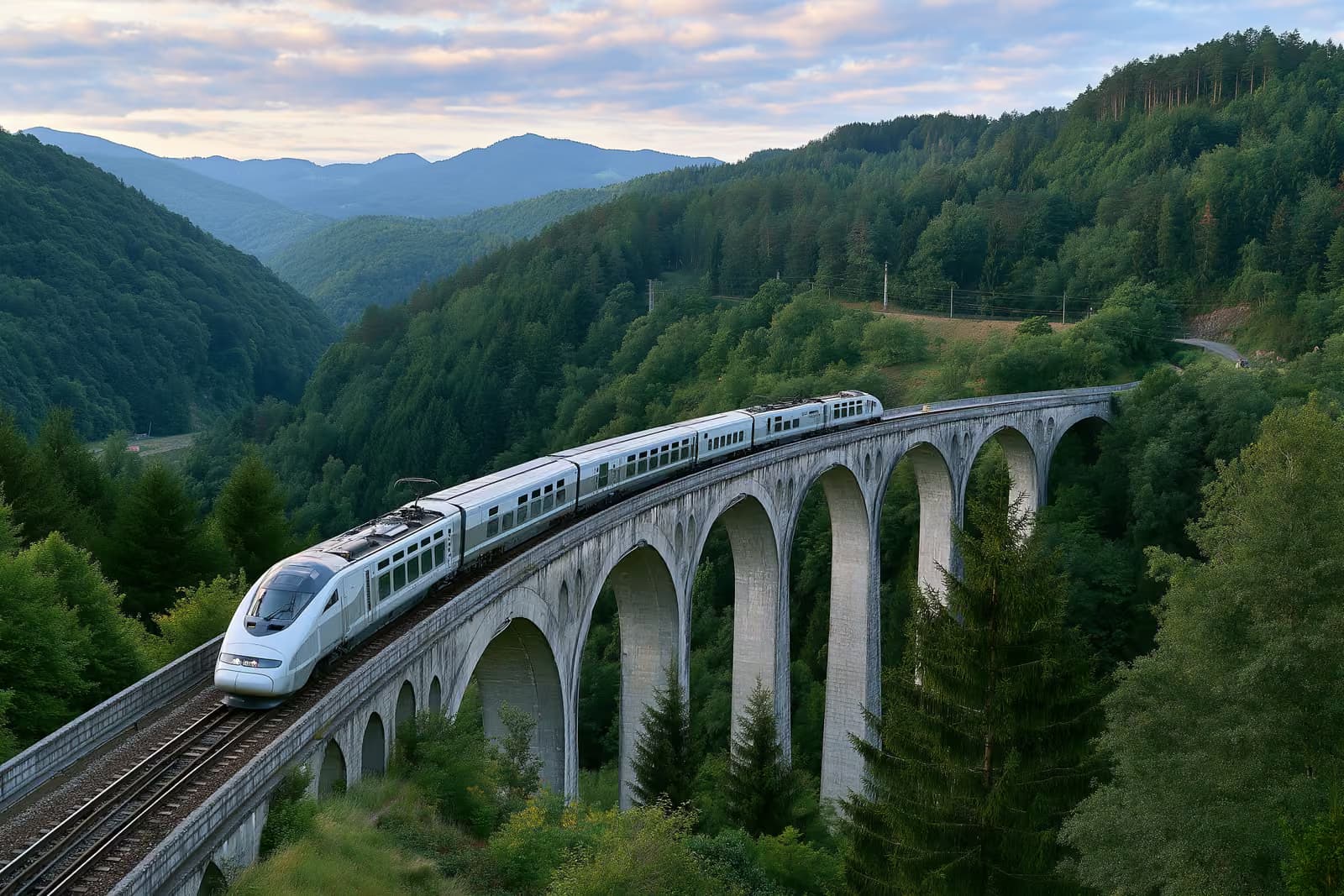
The backbone of domestic long-distance travel is Deutsche Bahn (DB), the national railway. Its Fernverkehr fleet has three names worth knowing. The ICE (InterCity Express) is the high-speed flagship, reaching up to 300 km/h and connecting the big hubs - Berlin, Hamburg, München, Frankfurt, Köln, Stuttgart - often faster, city-centre to city-centre, than flying once you count airport time. The IC (InterCity) is the slightly slower conventional long-distance train that also serves mid-sized cities the ICE skips. The EC (EuroCity) is the same idea but crosses a border, linking Germany to Austria, Switzerland, Italy, the Czech Republic and beyond. For travel inside Germany you will mostly ride ICE and IC.
It is worth being precise about what these trains are not. They are not covered by the Deutschlandticket. That flat monthly pass is Nahverkehr-only, valid on regional and local services but explicitly not on ICE, IC, EC or the private long-distance operator FlixTrain. If you own a Deutschlandticket, it will carry you to and from the station and across your region for free, but the moment you board an ICE you need a separate long-distance ticket. Many newcomers learn this the hard way when a conductor checks tickets on a fast train. So think of the two systems as complementary: the Deutschlandticket for the slow local legs, a DB long-distance fare for the fast intercity leg. For anything purely local or regional, see our Deutschlandticket chapter and stop reading here.
Long-distance trains are comfortable and, by international standards, dense: on the busiest corridors an ICE leaves every hour or better, so you rarely need to plan your life around a single departure. First class (1. Klasse) buys you wider seats, more space and sometimes at-seat service, but second class (2. Klasse) is perfectly pleasant and is what the money-saving advice below assumes. Punctuality is a national talking point rather than a national strength - long-distance trains are late often enough that the refund rules further down are not a footnote but a real part of the value equation.
Making Sense of DB Fares: Flexpreis, Sparpreis and Super Sparpreis
The fare system is what confuses almost everyone, because the same ICE seat can cost wildly different amounts depending on the ticket type. There are three to understand. The Flexpreis (flexible fare) is the fully flexible ticket: it is valid on any train on your booked route on the chosen day, you do not have to catch a specific departure, and it is fully refundable. It is also the most expensive, and it is what you pay if you rock up and buy at the machine without thinking. The Sparpreis (saver fare) is cheaper but train-bound: it is tied to the specific train you booked, so if you miss it you have lost the reservation, and refunds are limited (before the first day of validity you can cancel for a 19 EUR fee, and there is no refund once your travel day has begun). The Super Sparpreis (super saver fare) is the cheapest of all, even more strictly train-bound, and effectively non-refundable except for the free cancellation DB allows within three hours of booking.
The prices tell the story. As a standing offer the Super Sparpreis starts at 17,90 EUR for a second-class long-distance journey within Germany, the Sparpreis from around 21,99 EUR, while a Flexpreis on a long corridor can run to well over 100 EUR. During promotional weekends DB releases last-minute Super Sparpreis tickets from as little as 6,99 EUR, though those are limited windows rather than the everyday price. The catch is that the cheap fares are quota-limited: each train has only so many Sparpreis and Super Sparpreis seats, and once they sell out the price steps up towards the Flexpreis. Tickets are released roughly six months ahead, so the reliable way to travel cheaply is to book early, the moment your date is fixed. Buying an ICE ticket the day before you travel usually means paying the Flexpreis, which is why last-minute long-distance travel in Germany feels so expensive.
The practical rule follows from all this. If your plans are firm, book a Super Sparpreis as far ahead as you can and accept that you are committing to that train. If your plans might shift, a Sparpreis buys a little wiggle room for a modest fee, and a Flexpreis buys total freedom at a premium - genuinely worth it only if you truly cannot predict which train you will catch. All three fares can be bought on bahn.de or in the DB Navigator app, and the app is where you will also find your ticket, your platform and any delay information on the day.
The BahnCard: Doing the Honest Math
If you take more than a couple of long-distance trips a year, a BahnCard (a discount card for DB fares) usually pays for itself, but only if you do the arithmetic honestly. There are three main tiers. The BahnCard 25 gives you 25 percent off almost every fare, including Sparpreis and Super Sparpreis tickets, and costs from about 62,90 EUR a year in second class - so it starts saving you money after roughly 250 EUR of travel. The BahnCard 50 gives 50 percent off flexible fares and 25 percent off saver fares, and costs several times more (around 199 to 244 EUR in second class), which makes sense for frequent travellers who often buy the pricier flexible tickets. The BahnCard 100 is an all-you-can-ride annual pass for the entire DB network - around 4.899 EUR in second class, with the Deutschlandticket bundled in - and only makes sense if you effectively live on trains.
Here is the trap that catches thousands of people every year: the BahnCard renews automatically. It is a subscription, not a one-off purchase. Unless you cancel, DB bills you for another full year at the standard price when your card expires. The cancellation notice period was shortened in 2024 and now stands at four weeks before the end of the contract year (it used to be six), and the cancellation must be made in text form - through your DB account, the app or in writing. If you forget, you are locked into another paid year. The lesson is simple: the day you buy a BahnCard, set a reminder for about two months before it expires so you have time to decide and cancel. Consumer advice centres (Verbraucherzentrale) field a steady stream of complaints from people billed for a card they no longer wanted.
Two softer options exist for testing the water. DB periodically offers a Probe-BahnCard or “My BahnCard” - a shorter-term trial version at a lower price, sometimes limited to younger travellers - which is a low-risk way to see whether the discount matches your travel before committing to a full year. But the same auto-renewal logic applies, so read the terms and diarise the cancellation date. Because the BahnCard 25 discount stacks on top of Sparpreis and Super Sparpreis fares, a single card can turn an already cheap 17,90 EUR saver ticket into something closer to 13 EUR, which is where the card quietly earns its keep for ordinary travellers rather than commuters. Verify current prices on bahn.de before you buy, since DB adjusts them from time to time.
Regional Tickets and Group Travel
Not every long trip needs a fast train. Germany has a family of regional day tickets that let you cross real distances slowly and very cheaply, and they come into their own for groups and for unhurried weekend travel. Because they are valid only on Nahverkehr - regional RE and RB trains, plus local buses and trams in many areas - they pair naturally with, or substitute for, the Deutschlandticket. They do not work on ICE, IC or EC, so they are the opposite trade-off to the fast fares above: you swap speed for a low, predictable price.
The nationwide option is the Quer-durchs-Land-Ticket (“across the country” ticket). It costs 54 EUR for the first traveller plus 5 EUR for each additional person, up to five people, and gives you a full day of unlimited regional-train travel anywhere in Germany. On weekdays it is valid from 09:00, and all day at weekends and on public holidays. For a small group heading, say, from Hannover to the coast, it can undercut five separate long-distance tickets dramatically, as long as you accept the slower connections and the changes of train. Then there are the Länder-Tickets, one for each Bundesland - the Bayern-Ticket for Bavaria is the best known. A typical Länder-Ticket starts from around 25 EUR; the Bayern-Ticket, for example, is about 29 EUR for one person plus roughly 9 EUR for each additional traveller, again up to five, with children often riding free. Within its state a Länder-Ticket usually covers regional trains, U-Bahn, S-Bahn, trams and local buses for the day - a genuinely good deal for a group day trip.
All of these tickets still exist and are current in 2026, and they are worth checking before you default to an expensive last-minute ICE fare. The comparison to make is simple: if you are travelling alone and time matters, a booked-ahead Super Sparpreis on a fast train usually wins; if you are two, three or more people, or you are happy to make a day of the journey, a group regional ticket can be the cheapest way to move a whole party. For everyday city travel at your destination, and for whether the Deutschlandticket already covers what you need, see our Deutschlandticket and public transportation system chapters.
The Cheaper Alternatives: FlixTrain, FlixBus and Carpooling
Deutsche Bahn is not the only way to cross Germany, and its competitors are often cheaper. FlixTrain is a private long-distance rail operator running on the same tracks as DB but at lower prices. In 2026 it runs four lines serving more than fifty cities, from Hamburg in the north to Basel in the south and from Aachen in the west to Dresden in the east, with tickets from 3,99 EUR including a seat reservation. It is slower and less frequent than the ICE network, and it does not serve every route, but on the corridors it does cover - Berlin to Köln, Hamburg to München and similar - it can be a fraction of a walk-up DB fare. Note that neither your Deutschlandticket nor a BahnCard applies to FlixTrain; it is a separate company with its own tickets.
For places the trains do not reach cheaply, there is FlixBus, the dominant intercity coach network. Long-distance buses are the slowest option and the least comfortable on a long haul, but they are frequently the cheapest, they reach many smaller towns that have poor rail links, and they run through the night. Combining a FlixTrain leg with a FlixBus leg can stitch together a surprisingly dense and cheap national network. The third alternative is Mitfahrgelegenheit (a shared car ride), organised today mainly through BlaBlaCar: you pay a driver a share of their fuel and toll costs to ride along on a trip they were making anyway. It is cheap, sociable and flexible on timing, and it fills gaps where trains and buses are sparse. If you want to sanity-check whether driving yourself would actually be cheaper than the train for a given trip, the free Spritkosten-Rechner (fuel-cost calculator) on Werkzeu.ge - the browser tool platform built by Cryon UG, the company behind WeLiveIn.de - will estimate the petrol cost of a route so you can compare it against a rail fare. It is a helper, not gospel, and it is in beta; see current tool availability at werkzeu.ge/en/pricing.
This chapter stops at using someone else’s vehicle. If you are thinking about renting a car for a road trip, or joining a station-based car-sharing scheme for the driving itself, that is covered in our chapter on car sharing and rentals, and the rules of the road - licences, the Autobahn, tolls and insurance - live in our chapter on driving in Germany. The honest summary for a single traveller is that a booked-ahead train usually beats driving on cost once you count fuel, wear and parking, while a carful of people can tip the maths the other way.
Do Domestic Flights Still Make Sense?
For travel within Germany the answer is usually no. The country is compact, the fast trains are quick city-centre to city-centre, and the airlines have been retreating from the domestic market for years. Lufthansa and Eurowings have cut more than twenty purely domestic routes since 2020, and Lufthansa has begun replacing short feeder flights with Lufthansa Express Rail - reserved seats on DB trains sold as part of a flight booking - rather than flying them. The Frankfurt to Stuttgart flight, for instance, has given way to frequent Express Rail connections. Once you add the trip to and from the airport, security queues and boarding time, a flight from Berlin to München rarely beats the ICE door to door, and it is worse for the climate. A domestic flight can still make sense if it is the cheap first leg of a longer international journey with a single ticket and checked baggage, but as a way of simply getting across Germany it is usually the wrong tool.
If you do fly and things go wrong, you have rights worth money. Under EU air passenger rules a cancelled flight or a long delay can entitle you to a fixed cash payout, separate from any refund. Working out whether a specific delay qualifies, and for how much, is fiddly, which is exactly what the free Fluggastrechte-Rechner (air passenger rights calculator) on Werkzeu.ge is for: you enter the flight details and it estimates your entitlement so you know whether it is worth pursuing. It sits in the platform’s Alltagsverwaltung (everyday administration) category, it is free to use, and like everything on the site it prepares and informs but never files the claim for you - and it is not legal advice. The rail equivalent, which is far more relevant for domestic travel, comes next.
Night Trains: The ÖBB Nightjet
Overnight rail is having a quiet revival, and it can be a smart way to cover a long domestic or cross-border distance while you sleep - you save a night’s hotel and arrive in the morning. Deutsche Bahn left the classic night-train business years ago, so the sleeper market is now led by the Austrian railway ÖBB and its Nightjet brand. Nightjet trains run through Germany on routes such as Hamburg and Berlin down towards München, Austria, Switzerland and Italy, offering three levels of comfort: an ordinary seat (the cheapest, from around 29 EUR), a Liegewagen (couchette, a shared compartment with simple berths) and a proper Schlafwagen (sleeping car, with beds and sometimes a private washbasin or shower). Booking works much like DB’s saver fares - reserve early for the low prices, since the cheap allocations sell out.
For a purely domestic overnight leg your choices are more limited than for international routes, but they exist. FlixTrain also runs some late and overnight connections within Germany, such as Hamburg to München, though only in ordinary seating - there are no berths, so you doze in your seat rather than lie down. Treat night trains as a niche but genuine option: excellent for a long haul where the alternative is a full travel day or an early flight, less compelling for the short hops where a daytime ICE is quicker and cheaper. As always, the sleeper and couchette allocations are quota-limited, so the earlier you book, the better the price and the better your chance of an actual bed.
Claiming Your Money Back: Fahrgastrechte for Long-Distance Trains
German long-distance trains are late often enough that knowing your Fahrgastrechte (passenger rights) is real money, not trivia. Under EU Regulation 2021/782, which governs rail passenger rights across the Union, you are entitled to compensation when your long-distance train arrives late at your destination. If you reach your destination 60 minutes or more behind schedule, you get back 25 percent of the fare you paid for that trip. If the delay is 120 minutes or more, that rises to 50 percent. This applies to ICE, IC and EC journeys, and it is your money regardless of what caused the delay. The one practical floor is that payouts below 4 EUR are not made, so a cheap saver ticket on a short delay may fall under the threshold, but on a normal long-distance fare the sums are worth claiming.
The process is straightforward and most travellers never bother, which is precisely why so much compensation goes unclaimed. You fill in the Fahrgastrechte-Formular (passenger rights form). You can get it and submit it in three ways: hand a stamped paper form in at a DB ticket counter, post it, or - simplest - file the claim online or in the DB Navigator app, where a delayed journey can often be submitted with a couple of taps. Keep your ticket and note the actual arrival time; the app usually records the delay for you. You have up to twelve months from the journey to claim, and you can normally choose between a voucher and a cash payment. If DB rejects a claim you believe is valid, you can escalate for free to the söp (Schlichtungsstelle für den öffentlichen Personenverkehr), the independent arbitration body for public transport, which reviews disputes and often gets stuck claims paid.
One boundary to keep clear: these thresholds are the Fernverkehr rules. Local and regional Nahverkehr services run under a related but separate compensation and Mobilitätsgarantie regime, and that side is covered in our public transportation system chapter. For the fast trains this chapter is about, remember the two numbers - 25 percent from an hour late, 50 percent from two hours - and actually file the form. None of this is legal advice, but the rules themselves are clear and the money is genuinely yours to claim.
Practical Details That Save Time and Money
A few small habits make long-distance travel smoother. Seat reservations (Sitzplatzreservierung) are optional on ICE and IC trains - your ticket is valid whether or not you reserve - but on busy corridors, on Friday and Sunday evenings, around public holidays and during school breaks, a reserved seat for a few extra euros is the difference between a relaxed journey and standing by the luggage rack for three hours. On a quiet Tuesday you can safely skip it. The DB Navigator app is the tool that ties everything together: you buy and store tickets in it, it shows your platform and any last-minute changes, it flags delays and missed connections, and it is where you file a Fahrgastrechte claim afterwards. Download it before your first trip and let it hold your tickets so you are not hunting for a printout at the barrier.
Two features quietly add value. Many Sparpreis and BahnCard fares include a City-Ticket, which lets you use local public transport at your destination to get from the main station to your final address without buying a separate Nahverkehr ticket. It is included automatically when your journey qualifies - the start or destination is one of roughly 130 participating cities and the fare covers it - and it is valid for the local leg to and from the station on your travel day. It is easy to overlook, so check your ticket details before you buy a separate local ticket you may not need. On luggage, German long-distance trains have no checked-baggage system and no strict weight limits: you carry your bags on with you and stow them on the overhead racks or in the larger spaces at the carriage ends, which is liberating but means you should not travel with more than you can lift and mind yourself.
If you travel with a bicycle, long-distance trains need planning. Bikes are allowed on most ICE and IC services but require a separate bike ticket and, on the ICE, a compulsory bike-space reservation - the spaces are few and sell out, so book them with your own ticket rather than on the day. Folding bikes stowed like normal luggage are the easy exception and generally travel free. Finally, if a trip involves anything valuable or irreplaceable, or takes you outside Germany, it is worth checking that you are covered; our chapter on insurance essentials explains the travel and liability policies that most residents already hold or can add cheaply.
Finding the Cheapest Fare: A Booking Strategy
Beyond knowing the fare types, a little booking technique shaves real money off long-distance travel. Start every search with the Bestpreissuche (best-price search) on bahn.de or in the DB Navigator: instead of a fixed departure it shows the cheapest available fare across the whole day, so you can see at a glance that a train two hours earlier or later costs half as much. Midday, mid-week and late-evening departures are almost always cheaper than the Friday-afternoon and Sunday-evening peaks when everyone travels. If your dates are even slightly flexible, flex them - the price difference between a Tuesday and a Friday can be larger than the difference between two ticket types.
A few structural discounts are easy to miss. Children up to 14 travel free on long-distance trains when accompanied by a parent or grandparent, as long as they are listed on the ticket, which makes family travel far cheaper than it first looks. Travellers under 27 often get their own reduced fares and a cheaper BahnCard. And because Sparpreis fares are priced per segment, a journey with a change of train is sometimes cheaper booked as two separate saver tickets than as one through-fare - so-called split-ticketing. This is legitimate as long as the train actually stops where you split, and it is more effort than most trips are worth, but on an expensive corridor it can be a meaningful saving. The overarching rule is unchanged: the cheap quotas are limited and released about six months out, so the earliest booker wins.
Slow Travel and Scenic Routes on a Budget
Some of the best value in German travel comes from deliberately choosing the slow train, because the journey becomes part of the trip rather than dead time to be minimised. The regional network reaches valleys and coastlines the fast trains bypass, and with a Quer-durchs-Land-Ticket or a Länder-Ticket you can wander for a day for the price of a couple of ICE seats. The Moselle valley, with its terraced vineyards and riverside villages, the Rhine gorge between Mainz and Koblenz with its castles and the Loreley rock, the Black Forest, and the Harz mountains with their narrow-gauge steam lines are all reachable on regional services and reward an unhurried approach.
This kind of travel pairs naturally with a cheap weekend away. Outside the big-city luxury hotels, small-town Gasthäuser (family-run guesthouses), Pensionen and holiday flats (Ferienwohnungen) are inexpensive, and youth hostels are open to adults across the country. Booking a bed near a regional station lets you leave the car at home entirely and lean on the day tickets above. The point is not that slow travel is always the answer - when time is short, pay for the fast train - but that Germany makes the leisurely, low-cost option genuinely pleasant, and a scenic regional route on a group day ticket is one of the best-value ways to see the country.
When Your Connection Fails: The Train-Binding Rule
The strict train-binding of a Sparpreis sounds frightening until you learn its main exception, which every long-distance traveller should know. Zugbindung (the rule that ties a saver ticket to a specific train) is automatically lifted the moment your booked train is delayed or cancelled, or when a delay of 20 minutes or more means you would miss a connection on your route. Once that happens you may simply take the next suitable DB long-distance train - even an earlier one, or a higher category such as an ICE in place of an IC - at no extra cost. You do not have to buy a new ticket, and inside Germany you do not need any special paperwork, because the delay is recorded in the DB Navigator and a counter can print a delay certificate if you want one.
This changes how much risk a Sparpreis really carries. If the railway causes you to miss your train, the binding evaporates and you are effectively flexible for the rest of the day - you can even continue your journey later, up to a year after the original date, if that suits you better. The only situation the exception does not cover is missing your train through your own fault, such as arriving late at the station; then the binding stands and you would need a new ticket. Combined with the delay compensation described above, this rule means a cheap booked-ahead fare is far less fragile than it first appears, which is another reason not to overpay for a Flexpreis you may not need.
On Board: What to Expect
Knowing what a long-distance train offers helps you travel comfortably without paying for extras you will not use. ICE and IC trains carry a Bordbistro or Bordrestaurant selling drinks, snacks and warm meals, though prices are what you would expect from a captive audience, so many regulars bring their own food and a refillable bottle. Most seats have a power socket, tray table and reading light, free WiFi is available on the ICE (variable in quality, and weakest in the tunnels and rural stretches), and the DB Navigator streams an onboard entertainment portal to your own device on many trains. Larger stations and the trains themselves are generally step-free and staffed for travellers with reduced mobility, though booking assistance in advance through DB’s mobility service is wise on quieter routes.
A little seat-choosing knowledge goes a long way. When you reserve, you can usually pick a Großraum (open saloon) or a compartment, a table seat or an airline-style seat, and a spot in the Ruhebereich (quiet zone, where phone calls and loud conversation are discouraged) or, if you are travelling with small children, the Familienbereich (family area near the small play zone). On a busy Friday these choices are the difference between a restful trip and a stressful one, and they cost the same modest reservation fee either way. None of this is essential to a cheap journey, but it is the kind of detail that turns a long ride across the country from something to endure into a genuinely relaxing few hours.
What to Do Next
Turn all of this into a short routine you can reuse for every trip. First, install the DB Navigator app and let it hold your tickets, show your platforms and record any delays - it is the single tool that ties booking, travelling and claiming together. Second, whenever a date is fixed, search early with the Bestpreissuche and grab a Super Sparpreis while the cheap quota lasts; the difference between booking six months out and booking the day before is often the difference between 18 EUR and 90 EUR. Third, do the BahnCard math against your realistic yearly travel, and if you buy one, set a calendar reminder about two months before it expires so the automatic renewal never bills you by surprise.
Then match the ticket to the trip. Travelling alone with time pressure, take a booked-ahead fast train. Travelling as a group or in no hurry, compare a Quer-durchs-Land-Ticket or a Länder-Ticket, and weigh FlixTrain, FlixBus or a BlaBlaCar carpool for the routes where they undercut the rails. When a long-distance train arrives an hour or more late, file the Fahrgastrechte form - it is your money, and most people never claim it. For everything local at either end of your journey, lean on the Deutschlandticket and the wider public transportation system; when a trip calls for a car, turn to car sharing and rentals and the rules in driving in Germany. Master these few habits and getting around Germany becomes both cheap and genuinely enjoyable.
Sources
The information in this chapter draws on the official sources and publications listed below, last reviewed in July 2026. It is general guidance for orientation, not individual legal, tax, or medical advice.