





 Turkish
 Italian
 Spanish
 Portuguese
 Romanian
 Albanian
 Lithuanian
 Latvian
 Bulgarian
 Greek
Greek Hungarian
 French
 Croatian
 Czech
Czech
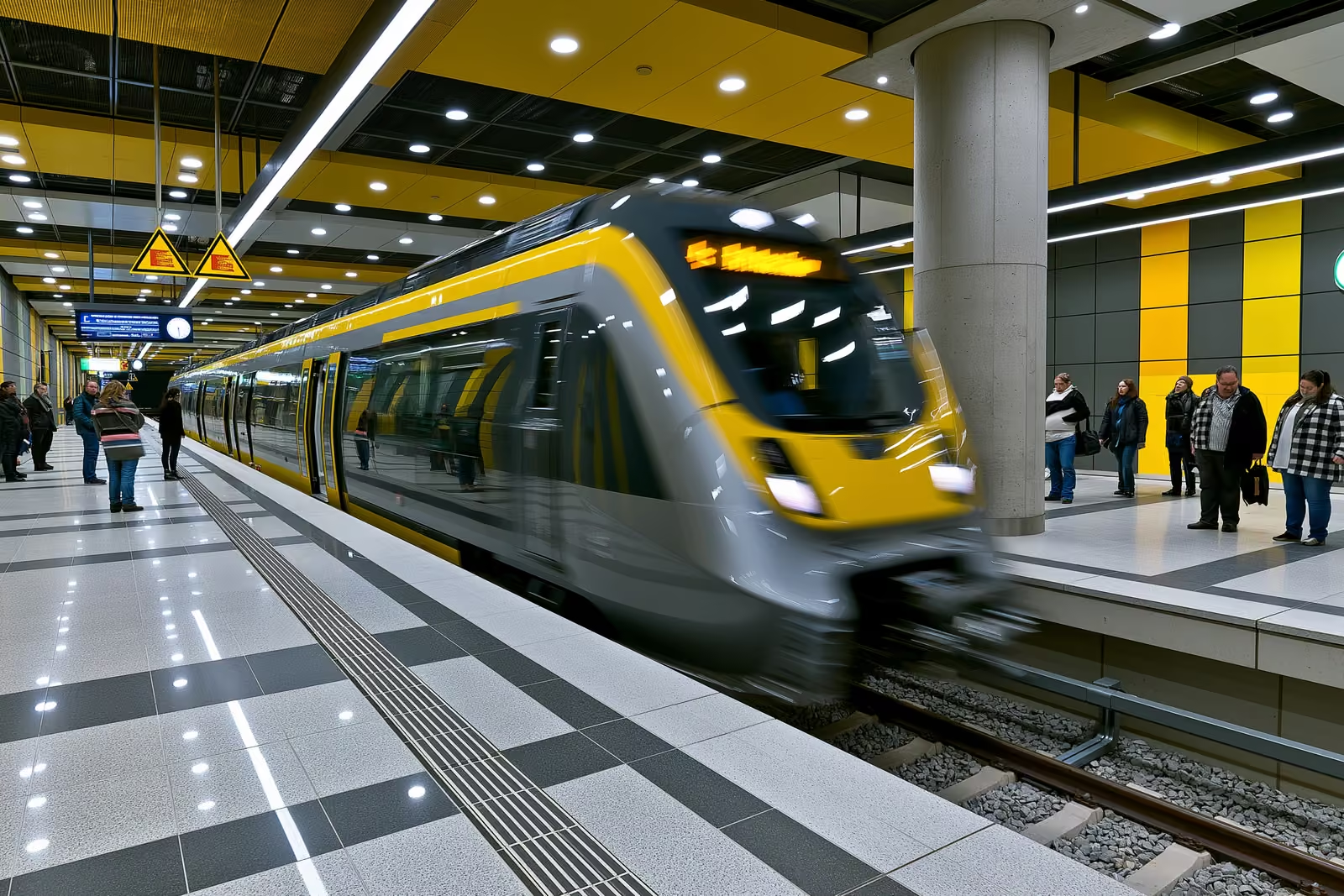
Germany’s public transportation system is one of the densest in the world, and once you understand how it is put together it can carry you through years of daily life here without a car. This chapter is the structural map. It spends less time on buying your first ticket – our companion chapter on the basics of public transportation covers that first ride step by step – and more on how the network is actually organised, why the same journey can be perfectly legal on one train and a criminal offence on the next, how reliable the system really is in 2026, and what you can claim when it lets you down. As the opening chapter of the Transport and Mobility section, it also points you onward to the more specialised chapters as each subject comes up.
How Germany Organises Local Transport
Germany has no single national transport authority, and that one fact explains most of what confuses newcomers. Under the Grundgesetz, the constitution, local public transport – Nahverkehr, the short-distance services you use every day – is the responsibility of the sixteen Länder, the federal states, which delegate it to regional and municipal bodies called Aufgabenträger, literally the bodies that carry the task. These bodies plan the routes, put them out to tender and pay operators to run them. The legal backbone is the Personenbeförderungsgesetz (PBefG), the passenger transport act, together with the Regionalisierungsgesetz, which channels federal money to the Länder so they can order regional rail. The upshot is that the bus outside your door, the tram two streets away and the suburban train to the airport may each be run by a different company under a different contract, all coordinated by your region rather than by Berlin.
Sitting on top of the operators is the institution the whole system turns on: the Verkehrsverbund, a regional tariff association. There are around sixty of them across the country. A Verkehrsverbund usually does not drive a single vehicle itself. Instead it pools every operator in a metropolitan region – the municipal U-Bahn company, the Deutsche Bahn subsidiary that runs the S-Bahn, the private firms that won the bus and regional-rail contracts – under one shared fare table. Berlin and Brandenburg share the VBB, Munich has the MVV, Hamburg the HVV, the Rhine-Main region around Frankfurt the RMV, the Rhine-Ruhr area the VRR, Stuttgart the VVS. You buy from the Verbund, not from the operator, and internalising that single shift is what makes everything else fall into place. When you move to a new city, the first thing to learn is not which company runs your line but which Verkehrsverbund you now live inside.
One Ticket, Every Operator, and Why It Dies at the Boundary
The reward for this arrangement is genuine and generous. Inside a Verkehrsverbund a single ticket covers every U-Bahn, S-Bahn, tram, city bus and, crucially, most regional trains, no matter which company operates the vehicle you are sitting in. Change from the underground to a bus to a tram in the course of one journey and you never buy a second ticket; you buy one ticket for the trip and it works across all of them until it expires. This is the deep logic of the German system, and it is why comparing it to a city where each operator sells its own separate fare is misleading. Here the operators compete for contracts behind the scenes, while the passenger sees one price list.
Each association then slices its territory into fare units, and the vocabulary shifts from place to place, which is where the confusion starts. Berlin uses concentric zones labelled A, B and C: zone A is the inner city, B runs out to the city boundary, and C reaches into Brandenburg and takes in Potsdam and BER airport – so a ticket priced AB will not carry you to the airport. Hamburg and Munich draw Ringe, rings, around a centre and charge by how many you cross. Much of the countryside is mapped into Waben, honeycomb cells, and the fare depends on the number of cells your route passes through. The names differ but the idea is identical: your price is a function of how far across the map you travel. The single most useful question on arrival in a new region is which zone or ring your home and your workplace fall into, because that decides your daily fare and which pass is worth buying.
The flip side of the association model is that a ticket dies the moment you leave the Verbund that sold it. A monthly pass bought in Cologne does nothing for you in Stuttgart. This is precisely the problem the Deutschlandticket was created to solve, and it is why that ticket has become the backbone of the whole fare system: a single nationwide subscription that ignores every zone, ring and cell boundary in the country. We cover it in full – price history, subscription rules, the Jobticket, the exceptions – in our dedicated chapter on the Deutschlandticket. For this chapter it is enough to hold one fact in mind: it is the one product that makes the sixty-association patchwork irrelevant for anyone who travels regularly, and for most residents it has quietly replaced the local monthly pass altogether.
The Same Track, Two Prices
Nothing costs newcomers more, in money and in legal trouble, than the trap in this section, so it is worth slowing down over. On a great many routes a regional train and a long-distance train run on the same rails, between the same two stations, sometimes only minutes apart – and only one of them is included in your local ticket or your Deutschlandticket. The platform display shows both. The price difference between them, and the consequence of boarding the wrong one, is enormous.
The dividing line is the category of service, not the destination. Regional services – the RB (Regionalbahn), which stops at every halt; the RE (Regional-Express), the same idea but skipping the small stations; and the IRE (Interregio-Express), a faster regional link – are Nahverkehr, and they are covered by your Verkehrsverbund fare and by the Deutschlandticket. Long-distance services – the IC (Intercity), the EC (Eurocity, an Intercity that crosses a border) and the ICE (Intercity-Express, the high-speed service) – are Fernverkehr, a completely separate commercial product with its own tickets, its own pricing and no connection whatsoever to your local pass. That two of them, an RE and an IC, may leave from neighbouring platforms bound for the same city changes nothing about the fare.
Board an ICE on your Deutschlandticket for a two-stop hop because it happened to arrive first, and you are travelling without a valid ticket even though you hold a pass and paid good money for it. This is not a misunderstanding the inspector will wave away; as the sections below explain, it is treated as fare evasion, with everything that follows. The habit that protects you is small: read the letters in front of the train number on the departure board before you step aboard. RB, RE and IRE mean your ticket works. IC, EC or ICE mean it does not, unless you are holding a separate long-distance ticket. The reverse is also worth knowing – your Verbund ticket usually covers regional trains inside the association’s area, so a forty-minute RE hop to a neighbouring town may already be included in the pass you own, and buying a separate ticket for it wastes money.
Knowing Your Vehicles
The vehicles stop being intimidating once the names stop blurring together. The U-Bahn (Untergrundbahn, underground railway) is the city metro, usually run by the municipal transport company and mostly below ground in the centre. The S-Bahn (Stadtschnellbahn, city rapid railway) is a suburban railway that reaches further out into the surrounding region and is, in most cities, operated by a Deutsche Bahn subsidiary rather than by the city – and yet the same Verbund ticket covers both, which is the entire point of the association. In the city centre the two behave almost identically; the practical difference is that the S-Bahn is the one that carries you out to the airport, the trade-fair grounds or the next town. Do not overthink which is which day to day: if your ticket is a Verbund ticket or a Deutschlandticket, both are yours to use.
The Straßenbahn, almost always shortened to Tram, runs on rails laid into the street and is the backbone of many mid-sized cities that never built a metro. Buses fill in everything the rails miss and are frequently the only service late at night or out in the villages. Above this local layer sit the regional trains already described, the stop-everywhere RB and the faster RE. After midnight the picture changes by city: larger places run a Nachtverkehr, a night service, of Nachtbus (night bus) lines and sometimes night trams, while Berlin and Hamburg keep parts of the U-Bahn and S-Bahn running straight through weekend nights. Night lines usually carry an N in front of the number and follow their own routes, which are not the daytime ones, so a night bus may stop where the day service never goes. Your ordinary ticket, the Deutschlandticket included, is valid on all of them at no extra charge. In rural areas the last connection can leave startlingly early and vanish entirely on Sundays, so the useful habit is to check the final departure of your line before you go out, not after.
The Reliability Reckoning
Germany’s trains have a reputation for punctuality that they no longer earn, and it is far better to know this before you plan a life around the last connection of the evening. Deutsche Bahn’s own figures for 2025 tell the story without embellishment: across long-distance services only 60.1 percent of trains were punctual, down from 62.5 percent the year before, while regional services managed 88.7 percent, itself down from 90.3 percent. And the word punctual is generous in these numbers – DB counts a train as on time if it is less than six minutes late, so a train five minutes behind schedule is officially a success. The lived experience, particularly on a regional line that shares congested track with long-distance and freight traffic, is more fragile than the old tourist-brochure image of German precision suggests.
There is a concrete reason it will stay fragile for years rather than months, and it is honest to say so. After decades of underinvestment, Deutsche Bahn is running a Generalsanierung, a general refurbishment, of its busiest corridors, known as the Hochleistungskorridore or high-performance corridors. Rather than patching a line during nights and weekends, DB closes an entire route for months at a time and rebuilds track, signalling and stations in a single pass. The pilot project, the Riedbahn between Frankfurt and Mannheim, was rebuilt in roughly five months and reopened in December 2024. Dozens of corridors are scheduled to follow; the programme was first meant to run to 2030, but DB InfraGO, the infrastructure arm, said in 2025 that it would stretch the schedule toward 2035. Every full closure diverts regional services onto replacement buses (Schienenersatzverkehr) and longer detours, so for the next several years a checked, live connection matters more than a printed timetable ever did. Plan with real-time data, and build a buffer into anything you genuinely cannot miss, such as a flight or a job interview.
Schwarzfahren, and Why It Is Criminal Law
This is the most important passage in the chapter for anyone whose right to remain in Germany could be touched by a criminal record. Almost all German local transport is an open system: no barriers, no gates, nobody checks a ticket as you board. This surprises people arriving from cities with turnstiles, and it leads a few of them to a costly conclusion. Enforcement comes instead from Kontrolleure, fare inspectors, who ride in plain clothes, block the doors at a stop and ask the whole carriage for tickets, and who can require you to identify yourself. If you cannot show a valid ticket you first owe an erhöhtes Beförderungsentgelt, an increased fare, of 60 euros. On buses and trams that figure comes from the standard terms of carriage (§9 VO-ABB); on the railway (§12 EVO) it is twice the normal fare but never less than 60 euros. The amount has stood at 60 euros since it rose from 40 in 2015.
The 60 euros is the smaller problem. Travelling without a valid ticket – Schwarzfahren in everyday German – is a criminal offence in Germany, not merely an administrative one. Section 265a of the Strafgesetzbuch (StGB), the criminal code, makes Erschleichen von Leistungen, obtaining a service by deception, punishable by up to a year in prison or a fine, and it names transport by a vehicle explicitly; even the attempt is punishable. In practice a single, first-time lapse over one 60-euro fare is usually settled by paying, and operators tend to report repeat offenders rather than a one-off case. But a conviction is a genuine criminal record, and a criminal record is a question you must answer on applications for naturalisation (Einbürgerung) and for residence permits. For a foreigner the real stakes are therefore far higher than the 60-euro figure implies, which is exactly why the casual attitude some locals take toward it is a bad model to copy.
This has been argued over for years, and it is worth being precise about where the law actually stands in 2026, because a great deal of what circulates online is out of date. Motions to decriminalise fare evasion and leave it to the civil 60-euro penalty were put to the Bundestag and rejected on 16 April 2026. The debate is real and may well return, but as of now §265a StGB applies in full and nothing has changed. The safe conclusion is the unglamorous one: always hold a valid ticket, keep it reachable rather than buried in a bag, and if you rely on a personal subscription such as the Deutschlandticket, make sure it is loaded and readable before an inspector reaches you, not after. None of this is legal advice; if you are ever charged, a lawyer is the correct next step rather than a guide.
What You Are Owed When Things Go Wrong
When a train is late your rights depend heavily on whether it was a long-distance or a local service, and the gap between the two catches people out. On the railway, passenger rights – Fahrgastrechte – are set by EU Regulation 2021/782 and are firm. Arrive at your destination 60 minutes or more late and you can claim 25 percent of the fare for that journey back; from 120 minutes late it rises to 50 percent. These rules cover regional trains, the RB, RE and IRE, as well as long-distance ones, which means a delayed RE is actually better protected than most other local trips. The detailed mechanics of claiming on long-distance travel – the forms, the thresholds, the interaction with a Sparpreis – belong to our chapter on domestic travel tips, which owns the Fernverkehr side of the network.
Local transport in the strict sense – the U-Bahn, the tram, the city bus – is much thinner ground, and this is the honest part most guides skip. The EU rail regulation does not reach it, and there is no statutory compensation when your underground train runs twenty minutes late. What partly fills the gap is voluntary: many Verkehrsverbünde operate a Mobilitätsgarantie, a mobility guarantee, that above a set delay – commonly 20 minutes off-peak – reimburses part of a taxi fare or an alternative journey, up to a modest cap, on terms the association writes itself. The thresholds and the sums differ from one Verbund to the next, so the truthful advice is to read your own association’s Mobilitätsgarantie rather than assume a nationwide rule exists. Where one applies, keep every receipt and claim within the stated deadline.
Behind both regimes stands an arbitration body worth knowing by name: the söp, the Schlichtungsstelle für den öffentlichen Personenverkehr, the independent conciliation body for public transport. If an operator refuses a claim you believe is valid, the söp will review it free of charge before you ever need a lawyer, and its remit spans rail, bus and coach. It is worth understanding that a transport contract runs on the same consumer-law foundations as everything else you sign in Germany: the terms of carriage, the Beförderungsbedingungen, are standard business terms subject to the same fairness controls, and your general cancellation and fairness rights sit in the same statutes. Our chapter on consumer protection laws sets that framework out in full, so this chapter does not repeat it.
Apps, the Handyticket and Check-in Systems
Two apps cover almost everything, and knowing which to reach for saves both money and mistakes. The DB Navigator, from Deutsche Bahn, plans and sells journeys nationwide and is the one to install first, especially for regional and long-distance trains and for anything that crosses a Verbund boundary. Alongside it, install your own Verkehrsverbund’s app – the BVG app in Berlin, MVGO in Munich, RMVgo in the Rhine-Main region, and so on. The honest rule of thumb is that for a purely local journey the Verbund app knows the local fares, the short-distance options and the zone quirks better than DB Navigator does, and it frequently sells a cheaper ticket for the very same trip. Google Maps is excellent for working out the route and the departure times, but buy the ticket in the operator’s or the association’s own app rather than through a third-party reseller, where the price is often higher and a refund harder.
A ticket bought in an app is a Handyticket, a mobile ticket, a QR code that is valid the moment you hold it, with nothing to stamp. That matters, because the older discipline of validating a paper ticket in an Entwerter – the little box on the platform that prints the time onto the ticket – still applies to some machine-bought paper tickets and reliably catches people out; the first-ride mechanics of that live in the companion basics chapter. The newer development worth watching is check-in and check-out ticketing, which is spreading quickly across the country. Instead of choosing a ticket in advance, you swipe to check in when you board and check out when you leave, and the system works out the correct fare afterwards, capped so that a day of trips never costs more than the day ticket and a month never more than the monthly ceiling – a Bestpreis, or best-price, guarantee. It runs as eezy across the Rhine-Ruhr and the wider North Rhine-Westphalia network, as MVVswipe in Munich, and as a check-in and be-out feature inside the RMV’s app, among others. For occasional and irregular travellers who can never be sure which ticket is cheapest, it removes the guesswork entirely.
The Small Print That Saves You Money
A handful of lesser-known ticket types quietly reward regular users. Most Verbünde sell a Kurzstrecke, a short-distance ticket, for very short hops – a fixed small number of stops, or a couple of kilometres – at a fraction of the single fare; if your trip is only three stops, ask for it rather than paying the full price out of habit. An Anschlussticket, a connecting ticket, tops up a ticket you already hold so that it reaches into a neighbouring zone, instead of forcing you to buy an entire new journey; this is exactly what you want when your zone pass or your Deutschlandticket runs out one zone short of your destination. And many S-Bahn networks sell a first-class carriage – quieter, and far less crowded at rush hour – for a small supplement on top of your normal fare or your Deutschlandticket, a detail most residents never realise exists.
Bringing things and companions along has its own quiet rules. A bicycle usually travels with you on the U-Bahn, S-Bahn and regional trains, but generally not for free: you need a Fahrradkarte, a bicycle ticket, it is not part of the Deutschlandticket, and many cities bar bikes during the morning rush hour. On long-distance ICE and IC services, bicycle spaces exist on some trains only and must be reserved well ahead. Our chapter on bicycle culture and routes covers the cycling side of all this properly. A small pet carried in a closed bag or box normally rides free; a larger dog usually needs a ticket, often the reduced child fare, and must be kept on a lead, with a muzzle where local rules require one.
Accessibility has improved unevenly, but it is taken seriously in law and, increasingly, in practice. Most U-Bahn and S-Bahn stations in larger cities now have lifts and level or ramped boarding, vehicles announce stops both audibly and visually, and Deutsche Bahn runs a Mobilitätsservice that arranges boarding assistance if you book it ahead. People with a Schwerbehindertenausweis, the official severe-disability card, carrying the right Merkzeichen, the marker codes, can travel free on local and regional transport with a valid token – an arrangement that works out far cheaper than any pass for those who qualify. The applications for the card and the token run through the Versorgungsamt, your regional pensions-and-benefits office, and are worth pursuing early if they apply to you or someone in your household.
Making the System Work for the Long Term
If you are new here, start with three concrete steps. Install the DB Navigator and your own Verkehrsverbund’s app. Find out which zone, ring or cell your home and your workplace sit in. Then decide honestly whether you are about to become a near-daily traveller, because that answer settles almost everything else: a regular traveller should compare the local monthly pass against the nationwide subscription and, in most German cities, will land on the Deutschlandticket, while an occasional traveller is usually better off with single tickets, a Kurzstrecke where it fits, or a check-in system that finds the best price automatically. If you commute, ask your employer whether a Jobticket exists, and if a disability card applies in your household, look into the token, because both can change the arithmetic dramatically.
Beyond that, the habits are small and quickly become automatic. Read the letters in front of the train number before you board, so an ICE never ends up on your regional ticket. Keep your ticket loaded and reachable, because inspectors board without warning and a criminal-code offence is a heavy price for a saved 60 euros. Check the last night connection before you go out rather than after. And plan with live data, not a printed schedule, while the Generalsanierung works its way across the network. From here the Transport and Mobility section goes deeper on each mode: our chapters on driving in Germany, car-sharing and rentals, taxi services and apps and pedestrian rights and rules each take one part of getting around, and if you have only just arrived, an expat’s first steps in Germany is the wider place to begin.
Sources
The information in this chapter draws on the official sources and publications listed below, last reviewed in July 2026. It is general guidance for orientation, not individual legal, tax, or medical advice.

