Eco-Friendly Shopping Options
27 min read
Eco-friendly shopping in Germany is less about willpower than about information. The country has plenty of green products, plenty of green shops and an enormous amount of green advertising, and the hard part is telling which of the three you are looking at. This chapter is about that skill: which labels on a German package are backed by a state authority, which are backed by an independent certification scheme, which are worth nothing at all, and where you can shop, refill and repair without paying a premium for a logo somebody awarded themselves.
The timing matters, because the rules are about to change. From 27 September 2026, a large part of the vague green language you currently see on German shelves becomes unlawful. That is the single most useful thing to know before you read another package, so this chapter starts there, then works through the label landscape, the greenwashing tells you can use unaided, the places worth shopping, and the trade-offs that eco-friendly shopping advice usually leaves out. Nothing here is legal advice.
What Changes on 27 September 2026
Directive (EU) 2024/825, known as the Empowering Consumers for the Green Transition directive, is the reason the shelves will start reading differently. It required every EU member state to adopt and publish national implementing measures by 27 March 2026, and to apply those measures from 27 September 2026. Both dates are worth remembering precisely, because they are different things: the first is the deadline for governments to pass the law, the second is the date from which businesses actually have to comply.
Germany met the first deadline. The Bundestag passed the transposition in December 2025, and it was promulgated as the Drittes Gesetz zur Änderung des Gesetzes gegen den unlauteren Wettbewerb, the Third Act amending the Act against Unfair Competition, published in the Bundesgesetzblatt on 19 February 2026 as BGBl. I 2026 Nr. 43. The Bundesgesetzblatt is the federal law gazette, and publication there is what makes a German law official. So the law already exists. What it does not yet do is bind anyone: the new obligations apply to businesses only from 27 September 2026. If you are reading this before that date, the green claims around you are still governed by the older, looser rules.
The substance is aimed squarely at the language this chapter is about. Generic environmental claims such as umweltfreundlich (environmentally friendly), klimafreundlich (climate friendly), grün (green) or nachhaltig (sustainable) will only be allowed where the trader can demonstrate a recognised excellent environmental performance for the product. A vague good intention will not be enough. Claims resting solely on Kompensation, meaning the purchase of carbon offsets rather than any actual reduction, will not be permitted at all. Claims about future environmental performance will require a detailed and realistic implementation plan with measurable, time-bound targets rather than an aspiration. And sustainability labels themselves will only be permitted where they are set by a public authority or based on a certification system with transparent access and independent monitoring.
That last point quietly does more work than the rest. A great many logos on German packaging today are simply drawn by the company selling the product, and from 27 September 2026 that practice is on the wrong side of the line. The rules sit inside the UWG, the Gesetz gegen den unlauteren Wettbewerb, which is Germany’s unfair-competition statute, and they are enforced through the mechanisms our chapter on consumer protection laws describes, including the Verbandsklage, the collective action brought by qualified consumer bodies. That chapter owns the enforcement procedure and is the right place to read how a claim is actually brought. What matters here is simply that greenwashing is a competition-law problem in Germany, and the people who bring the cases are consumer associations and competitors, not you.
The Court Got There First
You do not have to wait until September 2026 for the most common green claim to be legally risky, because the Bundesgerichtshof, Germany’s Federal Court of Justice and the highest court for civil matters, already dealt with it. In a judgment of 27 June 2024, case I ZR 98/23, brought against the confectionery manufacturer Katjes, the court ruled on advertising a product as klimaneutral, meaning climate neutral.
The court’s reasoning is useful to you as a shopper, because it names the exact ambiguity you should be alert to. Klimaneutral can mean two entirely different things. It can mean that the emissions from making the product were actually reduced, or it can mean that the emissions still happened and the company bought offsets to balance them on paper. Those are not remotely the same claim, and the court held that the term is ambiguous between them. Advertising with it is therefore misleading under § 5 UWG unless the advertisement itself explains which of the two is meant. Not a website somewhere. Not a QR code. The advertisement itself.
The court also confirmed that environmental advertising is held to strict requirements of accuracy, clarity and precision, on the reasoning that shoppers cannot verify these claims themselves and environmental concern is easy to exploit. Put the 2024 judgment and the September 2026 rules together and the direction is consistent: a green word without a stated mechanism behind it is becoming worthless in German law. Which means that when you see one, you are entitled to treat it as worthless too.
The Green Claims Directive Is Not Law, and May Never Be
You will find articles, and some quite confident retailer marketing, referring to the Green Claims Directive as though it were a settled part of European law. It is not, and this is worth stating plainly because it is one of the most commonly misreported points in this area.
The Green Claims Directive was a separate Commission proposal that would have required companies to substantiate and independently verify environmental claims before making them, going considerably further than the directive discussed above. On 20 June 2025 the Commission announced its intention to withdraw the proposal, and the third round of trilogue negotiations, scheduled for 23 June 2025, was cancelled. The European Parliament’s own legislative tracker currently records its status as blocked and pending withdrawal. It has not been formally withdrawn, because the withdrawal has not been published in the Official Journal, and the 2026 Commission work programme still lists it as pending, so it exists in a strange half-state.
What that means for you is straightforward. Do not expect the detailed pre-verification regime that was promised for green claims. The rules that will actually govern German shelves from 27 September 2026 are the ones described above, which ban the worst language but demand less substantiation and verification than the Green Claims Directive would have required. The gap is real, and it is a good reason to keep reading labels yourself rather than assuming the regulator has already done it for you.
Who Issues the Label Is the Whole Game
Once you know one thing about German eco-labels, everything else falls into place: the question is never what the logo says, it is who awarded it and who checks. There are four broad answers, and they are not equally good. A label can be issued by the state, meaning a public authority sets the criteria and an independent body certifies against them. It can be an EU label, mandatory in a defined area and guaranteeing a legal minimum. It can be issued by a private association or standards body with independent auditing, which can be stricter than the state minimum. Or it can be drawn by the company selling the product, which guarantees nothing whatsoever.
Most shoppers rank labels by how green they look. That is exactly backwards, because the self-awarded ones are the prettiest by design: nobody constrains the graphics of a logo they invented. Rank by issuer instead and the shelf becomes readable in seconds. The rest of this section works through the labels you will actually encounter in Germany, in roughly that order of trustworthiness.
Blauer Engel: The Strictest Label on the Shelf
The Blauer Engel, the Blue Angel, is the most demanding environmental label you will routinely see in Germany, and it is a genuine state label. It was introduced in 1978, which makes it the first environmental label anywhere in the world, and it now covers more than 70,000 products and services from more than 1,800 companies across roughly 110 product groups.
Its governance is the reason it is worth trusting, and it is worth understanding because it is the template against which every other label should be judged. The label is owned by the Bundesumweltministerium, the federal environment ministry. The Umweltbundesamt, the Federal Environment Agency and Germany’s central environmental authority, develops the award criteria and reviews them against the current state of technology. The decisions are taken by the Jury Umweltzeichen, an independent fifteen-member body drawn from environmental and consumer organisations, trade unions, industry, retail, municipalities, science, media, churches and the Länder, so no single interest controls it. RAL gGmbH acts as the independent certifier, checking applications and contracting with companies. Four separate organisations, none of which is the company selling you the product.
The practical consequence is that the Blauer Engel is comparative rather than absolute: it goes to products that are substantially better than the others in the same category, and the bar is raised as the category improves, so a product cannot earn it once and coast. You will find it on paper, cleaning products, paints and varnishes, electronics, furniture and a long list of services. If you want one rule for hard goods and household products, this is it. Where a Blauer Engel exists for a category, it is a stronger signal than anything else in that aisle.
Reading the Bio Labels
Food works differently, because Bio and Öko are legally protected terms in the EU. Any pre-packaged organic food produced in the EU must carry the EU-Bio-Logo, the green rectangle with the leaf outlined in stars. Mandatory is the key word. The logo is not a distinction a producer earns by going above and beyond; it is the baseline that certifies the legal minimum for organic production has been met. That is a real and audited standard, and it is also a floor rather than a ceiling.
Underneath the logo you will find a code in the format DE-ÖKO-001. That is not a decoration. It identifies the control body that inspected the operation: the member-state code, then bio or öko, then the reference number of the specific Kontrollstelle responsible. If a product claims to be organic and there is no code, be suspicious. You will also see a hexagonal German Bio-Siegel on some packaging. Its requirements are essentially comparable to the EU logo, and it is voluntary; it survives mainly because German shoppers recognise it, and it is often printed alongside the EU logo rather than instead of it.
The Anbauverbände, the organic farming associations, sit above that baseline, and this is where the difference is worth paying for. Bioland, Naturland and Demeter each run their own standards that go beyond the EU regulation, and the gaps are concrete rather than rhetorical. The EU organic regulation permits a farm to convert only part of its land to organic production and keep farming the rest conventionally, an arrangement called Teilumstellung. The associations require Gesamtbetriebsumstellung, conversion of the entire farm, which removes the awkward situation of one operation running both systems side by side. On additives, the EU permits 53 in organic food, while Bioland and Naturland permit 22 each, and Demeter between 13 and 21 depending on how you count. On livestock density, the EU regulation allows 230 laying hens per hectare against 140 for the associations, and the associations cap flock sizes where the EU does not: Demeter at 3,000 birds, Bioland at 6,000, Naturland at 12,000.
Demeter additionally follows biodynamic principles, which include practices derived from anthroposophy that have no scientific basis and are not the reason the standard is strict. The strictness is real and comes from the rules above; the philosophy is a separate matter and you can take or leave it. So the honest hierarchy for food is: EU-Bio-Logo means genuinely certified to a legal minimum, and a Verband label on top of it means measurably more than that minimum.
The Discounter Bio Question
This is where a lot of eco-shopping advice quietly misleads people, so it is worth being direct. The Bio own-brands at the discounters are real. GutBio at Aldi Nord, Bio Organic at Lidl, BioBio at Netto and Naturgut at Penny are certified to the EU organic standard, the same legally audited baseline as the organic products in an expensive shop. Cheap Bio is not fake Bio. A product carrying the EU-Bio-Logo at a discounter has met the same legal minimum as a product carrying it anywhere else, and in comparative tests own-brand organic products regularly perform as well as branded ones.
What you are usually not getting at a discounter is the Verband tier. Bioland, Naturland and Demeter labels are rare on discounter shelves, with Lidl’s Bioland dairy range, carried since late 2018, as the notable exception. So the accurate way to think about the price difference is not certified against uncertified, but baseline against association standard, plus whatever you attach to the shop itself, the sourcing relationships and the range on offer. If your budget is the binding constraint on how you shop, buying EU-Bio at a discounter is a legitimate choice and not a compromise you need to feel apologetic about. Anyone who tells you otherwise is selling something.
The Logos That Do Not Mean What You Think
Two very familiar marks on German packaging are routinely misread, and one of them is the single most successful piece of accidental misdirection in German retail.
The Grüner Punkt, the Green Dot, is not an environmental label at all. It does not mean the packaging is recycled, recyclable, environmentally friendly, or anything else about the product. It means that a licence fee was paid to a dual system for that packaging. That is the entire content of the claim. It says nothing about recycled content, nothing about whether the material can actually be sorted and reprocessed, and nothing about the environmental quality of what is inside. It is a mark from the producer’s side of the ledger, not a sorting instruction and not a quality signal.
It gets better. Printing the Grüner Punkt has not been compulsory since 1 January 2009. Producers must finance packaging collection through a dual system under the Verpackungsgesetz, the packaging act, but the logo itself is a trademark belonging to one particular company, and licensing obligations are met by contracting with any of several competing systems. Many companies still print it out of habit or under legacy licence agreements. So its presence tells you very little and its absence tells you almost nothing. If you have been using it as a green signal, stop; a great many shoppers have been doing exactly that for thirty years, which is precisely why it is worth naming.
The Nutri-Score is the other one, and the misreading here is different. The Nutri-Score is a real, well-founded label with independent scientific grounding, and it is not an environmental label. It rates nutrition only, on the basis of energy, sugar, fat, salt, fibre and protein, and it says nothing whatever about environmental impact, farming method or packaging. In Germany its use is voluntary and free for companies; the trademark is held by Santé publique France, the French public health agency, and companies register with it directly. An updated algorithm applies to products carrying the label from 2026, which separates healthier from less healthy products more sharply than the original version did. It is genuinely useful for the question it answers. It simply is not answering this chapter’s question, and a dark green A on a package is not an environmental statement.
Fairtrade and GOTS: People as Well as Plants
Two more labels are worth knowing because they cover ground the environmental labels do not. Fairtrade is primarily about trading terms rather than the environment: a minimum price, a premium paid to producer organisations, and conditions of trade. Its standards are set by Fairtrade International, a non-governmental organisation, with TransFair e.V. as the national organisation in Germany, and auditing is carried out by FLOCERT, which has operated as an independent certification body since 2003. The separation between the body that writes the standard and the body that audits against it is exactly what you should look for, and it is present here. Fairtrade does carry environmental requirements, but if your concern is carbon or pesticides specifically, this is not the label that answers it, and many Fairtrade products carry an organic certification alongside for that reason.
GOTS, the Global Organic Textile Standard, is the one to look for on clothing, and it is an industry and NGO standard rather than a state label. It comes in two grades, and the difference matters: the higher grade requires at least 95 percent certified organic natural fibres, while the more common grade requires at least 70 percent and is labelled as made with organic materials. GOTS also covers the processing chain rather than just the raw fibre, which is what makes it useful. It requires compliance with International Labour Organization minimum standards, and since version 6.0 requires facilities to document the gap between wages actually paid and a living wage and commit to closing it. It bans a list of chemicals including toxic heavy metals, formaldehyde and GMOs, and requires wastewater treatment at processing facilities. Compliance is verified through annual on-site inspections by accredited certification bodies, announced and unannounced. For textiles, IVN Best is stricter still, requiring 100 percent natural fibres from fully organic cultivation, though you will find it in far fewer places.
Greenwashing Tells You Can Use Without Looking Anything Up
You will not have a certification database open in the aisle, so it helps to have a short list of patterns that reliably indicate a claim is doing less than it appears. Each of these can be spotted from the package alone, in a few seconds.
The first is klimaneutral or a similar climate claim with no mechanism stated. After the 2024 judgment described above, an advertiser who means it has every reason to say which they mean, so silence is informative. If the package does not tell you whether emissions were reduced or merely offset, assume offset. The second is a percentage with the words bis zu, meaning up to. Bis zu 50% recycelt is compatible with two percent recycled content, because up to is a ceiling and not a floor, and a company with an actual figure prints the actual figure. The third is a logo you cannot attribute to anyone. If you cannot name the organisation behind a mark, and there is no certification number, no scheme name and no issuer anywhere on the package, it is almost certainly self-awarded. From 27 September 2026 that construction becomes unlawful, but plenty of it is still in circulation now.
The fourth is a scheme-free sourcing claim: aus nachhaltigem Anbau, from sustainable cultivation, with no scheme named, no certifier and no criteria. Sustainable cultivation according to whom, measured how? A real standard has a name and an auditor; a marketing line has neither. The fifth is the irrelevant virtue, where a product boasts about something that was never in question, such as a shampoo advertised as free from a substance that is banned in shampoo anyway, or packaging described as CFC-free decades after CFCs were prohibited. The sixth is the single-attribute distraction, where one genuinely improved feature is used to imply the whole product is green, such as a recycled cap on a bottle whose body is virgin plastic. None of these requires expertise. They require only the habit of asking who says so, and by what standard.
Where to Actually Shop
The Bioladen, the organic shop, and the larger organic supermarket chains remain the widest range of certified organic goods in one place, and they are where the Verband labels are concentrated, along with organic household cleaners, personal care products and bulk staples. What you are paying for there, honestly stated, is range and sourcing rather than certification as such, since the certification is the same EU baseline available at the discounter. If Verband-standard food matters to you, this is where you will find it without hunting.
The Wochenmarkt, the weekly market held in most German towns on fixed days, is the most straightforward route to regional and seasonal produce, and it is where you can ask the person who grew the food a direct question about how they grew it. Not every stall is a producer, and not every stall is organic, so ask rather than assume; the ones who farm the produce themselves will tell you so immediately and usually at length. Buying saisonal, in season, is one of the few choices in this chapter with a reliably large effect, because it avoids both long-distance air freight and heated greenhouse production.
Solidarische Landwirtschaft, usually shortened to SoLaWi and translating as community-supported agriculture, is a different arrangement from shopping. You pay a farm a fixed monthly contribution for a share of the harvest, typically for a year, and you collect what there is at a pickup point each week. You are financing the farm rather than buying products from it, which means you share the risk: a bad year for a crop is your bad year too, and you do not choose what you get. In exchange the produce is as regional and seasonal as it is possible to be, and the farm has predictable income. It suits people who cook flexibly and does not suit people who shop from a list. Ökokisten, organic box schemes, are the softer version: a weekly box of organic produce delivered to your door, usually with some choice over contents, and without the risk-sharing commitment.
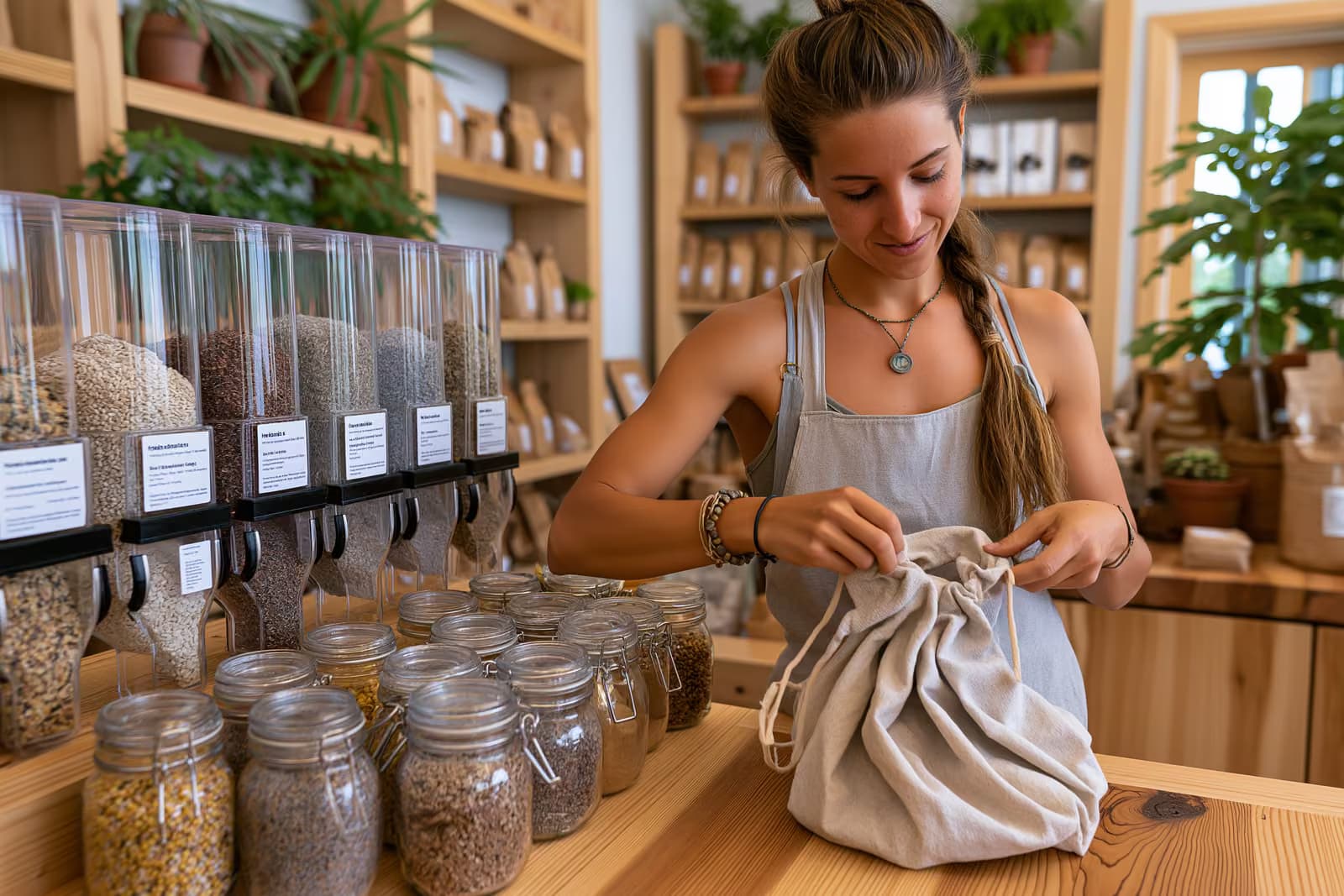
Unverpackt-Läden, package-free shops where you bring your own containers and fill them from bulk dispensers, deserve an honest description rather than an enthusiastic one. The sector had a boom that did not hold. The number of shops in Germany roughly halved over three years, and the trade association describes the situation as tense, attributing the decline to the pandemic, the inflation that followed the war in Ukraine, and customers moving to discounters as sustainability slid down their priorities. The association has been running since 2018 and reports over 330 members, and it maintains a Ladenfinder map, which is the practical answer to whether there is one near you: check the map rather than assuming, because the shop that existed in your city in 2022 may well not exist now. Where one does survive it is genuinely useful for dry goods and refills, and it works best as a supplement to normal shopping rather than a replacement for it.
Repair Instead of Replace
Repair is the part of eco-friendly shopping that involves not shopping, and it is where the environmental arithmetic is least ambiguous. Keeping an appliance running avoids the entire manufacturing footprint of its replacement, which for most electronics is the dominant share of lifetime impact. Germany’s legal repair rights, including the reform that cleared in July 2026 and the split date that determines which rules apply to your purchase, belong to our chapter on product warranties and returns, which owns that material and states it properly. This section is about the practical and financial side.
Repair-Cafés are volunteer-run workshops, usually monthly, in a community centre or library, where people with the relevant skills help you fix your own device. You bring the broken thing, you work on it with somebody who knows how, and you pay nothing beyond parts and perhaps a donation. The model matters because the most common reason a small appliance gets thrown away is not that it is unfixable but that fixing it costs more than replacing it once you are paying professional labour. Removing the labour cost changes the calculation entirely.
A Reparaturbonus is a subsidy from a Land or a municipality that reimburses part of a professional repair bill, and here you must check your own Land rather than trust general advice, because the map changed recently and most published guidance is out of date. Thüringen, which ran the best-known scheme for five years and supported roughly 50,000 repairs, discontinued it: the programme ended on 31 December 2025 and the Land has not funded it for 2026. Do not go looking for it. Sachsen, by contrast, restarted its scheme on 10 November 2025. It reimburses 50 percent of repair costs up to a maximum of 200 euros, requires a minimum invoice of 115 euros, allows two repairs per person per calendar year, is open to adults whose main residence is in Sachsen, and is funded with roughly four million euros from the Sachsen Klimafonds for 2025 and 2026. Applications are digital only, through the Sächsische Aufbaubank, with identity verification through Verimi.
Berlin kept its programme after the Senat reversed a planned cut, funding it with 1.25 million euros per year in the 2026/2027 double budget. It covers up to 50 percent of costs to a maximum of 200 euros, and it has a detail worth knowing: for a repair carried out at a Repair-Café or a similar initiative, the Land covers the full price of the spare parts. Berlin’s fund ran out once in mid-2025, which is the general lesson for all of these schemes: they are capped budgets, not entitlements, and applying early in the year is materially better than applying late. A nationwide Reparaturbonus has been attempted and failed, with the Bundesrat rejecting a Thüringen initiative to establish one, so this remains a patchwork. Some municipalities run their own schemes independently of their Land, including Aschaffenburg, Fürth and Starnberg in Bayern, the Landkreis Miltenberg, and Bielefeld in Nordrhein-Westfalen. If you live somewhere not named here, search for your city’s name with Reparaturbonus before assuming there is nothing.
Buying Used Is an Environmental Choice
The most eco-friendly product is almost always one that already exists. This is the logic of the Kreislaufwirtschaft, the circular economy, which treats materials as things to be kept in use rather than extracted, used once and discarded. Buying second-hand is the most direct form of it available to an individual, because it substitutes directly for a new manufactured item and requires no new extraction, no new production and no new transport beyond the last leg.
Textiles are where this bites hardest. Clothing production is resource-intensive, and the environmental cost of a garment is overwhelmingly incurred before you ever wear it, in fibre production, dyeing and finishing. A garment worn twice and discarded has effectively wasted its entire footprint, which is why the number of times you wear something is a better environmental measure than what it is made of. A conventional cotton shirt worn two hundred times is a better outcome than a GOTS-certified shirt worn five times. This is also the honest limit of sustainable fashion as a category: buying better-made new clothes is an improvement over buying badly-made new clothes, but buying fewer clothes and keeping them longer outperforms both, and no label can deliver that part.
The same reasoning applies to furniture, appliances, tools, bicycles and children’s equipment, where second-hand markets are deep and the items are often built better than their current equivalents. Where to actually find these things, how to tell a private seller from a trader, how to haggle, and what protections you give up when you buy from a private person are all covered in our chapter on flea markets and thrift stores, which owns the practical hunt in detail. The point to carry from here is only that the second-hand purchase is not a compromise version of eco-friendly shopping. In most categories it is the strongest version available.
The Trade-Offs Nobody Prints on the Packaging
Eco-friendly shopping advice loses its credibility when it pretends the choices line up neatly. They do not, and the honest version is more useful than the tidy one. The first and most important trade-off is that Bio, regional and low-carbon are three different things that people routinely treat as one. Organic certification governs farming method: no synthetic pesticides, no GMOs, restricted inputs. It says nothing about distance travelled. An organic avocado flown from Peru is genuinely organic and also carries a transport footprint that swamps the farming benefit. A conventionally grown apple from the Altes Land in season will usually beat an organic apple shipped from New Zealand on carbon while losing on pesticides. There is no single ranking that resolves this, because they are different environmental problems. If you want one heuristic that holds up: seasonal and regional tends to dominate for fresh produce with a short shelf life, while organic certification matters more for goods where farming intensity is the main issue and transport is a small share, such as dry goods, coffee and textiles.
The second trade-off is that Mehrweg, the reusable deposit system, genuinely beats Einweg, single-use, but not by as much as its enthusiasts claim and not in every case. Glass is heavy, and the environmental advantage of a returnable glass bottle depends on how many times it is actually refilled and how far it travels between refills. A regional Mehrweg bottle that goes back to a brewery thirty kilometres away is an excellent outcome. The same bottle trucked across Germany erodes much of the benefit through transport weight, and PET Mehrweg often outperforms glass Mehrweg for exactly that reason despite feeling less virtuous. How the Pfand system actually works, what each container costs, which are exempt, and how the Rückgabeautomat and the Bon operate are covered in our chapter on grocery shopping tips, which owns those mechanics. The sustainability point to add on top is simply that Mehrweg plus regional is where the system delivers, and Mehrweg alone is a weaker claim than the logo suggests.
The third trade-off is the one where the received wisdom is simply wrong, and it is worth correcting carefully rather than replacing one exaggeration with another. Germany’s Verpackungsgesetz produces genuinely high recycling rates, and the data does not support the common line that plastics recycling is mostly a fiction. According to the Umweltbundesamt, whose 2023 figures are the most recent available and were reconfirmed in a release published in May 2026, Germany generated 17.92 million tonnes of packaging waste, about 215 kilograms per head, of which private consumers accounted for 8.42 million tonnes. Under the stricter EU calculation method, which deducts processing losses and measures at the final recycling stage, 69.4 percent of all packaging was materially recycled. Glass reached 80.6 percent and paper and cardboard 86.6 percent, which are high figures by any standard.
Plastic packaging reached 52.2 percent under that same method. That is the number to hold on to, and it cuts both ways. It refutes the claim that plastic packaging recycling is largely thermal, because roughly half of it really is turned back into material. It also refutes any comfortable assumption that putting plastic in the yellow bin closes the loop, because the other half is largely burned for energy recovery, and Germany must still raise plastic packaging recycling to 55 percent by 2030 to meet its EU obligation. So the accurate statement is that glass and paper genuinely close the loop, plastic gets there about half the time, and the honest conclusion is the boring one: avoiding the packaging beats recycling it, and this is the one place where an Unverpackt-Laden or a refill has a clear and measurable advantage. Which bin each material goes in, and the rules for the Gelber Sack, Biotonne and the rest, are covered in our chapter on waste disposal and recycling rules.
The last trade-off is one of scale, and it is the least comfortable. Shopping is not where most of a German household’s environmental footprint lives. Heating, electricity and transport dominate it, and switching to a genuine Ökostrom tariff or reducing car use will outweigh a great deal of careful label-reading. Our chapter on energy providers and options covers how switching works and what separates a real green tariff from a rebadged one. This chapter is not going to pretend that your choice of yoghurt competes with your choice of heating. Reading labels well is worth doing, it saves you from being lied to, and it is a small share of the total. Both of those things are true.
What to Do Next
Start with the labels, because that is the skill that pays off every time you shop and takes no extra time once you have it. Learn the Blauer Engel and treat it as the strongest signal for household goods, paper, paints and electronics. Learn that the EU-Bio-Logo is a real but minimum standard, that a Verband label above it means measurably more, and that the code beneath the logo names the body that inspected the producer. Learn that the Grüner Punkt means somebody paid a licence fee and nothing else at all. Those three facts will carry most of your decisions.
Then check two things that are specific to where you live, because both vary and both are commonly out of date in general advice. Look up whether your Land or your city runs a Reparaturbonus, remembering that Sachsen and Berlin do, Thüringen no longer does, and various municipalities run their own. And check the Unverpackt association’s map before assuming a package-free shop near you still exists. If your Land does run a bonus, apply early in the year while the budget lasts.
After 27 September 2026, hold advertisers to the new standard. A generic claim like umweltfreundlich or nachhaltig without demonstrated excellent environmental performance, a climate-neutrality claim resting on offsets, or a sustainability logo that no independent scheme stands behind are all on the wrong side of the line from that date. If you see one, the route is not an argument in the shop: it is the Verbraucherzentrale, the consumer advice centres that exist in every Land, or the enforcement mechanisms set out in our chapter on consumer protection laws. Complaints from consumers are what tell the qualified bodies where to look.
Finally, keep the proportions straight. Buy things that already exist where you can, buy seasonal and regional for fresh food, repair before replacing, and do not let a well-designed logo do your thinking. If you want to go further than shopping, our chapter on environmental conservation initiatives covers the organisations and programmes you can actually join. The goal is not to shop perfectly, which is not available. It is to stop paying a premium for claims that mean nothing, and to spend the difference on the ones that do.
Sources
The information in this chapter draws on the official sources and publications listed below, last reviewed in July 2026. It is general guidance for orientation, not individual legal, tax, or medical advice.
- commission.europa.eu
- recht.bund.de
- boehmert.de
- europarl.europa.eu
- BGH I ZR 98/23
- blauer-engel.de
- Blauer Engel 1978
- Bioland Demeter Naturland vs EU-Bio
- verbraucherzentrale EU-Bio-Logo
- umweltbundesamt.de
- vzth.de
- smwa.sachsen.de
- euwid-recycling.de
- unverpackt-verband.de
- bmleh.de
- utopia.de
- Fairtrade TransFair FLOCERT