Flea Markets and Thrift Stores
24 min read
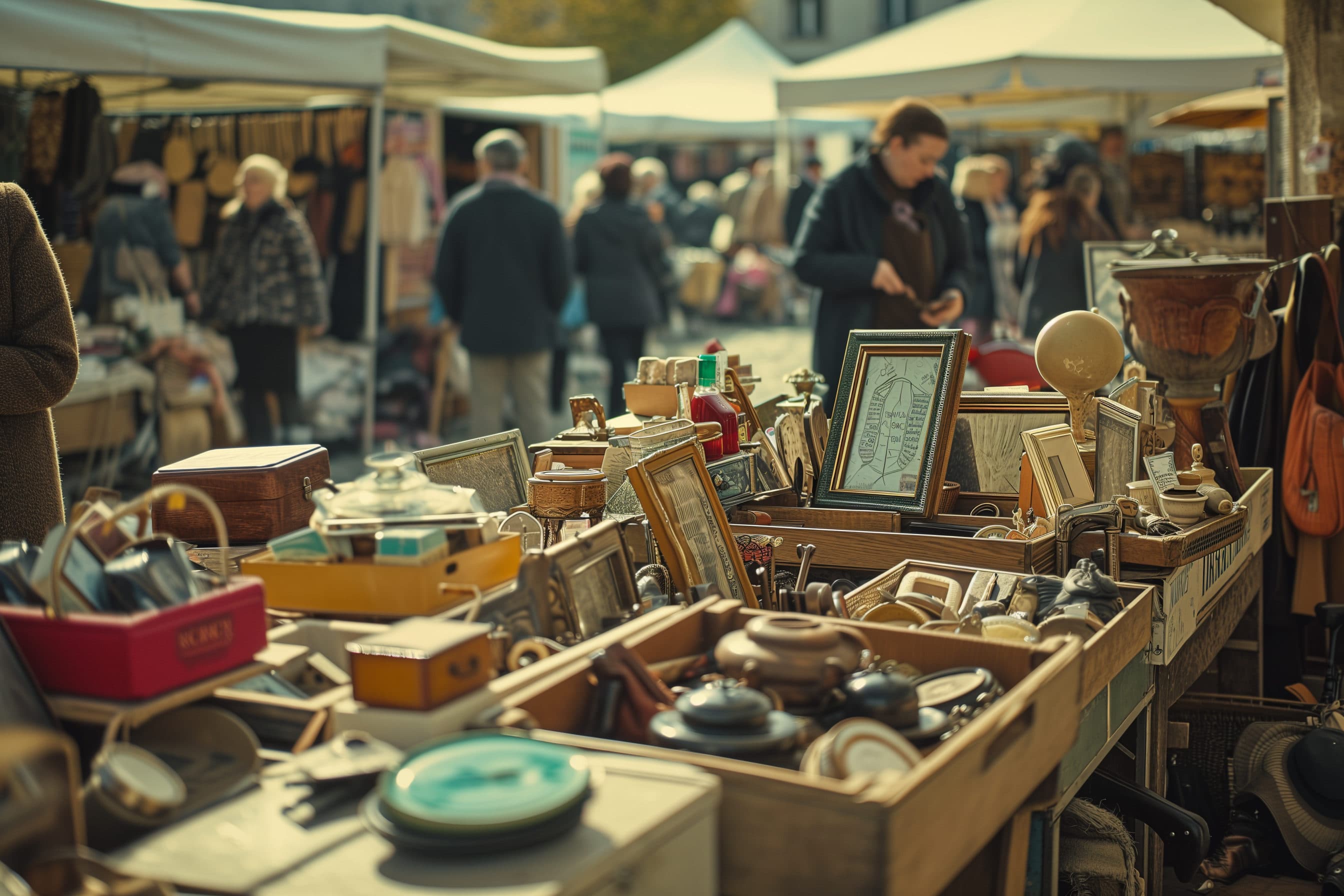
Second-hand shopping in Germany is genuinely good. The markets are large, the stock is deep, and prices for furniture, bicycles, tools, books and clothing sit far below what you would pay new. What catches people who have arrived from the United States or the United Kingdom is not the shopping. It is what happens afterwards. At flea markets and in much of the second-hand world you are usually buying from a private person rather than a shop, and that single fact removes almost every consumer right you are used to having. This chapter explains where to go, how to tell who you are actually buying from, what protection you keep and what you give up, how to sell your own things without accidentally becoming a business, and how to avoid the specific scams that target newcomers online.
The One Line That Decides Everything
German consumer law does not protect you because you are a consumer. It protects you because the other side is a business. The two definitions live in §13 and §14 BGB: a Verbraucher is a private individual acting outside any trade or profession, and an Unternehmer is a person or company acting in the exercise of a trade or self-employment. Consumer protection binds the Unternehmer. It says nothing about a private person.
So when both sides of the deal are private individuals, the entire protective apparatus simply is not there. There is no Widerrufsrecht, the fourteen-day right to withdraw. There is no protection against an exclusion of liability. And in practice there is no Gewährleistung, the statutory liability for defects, because a private seller is allowed to exclude it completely and essentially every one of them does. The moment you hand over the cash at a Flohmarkt stall, the deal is final. If the lamp does not work when you get it home, that is your lamp now. Nothing is broken about this and nobody has cheated you. It is what the law says.
Two things follow that surprise people. First, the same broken lamp bought from a shop would be a straightforward claim, so the identity of the person you bought from matters more than the fault itself. Second, the absence of a return right has nothing to do with second-hand goods. There is no Widerrufsrecht for any in-person purchase at all, new or used, in a flea market or in a department store. The fourteen-day right is a distance-selling right; it exists because you could not inspect the goods before buying. Standing in front of the item is treated as inspection enough. Our chapter on consumer protection laws sets out that framework in full, and it is worth reading before your first market, because everything below is a consequence of it.
Telling a Private Seller from a Händler
Since the whole question turns on who is selling, learning to read a stall is the most useful skill at a German flea market. The two types stand side by side at the same market and look similar at a glance.
A private seller is emptying a household. The stock is incoherent: a bread machine, some children’s clothes, a box of cables, three vases, a ski boot. There is one of each thing. Prices are guesses, often written on masking tape, and the seller will name a number rather than consult a list. They are often sitting on a folding chair looking mildly bored, because they are here once, not weekly. They take cash and nothing else, and they cannot give you a receipt because they have no receipt book.
A gewerblicher Händler, a commercial trader, looks like a small shop that has been unpacked onto a table. The stock has a theme: only vinyl, only tools, only militaria, only vintage denim, and there are multiples and sizes. There are printed price labels or a price list. There is often a card reader, a proper cash box, a business name on the awning or the van, and sometimes a printed receipt. The tell that never fails is repetition: ask whether they are here next week. A trader has a pitch and a schedule. Larger markets separate the two into different zones, and the market’s own website will usually say which section is which.
The difference is worth real money. Buy the same broken record player from the private stall and you have no claim at all. Buy it from the trader beside them and you have full Gewährleistung, because they are an Unternehmer under §14 and the law binds them exactly as it binds a department store. This is not a technicality and traders know it, which is why some of them prefer you to think of them as “just a guy at a market”. If a seller has a business name, a card reader and forty of the same item, they are a business, whatever they call themselves.
What “Gekauft wie gesehen” Actually Does
You will meet a set formula, on handwritten signs at markets and at the bottom of nearly every private online listing: “Privatverkauf, keine Garantie, keine Rücknahme” or the older “gekauft wie gesehen”, bought as seen. Most people, German and foreign alike, believe this phrase is a magic spell that ends all liability. It is worth knowing what each part really does, because the popular version is wrong in both directions.
“Keine Garantie” is close to meaningless. A Garantie is a voluntary promise that a seller chooses to give on top of the law. A private person was never going to give you one, so declining to give one changes nothing. It sounds impressive and does no work.
“Gekauft wie gesehen” does less than people think. Standing on its own, courts read it as excluding liability only for defects that an average buyer would have noticed on a proper inspection, without bringing an expert along. It covers the scratch you could see and the chip you could have seen. It does not cover a hidden defect, a versteckter Mangel, that no reasonable look would have revealed. A seller who wants a genuinely complete exclusion has to say so, with wording along the lines of “unter Ausschluss jeglicher Gewährleistung”, excluding all liability for defects. Between two private individuals that full exclusion is entirely lawful, and once it is written down your position is what it was going to be anyway: nothing.
And then there is the floor that no formula gets under. §444 BGB says a seller cannot rely on any exclusion or limitation of the buyer’s rights where he fraudulently concealed the defect, arglistig verschwiegen, or where he gave a Garantie for the quality of the goods. Arglist means he knew and kept quiet, or answered a direct question with a lie. A private seller who knows the engine is cracked, writes “gekauft wie gesehen” and says nothing has not protected himself at all. The exclusion collapses. This matters most for the bigger private purchases, a used car or a motorbike, where it is worth asking direct, specific, answerable questions and remembering the answers, because a lie in response to a direct question is exactly what §444 is built for.
Be realistic about enforcement, though. §444 is a real right and it is worth knowing. It is also close to useless against a stranger at a market who took your twenty euros in cash, whose name you do not know and whom you will never see again. The right survives; the defendant does not. Treat §444 as something that helps you in a private sale where you know who the seller is and have their details in writing, and treat a cash market purchase as final in practice regardless of what the law technically allows. Our chapter on product warranties and returns covers the Gewährleistung machinery properly, including how a claim actually works when you do have one.
When a Private Seller Stops Being Private
There is a line that people cross without noticing, and it runs in both directions: it can turn the person selling to you into a business with obligations, and it can do the same to you.
Nothing about calling yourself private makes you private. The BGH describes commercial activity as any independent, sustained activity carried on with the intention of making a profit and going beyond the merely private. Courts have applied this to online sellers for two decades now and the pattern is consistent. What they weigh is the duration and intensity of the selling, the organisational effort behind it, whether goods were bought in specifically to be sold on, whether the range includes new goods, how many listings run at the same time, the sales volume, and the number of ratings received. Reported cases give a feel for the scale: the BGH treated 91 sales in five weeks as commercial; the Landgericht Hanau found 25 sales in two months enough where the goods had been bought in for resale; the Landgericht Köln classified a seller running 77 simultaneous listings with 125 ratings in a year as commercial.
Notice that these numbers do not agree with each other, and that is the point. There is no threshold. No count of sales is a safe harbour, and anyone who tells you the magic number is 30 or 40 has confused this with something else. The criteria are qualitative, and buying things in order to sell them on is the factor that pulls hardest, because it converts clearing out your attic into trading.
For you as a buyer this is occasionally good news. A seller who is legally an Unternehmer owes you Gewährleistung whether they have admitted their status or not, and the “Privatverkauf” line at the bottom of their listing does not save them if their actual conduct makes them a trader. For you as a seller it is a warning, and the consequences are not just tax. A reclassified seller owes the full trader package: a Gewerbeanmeldung, an Impressum, correct Widerrufsbelehrung, and Gewährleistung on everything they have sold. Getting it wrong attracts an Abmahnung, a formal warning letter from a competitor or an association that comes with costs attached. This is a real cottage industry in Germany and private sellers who quietly turned into shops are its favourite target.
Where to Actually Go: Flea Markets and the Alternatives
The second-hand world here is not one thing, and the venues differ from each other on exactly the axis that matters, which is whether the seller is a business.
The Flohmarkt or Trödelmarkt is the classic: an open-air market, mostly private sellers, cash, haggling expected, held on a weekend. Trödel means junk, roughly, and a Trödelmarkt tends to be the more chaotic, less curated end of the same idea. This is where you find furniture, bikes, kitchen equipment and records at the lowest prices and with the least protection. Markets are common on Sundays, which is genuinely useful in a country where the shops are shut, but do not over-read this. The exemption is not automatic. A market that has been formally designated under §69 GewO, a Marktfestsetzung, takes its opening hours from that designation rather than from the Ladenschlussgesetz, and that is what lets it trade on a Sunday. Whether Sunday operation is permitted at all is tested against the individual state’s Feiertagsgesetz when the designation is granted, so it varies by Land and by market, and a purely private flea market cannot be designated in the first place. In practice: Sunday markets are normal and lawful where they are properly set up, but the Sunday closing rules themselves are unchanged, which our chapter on grocery shopping tips covers along with the cash-versus-card question.
A Sozialkaufhaus is a social department store, usually run by a charity or a municipal employment project, selling donated furniture and household goods very cheaply. A Kleiderkammer is the clothing equivalent, often run by the DRK, the German Red Cross. Access is the thing to check and there is no national rule: some require a Berechtigungsschein, an entitlement voucher, or other proof of low income; many are open to anyone at all; and some are open to everyone but reserve free or reduced goods for people who can show a Bedürftigkeitsnachweis, proof of need. It depends entirely on the organisation and how it is funded. Look at the website or ring before you go, and if you are not in need, be aware that in the means-tested ones you are competing for stock with people who are.
Charity shops proper, the Oxfam shops and the shops run by DRK, Caritas and Diakonie, are the closest thing to the British or American model: fixed prices, no haggling, open to everyone, no proof of anything, and the proceeds fund the organisation’s work. Prices are higher than a Sozialkaufhaus and the sorting is better. These are businesses in the legal sense, so you get your Gewährleistung.
A Second-Hand-Boutique is a curated commercial shop, typically clothing, often vintage or designer. Because it is gewerblich you have the full statutory position, and this is where one specific rule earns its keep. Under §476(2) BGB a trader selling used goods may shorten the limitation period for defect claims to one year, but only if two conditions are both met: you were specifically informed of the shortening before you made your contractual declaration, and the shortening was expressly and separately agreed in the contract. One year is a floor, not a starting point for negotiation. It cannot be cut further and it cannot be waived. A second-hand shop that hangs a “gekauft wie gesehen” sign by the till is not achieving anything, because §476(1) forbids a trader from excluding Gewährleistung against a consumer before a defect has even been notified. The sign is decoration. Your rights are intact.
Kilo-Läden sell clothing by weight, which sounds like a gimmick and is really a sorting model: the stock is unsorted bulk, the price per kilo is fixed, and the work is yours. They are commercial shops, so the rules above apply, though nobody is realistically bringing a Gewährleistung claim over a two-euro t-shirt.
Buying Second-Hand Online
Most second-hand buying in Germany now happens on a phone, and the platforms sort themselves by the same private-versus-commercial question.
Kleinanzeigen is the giant, and the name is worth explaining because half the internet still uses the old one. It was eBay Kleinanzeigen until 16 May 2023, when the eBay brand was dropped and the site became simply Kleinanzeigen at kleinanzeigen.de. This was not a change of ownership at that moment but a contractual clean-up: Adevinta, the Norwegian marketplace group, had bought eBay’s classifieds business in 2020 on terms requiring the eBay name to be retired by June 2024. Accounts, chat histories, ratings and the payment functions carried over unchanged. It is the default place to buy furniture, bikes and appliances locally, and it is overwhelmingly private sellers, which means it is overwhelmingly no-protection territory.
Vinted is clothing, app-first, with buyer protection built in and paid for by the buyer as a fee on top of the price. Momox and its shop medimops work in the opposite direction: they are a company that buys your books, media and clothing at a fixed quoted price and resells them. That direction matters legally. When you sell to momox you are the private seller, and when you buy from medimops you are buying from a business and you have your Gewährleistung, which is a rare thing in the second-hand world.
Then there is the pavement layer. In many neighbourhoods people leave usable things outside with a sign reading “Zu verschenken”, to give away, or in a box marked the same. This is one of the genuinely lovely things about German cities and it is legally clean: the owner has abandoned ownership deliberately and intends for anyone to take the item. Take it, it is yours, and that is what the sign is for. Sperrmüll is a completely different matter, which is worth its own section, because most English-language advice gets it wrong.
The Kleinanzeigen Safety Chapter
This is where foreigners get burned, and the scams are formulaic enough that knowing four of them covers most of the risk.
The one that matters most, above everything else in this chapter: never pay by PayPal “Geld an Freunde und Familie”, money to friends and family. That option carries no Käuferschutz, no buyer protection, at all. It is designed for splitting a restaurant bill with someone you know. If the goods never arrive, or arrive broken, or never existed, there is no buyer-protection route to get your money back. This is not a side effect of the scam; it is the entire scam. A seller who asks for Freunde und Familie is asking you to waive the only protection you had, and the reason they give is always the same, that it saves the fee and they will pass the saving on. The Verbraucherzentrale’s advice is blunt and correct: pay only via “Waren & Dienstleistungen”, goods and services. Refuse Freunde und Familie every single time, from every seller, however friendly, however plausible the profile, and treat the request itself as the end of the conversation rather than something to negotiate about.
The second is the fake Spediteur, and it targets you when you are selling. A buyer, usually abroad, is enthusiastic, does not haggle, and cannot collect in person, so they will send a shipping company. They offer to send you the transport costs in advance, and you receive an official-looking confirmation that the money is on its way, often more than was agreed, with a request to forward the difference to the shipping company. There is no shipping company and no buyer. The confirmation is forged, no money ever arrives, and what you forward is your own. Any transaction where you are asked to pay out money in order to receive money is a scam, without exception. The overpayment routine is the same trick with a different cover story.
The third is the fake Nachnahme, cash on delivery, presented as a safe compromise. It is not. Nachnahme means you pay the courier when the parcel arrives, but you pay before you can open it, so you are paying for a sealed box, not for its contents. Scammers ship bricks and paper. Nachnahme protects the seller and does nothing at all for you.
The fourth is simply the fake listing: a desirable item, priced clearly below the market, from a new account, with photographs that appear elsewhere online, and a seller who is in a hurry and wants a deposit to hold it. Search the photograph. Look at the account age. Nobody sells a good thing cheaply to a stranger in a rush.
Against all of this the platform offers “Sicher bezahlen”, secure payment, and it is worth understanding why it exists rather than dismissing it as a fee. It runs the payment through Adyen, a payment institution licensed by the Dutch central bank, which holds your money in escrow. The seller does not get paid when you pay. They get paid when you confirm you received the item and it is as described, or when Kleinanzeigen resolves a dispute, or automatically after fourteen days if you forget to confirm. It is free for the seller and the buyer pays the fee, which is precisely why sellers who intend to defraud you will invent reasons to avoid it. For anything shipped, to anyone you have not met, the fee is cheap insurance and refusing it is the thing you would regret. For a local pickup where you are standing in the seller’s kitchen looking at the sofa, cash on the spot is fine, because you are inspecting the goods and paying at the same moment.
One caution so the protection is not oversold: “Sicher bezahlen” is a platform service, not a statutory right, and it protects you against not receiving the item or receiving something other than what was described. It does not convert a private seller into a business. Once you have received the thing you actually bought, in the state it was actually described in, it is still a private sale with no Gewährleistung and no Widerruf.
Sperrmüll, and Why the Kerb Is Not Free
Sperrmüll is bulky waste: furniture, mattresses, appliances that a household puts out on the pavement for collection. It looks like a free-for-all, and English-language advice for newcomers routinely says that anything on the kerb is fair game. That is not the legal position, and the honest answer is that this is murky rather than free.
The reasoning is unromantic. When a household books a Sperrmüll collection with the municipal or private Entsorger, ownership of the pile transfers to that company. The household has not abandoned the items to the world; it has handed them to a contractor who is being paid to take them and who may have a commercial interest in what is in them. So the pile is not herrenlos, ownerless, and the rule about abandoned property that makes the “Zu verschenken” box lawful does not reach it. On top of that, most municipalities regulate this directly in their Abfallsatzung, the local waste by-law, and many forbid both taking and rummaging, because a searched pile has to be re-sorted before it can be loaded.
In practice the enforcement is mild. Municipalities generally treat it as an Ordnungswidrigkeit, a regulatory offence with a Bußgeld rather than a criminal matter, and someone taking one chair for their own flat, first offence, will usually get a word rather than a fine. A Diebstahl complaint is possible depending on what was taken and by whom, and people arriving with a van to strip piles systematically are the ones who attract real trouble. The rules sit in local Satzungen, so they genuinely differ from town to town and there is no national answer to give you.
What this means for you: it is not the crime of the century, but it is also not your right, and you should not be shocked to be told to put it back. If you want the risk-free version, the “Zu verschenken” box is it, and so are the Verschenkeboxen and give-away shelves that many neighbourhoods and some Wertstoffhöfe run officially. Our chapter on waste disposal and recycling rules covers how Sperrmüll collection is actually booked and what belongs in it.
Selling Your Own Things
Eventually you will be on the other side of the table, and the two questions people ask are whether they need to register a business and whether they owe tax. For an ordinary clear-out the answers are no and no, but both deserve their reasoning.
You do not need a Gewerbeanmeldung, a business registration, to sell your own used possessions occasionally. Emptying your cellar of books, clothes and furniture is private, and at a private Trödelmarkt stallholders need neither a Gewerbeanmeldung nor a Reisegewerbekarte, the itinerant trade licence. It is the organiser who has to notify the market to the Bürger- und Ordnungsamt, not you. What changes the answer is the pattern described earlier: selling regularly, offering new goods, or buying things in specifically to sell them on. Note one trap flagged in IHK guidance, because it catches collectors: selling off a single large private collection gradually over a long period can still be classed as commercial, precisely because it is sustained.
Booking a stall is mundane. Markets take an Anmeldung, a registration, in advance, online or by phone, and charge a Standgebühr, a stall fee, usually by the running metre of table and often more if you want to park your car behind the pitch. Popular markets sell out. You bring your own table, and you bring far more small change than you think you need, because your first customer will hand you a fifty for a two-euro book.
The tax question has a widely misunderstood answer. Private sales fall under §23 EStG, private Veräußerungsgeschäfte, which taxes a gain where you sell something within one year of buying it, the Spekulationsfrist. But there is a sentence people miss, §23(1) Satz 1 Nr. 2 Satz 2, which excludes Gegenstände des täglichen Gebrauchs, items of everyday use, from the rule altogether. Your old sofa, your bicycle, your children’s outgrown coats and your used phone are everyday items, so they sit outside §23 entirely, whatever the timing and whatever they fetch. This is also why you cannot deduct the loss when you sell your used car for less than you paid, which is the reason the exclusion was written in the first place. What §23 is actually aimed at is things that are not everyday goods and that can rise in value: gold, jewellery, art, antiques, collectibles.
For those items the numbers are: the one-year holding period, and a Freigrenze of 1.000 Euro per calendar year. Older guides say 600 Euro. That figure is stale. And Freigrenze does not mean allowance. If your total gain from private sales in the year comes to less than 1.000 Euro it is tax free, but if it reaches 1.000 Euro the whole gain becomes taxable, not merely the part above the line. A Freibetrag would shelter the first slice; a Freigrenze is all or nothing.
One more thing that alarms people unnecessarily. Since the Plattformen-Steuertransparenzgesetz took effect in 2023, platforms report a seller to the Bundeszentralamt für Steuern once they pass 30 transactions or 2.000 Euro in a calendar year. Being reported is not being taxed. It is a disclosure threshold, and it has no connection whatsoever to whether you owe anything: if you sold everyday household goods, you owe nothing at 30 sales and nothing at 300, and the report simply shows the tax office a set of transactions that are not taxable. Do not let the number frighten you into treating a legitimate clear-out as a problem. Equally, do not read the report as permission, because the reclassification criteria above operate independently of it. If you are selling at real volume with profit intent, get advice from a Steuerberater rather than from a threshold.
How to Actually Shop a Flea Market
The practical layer is easy once the legal layer is clear, and most of it follows from one fact: since you have no comeback, everything has to happen before you pay.
Bring cash, in small notes and coins. Private sellers do not take cards and the ones who say they do are traders. Carrying a spread of fives and tens also quietly helps you haggle, because “I have twelve euros on me” is a more persuasive position when you can show it.
Timing is a trade-off rather than a secret. Arrive early and you get the pick of the stock, alongside the dealers who arrived earlier still. Arrive in the last hour and you get the discounts, because a seller looking at a table of unsold things and a car to reload would genuinely rather give you the lamp for three euros than carry it home. Rare thing, go early. Bulky thing, go late.
Haggling, Feilschen, is expected at private stalls and you should do it, but the German version is quieter and less theatrical than in many countries. Ask “Was ist Ihr letzter Preis?”, what is your best price, or simply name one number that is somewhat below the asking price and then stop talking. One counter-offer, politely made, is normal. Grinding a pensioner down over a two-euro dish is not, and a seller who feels mocked will simply refuse to sell. Buying several things from one stall is the natural moment to ask for a round number for the lot, and it usually works. Fixed-price venues, charity shops and Sozialkaufhäuser, are not haggling venues; asking there is a small social mistake rather than a negotiation.
Test electricals on the spot, because “no Gewährleistung” is not an abstraction. Many markets have a socket somewhere and sellers are used to being asked. Plug it in. If you cannot test it, price it as if it is broken and be pleased if it is not. Check bicycles by riding them, not by looking at them, and be aware that a suspiciously cheap bike with a fresh paint job may be stolen, in which case you have bought nothing at all, because you cannot acquire good title to stolen goods no matter how honestly you paid. Ask for the original purchase receipt or the frame number for anything above trivial value.
For clothing, try to ignore the label size. German and European sizing differs from British and American sizing, vintage sizing differs from modern sizing in the same country, and second-hand garments have often been altered or have shrunk. Measure what you own and carry a tape measure, or hold the garment against yourself. There are no changing rooms at a market and no returns anywhere in this chapter.
As for the famous markets, they are worth a morning: Mauerpark and the Arena in Berlin, the Flohschanze in Hamburg, and the big ones in Cologne, Munich and the Ruhr. But the honest advice is that the famous markets are the tourist-priced ones, and the better buying is at the ordinary neighbourhood Trödelmarkt, the school and church markets, and the Hofflohmärkte where a whole street opens its courtyards on one weekend. Search your city’s name with “Flohmarkt Termine” for the current calendar rather than relying on any list, including this one.
What To Do Next
Start by settling the only question that matters before you buy anything expensive: is this person private or a business? If they are private, assume the purchase is final, inspect accordingly, and pay in cash only for something you are holding. If they are a business, you have the same rights you would have in any shop, and a used-goods seller can shorten your claim window to one year under §476(2) but only with specific advance notice and an express separate agreement, and can never remove it.
Online, make one rule and never break it: no PayPal Freunde und Familie, ever, for anything, no matter what reason you are given. Use “Sicher bezahlen” for anything shipped, and cash in person for anything you collect. If you are asked to send money in order to receive money, you are being defrauded, and you should stop.
If you are selling, an ordinary clear-out needs no Gewerbeanmeldung and generates no tax, because everyday household goods sit outside §23 EStG completely. Watch the pattern rather than the count: buying things in specifically to sell them on is what turns a private seller into a trader, with the Gewerbeanmeldung, Impressum and Gewährleistung that come with it, and no number of sales is a safe harbour in either direction.
For the legal framework underneath all of this, read consumer protection laws, which explains why the Verbraucher and Unternehmer definitions do the work they do, and product warranties and returns for how a Gewährleistung claim is actually made when you have one. If your reason for buying second-hand is environmental rather than financial, our chapter on eco-friendly shopping options takes up the reuse and Kreislaufwirtschaft argument that this chapter has deliberately left alone in favour of the practical hunt.
This chapter is general information about how second-hand buying and selling works in Germany, not legal or tax advice. The private-versus-commercial line is decided on the facts of an individual case, Sperrmüll rules sit in municipal Satzungen and differ from town to town, and anything involving real money, a reclassification risk or a dispute is worth taking to a Rechtsanwalt, a Steuerberater, or your local Verbraucherzentrale, which advises consumers directly and is the best source in the country on private-sale scams.
Sources
The information in this chapter draws on the official sources and publications listed below, last reviewed in July 2026. It is general guidance for orientation, not individual legal, tax, or medical advice.