Pedestrian Rights and Rules
12 min read
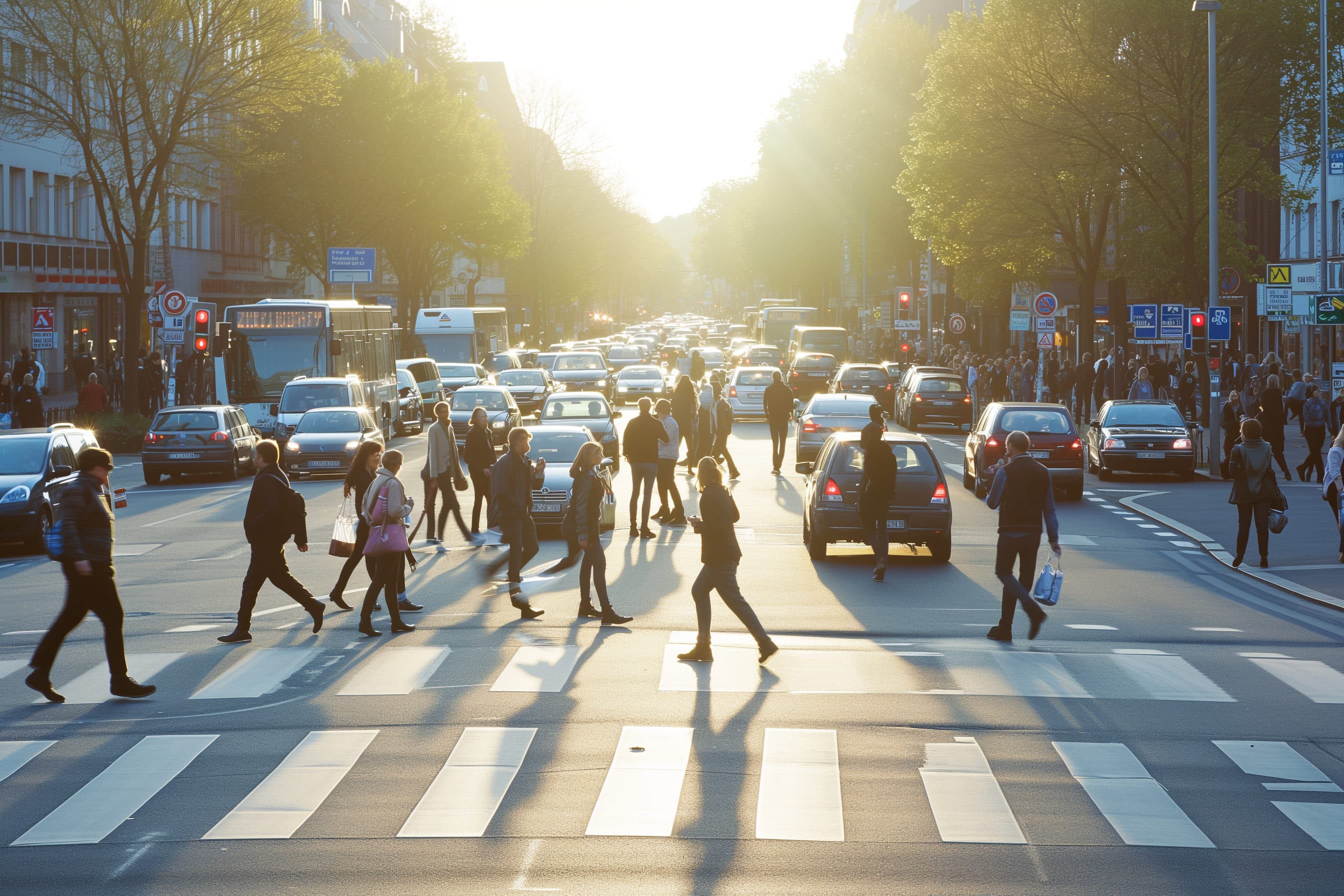
Walking is the most common way to move around a German town, and it comes with a set of written rules and a set of unwritten habits that catch newcomers off guard. This chapter explains your pedestrian rights in Germany, the duties that go with them, and the small offences that foreigners commit without realising it. The written rules live in the Straßenverkehrsordnung (StVO, the road traffic regulations), the same rulebook that governs drivers and cyclists. The unwritten habits live in the way people actually behave at a crossing. Understanding both keeps you safe, keeps you from being fined, and helps you read a situation the way the people around you already do. This is general guidance, not legal advice.
Why Everyone Waits at a Red Light
The single biggest culture shock for new arrivals on foot is that Germans wait at a red pedestrian light even when the road is completely empty. Crossing on a red Fußgängerampel (pedestrian traffic light) is not just frowned upon; it is an Ordnungswidrigkeit, a minor regulatory offence, and it carries a fine. The Bußgeldkatalog (the national schedule of traffic fines) sets the penalty at 5 euros for crossing on red, rising to 10 euros if your crossing causes or contributes to an accident. The amounts are small, but the point is that the offence is real, and the police do enforce it, especially in city centres and near schools. Being a foreigner is not an excuse that officers accept.
What surprises people more than the fine is the social pressure. Adults stand and wait at an empty crossing at midnight because it is simply what is done, and the pressure is strongest when children are watching. Germans take seriously the idea of being a Vorbild für Kinder, a role model for children, on the reasoning that a child who sees an adult cross on red will copy the adult on a busy road one day. If you step out on red, expect disapproving looks and sometimes a sharp word from a stranger, particularly if a family is standing beside you. You do not have to adopt the habit to respect it, but knowing why the person next to you is standing still stops you from reading it as timidity. When your light is green, cross without hesitation; when it is red, the local move is to wait.
Where and How You Are Allowed to Cross
Away from the social question, the StVO sets out plainly where and how you may cross. Under §25 StVO, if a pedestrian traffic light applies to you, you must obey it. Where there is no light but the traffic situation demands it, you are expected to use a nearby crossing rather than stepping into the road wherever you please; at junctions you must use the marked pedestrian crossings or the crossing markings at signals if they are there. Everywhere else you may cross the road, but you must do it zügig (promptly, without dawdling), by the shortest route, and roughly at a right angle to the traffic rather than strolling diagonally across. The rule assumes you will watch the traffic and pick a safe gap; it does not give you a free pass to walk out in front of moving cars.
The crossing that most confuses newcomers is the Fußgängerüberweg, the marked crossing everyone calls the Zebrastreifen (zebra crossing) after its black-and-white stripes. Here pedestrians have near-absolute priority. Under §26 StVO, vehicles, including cyclists, must approach a Zebrastreifen only at moderate speed and must stop and let you cross if you clearly want to. The catch is in that last phrase: your priority begins only once you make your intention to cross recognisable, by stepping up to the kerb and looking as if you are about to go. A driver is not required to read your mind while you stand chatting on the pavement. Step forward with clear intent and the traffic must yield; loiter uncertainly and it may roll on. A Zebrastreifen is not the same as a green light, so make eye contact before you trust it, but once you have committed, the right of way is yours.
Turning Traffic and the Rights You Hold Against Drivers
One of the most useful rights to understand is also one of the most dangerous in practice, because drivers routinely ignore it. When your pedestrian light is green and you step off the kerb, cars turning into the side street you are crossing must let you go first. This is not courtesy; it is §9 Absatz 3 StVO, which states that a turning driver must show special consideration for people on foot and, in the regulation’s own words, “wenn nötig, ist zu warten”, must wait if necessary. A driver turning right across your path, or turning left into the road you are crossing, has to give way to you even though the driver also has a green light for the turn. In law, the pedestrian crossing the side street wins.
In reality, many drivers turn without looking properly for pedestrians, so treat the right as something to check rather than something to rely on blindly. This applies with extra force at a Grünpfeil, the small green arrow on a sign or signal that lets a driver turn right on red after stopping: the driver may proceed only after yielding to pedestrians and cross-traffic, and the two of you can end up wanting the same patch of tarmac at the same moment. Glance at the front wheels of a waiting car before you step in front of it, because the wheels start moving before the bonnet does. The duty is the driver’s, but the injury would be yours. For the full picture of what drivers must do at crossings and how the driver-side fines work, see our chapter on driving in Germany; this chapter deliberately covers the pedestrian’s side of the same encounter.
Sidewalks, Cyclists and E-Scooters
Where a Gehweg (pavement, or sidewalk) exists, §25 StVO says you must use it rather than walking in the road. On a country road or anywhere without a pavement or verge, walk on the left-hand side facing the oncoming traffic where that is reasonable, so that you can see approaching cars and they can see you. It feels counterintuitive if you are used to keeping right, but facing the traffic is the safer and the legally expected choice outside built-up areas.
The pavement is also where the sharpest daily conflict happens, because pedestrians and cyclists are often squeezed onto the same strip. A Radweg (cycle path) is for bicycles, and walking in it is a genuine offence, not merely bad manners; you can be fined for it. On a gemeinsamer Geh- und Radweg (a shared foot-and-cycle path, marked by a single sign combining the pedestrian and bicycle symbols), both may use the full width, but neither may endanger the other and cyclists must adjust their speed to the people on foot. Keep to a predictable line, listen for a bell, and do not drift into the cycle lane while looking at your phone. Our chapter on bicycle culture and routes covers the cyclist’s duties on these shared paths in detail; from the pedestrian side, the rule to remember is that the marked cycle lane is not yours to walk in.
E-Scooter (electric stand-up scooters, legally Elektrokleinstfahrzeuge under the eKFV regulation) are a live grievance for people on foot, and the law is on the pedestrian’s side. An e-scooter is banned from the Gehweg entirely: where there is a cycle path or cycle lane it must use that, and otherwise it belongs on the road, never on the pavement, even with the motor switched off. Riders must be at least 14, and because an e-scooter counts as a motor vehicle it carries the same drink limits as a car, not the looser cyclist limits: 0.5 promille as the general threshold, 1.1 promille as the point where it becomes a criminal offence, and zero tolerance for novice drivers still in their probation period. Every legal e-scooter must also carry a Versicherungsplakette, a small annual insurance sticker on the rear, which is what pays out if a rider hits you. If a scooter is parked across the middle of the pavement, you are within your rights to move it aside.
Play Streets and Traffic-Calmed Zones
A zone that foreigners regularly misread is the verkehrsberuhigter Bereich, the traffic-calmed area marked by a blue square sign showing a house, an adult, a child playing with a ball and a car (Zeichen 325.1). People often call it a Spielstraße, a play street, and the name is accurate: here the normal hierarchy of the road is inverted. Pedestrians and children may use the entire width of the street, and children are expressly allowed to play anywhere in it, not just on the pavement. Cars are guests. They must drive at Schrittgeschwindigkeit, walking pace, which the courts treat as somewhere around 7 to 10 kilometres per hour, and they must not endanger or obstruct people on foot; if necessary, the car waits.
The mistake newcomers make runs both ways. Some walk through such a street as nervously as through any other, not realising the whole surface is theirs to use. Others, arriving by car, drive through at normal speed and are baffled to be honked at or fined. If you live on one of these streets, you can let children play in front of the house with the law behind you; the one courtesy the rules ask of pedestrians in return is not to obstruct the occasional slow car out of sheer bloody-mindedness. It is a genuinely different kind of space, and once you can recognise the sign, you will treat it the way your neighbours do.
Snow, Ice and the Duty to Clear the Path
Winter turns pavement rules into a question of money and liability, and it matters to you both as someone who walks and as someone who rents. The Räum- und Streupflicht is the legal duty to clear snow and scatter grit on the Gehweg in front of a property. It begins with the municipality, but almost every town passes it by local statute to the Anlieger, the adjoining property owner, and the owner in turn very commonly passes it to the tenants through a clause in the lease. If your Mietvertrag (rental contract) contains such a clause, then shovelling the snow outside your building on a winter morning is legally your job, typically on a daily schedule that runs through the working day and often from around seven in the morning until the evening. A vague reference in the house rules is usually not enough to bind you; the duty has to be in the contract itself.
This cuts both ways for a pedestrian. If you slip on an icy stretch that should have been cleared, you may be able to claim damages and even Schmerzensgeld (compensation for pain and suffering) from whoever held the duty, which is exactly why securing evidence at the scene matters, a photograph of the unclear surface and the name of a witness. But the duty is not absolute, and neither is your claim. A single cleared strip along the pavement can be enough to satisfy it, and you are expected to exercise your own Sorgfalt, ordinary care, by choosing sensible footwear and walking to the conditions. Where you have been careless yourself, a court will reduce or cancel your claim for Mitverschulden, contributory fault. So clear your own frontage if the lease makes it yours, and walk carefully on everyone else’s.
Accessibility and the Everyday Texture of Walking
German pedestrian infrastructure is built with accessibility in mind, and noticing how it works helps everyone use it better. Many crossings have Ampeln fitted with signals for blind and partially sighted people: a quiet ticking sound that speeds up when the light turns green, and a small tactile arrow or vibrating plate on the underside of the request button that points along the direction of the crossing. The bumpy ground surfaces at kerbs, called Bodenindikatoren (tactile paving), are a guidance system for white canes, so try not to stand on them while you wait. Dropped kerbs (abgesenkte Bordsteine) exist for wheelchairs, prams and rolling luggage, and they double as the spot where the pavement is level for everyone. Pedestrian light phases can feel short if you walk slowly, and it is fine to finish crossing on a light that has changed once you have already started; drivers must let you complete the crossing you lawfully began.
In a Fußgängerzone (pedestrian zone), the car-free shopping streets at the heart of most German towns, walking is the default and vehicles are the exception. Delivery vehicles are usually allowed only during limited early-morning or late-evening windows shown on the sign, and cyclists may ride there only where a supplementary sign expressly permits it, otherwise they must dismount and push. One quiet hazard to keep in view: children under eight must ride their bicycles on the Gehweg rather than the road, and those up to ten may, so a small cyclist appearing on the pavement behind you is doing exactly what the law requires. Our chapter on bicycle culture and routes explains that rule from the cyclist’s side. Walking is also the first and last leg of almost every journey by bus or train, so it connects directly to the wider network described in our public transportation system chapter.
Putting It Into Practice
The habits that keep you safe and unfined in Germany are quick to learn. Wait at the red Fußgängerampel even when the road is empty, because it is both a fineable offence and a watched social norm. Cross at the light or the marked crossing when one is within easy reach, and everywhere else go promptly and straight across after checking the traffic. Trust your priority at a Zebrastreifen only once you have signalled your intent and caught the driver’s eye, and watch turning cars even on your green, because the driver’s legal duty to yield is not the same as the driver actually doing it. Stay out of the cycle lane, expect e-scooters off the pavement, and read the play-street sign as an invitation rather than an ordinary road.
As a tenant, check whether your lease hands you the winter clearing duty, and if it does, take it seriously, because a neighbour who slips can look to whoever failed to clear the path. As a walker, keep your own footing in mind and gather evidence if you fall on ground that should have been safe. None of this needs to be memorised as a legal exam; a week of watching how people around you behave at crossings will teach you most of it, and the written rules in §25, §26 and §9 of the StVO fill in the rest. Walk with the confidence that the law does protect people on foot here, and with the awareness that the protection works best when you use it deliberately.