




 Turkish
 Italian
 Spanish
 Portuguese
 Romanian
 Albanian
 Lithuanian
 Latvian
 Bulgarian
 Greek
Greek Hungarian
 French
 Croatian
 Czech
Czech
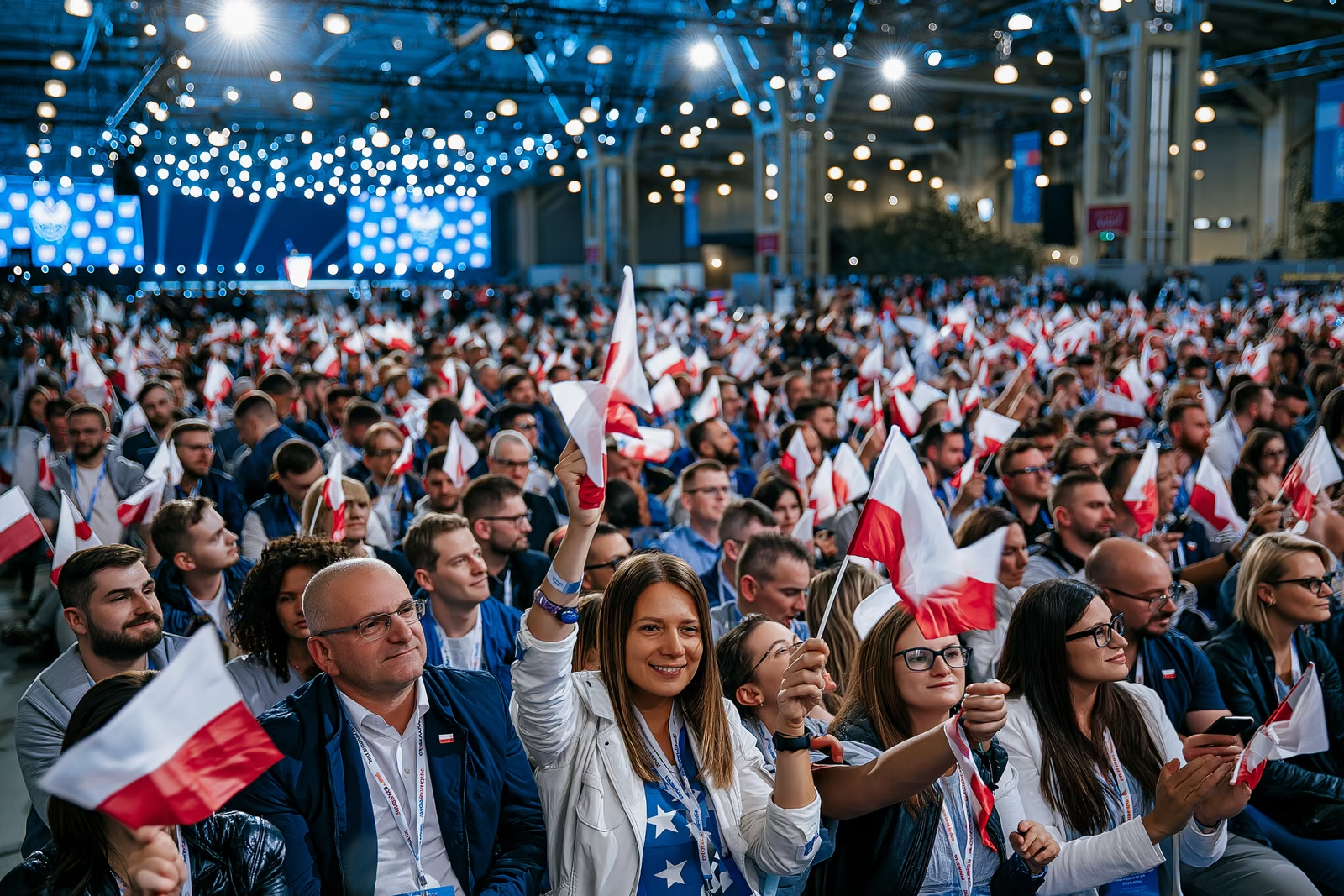
The AfD has formally opened its bid to govern a German state for the first time. At the AfD Magdeburg campaign launch on Saturday, July 18, party co-leader Alice Weidel told around 3,000 supporters at the Messe Magdeburg exhibition halls that top candidate Ulrich Siegmund would become the party’s first state premier. The rally marked the official start of the Sachsen-Anhalt election campaign, seven weeks before voters go to the polls on September 6.
Siegmund set the bar high. His declared goal is “45 percent plus X”, a result that would put an absolute majority within reach in the state parliament. Recent state polls place the party at 41 to 42 percent, far ahead of every competitor, which is why this regional vote is being watched across Germany and beyond.
AfD Magdeburg campaign opens with a claim to power
Inside the exhibition hall, the tone was one of certainty rather than hope. “You are part of history,” Siegmund told the crowd, and according to the Volksstimme he urged members to put “every horsepower on the road” in the coming weeks. Weidel’s appearance underlined how much the federal party has invested in this race: a first AfD state premier would be a symbolic breakthrough it has pursued for years.
Reports carried by Freie Presse and other outlets describe a program for the first 100 days of a possible AfD government that includes ending contributions to public broadcasting, immediate deportations, mandatory work requirements for asylum seekers and separate school classes for refugee children who do not speak German. The party presents this as restoring order; critics see an agenda targeting minorities.
The numbers behind the confidence
The polling picture explains the mood. With the AfD at 41 to 42 percent, the CDU, which currently leads the state government, polls around 23 percent, according to Freie Presse. Since every other party has ruled out a coalition with the AfD, the decisive question on September 6 is whether the party can reach a majority on its own, and if not, whether the remaining parties can assemble a workable government against it.
Sachsen-Anhalt is only the first act. Mecklenburg-Vorpommern elects a new state parliament two weeks later, and the AfD also leads polls there. We reported earlier this year on the party reaching an all-time high in national polling; the September votes will show whether those numbers translate into state power.
Protest outside the AfD Magdeburg campaign event
The launch did not go unanswered. Several hundred counter-demonstrators gathered at the fairgrounds hours before the doors opened, among them Omas gegen Rechts, a protest network of older women, alongside church congregations and groups from the state’s cultural scene. Police kept the two sides apart behind barriers, and the protest remained at a distance from the AfD event.

According to the Volksstimme, there were minor scuffles during the counter-demonstration, partly triggered by provocative livestreamers, and police confirmed that criminal complaints were filed. A representative of the Protestant church told reporters the protesters stood for democracy, humanity and solidarity. The scenes echoed the far larger demonstrations that accompanied the party’s national gathering earlier this year, when thousands protested the AfD party conference. Separately, the campaign group Campact says it has collected more than 2.5 million euros from donors to fund local initiatives against the AfD in Sachsen-Anhalt and Mecklenburg-Vorpommern.
A party under extremism surveillance
The context makes this election unusual by German standards. The AfD’s Sachsen-Anhalt branch is classified by the state’s Verfassungsschutz, the domestic intelligence agency, as definitively right-wing extremist, the agency’s highest warning level. The party rejects the label and is fighting similar classifications in court at the federal level.
That classification has practical consequences: the agency may use surveillance tools against the party, and civil servants who are active members can face professional scrutiny. It also frames the moral argument of the counter-protests, which contend that a party under such a designation should not be handed control of a state’s police, schools and administration.
What an AfD-led state would mean for foreigners
For internationals living in eastern Germany, the practical stakes are worth understanding calmly. Residence rights, visas and citizenship are governed by federal law, which a single state government cannot rewrite. But states control real levers: they run the police, the schools, the courts’ administration and the foreigners’ offices that process permits, and they fund integration courses, refugee housing and many local support services. A government committed to deportations and to separating refugee children in schools could change daily administrative practice long before any federal law changes.
A state government also gets seats in the Bundesrat, the federal chamber of the states, and a louder voice in national debates on migration. Whether any of this comes to pass depends on arithmetic: if the AfD falls short of a majority, Sachsen-Anhalt faces complicated coalition talks instead. The seven weeks until September 6 will decide which scenario the east wakes up to.

