




 Turkish
 Italian
 Spanish
 Portuguese
 Romanian
 Albanian
 Lithuanian
 Latvian
 Bulgarian
 Greek
Greek Hungarian
 French
 Croatian
 Czech
Czech
Football produces few genuinely romantic transfers anymore, but the Ruhr region just got one. The Gosens Schalke move is complete: Robin Gosens, 32 years old and a 24-cap Germany international, has joined FC Schalke 04 from Italian club Fiorentina for the coming Bundesliga season. The agreement was reached on July 15 and made official two days later, on July 17, when the club presented its new number 8. For Gosens, who grew up as a Schalke fan on the Lower Rhine, it is the fulfilment of something he has talked about publicly for years: pulling on the royal blue shirt of the club he has always called his Herzensverein, the club of his heart.
The Gosens Schalke move in detail
The Gosens Schalke move is built carefully around the club’s finances. Gosens arrives on a season-long loan from Fiorentina, where his contract runs until 2028. Attached to the loan is a purchase clause that becomes binding if Schalke stay in the Bundesliga, with Sportschau putting the fee at around 1.5 million euros and other German outlets reporting figures slightly above that. Fiorentina also continues to pay part of his salary during the loan, according to German media reports.
In other words, if Schalke survive their first season back in the top flight, Gosens becomes their player permanently at a price that would have seemed absurd for a player of his CV a few years ago. It is a structure that protects the club against the cost of relegation while giving the player what he wanted most: a route home.
A boyhood dream sealed in royal blue
Gosens comes from Emmerich am Rhein, a small town on the Dutch border in the far west of North Rhine-Westphalia. As the broadcaster ran and kicker recount, his godfather took him to Schalke’s stadium for the first time when he was six, and he has been a supporter ever since. In interviews over the years, including during his time in Italy, he repeatedly named Schalke as the club he dreamed of playing for one day.

The player himself kept his first words simple. “Everyone knows I have a special connection to Schalke. I’m really excited about this challenge,” Gosens said in the club’s announcement. Schalke fans, who have watched plenty of players use their club as a stepping stone, are getting the opposite: an established international taking a step down in salary and prestige terms because of what the badge means to him.
What Gosens brings back to the Bundesliga
On the pitch, Schalke are signing experience they simply did not have. Gosens made his name at Atalanta in Italy’s Serie A as one of Europe’s most productive wing-backs, played in the Champions League, moved to Inter Milan, and returned to Germany with Union Berlin before joining Fiorentina in 2024. He scored in a European Championship and has 24 caps for the national team, a level of pedigree rare in Gelsenkirchen in recent seasons.
His profile fits a promoted side, too. Gosens is a left-sided player who attacks relentlessly, arrives late in the box and throws himself into duels, qualities that translate well to a survival fight. At 32 he is no longer the sprinter of his Atalanta years, but leadership was as much a part of this signing as legs: Schalke’s young squad now has a senior professional who has played at every level of the European game.
Why the Gosens Schalke move matters for the club
Schalke return to the Bundesliga after years of turbulence, financial strain and two relegations that tested even one of Germany’s largest fan bases. The club’s stated goal for the season is unglamorous: stay up, stabilise, rebuild. Signing a player whose purchase clause only triggers if that mission succeeds aligns everyone’s interests neatly, and it hands the dressing room a figure who wants to be there for reasons beyond money.
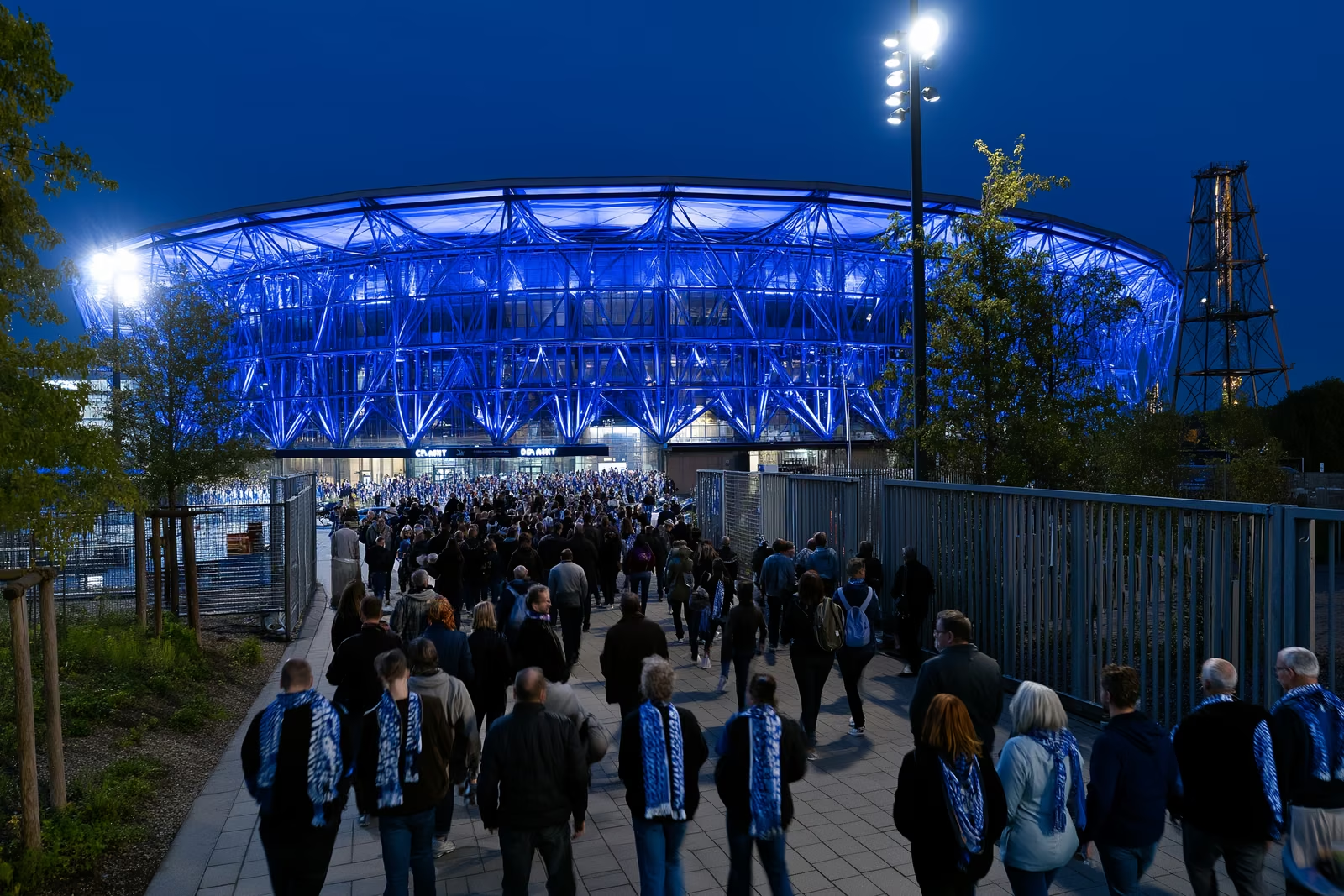
The symbolism is not lost on anyone in Gelsenkirchen. A local boy from the region’s footballing culture, who stood on the terraces as a child, returning as a Germany international to lead the club back: it is the kind of story that fills a 62,000-seat arena regardless of the table. Season ticket demand at Schalke was enormous even in the second division; expectation levels just rose again.
What this means for football fans in the Ruhr
For expats living in the Ruhr region, this is a good season to discover what German football culture is about. Schalke against Borussia Dortmund, the Revierderby, returns to the top flight, and the Gosens Schalke move adds a homecoming storyline even neutrals can enjoy. Tickets in Gelsenkirchen are hard to get but not impossible, especially for midweek games, and the matchday experience, from the fan walk to the choreography, is a crash course in local identity. Our overview of popular sports in Germany explains how the league system and ticketing work.
There is also a deeper point in this transfer for newcomers. German football clubs are not franchises but Vereine, member-owned associations rooted in their towns, which is why a player calling Schalke his heart’s club resonates so strongly here. If you want to understand that culture from the inside, joining a club yourself is the fastest way; our guide to Germany’s club culture shows how. Gosens waited 26 years for his membership to turn into a contract. Most fans settle for the scarf, and in the Ruhr, that is already a way of life.

