





 Turkish
 Italian
 Spanish
 Portuguese
 Romanian
 Albanian
 Lithuanian
 Latvian
 Bulgarian
 Greek
Greek Hungarian
 French
 Croatian
 Czech
Czech
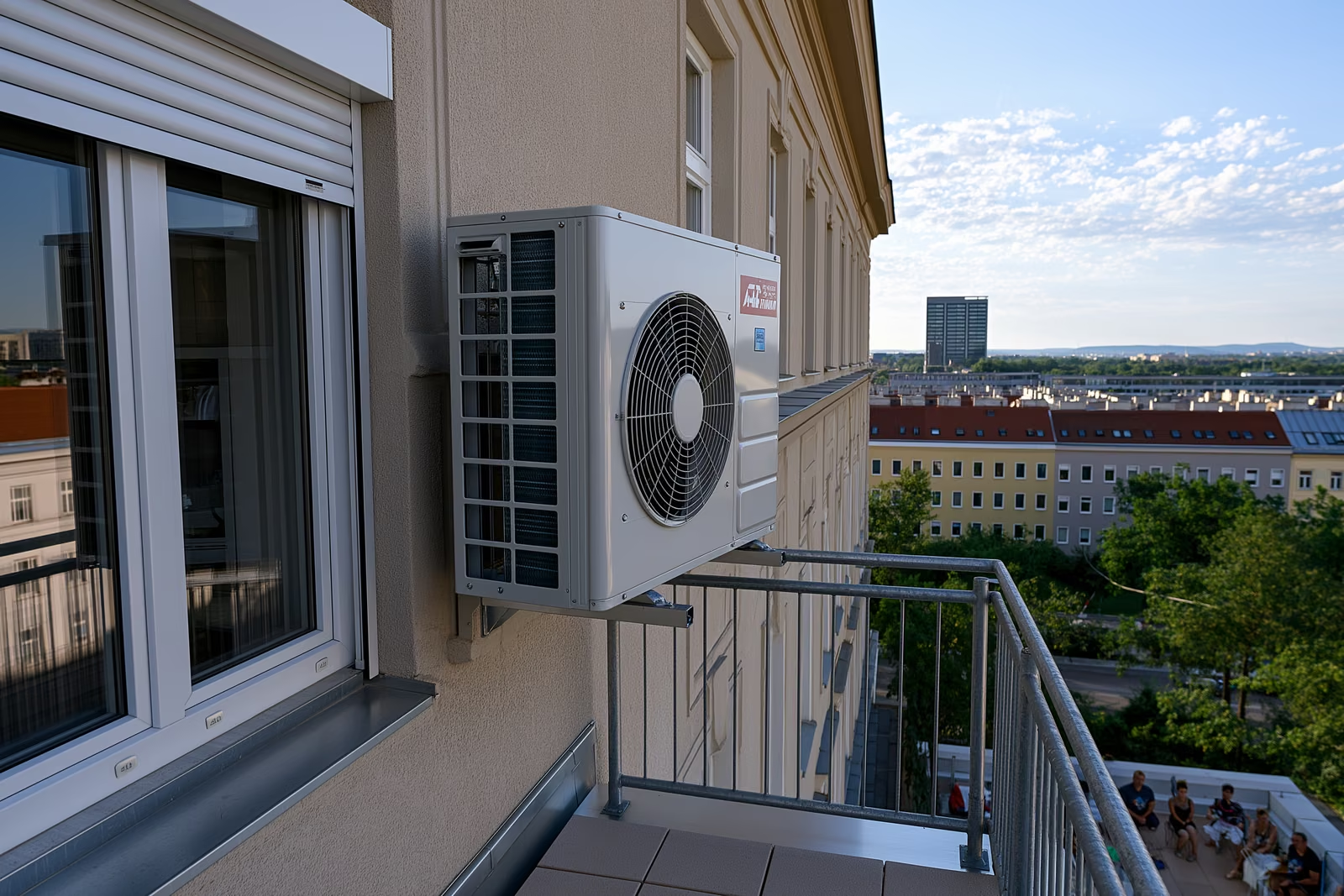
A long-running dispute over a balcony air conditioner has ended in a significant win for apartment owners across Germany. In its air conditioning ruling of July 17, 2026, in case V ZR 162/25, the Bundesgerichtshof (BGH), Germany’s highest civil court, decided that the owner of a flat can in principle demand that the owners’ association approve the installation of a split air conditioning unit on the balcony. The condition: other owners in the building must not be disadvantaged beyond what is unavoidable when people live together under one roof.
The decision arrives in the middle of another hot German summer and is likely to shape thousands of similar conflicts in apartment buildings. Air conditioning is still rare in German homes, and requests to install it have often failed at owners’ meetings. That balance of power has now shifted.
A Berlin Balcony Dispute Reaches Karlsruhe
The case began in Berlin. A couple who own a flat in a larger building asked their fellow owners at a meeting in December 2023 for permission to mount a split unit, a system with an outdoor compressor connected to an indoor device, on their balcony. The proposal did not find a majority, so the couple went to court with a Beschlussersetzungsklage, a lawsuit that asks a judge to replace a rejected resolution of the owners’ association with an approving one.
The local court, the Amtsgericht Pankow, dismissed the claim. The regional court, the Landgericht Berlin II, took the opposite view and granted the approval, tying it to conditions on the type of device and how it may be operated. According to the BGH’s press statement, the fifth civil senate has now confirmed that outcome in its essentials, settling the question for the whole country.
What the Air Conditioning Ruling Actually Says
Under German condominium law, the Wohnungseigentumsgesetz or WEG, any structural change to the shared parts of a building needs a resolution of the owners. Air conditioners are not on the list of privileged measures that owners can always demand, such as charging points for electric cars. But paragraph 20 of the law gives every owner a claim to approval if the change does not impair other owners beyond the unavoidable level of orderly communal living.
The core of the air conditioning ruling is how that impairment is measured. The judges made clear that at the approval stage, only the direct effects of the construction itself count, for example the visual appearance of the unit on the facade. In the Berlin case, no relevant visual disturbance was claimed. The legal news service beck-aktuell noted before the verdict that the case was widely seen as a test of how far climate comfort can be pushed against the resistance of neighbours.
Noise Fears Cannot Block Approval
The most contested point was noise. Neighbours who opposed the unit argued that the compressor would hum through summer nights. The BGH did not accept this as a reason to refuse permission. Feared future sounds from operating the device generally cannot stop the installation, because how loud an air conditioner really is depends mainly on how the owner later uses it.
Instead, the court pointed to a second line of defence. If the unit, once running, produces noise beyond what community standards allow, affected neighbours keep their legal remedies under the WEG and the civil code. In practice, courts would typically order restrictions on operating hours rather than removal of the device. The owners’ association can also set usage rules for the building, for example quiet times at night.

Air Conditioning Ruling: Limits Remain in Place
The air conditioning ruling is not a free pass. The approved device must be certified for the German market, and its position on the balcony must not create problems for others. The conditions attached by the Berlin regional court, covering the model and the operating mode, stay in force. An owner who ignores noise rules can still be taken to court by neighbours after the fact.
It is also worth stressing who the ruling helps. It applies to people who own their flat within an owners’ association. Renters are in a different position: they need their landlord’s permission for any fixed installation, and a landlord who owns a flat in a shared building must in turn get the association’s approval. The new case law makes that second step easier, which indirectly improves the chances of tenants who ask for cooling, but it creates no direct claim for them.
What This Means for Expats in Germany
For international residents who bought property here, the path is now clearer. Put a concrete proposal on the agenda of the next owners’ meeting, including the exact model, its placement and planned operating hours. If the meeting says no, a Beschlussersetzungsklage has a realistic chance of success, provided the visual impact is modest. Those still house-hunting can find the basics of ownership in our guide to buying property in Germany.
Renters should ask their landlord in writing and can point out that the legal climate has changed; portable units without any fixed installation remain an option that needs no permission at all. With heatwaves becoming a regular part of the German summer, as our report on heat and storms in Germany showed, the question of who may cool their home is no longer a niche legal topic. Whoever installs a unit should keep it quiet at night, because the right to install is now strong, but the duty to be considerate in operation is just as firm.

